

Pfizer, Johnson & Johnson, Novartis and Other Pharma Giants Accelerate Development of Next-Generation Blockbuster Drugs Amid Patent Cliff Pressures

Johnson & Johnson
Medical Device R&D and Manufacturer
Enter2024After the third quarter of the year, many large pharmaceutical companies have accelerated their pace in researching and developing new generations of drugs and therapies, hoping to see results in the next few years.In fact, a wide range of patent cliffs are threatening or have already eroded investors' expected profits.In addition to the loss of patent protection for blockbuster drugs, setbacks in some disease areas are also stimulating pharmaceutical companies to bet on new products.
Recently, during the third-quarter earnings conference call, executives from some pharmaceutical giants discussed the layout of new products that could potentially drive future revenue growth.
Pfizer:
Focus on Enhancing Vaccine Competitiveness
Pfizer2024Revenue for the third quarter of the year was177Billion USD, increased from the previous quarter31%。The company's vaccine franchise has been significantly impacted.For example, the heavy-duty pneumococcal vaccinePrevnar 13And the updated version launched last yearPrevnar 20Undergoing tremendous sales pressure.MSD in6Approved in21Pneumococcal Conjugate VaccineCapvaxive, andVaxcyteThe company has successfully advanced to Phase III trials.31Pneumococcal Conjugate VaccineVAX-31All arePrevnarA powerful competitor.
In order to tap into potential growth points, this large company has acquired numerous enterprises in recent years, but their actual market performance has been mixed. Its $11.6 billion acquisition of Biohaven’s migraine drug portfolio was a successful move, with revenue surpassing broker forecasts. The migraine drugs Nurtec ODT and Vydura generated $337 million in revenue for Pfizer in the third quarter, marking a 45% increase from the same period last year.
However, Oxbryta, the sickle cell disease treatment drug that Pfizer acquired through its $5.4 billion purchase of Global Blood Therapeutics, was withdrawn from the market in September due to safety concerns. Additionally, the returns from Pfizer's $6.7 billion acquisition of Arena in 2021 remain uncertain. Velsipity, developed by Arena for the treatment of ulcerative colitis, was approved for marketing in October 2023, but sales figures have yet to be disclosed.
Johnson & Johnson:
Tilting Resources Towards Self-Immune Blockbusters
In the third quarter, accounting for Johnson & Johnson's total revenue65%The innovative pharmaceutical revenue of2023An increase of nearly5%, relatively2024Growth of less than in the second quarter of the year1%。On the surface, medical device sales in the third quarter performed better than the pharmaceutical sector.2023An increase of nearly6%, but relatively2024Decreased nearly in the second quarter of the year1%。
Despite Johnson & Johnson's Tremfya, a monoclonal antibody targeting IL-23 launched in 2017, having become one of the leading drugs in the immunology field, it has consistently remained under the shadow of the company’s own product, Stelara. As biosimilars of Stelara continue to enter the market, eroding the market share of the originator drug, Johnson & Johnson is positioning Tremfya as a potential market leader.
In the third quarter, the growth of Johnson & Johnson's innovative drugs was significantly driven by Darzalex, a treatment for multiple myeloma, with sales increasing 21% compared to the same period in 2023 and nearly 5% compared to the second quarter of 2024. However, the shine of Darzalex's sales growth was somewhat dimmed by the decline in Stelara's sales.
Due to increased competition from Stelara biosimilars in Europe since July and the anticipated entry of biosimilar competitors in the U.S. market by January 2025, Stelara's sales in the third quarter declined nearly 7% compared to the same period in 2023 and dropped over 7% from the second quarter of 2024.
Jennifer Taubert, Executive Vice President and Global Chair of Johnson & Johnson’s Innovative Medicine, stated at the conference that the recent approval of Tremfya for active ulcerative colitis was a significant achievement. The company also validated Tremfya's advantages over Stelara in the inflammatory bowel disease area through a head-to-head trial.
Biogen:
The Accessibility Challenge of New AD Drugs Remains Unsolved
Biogen's Third Quarter Revenue was25Billion USD, and raised the full-year forecast.Over the past few quarters, its Alzheimer's disease treatment co-developed with Eisai (AD) New DrugLeqembiSales have been growing, bringing in the third quarter6700Million USD in sales, surpassing Wall Street's forecast of5000Million US dollars.
But Christopher Viehbacher, CEO of Biogen, said that the revenue of Leqembi in the United States "is still below the expectations of the collaboration."
Viehbacher pointed out that the company is trying to explore a subcutaneous formulation of Leqembi to replace infusions, as well as blood-based diagnostic methods to replace PET scans, in order to improve the accessibility of Leqembi.
In addition to AD drugs, Biogen also highlighted the CD40L antibody dapirolizumab pegol, co-developed with UCB, the fully humanized CD38-targeting monoclonal antibody felzartamab, and the immunology asset felzartamab recently acquired from Human Immunology Biosciences for $1.15 billion.
In the view of the company's senior executives: "If they all enter the market, the cumulative peak sales will reach approximately $140 billion. Considering that the company's current pharmaceutical business is about $75 billion, in the long term, this late-stage product pipeline may truly transform Biogen."
Novartis:
Dependence on Novel Tumor Therapeutic Drugs
2024In the third quarter of the year, Novartis revenue128.23USD billion, a year-on-year increase of10%。Earlier this year9Months, Novartis' total revenue was approximately371.64Billion USD, year-on-year growth11%。
In the view of industry insiders, Novartis has already accepted the existence of the patent cliff, and its new drug pipeline may compensate for the revenue gap in the coming years, including Scemblix, a newly approved treatment for chronic myeloid leukemia that has just received FDA approval in the United States.
Currently, Novartis has a number of new oncology drugs, including Kisqali for breast cancer treatment and Pluvicto for prostate cancer treatment.
Relevant<<<
Observation on the Flow of Venture Capital
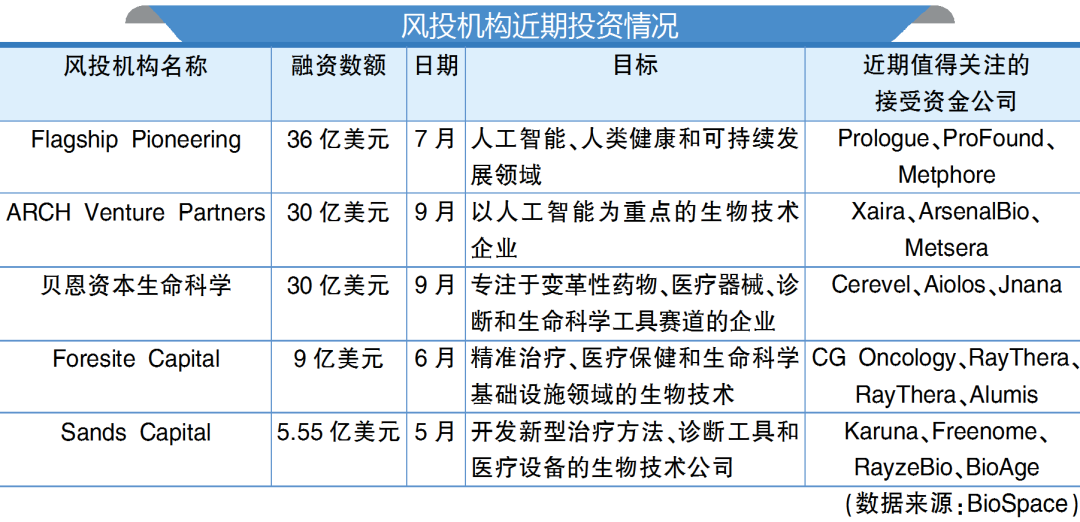
In partAfter "the lucky ones" provided development funds, well-known venture capital institutions raised billions of dollars again.For example, well-known venture capital institutions in the industryFlagship Pioneering, in7Monthly fundraising36Billion US dollars will be used to support25Jiaxin Company.ARCH Venture PartnersCompany, recently raised30Billion dollars, used to establish and invest in early-stage biotechnology companies, targeting artificial intelligence.
At the same time, smaller venture capital firms are on the lookout for under-the-radar companies that have the potential to become tomorrow's stars.
Bottom-up B Round Financing
As with industry mediaBioSpaceThe venture capitalist pointed out that the capital flow of these large institutions does not represent the full picture of the industry's innovative power.Wing Venture CapitalPartnerSara ChoiFrankly, I hope to see more funds entering the pureBRound financing stage, this is the stage with a higher risk of corporate capital chain breakage.
In fact, the Series B financing stage is typically a critical period for companies transitioning from initial product validation to market expansion and accelerated growth. At this stage, companies may have already used up the funds from early financing but are still some distance away from achieving self-sustainability.
Conduct Research Before Reaching Out
Sofinnova InvestmentsThe Managing PartnerJakob DupontReminder: Small and medium-sized biotech companies need to conduct research before approaching venture capital firms.This becomes even more critical given that the market currently favors low-risk, late-stage assets.
Although most institutions are relatively conservative, small venture capital firms like Wing and KdT that focus on early-stage biotechnology are more willing to place bets on emerging fields.
Choi noted that seed and Series A financing rounds are still ongoing, but biotech companies now need to work harder to prove their value and potential, as the relaxed investment environment of 2021 is long gone. Raising over $100 million in funding has become significantly more challenging. In terms of valuation, the industry is gradually returning to rationality.
When considering future investment needs, prudent use of funds is also key. Dupont reminded that this means trying to streamline the company's team and management.
Editor: Zhang Jieying
Source: "Pharmaceutical Economy News" Issue 85, 2024



www.yyjjb.com.cn
Insight into Industry Trends

"Pharmaceutical Economy Herald"
Academic Official Account
Focus on the Frontiers of Oncology Academia

Terminal Official Account