2024 AI for Science Forum was held in Beijing from November 4 to November 6. This summit brought together organizations in the "industry, academia, research, and application" sectors of the AI for Science field to collectively explore the applications and future of AI in scientific research. The forum created a dialogue platform for scientists and industry participants to identify key issues in scientific research, seize new opportunities, promote interdisciplinary integration, and thereby find the best path for practical implementation.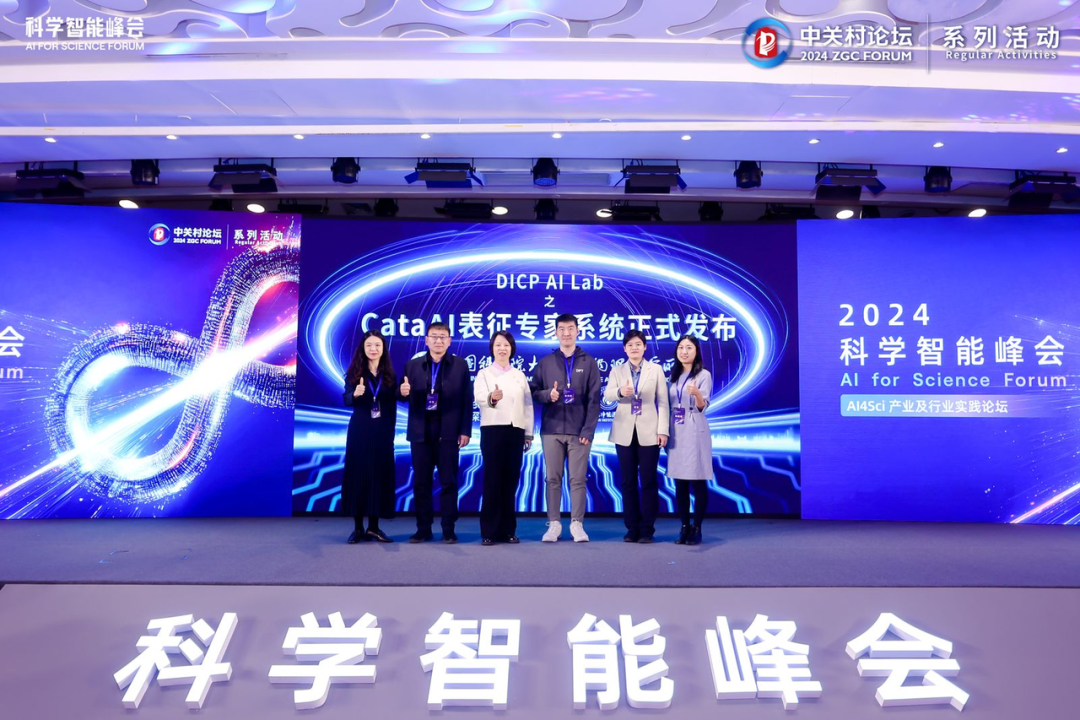 Notably, on the same day, DP Technology, in collaboration with the Dalian Institute of Chemical Physics, Chinese Academy of Sciences, and Yulin Zhongke Clean Energy Innovation Institute, jointly released the "DICP AI Lab's CataAI Characterization Expert System." This system is capable of intelligently managing and analyzing massive amounts of multi-dimensional and multi-modal material characterization data, including data from electron microscopy, infrared spectroscopy, mass spectrometry, X-ray diffraction, and other characterization methods.At the same time, Dalian Institute of Chemical Physics will collaborate with DP Technology to build an intelligent neural network for characterization based on the CataAI characterization expert system, enabling batch intelligent processing and automated experimental operations for characterization, creating an intelligent characterization laboratory, and advancing towards a larger DICP AI Lab ecosystem.In recent years, artificial intelligence (AI)-driven technology has become a new paradigm in the field of materials research. Dr. Yan Jin from the Energy Research Technology Platform (DNL20) at the Dalian Institute of Chemical Physics provided a detailed analysis of the CataAI Characterization Expert System: The application of AI technology has enabled high-throughput synthesis of new materials, but it has also generated vast amounts of characterization data. Efficiently analyzing this characterization data has become a key step in material development. To address challenges such as large volumes of characterization data, multi-dimensional data intersections, and difficulties in data translation and coupling, the research team developed the "CataAI Characterization Expert System," achieving significant progress in the intelligent processing of images and spectral data. They established a two-stage neural network model to detect and identify particle targets in images, using a loss function to determine the optimal target box before feeding it into a segmentation model for pixel classification, ultimately obtaining precise particle boundary information to enable accurate analysis of complex features like nanoparticles, clusters, and single atoms in catalytic materials. For specific reaction processes, they designed an interpretable preprocessing model for infrared spectral data, including baseline correction and peak fitting. Through feature extraction and deep learning model training, they achieved real-time, intelligent recognition and analysis of surface functional group species on materials during catalytic reactions via in-situ spectroscopy. Additionally, by building proprietary databases and algorithms, they realized molecular structure recommendations from mass spectrometry data. The system also incorporates functions such as data management, categorized storage, and intelligent extraction of characteristic parameters from spectral data.
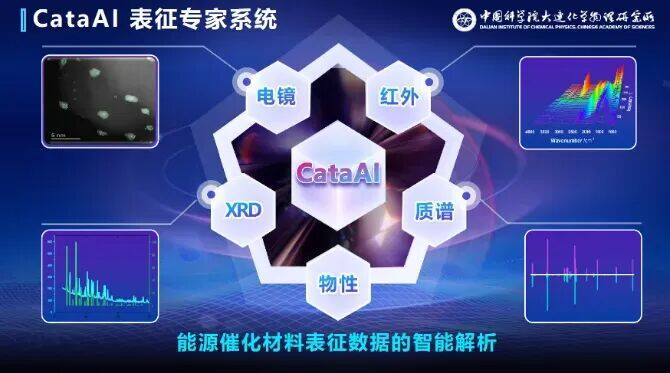 The "CataAI Characterization Expert System" will be the first case application on the DICP AI Lab. The DICP AI Lab is a "DICP-exclusive AI ecosystem" jointly developed by the Dalian Institute of Chemical Physics (DICP), DP Technology, and the Yulin Zhongke Clean Energy Innovation Research Institute. It aims to provide a practical and shared ecological environment for AI-related research at DICP. Additionally, DNL20 will further develop an intelligent characterization laboratory, where the "CataAI Characterization Expert System" is expected to serve as the intelligent core, providing high-level technical support for energy catalysis research and promoting innovation and progress in the field of energy catalysis.
About Dalian Institute of Chemical Physics, Chinese Academy of Sciences
Dalian Institute of Chemical Physics, Chinese Academy of Sciences, has won 95 national-level awards and made significant contributions to the progress of national science and technology over more than 70 years since its establishment in 1949. As a frontier base for research in energy materials and other fields in China, Dalian Institute of Chemical Physics has always been at the forefront of the scientific intelligence wave, striving to create an intelligent laboratory for the future.
AboutYulin Zhongke Clean Energy Innovation Research Institute
Yulin Zhongke Clean Energy Innovation Research Institute(Yulin Base of Dalian Institute of Chemical Physics, Chinese Academy of Sciences, formerly known as Yulin Branch of the Institute of Clean Energy Innovation, Chinese Academy of Sciences, abbreviated as "Yulin Innovation Institute") The aim is to carry out applied research in the energy field, providing technological support for Yulin to build a high-end energy chemical base and construct an energy revolution innovation demonstration zone; solve key technologies for national energy security and energy industry development, serve the clean energy and related industries, and conduct international cooperation and exchange. The business scope focuses on the low-carbon development of Yulin as a high-carbon city, closely aligning with the construction needs of the demonstration zone. It concentrates on breaking through key core technologies for "dual carbon" goals, with four main lines: clean and efficient utilization of fossil energy and coupling substitution, multi-energy complementarity and large-scale application of non-fossil energy, low-carbon/zero-carbon process reengineering in industry, and digital/intelligent integrated optimization. It aims to create four major platforms: advanced energy storage, comprehensive hydrogen energy demonstration, integration of hydrogen and coal chemical industry, and carbon dioxide resource utilization.
DP Technology is a global leader in AI for Science, which uses AI to learn a series of scientific principles and knowledge, and further addresses key issues in scientific research and industrial R&D.Relying on deep cultivation in the field of interdisciplinary research, DP Technology has built the "Deep Potential·Universe" AI for Science large model system, further addressing key issues in scientific research and industrial R&D. This effort has transitioned research methodologies across numerous disciplines from the "experimental trial-and-error/computational" era into the "pre-trained model era," forming an "innovation-to-application" chain and open ecosystem for AI for Science. DP Technology has established microscale industrial infrastructure based on AI for Science, empowering industries across the board and creating a new generation of industrial design and simulation systems for the most fundamental areas of human economic development: biomedicine, energy, materials, and information science and engineering.DP Technology is a national high-tech enterprise and a national specialized and innovative "little giant" enterprise, with research and development centers located in cities such as Beijing, Shanghai, and Shenzhen. The scientific research and technology team is led by an academician of the Chinese Academy of Sciences, bringing together over a hundred outstanding young scientists and engineers from various fields such as mathematics, physics, chemistry, biology, materials, and computer science. Among the company's members, more than 35% are PhDs and postdoctoral researchers. Core members have received the "Gordon Bell Prize," the highest award in the field of global high-performance computing in 2020. Their related work was selected as one of China's top ten scientific and technological advances in 2020 and one of the ten major technological breakthroughs in the global AI field.