

Novartis, the Global Radiopharmaceutical Leader, Enters China with Pluvicto: Set to Reshape Prostate Cancer Treatment

Novartis
Drug Development and Manufacturing
In recent years, new cancer therapies have emerged one after another. Among them, nuclear medicine therapy has shown great therapeutic potential in the field of oncology. In the field of nuclear medicine, Novartis is undoubtedly the leading company, and its key nuclear medicine, Pluvicto, is a significant player in this arena.The Hottest Product in Recent Years. Novartis' latest Q3 report shows,Pluvicto's total revenue in the first three quarters has exceeded $1 billion, making it the highest-selling radiopharmaceutical to date.。
November 13th,NovartisRadioligand TherapyPluvicto(Lutetium [177Lu] TexiveptideInjection)Marketing application accepted by CDE。Previously, the drug had been granted priority review by the CDE for the treatment of adult patients with metastatic castration-resistant prostate cancer (mCRPC) that is positive for prostate-specific membrane antigen (PSMA), and who have received androgen receptor pathway inhibitors and taxane chemotherapy.
This drug is the first FDA-approved medication targetingCastration-Resistant Prostate CancerThe patient's targeted radioligand therapy is being reported for marketing approval in China for the first time.。
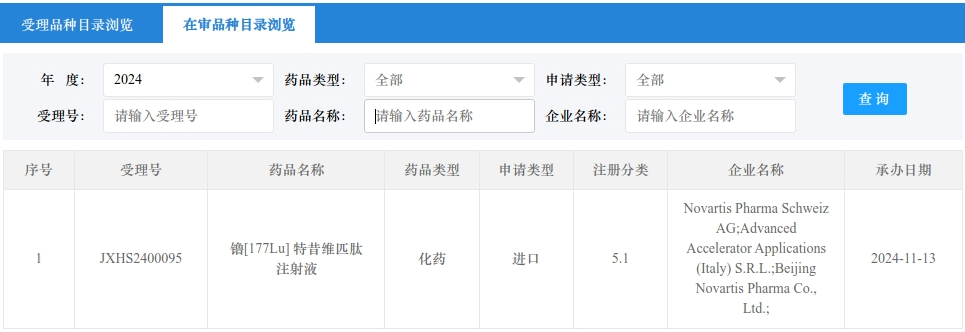
The World's First $1 Billion Nuclear Medicine Product
The global nuclear medicine market size is expected to increase from USD 6 billion in 2019 to approximately USD 30 billion by 2030. This growth trend, combined with the unique advantages of nuclear medicine in precision healthcare, has made nuclear medicine a new blue ocean in the pharmaceutical industry.
Radioligand Therapy: A Promising New Frontier in Cancer Treatment. These drugs deliver targeted radiation therapy, specifically killing cancer cells while causing less damage to healthy tissues.
Radiopharmaceuticals, represented by radioligand therapy, are a key area of focus for Novartis' significant investment.Novartis' nuclear medicine Pluvicto (Lutetium [177Lu] Texiveptide) is the star product in this field.
Lutetium [177Lu] Texiveptide is a PSMA-targeted radioligand therapy that connects PSMA-617 with the beta-emitting 177Lu. After binding to prostate cancer cells expressing PSMA, the radiation energy released by 177Lu will irradiate and kill the tumor cells.
It was approved in the U.S. in March 2022 for the treatment ofPSMA PositiveMetastatic castration-resistant prostate cancer (mCRPC).In the first half of 2023, the commercial supply of Novartis' RDC product Pluvicto ran short as demand exceeded expectations, causing delays in patient dose deliveries at multiple U.S. medical institutions.
It is expected in the industry that the above-mentioned shortage is due to supply issues. Due to the enormous demand, Pluvicto's production capacity has been insufficient because of a shortage of isotope supplies, resulting in a significant gap in clinical demand.In addition, the drug has a shelf life of only a few days, making it impossible to stockpile in advance, which limits the widespread use of Pluvicto.In order to gradually solve the production and supply issues, Novartis has invested in expanding its production capacity in multiple countries around the world, mainly adopting a centralized production model, and through FedEx, ensuring that medications are quickly delivered to patients within 12 hours.
Despite an extremely tight supply, Pluvicto's sales in the first quarter of 2023 still reached $211 million, a year-on-year increase of 18%, surpassing Wall Street's expectation of 11%. In the second quarter of the same year, Pluvicto continued to gain momentum, with sales reaching $240 million. In 2023, Pluvicto achieved $980 million in revenue with a 260% increase, just one step away from becoming a blockbuster drug worth $1 billion. In 2024, Pluvicto maintained its growth momentum, with first-half sales amounting to $655 million, representing a year-on-year increase of 45%.
The latest third-quarter report shows that Pluvicto's total revenue in the first three quarters reached $1.041 billion, making it the world's first nuclear medicine product with sales exceeding $1 billion.。Wall Street's sales peak forecast for Pluvicto is as high as $6 billion, which undoubtedly shows the market's great expectations for nuclear medicine.
The King Leading the Nuclear Medicine Track
Lutathera(Lutetium 177Lu dotatate) is a 177Lu-labeled somatostatin analog peptide. The peptide molecule DOTA-TATE binds with Lu-177 through a chelating agent, forming a novel compound drug. After Lutathera is injected into the patient's body, it captures tumor cells via the receptor-ligand targeting recognition effect, subsequently introducing the radionuclide into the tumor tissue. Lu-177 emits high-energy beta rays, ultimately destroying the tumor cells. In 2017, Novartis acquired Advanced Accelerator Applications (AAA) for $3.9 billion, obtaining Lutathera.
Lutathera was launched in Europe and the United States in 2017 and 2018, respectively, for the treatment of gastrointestinal pancreatic neuroendocrine tumors (GEP-NETs) that are positive for somatostatin receptors. This is the first FDA-approved radioligand therapy.Lutathera Sales Reach $605 Million in 2023, $534 Million in the First Three Quarters of 2024。
At the same time, Novartis provides radiopharmaceuticals for use with radioligand therapy.Gallium [68Ga] Gozetotide InjectionThe marketing application for the compounded medication kit has also been accepted and included in the priority review.Through the "integrated diagnosis and treatment" approach, tumor lesions are first located using radioligand imaging technology, followed by targeted radioligand therapy drugs to precisely attack cancer cells.
In addition, Novartis currently has several radiopharmaceuticals under research, such as AAA603, AAA604, AAA614, AAA802, and AAA817.
Among them, AAA604 targets Integrin beta-3/beta-5, and the clinical trial for pancreatic cancer is in Phase I.
AAA614, acquired by Novartis through the purchase of Clovis Oncology, targets FAP and is currently in Phase I clinical trials for solid tumors.
Both AAA802 and AAA817 target PSMA, and the labeled radionuclide is 225Ac for both.
In China, Novartis has not only launched several clinical studies on radioligand therapies but is also actively collaborating with other industry players to establish a robust radioligand therapy ecosystem.For example, in collaboration with GE Healthcare China, Shanghai Pharmaceutical Holdings, and Chongqing Pharmaceutical Holdings, Novartis is promoting the introduction of radioligand therapy in the Chinese market.
Novartis introduced that radioligand therapy has the characteristics of precision, efficiency, and safety in its drug mechanism. However, due to the limitation of the half-life of radionuclides, the preparation, testing, release, and distribution of the drug must be completed within an effective time frame to deliver the drug to patients.Therefore, this poses extremely high requirements for the production, inspection, and logistics transportation of pharmaceuticals.
Notably, to meet the growing market demand, Novartis has established multiple radiopharmaceutical production bases worldwide, including in Italy, Spain, the United States, and China. On July 2, the groundbreaking ceremony for Novartis' first radiopharmaceutical production base in China was held in Haiyan, Zhejiang, officially launching the construction project. This production base is located in the Nuclear Technology Application (Isotope) Industrial Park in Haiyan County, Jiaxing City, Zhejiang Province, with a total investment of approximately 600 million RMB, and is expected to commence operations by the end of 2026.
Global Layout of Nuclear Medicine Track
In addition to Novartis, multinational pharmaceutical companies such as BMS, AstraZeneca, Merck, Roche, Eli Lilly, Bayer, and Johnson & Johnson have also entered the radiopharmaceuticals field in recent years through equity investments, technology acquisitions, and other methods.
According to statistics, in 2023, there were 18 financing events in the global nuclear medicine field, of which 4 occurred in China, with a total financing amount exceeding 1.3 billion yuan.By 2024, the radiopharmaceuticals sector has not only failed to cool down but has instead become increasingly vibrant, already emerging as a battleground for global pharmaceutical giants.
September 13Sanofi enters into an exclusive licensing agreement worth approximately 320 million euros with RadioMedix and Orano Med to jointly develop radioligand therapy (RLT) based on the isotope 212Pb for cancer treatment.
On June 30, Radionetics Oncology announced that it had reached a strategic cooperation with Eli Lilly to jointly advance small-molecule radiopharmaceuticals targeting GPCRs.According to the terms of the agreement, Radionetics received a $140 million upfront payment.As part of the strategic cooperation, Lilly also has an exclusive option to acquire Radionetics for $1 billion in the future.
On June 5, Nucleus RadioPharma, a radiopharmaceutical CDMO company, announced the completion of its Series A extension financing led by AstraZeneca, with the specific amount yet to be disclosed.The industry believes that AstraZeneca's choice to bet on Nucleus RadioPharma is precisely due to its comprehensive capabilities in nuclear medicine R&D, production, manufacturing, supply, and clinical resources as a CDMO.
On May 21, Eli Lilly and Aktis Oncology reached a multi-target discovery collaboration agreement for radiopharmaceutical therapies, with a total transaction value exceeding $1.1 billion.In October 2023, Eli Lilly invested $1.4 billion to acquire POINT Biopharma, gaining access to drug candidates such as PNT2002, which uses 177Lu as an isotope and targets PSMA, officially entering the radiopharmaceuticals field.
On March 19, AstraZeneca announced the acquisition of all outstanding shares of Fusion, with a potential total transaction value of $2.4 billion.Through this transaction, AstraZeneca gains access to Fusion's pipeline of radiopharmaceutical conjugates, including the most advanced project, FPI-2265, a potential new treatment for patients with metastatic castration-resistant prostate cancer (mCRPC).FPI-2265 targets prostate-specific membrane antigen (PSMA), a protein highly expressed in mCRPC, and is currently undergoing Phase 2 trials.
MNCs have a fixed strategy of entering the market by completing the construction of supply chains and production-distribution capabilities through mergers and acquisitions.Of course, the inherent attributes of nuclear medicine also make it one of the best choices for nuclear medicine Biotechs to be acquired by MNCs.。
At the same time,Chinese pharmaceutical companies are also actively seizing business opportunities in the field of nuclear medicine,According to the public information from CDE, recently,Radiodrugs' Application for Technetium [99mTc] Hydrazinonicotinamide PEGylated Cyclic RGD Peptide Injection(Short for "99mTc-3PRGD2") and Sodium Tosylate Nicotinamide Hydrazide Polyethylene Glycol Bicyclic for InjectionRGD PeptideIncluded in the CDE's priority review list. Data shows that 99mTc-3PRGD2 is a radioactive pharmaceutical independently developed by Raydio Medicine.Radionuclide ConjugationDrug (RDC) is a Class 1 new radiodiagnostic drug in nuclear medicine in China.
Another exampleHengrui MedicineWholly-owned subsidiary Tianjin Hengrui was established in just over three years,Four radiopharmaceutical conjugates (RDCs) have been advanced into clinical trials.Including 2 diagnostic drugs: Gallium [68Ga] IsoCurcuminInjection, HRS-9815 Injection, and two therapeutic drugs: Lutetium [177Lu] Oxodotreotide Injection, HRS-4357 Injection. Additionally,China IsotopesThese two veteran nuclear medicine enterprises, Dongcheng Pharmaceuticals, have significant existing competitive advantages in this industry.
Experts in the industry indicate that, with the development of integrated nuclear medicine diagnosis and treatment, radiopharmaceuticals represented by radioligand therapy are highly expected to become a new pillar in cancer treatment, transforming the future of cancer care. According to publicly available data,Currently, there are 32 radiopharmaceuticals under development in China.And companies like Grand Pharmaceutical and China Isotope & Radiation Corporation are also beginning to reap the benefits in the field of nuclear medicine.
As shown in Grand Pharmaceutical's 2024 interim results, driven by the revenue growth in the company’s nuclear medicine and oncology treatment sector, a net profit of approximately HK$1.56 billion was achieved during the reporting period, representing a year-on-year increase of 58% excluding exchange rate effects. China Isotope & Radiation Corporation’s revenue exceeded 2.8 billion yuan in the first half of the year, with radiopharmaceuticals for imaging diagnostics and treatment generating 864 million yuan in revenue, marking a year-on-year increase of 5.8%. Additionally, Dongcheng Pharmaceutical's nuclear medicine business segment achieved revenue of 1.017 billion yuan in 2023, reflecting a year-on-year growth of 11.2%.
Conclusion
Novartis' rapid progress and impressive sales data in the radiopharmaceuticals sector have, in turn, fueled the global radiopharmaceuticals market's boom, injecting a strong boost into the industry’s development. As more pharmaceutical companies join the field, the radiopharmaceuticals sector is experiencing an unprecedented period of prosperity. In the future, with the launch of more radiopharmaceuticals and the improvement of the industrial chain, radiopharmaceuticals are bound to become a mainstream therapy for the next generation of cancer treatments.
Disclaimer:
The content of the article is for reference only and does not constitute investment advice. Investors who take actions based on this information bear their own risks. We remain neutral regarding the statements and viewpoints in the article and do not provide any express or implied guarantees concerning the accuracy, reliability, or completeness of the content contained within. Readers are advised to use this information solely as a reference and assume full responsibility for their actions. The various articles published by this public account focus on sharing; if there is any infringement, please contact us, and we will delete them.
ABC 2025
Booths are booking up fast!
Scan to consult immediately
Phone: 13816031174
(Same as WeChat)
Sponsorship forms include but are not limited toSpeaking slots, exhibition booths, color pages in the conference proceedings, dinner sponsorship, promotional materials for the conference, etc.