Source: Future Eye; Editor: SophiaReprint requirements: Can be reprinted 24 hours after the first publication, source must be credited.
Global Ophthalmology Conference Registration
The other day,Aier Eye Optometry Research Institute under Aier EyeAndMAGNOSIS (Beijing) Technology Co., Ltd.("MAGNOSIS")Sign a Strategic Cooperation Agreement, both parties willJointly Build an Ophthalmology Magnetoencephalography (MEG) Medical Platform, and carry out in-depth cooperation in life health-related fields such as ophthalmology and visual cognitive science.Academic Vice President of the Institute of Biophysics, Chinese Academy of Sciences, Director of the State Key Laboratory of Brain and Cognitive ScienceMr. HeAnd related research members, withGlobal President of Aier Eye Hospital Group Co., Ltd.Li Liand the heads of various departments attended the signing ceremony.In this cooperation, both parties will base themselves on the platform of ophthalmology and visual cognitive science,Jointly Building the World's First Magnetoencephalography System for Research and Clinical Application in Pediatric Neuro-ophthalmology, using magnetoencephalography technology as a means to achieve innovation and breakthroughs in the field of eye health management throughout the entire life cycle, benefiting a wide range of patients with eye diseases.Source: Aier Eye Official WeChatAier Eye continuously innovates in the field of optometry technology. In 2016,Aier Eye has independently developed the world's first myopia prevention and control smart wearable device, "Cloud Clip.", and in 2018 launched the first myopia big data multicenter research project led by a Chinese research team, with participation from top research teams across 16 countries globally.MAGNOSIS is a technology transfer enterprise incubated by the Institute of Biophysics, Chinese Academy of Sciences.China's leading "wearable magnetoencephalography" R&D and manufacturing enterprise, has been granted multiple domestic and international invention patents in the fields of magnetoencephalography and zero-field weak magnetic detection technology, and has established a North American technology research and development center.According to the latest data released by Coherent Market Insights, the global magnetoencephalography (MEG) devices market size was USD 253.3 million in 2018 and is expected to grow at a compound annual growth rate (CAGR) of 4.5%.By 2026, the global magnetoencephalography (MEG) equipment market will exceed USD 359.5 million.。The cooperation between the two parties will undoubtedly inject new vitality into the development of ophthalmic diagnosis and treatment technology.。Vision is the most important way for humans to perceive external information, with 80% of external information obtained through visual transmission.Eye diseases are not only limited to eyeball disorders but also include lesions in the entire visual pathway, among which...Involving cerebral perceptual lesions, it is neuropathic eye disease.。Since nerve cells cannot regenerate, their damage is often irreversible. Therefore,Early Detection and Early Treatment Are Key to Neurological Eye DiseasesOn the one hand, there is a need for more sensitive and highly specific diagnostic methods, and on the other hand, more effective and targeted treatment options are required.Magnetoencephalography (MEG) is a non-invasive neuroimaging technique used to measure changes in the brain's magnetic fields. Its principle isDetermine the dynamic activity of brain functions by detecting the weak magnetic fields generated by neuronal activity.Magnetoencephalography has been widely used for auxiliary localization and diagnostic evaluation of epileptic foci and brain functional areas before neurosurgical operations, and has been included in clinical application guidelines and expert consensus both in China and internationally.Magnetoencephalography (MEG) has a very high spatial resolution (2-5mm)., which can accurately locate the activity in different areas of the brain,The time resolution is also excellent (0.001s)., which can capture the temporal changes of brain activity in real time;And it is non-invasive and radiation-free for the human body, making it one of the most cutting-edge technologies in the field of brain imaging at this stage.MAGNOSIS's wearable magnetoencephalography has the following characteristics:Strong Signal: The detector is tightly attached to the scalp, and with multi-axis recording, the signal intensity is several times higher than that of traditional magnetoencephalography;Wearable: It can effectively record brain magnetic signals in a state of free movement, with a wide range of applicable populations and small differences between individuals;Low cost: The detector can operate at room temperature, without any consumables, significantly reducing procurement, usage, and deployment costs.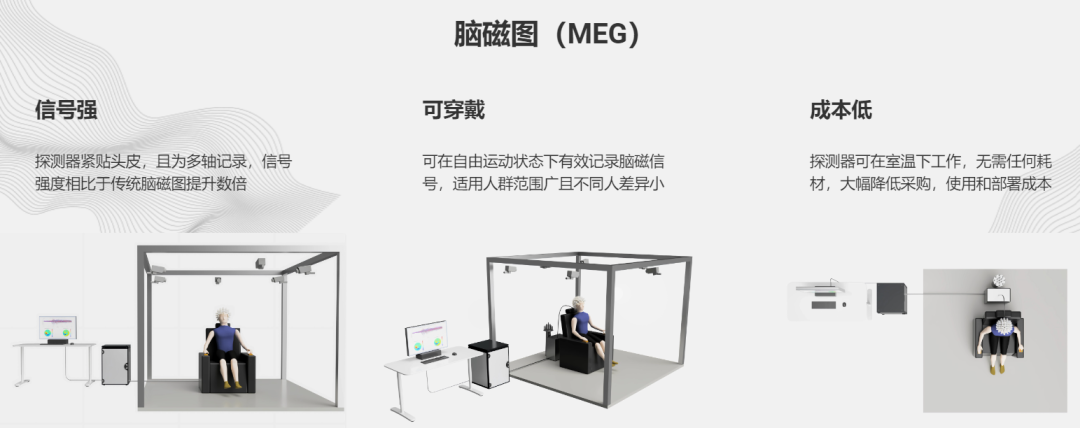
The combination of magnetoencephalography and ophthalmology is mainly reflected in the following aspects.:- Visual Processing Research:Magnetoencephalography can be used to study how visual information is processed in the brain.By stimulating the visual system (e.g., using light flicker or image presentation), researchers can observe the activity in vision-related brain regions. This is crucial for understanding the visual pathways from the eyes to the brain and their mechanisms under various visual conditions.
- Assessment of Visual Impairment: For patients with certain visual impairments (such as optic neuropathy or retinopathy),Magnetoencephalography can help assess the function of the visual system., providing more in-depth neurophysiological information than traditional ophthalmic examinations.
- Preoperative Assessment: In some cases where ophthalmic surgeries (such as retinal surgery or optic nerve-related surgeries) are required, the use of magnetoencephalography (MEG) canHelp doctors understand the visual function status of patients and related activities in the brain., better planning for surgery.
- Brain-Visual Interface Technology: With the development of brain-computer interface technology,Magnetoencephalography can provide data support for the development of new visual assistive devices., making functional visual recovery possible.

Aier Eye was established in 2002, reorganized into a joint-stock company in 2007, and listed on the ChiNext Board of the Shenzhen Stock Exchange in 2009 (Stock Code: 300015). The company's branches in Europe and Southeast Asia are respectively listed in Madrid, Spain (CBAV.MC) and Singapore (SGX:40T). The group's headquarters is located in Changsha, Hunan.As a professionalOphthalmology Chain Medical InstitutionsThe company's main business involves the diagnosis and treatment of various ophthalmic diseases, surgical services, and medical optometry and eyewear fitting. In terms of global presence, it operates respectively in..."Graded Chain" in China Combined with "Highland Layout" Overseas, and currently, the medical network has spread across mainland China, Hong Kong, Europe, the United States, and Southeast Asia;As of 2023, the company's overseas business accounts for 10.50%.。As of December 31, 2023,Aier Eye brand hospitals, eye centers, and clinics total 881 globally.. Among them,750 institutions in mainland China(Including 439 under listed companies and 311 under industrial M&A funds), 8 in Hong Kong, China, and 123 ophthalmic clinics overseas, including 1 in the United States, 108 in Europe, and 14 in Southeast Asia.As of now, Aier Eye Hospital Group Co., Ltd. and itsThe total number of employees worldwide exceeds 50,000.。
MAGNOSIS (Beijing) Technology Co., Ltd. was established in 2019 and is committed toNew Magnetoencephalography and Other Biomagnetic Detection DevicesResearch and development, production, and service areTechnology transfer enterprises incubated by the Institute of Biophysics, Chinese Academy of Sciences, members of the founding team have won the second prize for scientific and technological achievement transformation awarded by the Beijing Branch of the Chinese Academy of Sciences.2023Pioneering the technological breakthrough in wearable magnetoencephalography and its core component, the zero-field atomic magnetometer probe., which has been granted multiple patents domestically and internationally, established a research and development center in North America, and is committed to promoting the clinical transformation of innovative biomagnetic detection equipment such as new magnetoencephalography.Atomic magnetometers combined with high-performance magnetic shielding devices (magnetic shielding cylinders) can be used in the field of zero-field weak magnetic detection; the company also provides modular scientific research instruments and customized industrial application solutions based on customer needs.# Global Leading Ophthalmic Device and Consumables CompanyCarl Zeiss AG|Alcon| J&J Vision | Bausch + LombBaushe & Lomb | EssilorEssilor | TopconTopcon | Nidek Nidek | CooperC Groupompanies
# Chinese Ophthalmic Devices and Consumables Companies
# Chinese Ophthalmic Medical Service Companies
# Overseas Ophthalmology Startups
AEYE Health | Samsara Vision | AcuSurgical | Balance Ophthalmics | CorneaGen | ThermOcular AI