Eli Lilly's Potential First-in-Class Oral Small Molecule Muvalaplin Reduces Lp(a) Levels by Up to 85.8% in High-Risk Adults

Eli Lilly
Global Pharmaceutical R&D and Production Company

On November 18, Eli Lilly announced the results of a Phase II study on muvalaplin, a once-daily oral selective inhibitor of lipoprotein(a) [Lp(a)]. The study showed that muvalaplin significantly reduced elevated Lp(a) levels in adults, achieving the primary endpoint (the percentage change in Lp(a) from baseline to week 12).
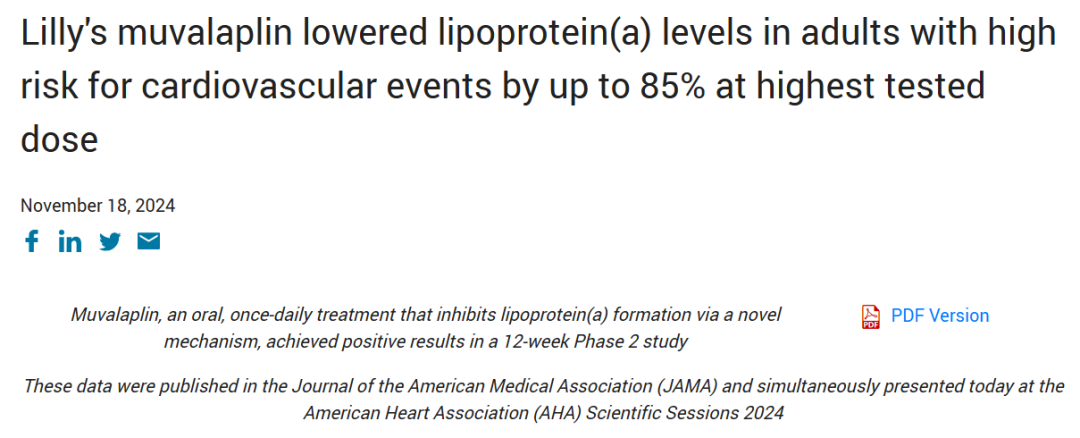
Eli Lilly is evaluating muvalaplin, a potent and multivalent small molecule drug that inhibits the formation of Lp(a) by blocking the initial interaction between apolipoprotein(a) [apo(a)] and apolipoprotein B (apoB). In the United States, approximately 20% of the population, or about 63 million people, have elevated levels of Lp(a). Elevated Lp(a) levels can double or even triple the risk of heart attacks and are associated with other cardiovascular issues.
In the 12-week study, muvalaplin (10mg, 60mg, and 240mg) significantly reduced Lp(a) levels compared to placebo. Using the full Lp(a) assay, the placebo-adjusted reduction was up to 85.8%, and using the apo(a) assay, the reduction was up to 70.0%.
Specifically, using the complete Lp(a) assay, the reductions were 47.6% (10mg), 81.7% (60mg), and 85.8% (240mg); using the apo(a) assay, the reductions were 40.4% (10mg), 70.0% (60mg), and 68.9% (240mg).
All three tested doses (10mg, 60mg, and 240mg) of Muvalaplin achieved the secondary endpoint. All three doses demonstrated statistical significance in reducing Lp(a) levels, and the 60mg and 240mg doses also showed statistical significance in lowering apoB. These data also suggest
Using the complete Lp(a) assay, the proportion of participants achieving Lp(a) levels below 125 nmol/L at week 12 was 64.2% (10mg), 95.9% (60mg), and 96.7% (240mg), compared to 6.0% in the placebo group. Through apo(a) testing, the proportion of participants with Lp(a) levels below 125 nmol/L was 38.9% (10mg), 81.9% (60mg), and 77.4% (240mg), compared to 3.6% in the placebo group. ApoB levels decreased across all doses, with placebo-adjusted reductions of 8.9% (10mg), 13.1% (60mg), and 16.1% (240mg), respectively.
The incidence of adverse events was similar in the muvalaplin and placebo groups. Treatment-emergent adverse events related to the study drug occurred in 14.9% of patients in the placebo group, 5.9% in the 10-mg group, 14.3% in the 60-mg group, and 14.7% in the 240-mg group. The incidence of adverse events leading to discontinuation across the treatment groups ranged from 0 to 8.8%, with all being single events distributed across various system organ classes. There were no deaths reported in the study.
"High levels of Lp(a) have been shown to be a significant risk factor for atherosclerotic cardiovascular disease, affecting more than a billion adults worldwide."
Copyright © 2024 PHARMCUBE. All Rights Reserved.
Welcome to forward, share, and reasonably cite. When citing, please clearly indicate the source of the article in a prominent position.For reprint, please leave a message or send a message to the WeChat Official Account backend, and indicate the name and ID of the official account.
Disclaimer: The information in this WeChat article is for general reference only and should not be used directly as decision-making content. PharmaCube assumes no responsibility for any loss incurred by any party due to the use of the content herein.