Johnson & Johnson Medical China Cuts Workforce by 20%, Focuses on Surgical Business Restructuring

Johnson & Johnson
Medical Device R&D and Manufacturer


Source: Medical Device Business Review
Author: Yu Bai
Reproduction without authorization is prohibited, and reproduction is allowed 24 hours later.
On November 17, 2024, according to a report by the Southern Metropolis Daily,Johnson & Johnson China is implementing a layoff plan involving multiple product lines, insiders revealed that thisLayoffs as high as 20%, mainly involving the surgical department.
The compensation plan circulated online is: upon joining the companyCompensation of N+1 for less than 3 years,Compensation of N+2 for 3 to 6 years,Compensation of N+3 for more than 6 years, the majority of employees expressed satisfaction after discussing the compensation.
Just a week before the disclosure of the news, an internal email from Johnson & Johnson announcedReorganization of the Surgical DivisionAnd each sectionChanges in the Senior Leadership TeamThe message.
It is reported that, starting from January 1, 2025, the Surgical Division will consist of six departments: the Minimally Invasive and Energy Surgical Division, the Wound Closure Division, the Biosurgery Division, the Surgical Full Product Expansion Division (also known as the Broad Market Division), the Strategic Marketing Department, and the Robotics and Digital Division.
Among them, the Senior Director of the MONARCH Surgical Division of Johnson & Johnson Medical Technology ChinaChen XiaomingIt has been decided to leave. The head positions of the Wound Closure Division, Biosurgery Division, and Robotics & Digital Solutions Department are yet to be announced.
It is worth noting that,In terms of scale, this time the surgery involvedSurgical Services(Original name: Ethicon)It is the largest business segment of Johnson & Johnson Medical.
Ethicon, founded in 1915, started with sutures and initially focused on producing surgical sutures and wound closure devices. Leveraging its product technology advantages and the urgent need for wound care products during wartime, Ethicon rapidly expanded its team in a short period.
According to statistics, after the end of World War II, Ethicon's global market share of surgical sutures soared from 15% to 70%, and its market share in the United States once approached 80%. It became the world's most comprehensive suture manufacturer, and its Vicryl suture also became the best-selling synthetic absorbable suture in history.
Compared with the glorious rise in the past, under the strategic background of Johnson & Johnson's focus on the cardiovascular electrophysiology field, the surgical business is undergoing a profound adjustment and reshaping.
In February this year, the global head of Johnson & Johnson's surgical business and chairman of Johnson & Johnson Group announced his resignation.
It is worth noting that in the past two years, Johnson & Johnson has repeatedly been reported to have layoffs.
In May this year, Johnson & Johnson's new company Kenvue announced a global workforce reduction of 4%, affecting approximately 920 employees. In March last year, Johnson & Johnson was reported to have laid off at least 1,000 employees, impacting all major business segments across the company.
Tracing back, almost every layoff is accompanied by adjustments in production lines and business structures.

In the first half of this year, one week after the official announcement of Kenvue's global layoffs, Johnson & Johnson announced the sale of its entire remaining stake in Kenvue (over 189.3 million shares, approximately 9.5% of total shares), completely exiting the consumer health business. This marked the conclusion of the largest restructuring in its 137-year history.

Last July, Johnson & Johnson announced a $1.0$6.5 billion (approximately770 millionRMB) to sell its entire Blink product line to rival Bausch + Lomb.
Blink Main BusinessOver-the-counter eye drops and contact lens solutionsProduct,Affiliated withJohnson & Johnson Vision under Johnson & Johnson Medical (Johnson & Johnson Vision)。

Last October, executives of Johnson & Johnson Medical mentioned during the quarterly earnings call,Is restructuring its DePuy Synthes orthopedics business,The reorganization is expected to be completed by the end of 2025.
Johnson & Johnson CFO Joe Wolk said that the restructuring cost is $700 million to $800 million (approximately RMB...5.1 billionTo5.8 billionYuan),Intended to separate the orthopedic department from "markets and product lines with lower profits", in order to enhance the long-term profitability of this department.

December last year,Johnson & JohnsonAnnounced that it will be $280 million (approximately RMB2 billion) to sell its Acclarent ENT subsidiary to Integra LifeSciences, a leader in neuromodulation.
Acclarent Subsidiary isOne of the largest providers of balloon sinus dilation globally,It is also one of the main business branches of Johnson & Johnson Medical, and now belongs to the Johnson & Johnson Surgery Department.
FromSplitting Consumer Health Division for Independent Listing, toSell the entire Blink product line to competitor Bausch + Lomb,Then toReorganizationDePuy Synthes Orthopedics Business, Divestment of Surgical Product Lines。
These series of initiatives have confirmed what Du Anqing, the new CEO of Johnson & Johnson, explained when he took office."Accelerate and Simplify Healthcare Business": The recent restructuring of the surgical business in China is a strategic continuation of the group's overall organizational adjustment.
Beyond the business dimension, this round of layoffs is located inRegional DimensionStill needs specific analysis.
In the past two years, it has been common to see a decline in revenue from China operations for medical device giants, including Johnson & Johnson.
Last month, Johnson & Johnson released its Q3 2024 financial results. In the medical device sector, domestic business in the U.S. remained the primary source of revenue.
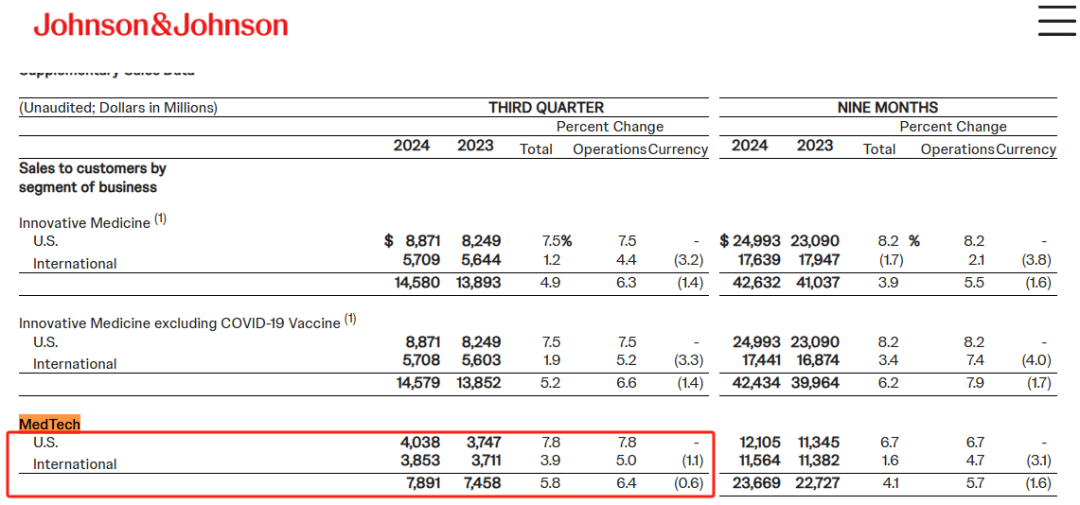
In the last quarter's teleconference, the performance of the Chinese market became the key discussion topic.
Facing the competitive challenges and loss of market share in the environment of centralized procurement and anti-corruption, Tim Schmid, Global Chairman of Johnson & Johnson Medical, views these two challenges as short-term pressures. In the long run, however, Johnson & Johnson will still benefit from them.
The long-standing localized layout is not only an important basis for Johnson & Johnson's senior management to remain optimistic, but also a necessary means to address new risks.
Recently, the U.S. presidential election concluded, and Trump's strong comeback has become the focus of international attention.Before this, he had repeatedly made public statements to fully defend high tariffs and even mentioned imposing tariffs as high as 60% on Chinese goods.
Now that the dust has settled on the election results, the variable of tariffs has become a pressing reality that all sectors need to face and address.
Under the pressure of centralized procurement and potential tariff variables, maintaining a presence in the Chinese market will inevitably require accelerating the comprehensive layout of localization.
In the product sectorJohnson & Johnson currently has a factory in Suzhou, covering multiple business products such as surgical and orthopedic fields.
Only by continuously optimizing product quality, accelerating innovation and technology upgrades, and deepening its irreplaceability can one gain more "pricing power" and still gain the upper hand even at the same price.
After all, no matter how market policies adjust, high-value product technology remains the ultimate key to winning patients' favor.
Circulation ProcessEqually important is the role of localization.At the Sixth CIIE last year, according to the official media release from "Johnson & Johnson China," Johnson & Johnson MedicalJiuZhouTong、China National Pharmaceutical CorporationAndChina Resources PharmaceuticalThe Big Three Distribution GiantsReached a total of$1 billion (approximately RMB7.2 billion)Medical device procurement cooperation.
As in other industries, the more intermediaries there are in the medical device distribution sector, the more gross profit is often taken away. Meanwhile, leading distributors with mature localized resources can provide significant support to multinational companies in terms of hardware costs, time costs, and operational costs.
Overall, facing increasingly fierce market competition and constantly changing policy environments, the second half of Johnson & Johnson's journey in China is not going to be smooth. Accelerating localized strategies, innovating and optimizing product lines, and enhancing technology and service levels all need to advance simultaneously.
After a round of layoffs and major restructuring, Johnson & Johnson China is looking forward to a new chapter.
The content of this article is for reference only and does not constitute investment advice. Readers are advised to effectively distinguish.If any platform reprints this article, it must take responsibility for the content of the article itself. Medical Device Business Review is not responsible for any impact caused by secondary dissemination after reprinting.
*Advertisement


To ensure you don't miss any content, everyone should remember toMedical Device Business ReviewSet as starred? Oh,
Looking forward to meeting you at the first moment every time