

AI-Driven Pharma BD Boom: High-Value Deals Reshape Drug Discovery Landscape
XtalPi
Computation-Driven Innovative Drug R&D Provider

CSPC
Innovative Drug Research and Development, Manufacturer

Johnson & Johnson Innovative Medicine
Pharmaceutical R&D Developer

AstraZeneca
Biopharmaceutical Manufacturer

Regor Therapeutics
Pharmaceutical R&D Developer

Genentech
Pharmaceutical R&D Manufacturer
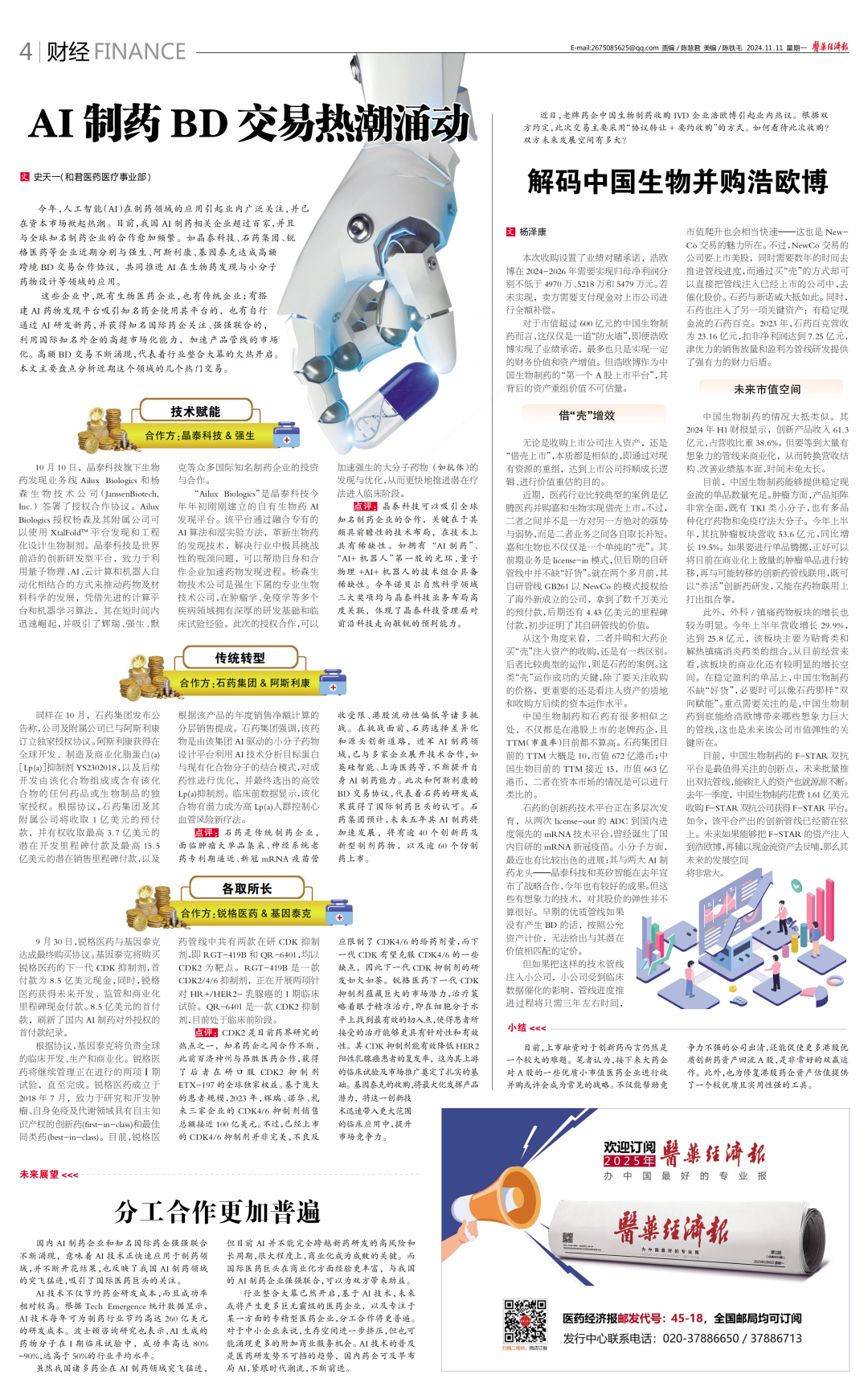
This year, artificial intelligence (AI) has attracted widespread attention in the pharmaceutical industry and has already sparked a wave of enthusiasm in the capital market. Currently, in China,AIThere are over a hundred pharmaceutical-related enterprises, and their cooperation with globally renowned pharmaceutical companies is becoming increasingly frequent. For instance, XtalPi, CSPC, and Regor Therapeutics have recently reached high-value cross-border collaborations with Johnson & Johnson Innovative Medicine, AstraZeneca, and Genentech, respectively.BDTransaction Cooperation Agreement, Jointly PromoteAIApplications in biopharmaceutical discovery and small molecule drug design.
Among these companies, there are both biopharmaceutical firms and traditional enterprises. Some have built AI drug discovery platforms to attract well-known pharmaceutical companies to use their platforms, while others independently develop new drugs through AI and gain attention from renowned international pharmaceutical companies, leading to powerful collaborations. By leveraging the advanced market capabilities of internationally renowned foreign enterprises, they accelerate the commercialization of their product pipelines. High-value BD transactions continue to emerge, representing the fiery opening of the industry integration curtain. This article mainly reviews and analyzes several popular transactions in this field recently.
Technology Empowerment
Partners: XtalPi & Johnson & Johnson Innovative Medicine

On October 10, Ailux Biologics, the biologics discovery business unit of XtalPi, signed a licensing agreement with Janssen Biotech, Inc. Ailux Biologics has granted Janssen and its affiliates the right to use the XtalFoldTM platform for the discovery and engineering design of biologics. XtalPi is a world-leading innovative R&D platform that aims to advance drug and materials science by combining quantum physics, AI, cloud computing, and robotic automation. With its advanced computational platform and machine learning algorithms, XtalPi has quickly risen to prominence in a short period of time, attracting investments and collaborations from many internationally renowned pharmaceutical companies such as Pfizer, Johnson & Johnson, and Merck.
"Ailux Biologics" is XtalPi's proprietary AI-based biologics discovery platform, which was established earlier this year. By integrating proprietary AI algorithms with wet-lab methods, the platform revolutionizes biologics discovery technology and addresses highly challenging bottlenecks in the industry, helping both XtalPi and its partner companies accelerate the drug discovery process. Janssen Biotech, a subsidiary of Johnson & Johnson, has a strong R&D foundation and extensive clinical trial experience across multiple disease areas, including oncology and immunology. This licensing collaboration can expedite the discovery and optimization of large-molecule drugs (such as antibodies) for Johnson & Johnson, thereby advancing potential therapies into clinical stages more rapidly.
Comment: The key to XtalPi's ability to attract collaborations with globally renowned pharmaceutical companies lies in its forward-looking technological layout, which is technologically scarce. For instance, it holds the title of being the "first AI drug discovery" and "AI + robotics" stock, and its combination of quantum physics, AI, and robotics is rare. This year’s three major Nobel Prizes in the natural sciences are highly relevant to XtalPi’s business layout, showcasing the company’s management team's keen foresight into cutting-edge technology trends.
Traditional Transformation
Partners: CSPC & AstraZeneca

Similarly, in10In a recent month, CSPC PHARMACEUTICAL GROUP LIMITED announced that the company and its subsidiaries have entered into an exclusive licensing agreement with AstraZeneca. AstraZeneca has obtained the rights for global development, manufacturing, and commercialization of lipoprotein.(a)[Lp(a)] InhibitorYS2302018, as well as the exclusive rights to any pharmaceuticals or biologics subsequently developed that are composed of or contain this compound. According to the agreement, CSPC and its subsidiaries will receive1USD billion as an upfront payment, with the right to receive up to3.7Hundreds of millions of dollars in potential development milestone payments and up to15.5Potential sales milestone payments in billions of dollars, as well as tiered sales royalties calculated based on the product's annual net sales. CSPC emphasized that the drug was developed by the group.AIDriven small molecule drug design platform utilizesAITechnical analysis of the binding mode between the target protein and existing compound molecules, optimization of drug-likeness, and final selection of highly efficient candidates.Lp(a)Inhibitor. Preclinical data show that the compound has the potential to be highlyLp(a)New Therapy for Cardiovascular Risk Control in Populations.
Comment: CSPC is a traditional pharmaceutical enterprise, facing many challenges such as the centralized procurement of major oncology products, the approaching patent expiration of old drugs in the nervous system category, limited revenue from the COVID-19 mRNA vaccine, and low liquidity in Hong Kong stocks. In response to these challenges, CSPC has chosen a path of differentiation and original innovation by entering the AI drug discovery field. It has already established technical collaborations with several companies, such as Insilico Medicine and Shanghai Pharmaceuticals, continuously enhancing its AI-driven drug discovery capabilities. This BD deal with AstraZeneca signifies that CSPC's research achievements have gained recognition from an international pharmaceutical giant. CSPC Group anticipates that its AI drug discovery initiatives will accelerate over the next five years, with over 40 innovative drugs and novel formulations, as well as more than 60 generic drugs expected to be launched.
Leverage Strengths
Partners: Regor Therapeutics & Genentech

On September 30, Regor Therapeutics reached a definitive purchase agreement with Genentech. Genentech will acquire Regor Therapeutics' next-generation CDK inhibitor, with an upfront payment of $850 million in cash. Additionally, Regor Therapeutics is eligible to receive future development, regulatory, and commercial milestone payments. The $850 million upfront payment sets a new record for the largest upfront payment in China's AI-driven drug discovery licensing deals.
According to the agreement, Genentech will be responsible for global clinical development, manufacturing, and commercialization. Regor Therapeutics will continue to manage the two ongoing Phase I trials until completion. Founded in July 2018, Regor Therapeutics is committed to researching and developing innovative drugs (first-in-class) and best-in-class drugs with independent intellectual property rights in the fields of oncology, autoimmune diseases, and metabolism. Currently, Regor Therapeutics has two CDK inhibitors in its pipeline: RGT-419B and QR-6401, both targeting CDK2. RGT-419B is a CDK2/4/6 inhibitor undergoing two Phase I clinical trials for HR+/HER2- breast cancer. QR-6401 is a CDK2 inhibitor currently in the preclinical stage.
Comment: CDK2 is currently one of the hotspots in pharmaceutical research, with continuous collaborations between renowned pharmaceutical companies. Previously, BeiGene partnered with Ascletis to acquire the global exclusive rights to the latter's investigational oral CDK2 inhibitor ETX-197. Based on a large patient population, in 2023, the total sales of CDK4/6 inhibitors from Pfizer, Novartis, and Eli Lilly approached $10 billion. However, the marketed CDK4/6 inhibitors are not perfect; adverse reactions have limited the dosing of CDK4/6 inhibitors. The next generation of CDK inhibitors is expected to overcome some of the shortcomings of CDK4/6 inhibitors, thus the development of next-generation CDK inhibitors is in full swing. Regor Therapeutics' next-generation CDK inhibitors hold immense market potential, with a treatment strategy focused on precision medicine—finding the most effective point of intervention at the cellular and molecular level to make the treatment more targeted and effective for patients. Their CDK inhibitor can effectively reduce the recurrence rate in HER2-positive breast cancer patients, laying a solid foundation for upstream clinical trials and market promotion. Genentech’s acquisition will maximize the product's potential, rapidly bringing this innovative technology into broader clinical applications and enhancing market competitiveness.
Future Outlook<<<

Division of labor and cooperation is more common.
The continuous emergence of strong alliances between China's AI pharmaceutical enterprises and renowned international pharmaceutical companies signifies the rapid application of AI technology in the pharmaceutical field, yielding fruitful results. It also reflects the remarkable progress in China’s AI pharmaceutical sector, drawing attention from global pharmaceutical giants.
AI Technology Not Only Reduces R&D Costs for Pharmaceutical Companies but Also Achieves a Relatively High Success Rate. According to statistics from Tech Emergence, AI technology can save up to $26 billion annually in R&D costs for the pharmaceutical industry. Boston Consulting Group research also indicates that drug molecules generated by AI achieve success rates of 80% to 90% in Phase I clinical trials, significantly higher than the industry average of 50%.
Although many pharmaceutical companies in China have made rapid progress in the AI drug discovery field, AI currently cannot fully overcome the high risks and long cycles associated with new drug development. To a large extent, commercialization has become the key to success or failure. International pharmaceutical giants, with their richer experience in commercialization, can benefit both parties by forming strong alliances with China’s AI-driven pharmaceutical enterprises.
The curtain of industry integration has already opened. Based on AI technology, the future may see the emergence of more mega-sized pharmaceutical enterprises as well as specialized ones focusing on specific areas, with division of labor and cooperation becoming more common. For small and medium-sized enterprises, their survival space will be further squeezed, but there may also be more opportunities for additional commercial services. The popularization of AI technology is an irresistible trend in pharmaceutical R&D, and pharmaceutical companies in China can plan ahead for AI, keep up with the times, and continue to advance.
Editor: Chen Huijun
Source: "Pharmaceutical Economy News" Issue 86, 2024
Layout Editor: Wanwan


www.yyjjb.com.cn
Insight into Industry Trends
"Pharmaceutical Economy Herald"
Academic Official Account
Focus on the Frontiers of Oncology Academia

Terminal Official Account