METiS Pharmaceuticals Co-Authors Nature Communications Paper on Selective Regulation of Macrophage Lipid Metabolism via Nanomaterial Surface Chemistry

METiS TechBio
AI-Driven Drug Formulation Developer

On September 27, 2024, METiS TechBio (METiS Pharmaceuticals), as the co-first author, collaborated with the National Center for Nanoscience and Technology and the Institute of High Energy Physics of the Chinese Academy of Sciences, among other institutions, to publish a significant research achievement in the prestigious international academic journal *Nature Communications*. The title of the research is “Selective regulation of macrophage lipid metabolism via nanomaterials’ surface chemistry”.This study reveals how nanomaterials (especially graphene oxide, GO) selectively regulate lipid metabolism in macrophages through surface chemical properties.
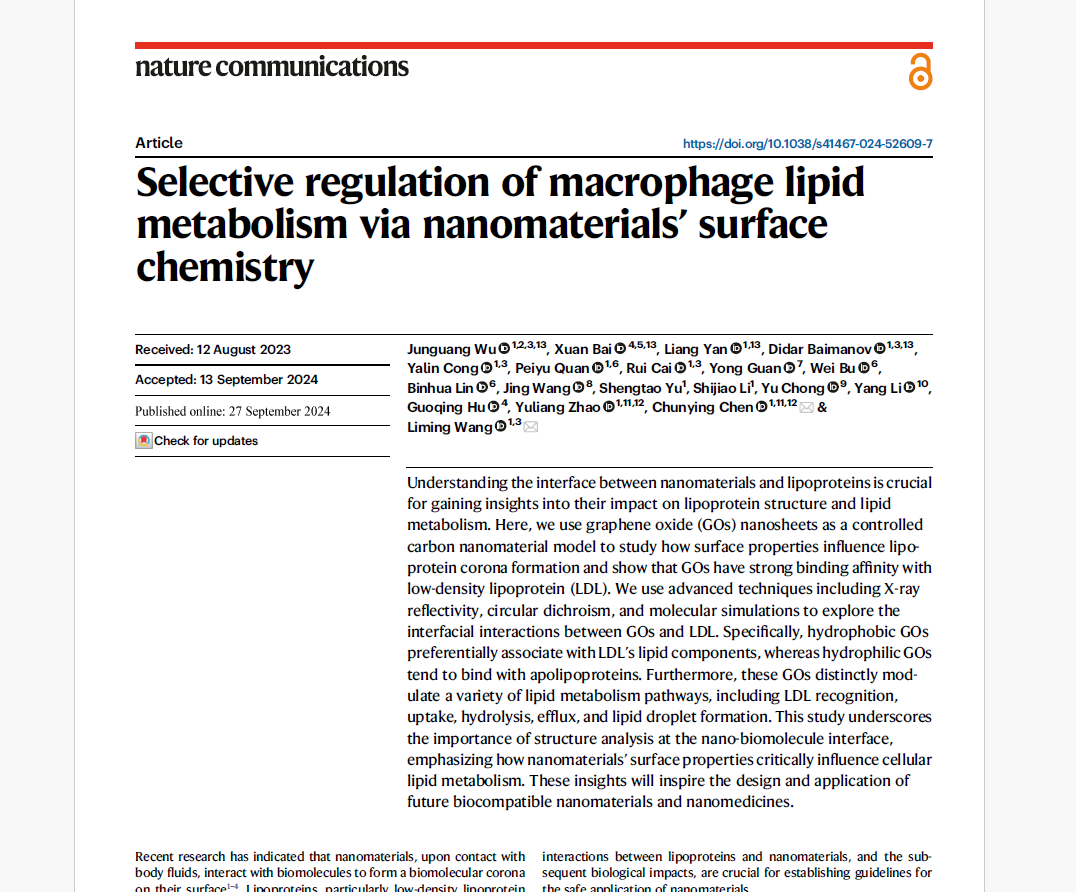
Paper Title: Selective regulation of macrophage lipid metabolism via nanomaterials’ surface chemistry
Author: Junguang Wu, Xuan Bai, Liang Yan, Didar Baimanov, Yalin Cong, Peiyu Quan, Rui Cai, Yong Guan, Wei Bu, Binhua Lin, Jing Wang, Shengtao Yu,Shijiao Li, Yu Chong, Yang Li, Guoqing Hu, Yuliang Zhao, Chunying Chen & Liming Wang
Published Journal: Nature Communications (2024)
Paper link: https://doi.org/10.1038/s41467-024-52609-7
In recent years, the interaction between nanomaterials and biomolecules has received widespread attention. Studies have shown that after nanomaterials come into contact with body fluids, they interact with biomolecules to form a biomolecular corona primarily composed of low-density lipoprotein (LDL). Lipoprotein adsorption can prolong the circulation time of nanomaterials in the blood and promote targeted delivery, but its impact on the structure, composition, and function of lipoproteins remains unclear. As a carrier of cholesterol and lipids, structural changes in LDL may trigger lipid metabolism imbalance, leading to foam cell formation and exacerbating atherosclerosis. Additionally, structural analysis of the nano-lipoprotein interface poses challenges in liquid environments, limiting in-depth understanding of its mechanisms of action and cellular behavior.
This study used graphene oxide (GOs) as a model material and systematically analyzed its interfacial structure and functional changes with LDL through advanced techniques (such as synchrotron radiation circular dichroism and X-ray reflectivity) combined with molecular simulations. The results showed that,The hydrophilic regulation of GOs affects the adsorption, structural changes, and metabolic behavior of LDL in macrophages, including lipid uptake, accumulation, and efflux. The study reveals the crucial role of the physicochemical properties of nanomaterials in modulating lipoprotein function and metabolism, providing a new theoretical basis for the safety evaluation and biomedical application of nanomaterials.
Learn More About METiS TechBio
METiS TechBio's MTS105 Wins Outstanding Poster Award at International mRNA Conference
METiS TechBio Scientist Discusses miRNA, RNAi, and mRNA Technologies
From AI Dominating the Nobel Prize to Industry Trends: METiS TechBio's Reflections and Forecasts