Zhangjiang Pharma Companies Tackle Autoimmune Diseases: From Biologics and Immunosuppressants to Cell Therapies

Chimagen Biosciences
Monoclonal Antibody Drug Developer and Manufacturer

GSK China
Pharmaceutical Manufacturer

Johnson & Johnson
Medical Device R&D and Manufacturer

If you were told that for the rest of your life, you couldn't be exposed to sunlight and could only sustain life by relying on hormones and chemotherapy drugs with strong side effects, or even dialysis and plasma exchange, how would you live?

Recently, the passing of Sha Bai, Zhou Haimi, and others has sparked public curiosity and fear about systemic lupus erythematosus. As one of the common autoimmune diseases, systemic lupus erythematosus still cannot be completely cured.
What is Systemic Lupus ErythematosusAnd AutoimmuneDisease?

Lupus erythematosus can be divided into cutaneous lupus erythematosus (CLE) and systemic lupus erythematosus (SLE). Among them, SLE is a chronic, recurrent autoimmune disease with an unclear specific cause, and it often leads to a series of complications due to the disease itself and the treatments used.
SLECan affect multiple organs throughout the body, with clinical symptoms being diverse and complex, including skin symptoms, cardiac symptoms, pulmonary symptoms, renal symptoms, and hematological system symptoms.、Symptoms of the nervous system, etc. Currently, there is no cure for SLE, and it can only be controlled and improved by avoiding prolonged exposure to sunlight, monitoring with anti-phospholipid antibodies or anti-cyclic peptide antibodies, and other methods.
Autoimmune (hereinafter referred to as "AI") diseases are disease states caused by the immune system's response to self-components. The result of an immune response to foreign antigens is usually the clearance of the antigen, but when an immune response occurs against self-cells or tissue antigens, these cells or tissues are not easily completely cleared by the effector cells of the immune system and are continuously attacked, leading the body into a diseased state.
Autoimmune diseases mainly include SLE, rheumatoid arthritis (RA), Sjögren's syndrome (SS), systemic sclerosis (SSc), idiopathic inflammatory myopathies (IIMs), etc. In addition to SLE, psoriasis, ankylosing spondylitis, and myasthenia gravis are also relatively common autoimmune diseases.

Acquisition Agreements, Clinical Progress, Market Applications... Zhangjiang Pharma Companies Active in Autoimmune Field
Autoimmune diseases are a type of condition with an extremely wide range. Therefore, pharmaceutical companies dedicated to bringing new treatment options to patients and improving their quality of life are also deeply exploring this disease area. Zhangjiang, a key hub for China's biopharmaceutical industry, has recently been making continuous moves in the autoimmune field:
●October 29,Chimagen BiosciencesAndGSK ChinaGSK China has reached an acquisition agreement for a novel triple-antibody autoimmune drug. GSK China will acquire all global rights to CMG1A46 from Chimagen Biosciences for an upfront payment of $300 million. Chimagen Biosciences will also be eligible to receive up to $550 million in development and commercialization milestone payments.
CMG1A46 is a trispecific T cell engager antibody targeting CD3, CD19, and CD20, used for treating various drug-resistant and relapsed B-cell hematological malignancies. The product exhibits high affinity for CD19 and CD20 positive B cells and low affinity for CD3, which can reduce toxicity commonly associated with T cell engagers (TCE).
● On November 12, the official website of the Center for Drug Evaluation (CDE) of the National Medical Products Administration (NMPA) announced,Johnson & JohnsonNicarlimab Injection is proposed to be included in the priority review, applicable for the treatment of adult and adolescent patients (over 12 years old) with generalized myasthenia gravis who are positive for autoantibodies.
Nicalimab is an FcRn antibody that binds with high affinity to block FcRn and reduce circulating immunoglobulin G antibody levels (including autoantibodies and alloantibodies), while maintaining immune function without causing broad immunosuppression.
● At the American College of Rheumatology Annual Meeting held from November 14 to 19,Cibiom BiotechPreclinical study data of C-CAR168 was published in a special report.Hengrui MedicinePresented the results of the Phase II dose-finding study of Funaqizumab (SHR-1314) in an oral report;Hansoh PharmaShowcased positive results from the Phase III clinical trial of Inebilizumab for the treatment of Immunoglobulin G4-Related Disease.
C-CAR168It is a novel bispecific autologous CAR-T therapy targeting CD20 and B-cell maturation antigen, aimed at treating patients with lupus nephritis and systemic lupus erythematosus who are unresponsive to conventional treatments;FunacizumabIt is a humanized IgG1 anti-IL-17 monoclonal antibody drug with uniquely innovative epitope binding, which can specifically bind to IL-17 to inhibit the production of downstream chemokine ligand 1, thereby blocking the inflammatory signaling pathway.InebilizumabIt is a B-cell depleting antibody targeting CD19, suitable for adult patients with neuromyelitis optica spectrum disorder who are positive for anti-aquaporin-4 antibodies.
●November 18,3SBioThe marketing application for monoclonal antibody injection 608 has been accepted by the NMPA. In the Phase III clinical trial results of 608 for the treatment of moderate to severe plaque psoriasis in adults, all primary efficacy endpoints, key secondary efficacy endpoints, and all secondary efficacy endpoints were successfully achieved.
608It is a recombinant anti-IL-17A humanized monoclonal antibody independently developed by 3S Bio, which can selectively bind to human IL-17A, neutralize the activity of IL-17A, effectively inhibit the release of inflammatory factors, and thereby exert an inhibitory effect on the biological activity of IL-17A, effectively suppressing inflammatory responses to achieve therapeutic effects for psoriasis.
Mainstream Therapies, Technological Upgrades, and the Rise of Local Enterprises… The Autoimmune Drug Market is Steadily Growing
According to Frost & Sullivan's forecast: By 2030, the global autoimmune drug market size is expected to reach $176 billion, with a compound annual growth rate of 3.6% from 2022 to 2030. Among this, China's autoimmune drug market size is expected to reach nearly $25 billion by 2030, achieving a tenfold increase compared to 2020, serving as a significant incremental source for the global autoimmune drug market.
The autoimmune drug market is the second largest pharmaceutical market globally, only after the oncology market. However, compared to the "fiercely competitive" landscape of the oncology market, the autoimmune drug market remains largely untapped, especially in China, where it is almost entirely unexplored, offering immense growth potential.
In the past, autoimmune drugs mainly relied on traditional anti-inflammatory treatments such as non-steroidal anti-inflammatory drugs and glucocorticoids. Taking glucocorticoids as an example, more than 30% of SLE patients experience glucocorticoid-related adverse reactions. Long-term, high-dose use of glucocorticoids can not only lead to problems such as osteoporosis and type 2 diabetes but also significantly increase the risk of infection, which is a primary reason for the low long-term survival rate of SLE patients.
Currently, innovative drugs emerging in the autoimmune field are shifting towards innovative targeted therapies, including anti-TNF (tumor necrosis factor) agents, anti-IL (interleukin) agents, and JAK (Janus kinase) inhibitors, among others.
01 TNF preparation
The targets of TNF formulations include the pro-inflammatory cytokine TNF-α, tumor necrosis factor receptor TNFR superfamily, etc.HenliusAdalimumab (Trade name: Handafar®),Junshi BiosciencesAdalimumab (Trade name: Junmaikang®),Johnson & JohnsonInfliximab (trade name: Remicade®) and other TNF formulations targeting TNF-α or TNF-α fusion proteins have been approved for marketing in China.RocheRVT-3101、SanofiTEV-48574、PfizerThe progress of TNF formulations targeting the more cutting-edge target TL1A, such as PF-07261271, varies from preclinical to Phase III clinical trials.
02 IL Formulation
Targets of IL formulations include IL-17, IL-12/IL-23, IL-2, IL-6, etc., and are mainly used for the treatment of psoriasis. Targeting IL-17NovartisSecukinumab (trade name: Cosentyx®),Eli LillyIxekizumab (Trade Name: Taltz®),Hengrui MedicineFunaqizumab (trade name: Andazhen®) and targeting IL-12/IL-23Johnson & JohnsonUstekinumab (trade name: Stelara®) has been approved for marketing in China.
03 JAK Inhibitors
The targets of JAK inhibitors include JAK1, JAK2, JAK, TYK2, etc. Currently, there are approximately 15 JAK inhibitors approved for marketing worldwide. Targeting JAK1,Dizhe PharmaceuticalsGolidixitinib (Brand Name: Correvio®), Targeting JAK1/2NovartisRuxolitinib Phosphate (Trade Name: Jakafi®), Targeting JAK3PfizerRitlecitinib tosylate (brand name: Leflunon®) has been approved for marketing in China.
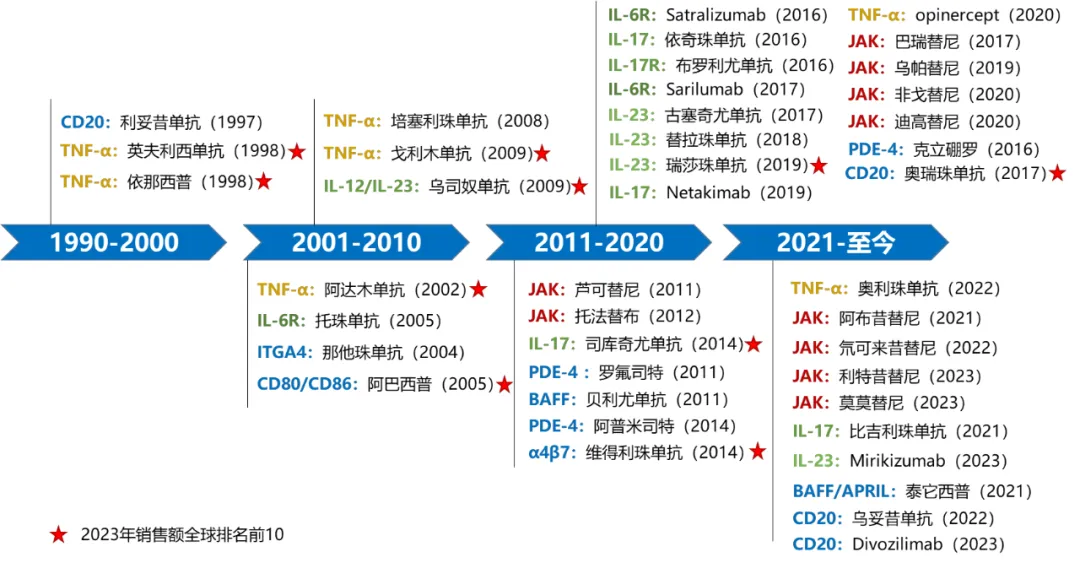
Review of Approval Timelines for Global Autoimmune Drugs (Partial)
(Image source: Pharma Research Network)
Currently, JAK and IL are gradually replacing TNF-α as the hot targets for the new generation of autoimmune drug development. As a more cutting-edge technology, cell and gene therapy (CGT) is also gaining momentum. Pharmaceutical companies in China, especially those in Zhangjiang, have accumulated rich technologies and pipelines in this field.
Although the pathogenic mechanism of SLE has not been fully elucidated, it is certain that B cells producing autoantibodies play a key role in the disease. As long as these pathogenic B cells can be eliminated, we will be one step closer to truly conquering SLE.Dr. Xi Zheng, VP of Project Management and Preclinical at ImClone"This is currently the only direction that has been clinically proven to be relatively promising."
October 24,ImmunotechChimagen Biosciences' self-developed CD47/CD20 dual-target large molecule drug Amurufup a (IMM0306) has completed the enrollment of the first patient in the Phase Ib clinical trial for moderate to severe SLE, becomingThe first dual-target large molecule drug to enter clinical development for SLE indication。
In the Phase I clinical trial of lymphoma, IMM0306 demonstrated good safety tolerance and potent B-cell depletion; in the peripheral blood B-cell depletion experiment with SLE patients, IMM0306 also showed more effective B-cell depletion than CD20 antibodies.
Similarly, CAR-T cell therapy, originally developed for cancer treatment, has also shown great potential in the autoimmune field. In March this year, the Children's Hospital affiliated with Zhejiang University School of Medicine conducted the first clinical trial in China using autologous CD19-targeted CAR-T cell therapy for refractory SLE. All 20 patients with refractory SLE who received the treatment showed improvement in symptoms and were able to discontinue steroids and all immunosuppressants. CAR-T cell therapy also holds promise for treating B-cell-mediated autoimmune diseases such as SSc and IIMs. By profoundly depleting B cells, including autoreactive B-cell clones, CAR-T cell therapy can restore normal immune function, achieving what is referred to as "immune reset."
Currently, six CAR-T products have been approved for marketing in China, all of which are autologous CAR-T, and three of them come from Zhangjiang pharmaceutical companies:
June 2021,Fosun PharmaIn collaboration with Kite Pharma, the first CAR-T product approved in China, Axicabtagene Ciloleucel (trade name: Yikaida®), was introduced. Axicabtagene Ciloleucel targets CD19 and has currently been approved for clinical trials for a third indication in China.
September 2021,JW TherapeuticsThe self-developed CAR-T product targeting CD19, Relma-cel (trade name: Bynodat®), has been approved for marketing and received approval for its third indication in August this year, becoming the first CAR-T product in China to gain approval for three indications.
June 2023,Reindeer BioEquecabtagene Autoleucel (trade name: Focuxin®) has been approved for marketing, becoming the first CAR-T product targeting fully human BCMA to be approved in China. In October this year, the first patient treated with Equecabtagene Autoleucel completed the first month of follow-up after discharge, showing significant treatment effects.
Moreover, at the 2024 Zhangjiang International Summit on Cell and Gene Therapy Industry, Professor Liu Mingyao, Director of the Institute of Life Medicine at East China Normal University and Founder/Chairman of Shanghai Bond Biotherapeutics, presented the achievements of Bond Biotherapeutics in the field of CAR-T cell therapy: The non-viral targeted integration CAR-T platform Quikin CAR-T developed by Bond Biotherapeutics utilizes CRISPR gene editing technology to achieve gene knockout and targeted stable integration of CAR components; innovatively targets CAR-T integration into the PD-1 site, equivalent to combining PD-1 and CAR-T, achieving the "best and optimal" efficacy; the allogeneic universal CAR-T, which has evolved to its sixth generation since 2016, completely eliminated pathogenic B cells in a scleroderma patient during clinical trials, opening the door to treating autoimmune diseases.

There are many reasons why the autoimmune drug market in China has not fully opened up, including:
●The high R&D difficulty and long approval process lead to a limited number of products on the market;
●Limited clinical demand caused by high drug prices, limited patient affordability, and fewer products covered by medical insurance;
●The lack of education and promotion of autoimmune drugs leads to the fact that most doctors and patients are not aware of autoimmune drugs.
However, in recent years, the continuous emergence of innovative products independently developed by pharmaceutical companies in China, the ongoing clinical trials and commercial applications of innovative drugs, as well as the increase in clinical demand and supportive policies, are all helping more autoimmune drugs reach the market and come into the public eye.
The CGT treatment industry, which is at the forefront of autoimmune drugs, also shows strong development momentum driven by technology, policy, and market. Zhangjiang has gathered more than a hundred upstream and downstream companies in the CGT industry chain, making it one of the regions with the highest concentration, visibility, and output of achievements in the cell and gene fields in China. In the future, it will continue to bring more, newer, and more accessible solutions to autoimmune patients.