

Billion-Dollar Autoimmune Market Heats Up: Can Johnson & Johnson Dominate with Oral IL-23R Inhibitor Icotrokinra?

Johnson & Johnson
Medical Device R&D and Manufacturer
Driven by clinical needs, the field of autoimmune diseases has gradually become a highly valued and key investment segment in the global pharmaceutical industry.
Recently, Johnson & Johnson announced a significant advancement: its orally administered interleukin-23 receptor (IL-23R) antagonist Icotrokinra (JNJ-2113) achieved positive pivotal results in the Phase III ICONIC-LEAD study for treating patients aged 12 and above with moderate to severe plaque psoriasis (PsO). This indicates that Icotrokinra, as the first targeted oral peptide drug selectively blocking IL-23R, has made a solid step forward in psoriasis treatment, potentially offering patients a more convenient and effective therapeutic option.
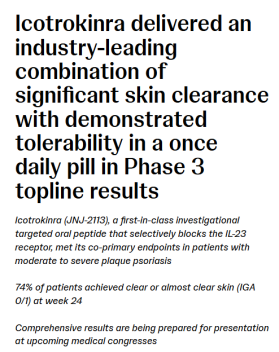
It is worth noting that the pathogenesis of psoriasis is complex, with relatively few targets suitable for designing into small molecules, while drugs developed for various cytokines account for a larger proportion. Therefore, past drug development strategies in this field have mainly focused on biologics dominated by injectable antibodies. However, the successful development of Icotrokinra has brought a breakthrough to this traditional pattern, demonstrating the great potential of oral small-molecule drugs in the treatment of psoriasis.
With the rapid development in the field of autoimmune disease treatment, IL-23R has emerged as a key target, attracting widespread attention and strategic investment from numerous pharmaceutical companies both in China and abroad. In addition to Johnson & Johnson, industry giants such as AbbVie and Eli Lilly have also entered the IL-23R arena, competing for a first-mover advantage in this promising market. Industry experts note that this trend is expected not only to accelerate the development of IL-23R-targeted therapies but also to offer patients more diverse and precise treatment options.

Phase III Clinical Study Succeeds
Oral IL-23R-Targeted Drug on the Way
As a chronic immune-mediated disease, plaque psoriasis causes significant suffering for patients, with symptoms including erythema, scaling, and body pain caused by skin inflammation.据统计,全球有超过1.25亿例斑块状银屑病患者,其中约25%的病情达到中度至重度,亟需更有效的治疗手段。
Johnson & Johnson, in collaboration with Protagonist Therapeutics, has developed Icotrokinra, the world's first oral antagonist peptide targeting IL-23, which is leading a new trend in the treatment of psoriasis. The recently announced ICONIC-LEAD study is a global, multicenter, randomized, double-blind, placebo-controlled clinical trial that enrolled a total of 684 patients, including 66 adolescents.
This study aims to evaluate the safety and efficacy of Icotrokinra versus placebo in treating adolescent patients aged 12 years and older and adults with moderate to severe plaque psoriasis. The study has set dual primary endpoints: the proportion of patients achieving at least a 90% improvement in the Psoriasis Area and Severity Index (PASI 90) at week 16, and the proportion of patients with an Investigator's Global Assessment (IGA, five-point scale) score of 0 or 1 (IGA 0/1) and at least a two-point improvement.
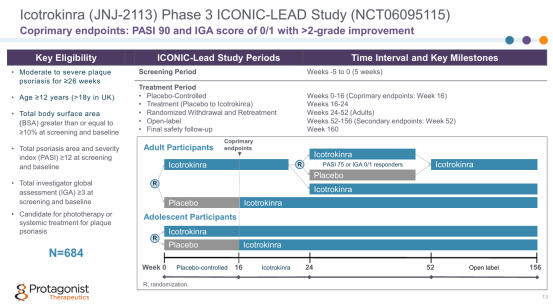
The results are encouraging, with the Icotrokinra group excelling in both co-primary endpoints. At Week 16 of treatment, a significantly higher proportion of patients in the Icotrokinra group achieved PASI 90 compared to the placebo group (49.6% vs. 4.4%), and similarly led in achieving IGA 0/1 (64.7% vs. 8.3%). Moreover, the response rates continued to improve by Week 24, with 64.9% and 74.1% of patients in the Icotrokinra group reaching PASI 90 and IGA 0/1, respectively.
In terms of safety, Icotrokinra also demonstrated robust performance. In the study, the proportion of patients experiencing adverse events (AE) was similar between the Icotrokinra group and the placebo group, with 49.3% and 49.1% of patients, respectively, reporting treatment-emergent adverse events (TEAE) by week 16. Additionally, the phase III ICONIC-TOTAL study focusing on plaque psoriasis in specific areas (such as the scalp, genital region, and/or palms and soles) achieved positive results, further validating the broad applicability of Icotrokinra.
The success of Icotrokinra is no accident, as it relies on Protagonist Therapeutics' exclusive peptide technology platform, successfully overcoming key development challenges such as low oral bioavailability, permeability and stability issues, and gastrointestinal degradation of peptides. Reportedly, this orally administered peptide drug, which selectively blocks IL-23R, exhibits binding affinity to IL-23R at single-digit pM levels, demonstrating significant potential for treating plaque psoriasis and other inflammatory diseases mediated by IL-23R.
Unlike the currently marketed IL-23 products, which are all monoclonal antibody injections, the oral administration of Icotrokinra undoubtedly offers patients a more convenient treatment option. Following the achievement of the primary endpoint in this Phase III study, Protagonist will receive a milestone payment of $165 million, which will help further validate the clinical potential of this blockbuster product, Icotrokinra.
In recent years, Johnson & Johnson's dedicated efforts in the psoriasis field have been evident. From infliximab, golimumab, ustekinumab to guselkumab, Johnson & Johnson has continuously introduced innovative drugs, leading the iterative advancement in psoriasis treatment. Now, with the addition of the oral IL-23R antagonist Icotrokinra, Johnson & Johnson's influence in the psoriasis field is expected to further expand.
Reviewing the history of collaboration, since Johnson & Johnson and Protagonist Therapeutics entered into a licensing and collaboration agreement in 2017, their partnership has continued to deepen. In 2019, the scope of cooperation expanded to include second-generation IL-23R drugs; in 2021, Johnson & Johnson revised the collaboration agreement again, gaining global rights to two second-generation IL-23R drugs, including Icotrokinra. This series of collaborations not only demonstrates Johnson & Johnson's firm confidence in the field of psoriasis treatment but also indicates the broad market prospects for Icotrokinra in the future. With Icotrokinra achieving positive results in Phase III studies, it is gradually moving towards the market and may become a key asset in Johnson & Johnson’s autoimmune portfolio.

Betting on Oral Psoriasis Therapy
Competition in the autoimmune field intensifies again
As the number of patients with autoimmune diseases continues to rise globally, patient needs are becoming increasingly urgent. Major pharmaceutical companies are accelerating their efforts to gain a competitive edge in this blue ocean market.
According to statistics from Frost & Sullivan, the total number of people globally suffering from autoimmune diseases has exceeded 500 million, with nearly 40 million patients in China suffering from major autoimmune diseases. It is estimated that by 2030, the global market size for autoimmune disease drugs will soar to $176 billion, with a compound annual growth rate (CAGR) of 3.6% from 2022 to 2030. The market size in China is expected to achieve a remarkable leap, reaching nearly $25 billion by 2030, representing a tenfold increase compared to 2020, making it an important growth driver in the global autoimmune drug market.
In this market, numerous blockbuster products have emerged. Johnson & Johnson's ustekinumab and AbbVie's risankizumab, both initially indicated for psoriasis, have achieved significant commercial success. Notably, ustekinumab's sales in 2023 have surpassed the $10 billion mark, with risankizumab soon to follow. Additionally, Novartis' secukinumab, Johnson & Johnson's guselkumab, and Eli Lilly's ixekizumab have all become best-selling products worth billions of dollars.
For the treatment of plaque psoriasis, 22 targeted therapies have been approved globally, but oral therapies remain scarce. Currently, only Amgen's PDE4 inhibitor apremilast and BMS's TYK2 allosteric inhibitor deucravacitinib are available as oral options. In the POETYK PSO-1/2 head-to-head studies, deucravacitinib demonstrated superior efficacy compared to apremilast and is highly anticipated by the industry.
However, in terms of commercial performance, deucravacitinib seems to have not yet met market expectations. It is reported that deucravacitinib has entered its third year on the market, but its sales in the first three quarters of this year were only $163 million, with projected annual sales between $200-$250 million. Compared with blockbuster drugs like secukinumab and guselkumab, which experienced rapid growth shortly after their launch, there is still a certain gap.
At this moment, the clinical research success of Icotrokinra, developed by Johnson & Johnson, has undeniably brought new hope to the field of oral psoriasis treatment. According to the latest data from the ICONIC-LEAD study, Icotrokinra demonstrates significant therapeutic potential and is expected to become the most competitive oral targeted therapy for psoriasis currently available.
At the same time, other pharmaceutical giants are also actively promoting the iteration of psoriasis treatment from injection to oral. Sanofi has made a name for itself in the autoimmune field with dupilumab and now aims for the autoimmune "throne" with its oral TNFα inhibitor SAR441566 as its trump card. Lilly, on the other hand, is heavily investing in oral IL-17 small molecule inhibitors. Despite multiple failures, it remains committed and continues to deepen its development path in IL-17.
In the development of oral IL-17 small molecule inhibitors, Eli Lilly initially advanced its self-developed drug LY3509754, but it was halted in Phase I clinical trials due to adverse reactions of liver damage. However, Lilly did not give up, but continued to explore and acquired DICE Therapeutics to obtain two IL-17 small molecule inhibitors in clinical stages, DC-806 and DC-853. Although DC-806 was abandoned for certain reasons, Lilly’s efforts in the IL-17 small molecule inhibitor field have not ceased.
With the continuous advancement in the field of autoimmune disease treatment, IL-23R, as a key target, will continue to attract more attention and strategic focus from pharmaceutical companies. Through ongoing innovation and differentiated competition, these companies will drive the continuous progress of IL-23R drug development, bringing more hope and benefits to patients with autoimmune diseases. In this intense competition, who will stand out and become the leader in the autoimmune field remains to be seen by the industry.



www.yyjjb.com.cn
Insight into Industry Trends

"Pharmaceutical Economy Newspaper"
Academic Official Account
Focus on the Frontiers of Oncology Academia

Terminal Official Account