Data Breakthrough: ASO-Based Hepatitis B Drug AHB-137 Achieves Over 60% HBsAg Loss at Week 12 in Phase IIa Trial

AusperBio
Biological Vaccine and Nucleic Acid Drug Developer

AHB-137 is an antisense oligonucleotide (ASO) developed by AusperBio Therapeutics and Ausper Biopharma, a clinical-stage biopharmaceutical company, for the treatment of chronic hepatitis B (CHB). It has demonstrated good preclinical safety and strong antiviral activity and has now entered Phase II clinical development.
At the previous 2024 European Association for the Study of the Liver (EASL2024) annual meeting, researchers reported partial Phase 1a/1b clinical research data. The results showed that the drug demonstrated good tolerability and potent antiviral activity during a 4-week treatment period (details:EASL2024: Antisense Oligonucleotide (ASO) AHB-137 Phase I Clinical Data in Chronic Hepatitis B Shows Promising HBsAg Clearance Efficacy and Safety)。
At the 2024 American Association for the Study of Liver Diseases Annual Meeting (AASLD2024), researchers presented a Phase IIa study conducted in China, involving chronic hepatitis B (CHB) subjects.AHB-137 Preliminary Results of 24-Week Treatment (12-Week Medication Data).
This multicenter, randomized, open-label Phase IIa study (NCT06115993) enrolledHBeAg-negative, baseline HBsAg > 100 to 3,000 IU/mL (inclusive), chronic hepatitis B subjects receiving stable nucleoside analog (NA) treatment.Subjects were randomly assigned to receive weekly subcutaneous injections of 300 mg or 225 mg of AHB-137, with loading doses on days 4 and 11. After 24 weeks of treatment, a 24-week follow-up with NA monotherapy was scheduled, followed by an additional 24-week follow-up after discontinuation of NA.
The primary objective of the study is to evaluate the proportion of subjects with HBsAg loss (HBsAg < limit of detection (0.05 IU/ml) and HBV DNA < lower limit of quantification (10 IU/ml)) at the end of 24 weeks of AHB-137 treatment. The secondary objectives are to assess the safety, PK, PD, immunogenicity, and impact on quality of life of AHB-137 in HBeAg-negative chronic hepatitis B subjects receiving NA treatment.
Research results: to date, all subjects have completed at least 12 weeks of AHB-137 treatment. Serum HBsAg levels decreased rapidly after administration of AHB-137.At Week 12, 62% (20/32) of subjects in the 300 mg treatment group and 43% (10/23) in the 225 mg treatment group achieved HBsAg seroclearance, primarily during the initial 8 weeks of treatment (44% and 30%, respectively; see figure).
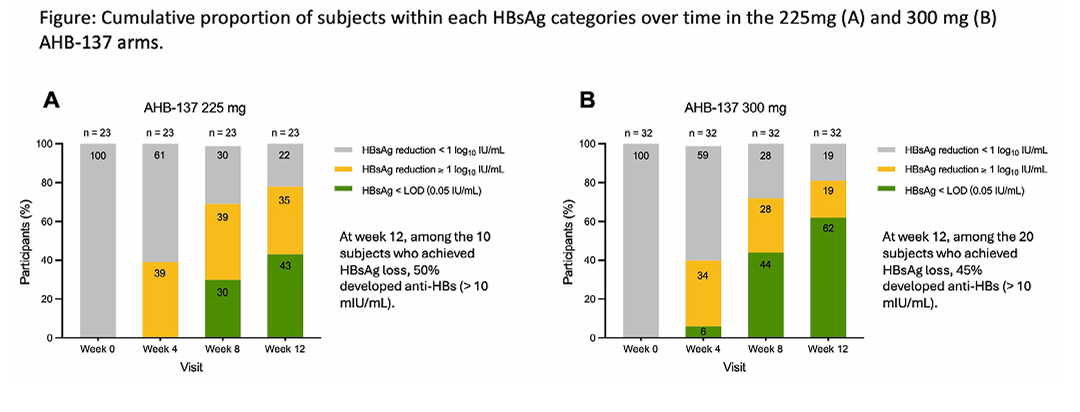
In addition,In the 300 mg treatment group, 50% (7/14) of subjects with baseline HBsAg > 1,000 IU/ml ≤ 3,000 IU/ml achieved HBsAg clearance. Among the 30 subjects who achieved HBsAg clearance, 47% experienced seroconversion at week 12 (anti-HBsAg antibody detected > 10 mIU/ml).
No serious adverse events (SAEs) or discontinuations occurred. The most common treatment-related adverse events (TRAEs) were grade 1-2, including injection site reactions, fever, and laboratory abnormalities. Grade 3 adverse events included elevated alanine aminotransferase (ALT), elevated aspartate aminotransferase (AST), and transient lymphocyte count reduction. No grade 4 TRAEs were observed. Notably, ALT elevation followed by normalization post-treatment was highly correlated with HBsAg seroclearance.
The study suggests that AHB-137 is well-tolerated in this ongoing Phase IIa trial. At a dose of 300 mg of AHB-137, 62% of participants experienced a rapid decline in HBsAg within 12 weeks. Furthermore, nearly half of the participants who achieved HBsAg seroclearance also underwent seroconversion. The current data supports further development of AHB-137 for functional cure of chronic hepatitis B.
Check the data of the similar drug regimen from GSK's Bepirovirsen (GSK836) in Phase 2b clinical trials:
Chronic Hepatitis B Patients Treated with NA (Participant Requirements Included)AHB-137 is different):Patients are required to have HBsAg > 100 IU/mL, HBV DNA < 90 IU/mL, and alanine aminotransferase (ALT) < 2 times the upper limit of normal.
Bepirovirsen (GSK836) 300mg once weekly on Day 4 and Day 11 with a loading dose (LD), for 24 weeks.
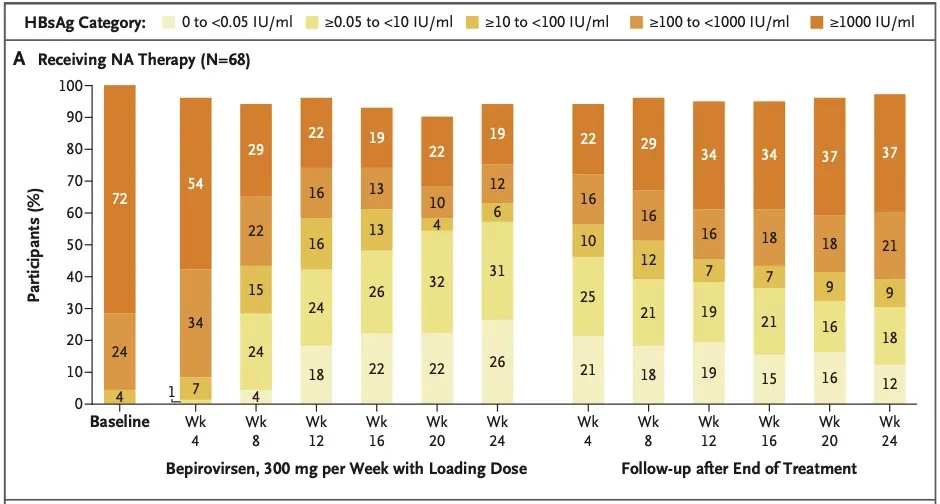
Patients from the entire population at 12 weeksThe HBsAg negative conversion rate was 18%, and no specific analysis regarding seroconversion was observed.
One of the reasons for the significant difference in the data is the variation in the enrolled patients:Bepirovirsen (GSK836) includes both HBeAg-positive and HBeAg-negative patients,AHB-137 is only available inHBeAg-negative patients.
So someone may ask, what's nextWill AHB-137 cause withdrawal effects after discontinuation likeBepirovirsen (GSK836) after discontinuationHBsAg Will there be a rebound after the negative conversion? The answer is yes, there will definitely be some rebound, it just depends on how much. But undoubtedly, for those with relatively low surface antigen...A great progress has been made for HBeAg-negative chronic hepatitis B patients.
Looking forward to seeing the 24-week medication data and subsequent 24-week post-discontinuation data at the APASL2025 conference.
Source of the article: Liver Time
Author: Lüe Xiao Xue