

J&J's Blockbuster Stelara Faces Biosimilar Competition: Will CSPC Secure Third Spot After Huadong and Bio-Thera?

Johnson & Johnson
Medical Device R&D and Manufacturer
CSPC
Innovative Drug Research and Development, Manufacturer

Bio-Thera
Innovative Drug Developer
As blockbuster drug patents expire, the global speed of generic production is bound to accelerate, initiating a battle for market share of original products.
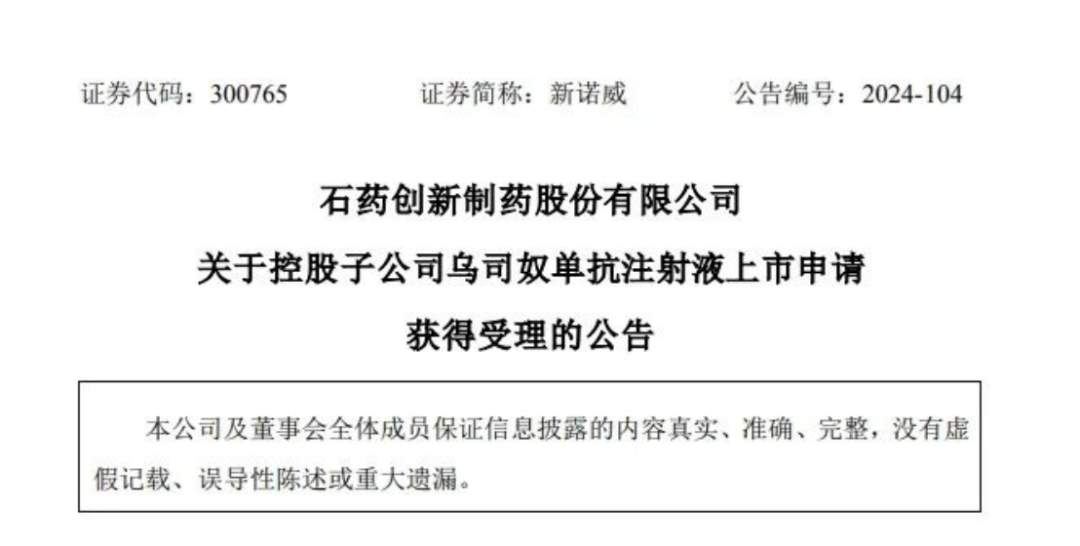
Recently, CSPC Innovative Pharmaceuticals announced that its holding subsidiary, CSPC Jushi Biologics, had received the "Acceptance Notice" issued by the National Medical Products Administration. The company's ustekinumab injection, submitted for marketing approval as a therapeutic biological product under category 3.3, has been accepted. The indication is for adult and pediatric plaque psoriasis.
It was not long ago,On November 5, the marketing authorization application for the ustekinumab injection, co-developed by Quanxin Biologics and Huadong Medicine for adult patients with moderate to severe plaque psoriasis, was approved, becoming the first ustekinumab biosimilar approved for marketing in China.In addition,Bio-TheraBiosimilarBAT 2206 was launched in China this May.ShenReport for Market Launch。
Industry insiders pointed out that as the patent for Johnson & Johnson's original product ustekinumab (Stelara) has expired, the competition in the biosimilar market has begun. With this production report, CSPC may secure a top-three competitive position in the Chinese market for ustekinumab injection biosimilars.
Blockbuster Autoimmune Drug Faces Patent Cliff
CSPC Biosimilars Coming One After Another
Public information shows,Johnson & JohnsonProduct: STELARAIs the world's first to simultaneously selectively targetBiologics for IL-12 and IL-23.IL-12 and IL-23 are two naturally occurring cytokines,The drugThrough cooperation withThe p40 subunit shared by IL-12 and IL-23 binds specifically with high affinity, blocking the interaction of IL-12 and IL-23 with the cell surface receptor IL-12β1, thereby inhibiting IL-12 and IL-23 mediated signal transduction and cytokine cascade reactions.
Due to its critical role in immune-mediated inflammatory diseases, Stelara has been approved globally for multiple indications, including Crohn's disease, plaque psoriasis, ulcerative colitis, juvenile psoriatic arthritis, and psoriatic arthritis.
Notably, the dosing regimen of Stelara involves an initial 45 mg subcutaneous injection, followed by the same dose at week 4 and every 12 weeks thereafter. With only four injections required per year during the maintenance phase, it is one of the biologics with the lowest dosing frequency in the field of psoriasis treatment. Due to its ease of use, high safety profile, good tolerability, and sustained efficacy, Stelara has been the preferred treatment option for related conditions since its market launch.
Currently, the patent for Stelara has expired in the Chinese market, and domestically produced biosimilars have begun to enter the application/approval stage for market launch. This time, CSPC's ustekinumab injection was filed as a Category 3.3 therapeutic biologic, with indications for plaque psoriasis in adults and children.
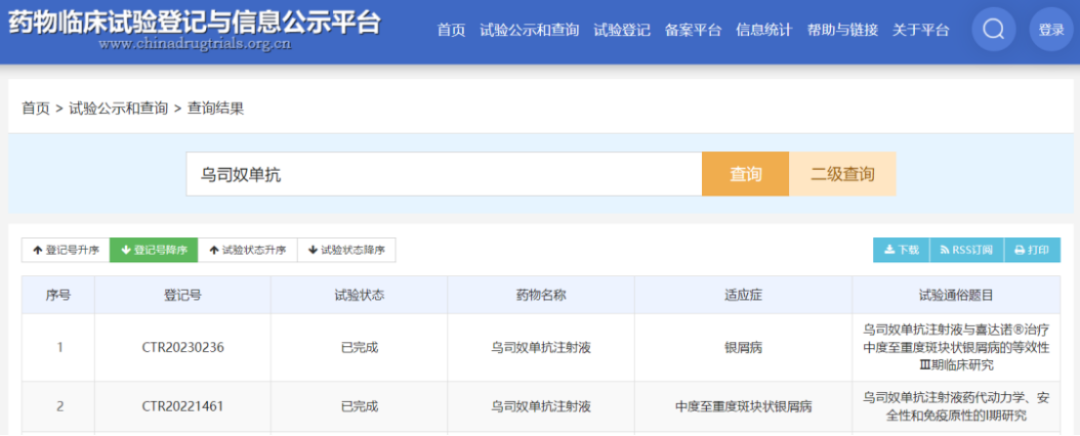
According to the official website of the Chinese Clinical Trial Registry and Information Disclosure Platform, CSPC has completed two clinical studies on ustekinumab injection in China: a Phase 1 study on the pharmacokinetics, safety, and immunogenicity of ustekinumab injection, and a Phase 3 clinical study evaluating the equivalence of this product to the original ustekinumab product in treating moderate to severe plaque psoriasis.
It is reported that this application is based on aKeyPhase III clinical trial, enrolling adult patients with moderate to severe plaque psoriasis who have had an inadequate response, intolerance, or contraindications to any systemic treatment (including cyclosporine, methotrexate (MTX), PUVA (psoralen and ultraviolet A), acitretin capsules, etc.).
CSPC responded to the interview by the New Media Center of the Pharmaceutical Economy News, stating that clinical trial results showed that the efficacy of the biosimilar product submitted for production this time was highly consistent with the original drug Stelara in treating patients with moderate to severe plaque psoriasis, and its safety was good. CSPC will further advance the progress of the product's submission, hoping to obtain the drug marketing approval as soon as possible, further improving the accessibility of medicines in China, and bringing more medication options and clinical benefits to more patients.
The Market Competition is Fierce
Competition in the Billion-Dollar Track Intensifies
Psoriasis is a chronic, recurrent, inflammatory disease that primarily affects the skin and joint systems. It is currently incurable and requires long-term or even lifelong treatment.Plaque psoriasis accounts for approximately80%~90%, the most common type in psoriasis.
In the market aspect, Stelara is not only a重磅 drug in the autoimmune field but also one of Johnson & Johnson's best-selling products. In 2023, fourteen years after its launch, Johnson & Johnson’s Stelara still achieved a growth rate of 11.7%, with global sales reaching $10.858 billion. According to data from Menet, in 2023, the sales revenue of ustekinumab in China's three major terminals and six major markets exceeded 1.3 billion yuan, representing a year-on-year increase of 38.57%.
Global Sales of Johnson & Johnson's Ustekinumab (Million USD)
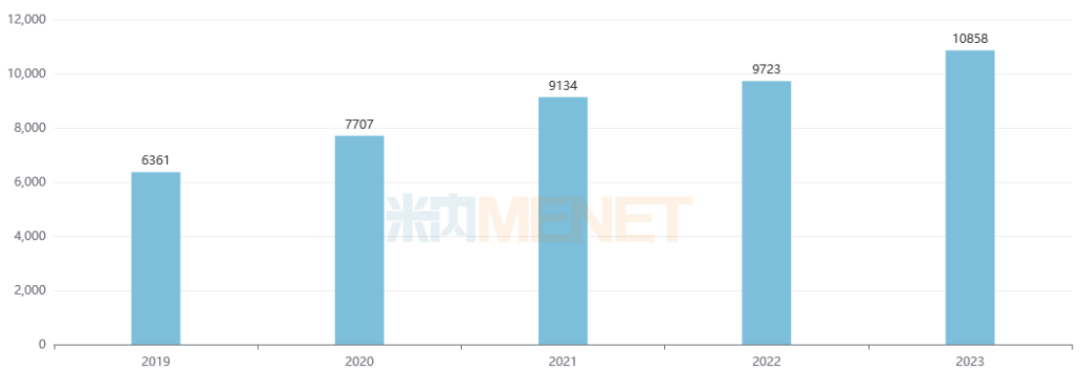 Source: MiNe Network Cross-Border Listed Company Sales Database
In terms of sales contribution from specific indications, Crohn's disease has been the main driver of Stelara's performance in recent years. Nevertheless, even with Johnson & Johnson's extensive development of multiple indications, it is still difficult to resist the market share capture by biosimilars after the patent expiration.
As Stelara faces patent expiration, several biosimilars have already emerged in the global market, such as Wezlana (ustekinumab-auub) developed by Amgen, which was approved by the U.S. FDA on October 31, 2023, as an interchangeable biosimilar to Stelara. For this blockbuster drug, Johnson & Johnson is clearly unwilling to let go easily. In May 2023, Amgen and Johnson & Johnson reached a settlement in the patent case regarding Johnson & Johnson's ustekinumab injection, allowing Amgen to launch its biosimilar no later than January 1, 2025.
In April 2024, Teva Pharmaceuticals announced that the U.S. FDA had approved its developed Selarsdi (ustekinumab-aekn) subcutaneous injection as a biosimilar to Stelara, for the treatment of moderate to severe plaque psoriasis and active psoriatic arthritis in adult and pediatric patients aged 6 years and older. It is reported that Selarsdi will be available in 45mg/0.5ml and 90mg/ml single-dose prefilled syringes and is expected to launch in the United States in February 2025.
In China, in addition to CSPC's ustekinumab injection, Huadong Medicine/Quanxin Biotech's Seluxin (HDM3001/QX001S) was approved in November this year for the treatment of adult patients with moderate to severe plaque psoriasis. It is the first approved ustekinumab biosimilar in China. On November 13, the first prescription in China for Seluxin was issued by Peking University People's Hospital. Additionally, Bio-Thera’s BAT 2206 has been submitted for marketing approval in May this year, with indications presumed to be for plaque psoriasis.
Regardless, with the gradual increase of ustekinumab biosimilars in the global and Chinese markets, it is expected to provide patients with more treatment options, which is of great significance for improving drug accessibility and reducing the economic burden on patients. At the same time, this also implies that fierce market competition among major pharmaceutical companies will unfold.
Industry insiders pointed out that this also reminds pharmaceutical companies that the product life cycle management of innovative drugs is crucial. Based on the approved indications, combination therapies and the expansion of related indications should be pursued to build a strong moat for their own products.
Editor: Vanilla


www.yyjjb.com.cn
Insight into Industry Trends

"Pharmaceutical Economy Herald"
Academic Official Account
Focus on the Frontier of Oncology Academia

Terminal Official Account