

GSK Inks $975M Deal with Duality Biologics for Preclinical GI Cancer ADC DB-1324

DualityBio
Innovative Molecular Type Drug Developer

GSK
Pharmaceutical R&D Manufacturer
On December 4, Duality Biologics ("Ying Bio") announced that it has reached an exclusive licensing agreement with global biopharmaceutical company GlaxoSmithKline (GSK) for a potential best-in-class ADC drug (DB-1324). According to the agreement, GSK will obtain exclusive rights globally (excluding mainland China, Hong Kong, and Macao) to advance the research, development, and commercialization process of this ADC drug.
According to the terms of the agreement, GSK will pay an upfront fee of $30 million and other pre-option milestone payments to obtain an exclusive license to advance the research, development, and commercialization of DB-1324 globally (excluding mainland China, Hong Kong, and Macau). If GSK exercises the option, DualityBio will receive an option exercise fee and subsequent milestone payments at different stages of development, regulatory registration, and commercialization, which could reach up to $975 million (approximately RMB 7.31 billion in total). Upon successful commercialization, GSK will pay tiered royalties on global net sales (excluding mainland China, Hong Kong, and Macau) at various rates and also receive royalties from net sales in mainland China, Hong Kong, and Macau.
DB-1324 is still in the preclinical stage.
The pipeline DB-1324 involved in this transaction is an innovative ADC molecule developed based on Dyadic's proprietary and clinically validated Duality Immune Toxin Antibody Conjugates (DITAC) platform. It is currently still in the preclinical development stage, and its research direction may focus on gastrointestinal (GI) cancers.
DITAC (Duality Immune Toxin Antibody Conjugate Platform) is a proprietary ADC platform developed by DualityBio based on topoisomerase inhibitors. It has been validated by global clinical data from over 1,000 patients across the United States, China, Europe, Australia, and other major markets. The platform's development is based on significant technical improvements, screening, and optimization of a proprietary ADC component library, including its proprietary payloads P1003 and P1021. As a result, DITAC allows DualityBio to design ADCs with critical flexibility, achieving better systemic stability, tumor-specific payload release, bystander killing effect, and rapid toxin clearance.
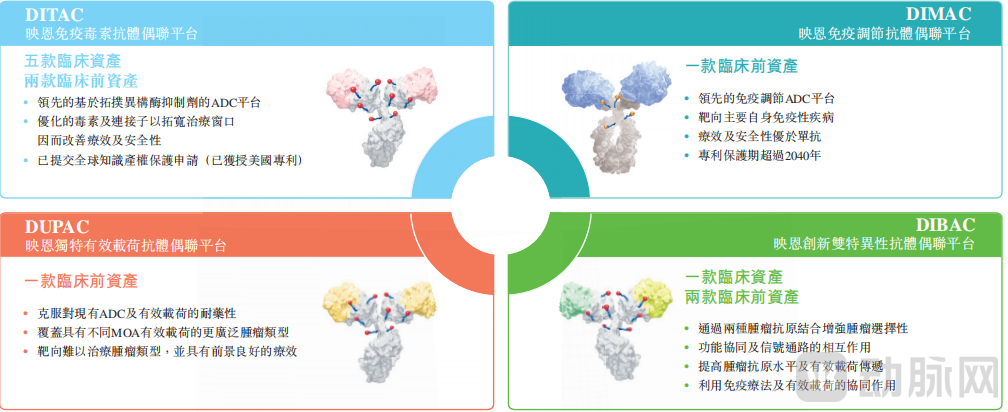 Four Major Technology Platforms (Source: Duality Biosciences Prospectus)
In addition, DualityBio has several key technology platforms, including DIBAC, DIMAC, and DUPAC.
The DIBAC Platform: One of the Few Bispecific ADC Platforms in the World
The DIMAC platform, equipped with DualityBio's proprietary immune-modulating payload, unlocks the potential of ADC drug formats in significant untapped markets within autoimmune and other therapeutic areas. Currently, many patients with chronic autoimmune diseases receive treatments that often lead to severe side effects. ADCs can redefine the treatment paradigm for autoimmune diseases by offering targeted therapies with lower systemic exposure, enhanced efficacy, and improved safety. Molecules developed on the DIMAC platform have demonstrated effective and broad anti-inflammatory activity in preclinical studies, with long drug action duration, high stability, and low systemic exposure.
The DUPAC platform is used to develop linker-payload complexes with novel mechanisms of action that are superior to traditional cytotoxic drugs, addressing the growing challenges of drug resistance and difficult-to-treat tumors. Currently, DualityBio has made significant progress in several unique payload mechanisms and obtained candidate toxin payloads with broad anti-tumor activity against various solid tumors, which have demonstrated potent direct and bystander killing effects in preclinical studies.
Duality Bio submitted its prospectus for a Hong Kong IPO in August this year. The prospectus shows that Duality Bio currently has 12 ADC pipelines, with no products yet approved for marketing. Six pipelines have entered the clinical stage, and its HER2 ADC already has indications in Phase 3 clinical trials. The DB-1324 involved in the transaction with GSK was not previously disclosed.
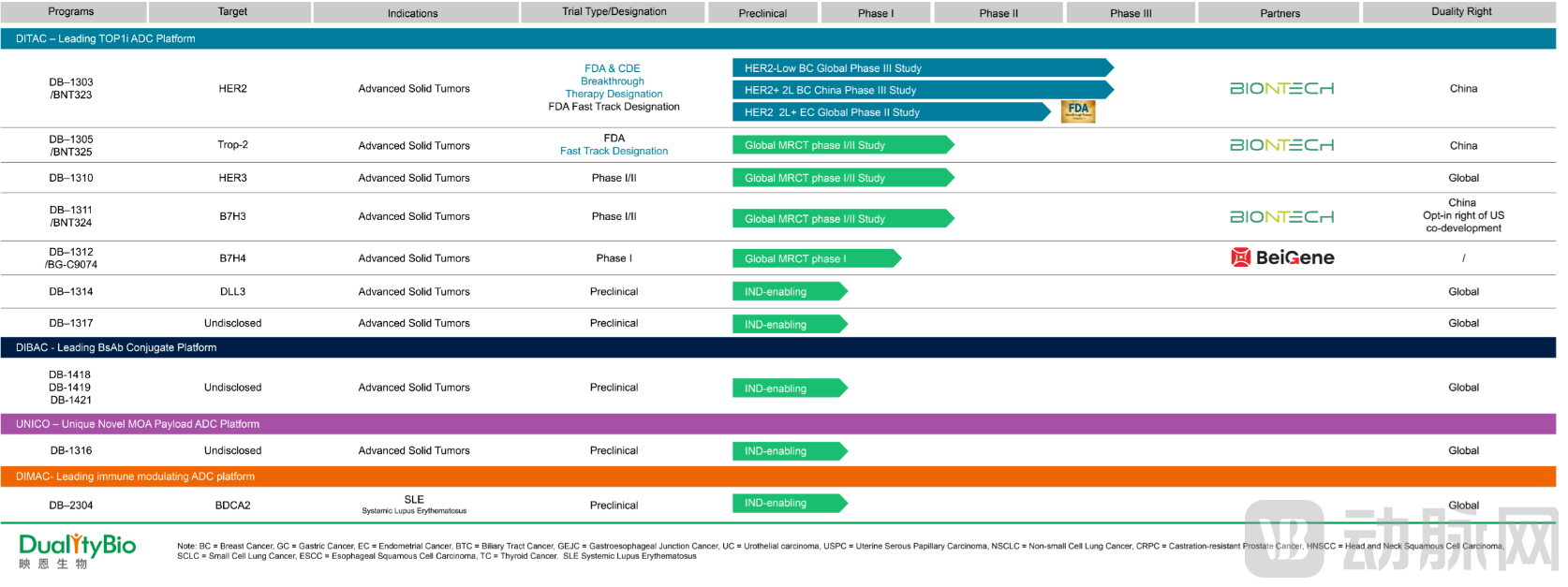 Mapping Bio Pipeline Source: Mapping Bio Official Website
The prospectus shows that, through collaborations with major pharmaceutical companies such as BioNTech (for DB-1303, DB-1311, and DB-1305), Adcendo (for its ADC assets targeting specific antigens using our payload-linker), BeiGene (for DB-1312), Sinotong Pharmaceutical, and Harbour BioMed, DualityBio has secured substantial upfront payments along with continuous milestone payments in the future. The total value of these deals exceeds $4 billion (including upfront and subsequent milestone payments).
GSK is "killing" its way back into the oncology track
In 2015, Novartis and GSK completed a "business swap" deal: Novartis acquired GSK's oncology-related products for $16 billion, integrating the consumer businesses of both companies; GSK purchased Novartis' vaccine business, excluding flu vaccines, for $5.25 billion. Through this transaction, Novartis obtained two oncology products that were already approved by GSK at the time for the treatment of metastatic melanoma: the BRAF inhibitor dabrafenib and the MEK inhibitor trametinib.
Two years later, GSK's new CEO Emma Walmsley took office and immediately restructured the pharmaceutical business. In the Q2 financial report of that year, it was announced that more than 30 ongoing research projects would be abandoned, with plans to focus 80% of R&D expenditure on core businesses—respiratory diseases, HIV, oncology, and immune inflammation. Since then, GSK has begun rebuilding its influence in the field of oncology through a combination of "in-house R&D + acquisition."
In 2018, GSK spent $5.1 billion to acquire Tesaro, a tumor drug manufacturer, obtaining all development and commercial rights to the oral PARP inhibitor Zejula (niraparib), officially announcing its return to the oncology field. Following this collaboration, they successfully launched commercial products such as PARP inhibitors and PD-1 monoclonal antibodies.
In 2019, GSK and Merck signed a cooperation agreement worth up to 4.2 billion US dollars to jointly take charge of the future global clinical development and commercial promotion of M7824. However, due to M7824’s failure to replicate the encouraging data observed in earlier studies during the Phase III clinical trial, the cooperation was announced to be terminated in 2021.
Since 2022, GSK has shown a strong interest in ADC and has made a series of significant moves and investments in this field.
Despite GSK's first BCMA ADC drug, Blenrep, failing in the confirmatory Phase III clinical trial DREAMM-3 in 2022, which led to the withdrawal of its market approval in the United States, the company has not abandoned further research and development of Blenrep. Instead, GSK has continued to advance two other ongoing clinical trials, DREAMM-7 and DREAMM-8, to explore Blenrep's potential in combination therapies.
In the DREAMM-7 trial, the combination therapy of Blenrep with bortezomib and dexamethasone demonstrated significant therapeutic effects, reducing the risk of disease progression or death by nearly 60% and extending the median progression-free survival (PFS) by almost three times. In the DREAMM-8 trial, the combination therapy of Blenrep with pomalidomide and dexamethasone also showed statistically significant and clinically meaningful PFS benefits. These positive results have reignited GSK's hopes for Blenrep and prompted the company to resubmit the drug's marketing application for use as a second-line treatment for relapsed or refractory multiple myeloma (r/r MM).
In addition to Blenrep, GSK has also made extensive arrangements in the ADC field. In 2023, the company introduced two ADC drug candidates targeting different antigens from Hansoh Pharma, paying a substantial upfront fee and potential milestone payments. Moreover, GSK has also collaborated with companies like Mersana to gain co-development and commercialization rights for more ADC drugs.
In the field of solid tumors, although GSK's layout is relatively late, the company has quickly established a solid tumor ADC pipeline through both in-licensing and self-developed approaches. Currently, GSK has multiple ADC drugs targeting different antigens at various stages of clinical development, including the HER2 ADC drug XMT-2056, the B7-H4 ADC drug HS-20089, and the B7-H3 ADC drug HS-20093.
The ADC-related deal reached with DualityBio this time marks GSK's first collaboration with a Chinese ADC company. This partnership signifies an important strategic shift in GSK's global drug R&D layout and highlights the growing influence of Chinese ADC companies on the international stage.
Currently, GSK has several key products in the oncology sector, including the BCMA ADC drug Blenrep, the PD-1 monoclonal antibody Jemperli, the PARP inhibitor Zejula, and the JAK1/JAK2 and ACVR1 inhibitor drugs Ojjaara/Omjjara, among others.
In recent years, the oncology segment's business reconstruction has also shown a steadily increasing trend: GSK’s oncology segment revenue was approximately £600 million in 2022, marking a year-on-year increase of 23%; in 2023, revenue reached about £30 billion, with oncology business revenue growing over 20% year-on-year. According to GSK's Q3 2024 financial report, sales of oncology and HIV drugs were robust, with the oncology drug Ojjaara showing outstanding performance, driving a 19% increase in specialty medicines revenue.