



Interface News reporter |
Interface News Editor |Xie Xin
Beijing time on the evening of December 4, AstraZeneca announced a personnel appointment, declaring that Iskra Reic will serve as Executive Vice President, Global Head of International Business, fully responsible for regional operations including China, Asia and Eurasia markets, Middle East and Africa, Latin America, Australia, and New Zealand.
AstraZeneca's appointment means that Iskra Reic has filled the vacancy in AstraZeneca's global management system—At the end of October, Leon Wang, AstraZeneca’s Executive Vice President, International Markets President, and China Country President, was announced."Currently cooperating with the investigation in China"。
As of now, there are no updated official investigation results regarding the Wang Lei incident. AstraZeneca's latest statement on Wang Lei is that, "Wang Lei continues to be temporarily away from his post due to an ongoing investigation in China." On AstraZeneca's global official website, Wang Lei’s job responsibilities are no longer listed.
On the evening of December 4, there was also a change in the position of General Manager of AstraZeneca China. An internal letter released by Iskra Reic showed that Leon Lin will serve as the General Manager of AstraZeneca China. According to the AstraZeneca China official website, Leon Lin was previously the General Manager of AstraZeneca China's biopharmaceuticals business and the head of AstraZeneca in Hong Kong and Macao.
Interface News learned that Minglong Lai, who previously served as the General Manager of AstraZeneca China, will be transferred to AstraZeneca's Global Oncology Business Unit.
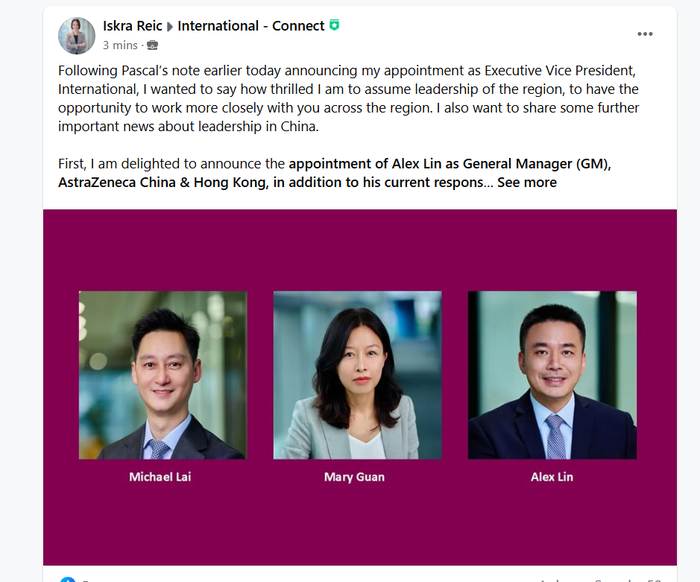
Public information shows that Lin Xiao joined AstraZeneca in 2019 as the Head of AstraZeneca China's Renal Therapy Area. In January 2021, Lin Xiao took on the additional role of Head of AstraZeneca China's Digital Business, responsible for the development of digital, e-commerce, and internet hospital businesses. In February 2022, he became the Vice President of AstraZeneca China and the Head of the Respiratory, Digestive, and Autoimmune Business Unit. In August 2023, he was appointed as the Vice President of AstraZeneca China, Head of the Respiratory Inhalation and Biologics Business Unit, and Head of the Hong Kong and Macao regions.
In addition, after the completion of the restructuring within the year, AstraZeneca China's main business is divided into three major sectors - biopharmaceuticals, oncology, and rare diseases, with Lin Xiao becoming a key leader. At the beginning of this year, AstraZeneca China established its biopharmaceutical business, which is led by Lin Xiao. In October, AstraZeneca China’s Omnichannel Business Division was integrated into its biopharmaceutical business in China. The organizational structure of each Omnichannel Business Unit remains unchanged, and the heads of the four major business teams will report directly to Lin Xiao.
At the same time, AstraZeneca China merged its respiratory inhalation business, respiratory nebulization business, and digestive business to establish the Respiratory and Digestive Business Unit, which will be fully led by Liu Qian, the current General Manager of AstraZeneca China’s Omni-Channel Business Unit, reporting to Lin Xiao. The biologics business, vaccine and immunotherapy, and autoimmune business units have been merged to form the Respiratory and Autoimmune Biopharmaceuticals, Vaccines, and Immunotherapy Business Unit, headed by Chen Xi, who will continue to report to Lin Xiao. The Cardiovascular, Renal, and Metabolism Business Unit will continue to be fully managed by Guan Dongmei, Vice President of AstraZeneca China and Head of the Cardiovascular, Renal, and Metabolism Business Unit, who will also continue to report to Lin Xiao. Additionally, Guan Dongmei is now also responsible for the oncology business.
Before joining AstraZeneca, Lin Xiao served as the Head of Strategic Planning for Asia and Greater China at Sanofi, as the Market Head of Sanofi China's Core Products Division, and also as the Vice President of Ping An Good Doctor (now renamed "Ping An Health").
During the one-month investigation of Wang Lei, Leon Lai Ming-lung, Senior Vice President of AstraZeneca Global, General Manager of AstraZeneca China, and General Manager of Oncology Business, briefly took over various operations in China.
Until the incident in October this year, Wang Lei had been with AstraZeneca for 11 years. In 2013, Wang Lei joined AstraZeneca China. In December 2014, he was promoted to President of AstraZeneca China. In 2017, Wang Lei was promoted twice within a year, becoming Global Vice President of AstraZeneca, President of International Business and China, responsible for emerging markets including Asia-Pacific, Middle East, Russia, Africa, and Central and South America. It was also during Wang Lei’s term that the Chinese market became AstraZeneca's second largest market.
Iskra Reic's resume shows that she has been a member of AstraZeneca's Senior Executive Team since 2017. She joined AstraZeneca in 2001 and previously served as the company's Executive Vice President, Global, and Head of Europe and Canada. After 2021, Iskra Reic also took on the role of head of the company’s vaccines and immunotherapy business. The current appointment also indicates that Iskra Reic's management scope is expanding.
For now, the separation between AstraZeneca and Wang Lei continues. On November 5 local time, AstraZeneca's global headquarters held an investor briefing.First ResponseRegarding the investigation involving Leon Wang, President of AstraZeneca China. Aradhana Sarin, Chief Financial Officer of AstraZeneca, stated that the current investigations in China are only targeted at individuals and do not involve the company level.
At that time, AstraZeneca disclosed that the investigations involving Wang Lei, current and former senior executives of AstraZeneca, were all related to the previous...Insurance Fraud CaseIrrelevant, but involves issues related to drug imports and data. AstraZeneca Global revealed that Leon Wang (China president) had been detained. Additionally, in the previous AstraZeneca Tagrisso insurance fraud case, approximately 100 former employees have been sentenced to prison.
Beijing time, November 12th evening, AstraZeneca CEO Pascal Soriot was alsoResponse at the Earnings ConferenceRegarding the detention of Wang Lei.
Soriot said: "Regarding the investigation of local management team members by Chinese law enforcement agencies, the company knows very little about the details of the investigation. The company has 'strong' compliance policies in China and has implemented new measures to identify any potential violations. At the same time, AstraZeneca remains committed to conducting business in China, both for patients and for innovation." He mentioned that all projects in China are proceeding very smoothly, and AstraZeneca's business growth is driven by newly launched products.
Additionally, AstraZeneca also released its third-quarter report for this year a little earlier. The data shows that the company achieved revenue of $39.182 billion in the first three quarters of this year, representing a 19% year-on-year increase; while the revenue for the third quarter reached $13.565 billion, marking a 21% year-on-year growth.
Of which, AstraZeneca's revenue in China for the first three quarters reached $5.049 billion, representing a 15% year-on-year increase; revenue for the third quarter alone was $1.671 billion, also marking a 15% year-on-year growth. Based on the data from the first three quarters, revenue from China accounts for 13% of AstraZeneca's global income. The proportion of revenue achieved by the company in China has exceeded 10% for the fifth consecutive year, and the 15% growth rate indicates that AstraZeneca’s revenue growth in China this year has returned to a double-digit growth trajectory.
To date, AstraZeneca has become one of the most well-known multinational pharmaceutical companies in China. The company entered China in 1993 and has since brought more than 40 innovative drugs to the Chinese market. Its business areas encompass oncology, cardiovascular, renal, metabolism, respiratory, gastrointestinal, rare diseases, vaccines and antibodies, as well as autoimmune diseases.