

Electric Precision, Pulsed Innovation: Xiangya Hospital Pioneers Nationwide RhythPulse™ PFA Ablation Surgeries in Collaboration with Xuanyu Medical

ShineyoMedical
Provider of Atrial Fibrillation Electrophysiology and Peripheral Vascular Intervention Solutions
"From the 1920s when Xiangya pioneered cardiovascular medicine in China, to today leading the revolution in non-thermal ablation, this baton has been passed on at Xiangya Hospital for a century."




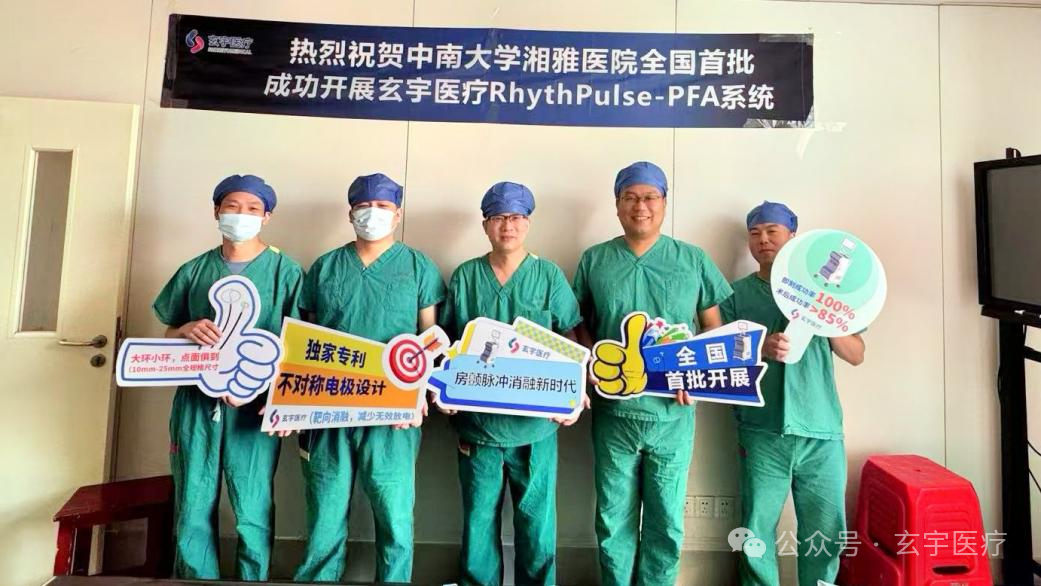
June 13, 2025, Xiangya Hospital of Central South UniversityDirector Bai Yongping's TeamDirector Xie QiyingSuccessful Application of ShineyoMedical RhythPulse®️Pulsed Field Ablation Catheter Successfully Performs Hybrid Pulsed Field Ablation (PFA) and Left Atrial Appendage Closure Procedure, as well as Standalone PFA Procedure on Two Patients with Atrial Fibrillation — Among the First Batch in ChinaRhythPulsePulse Ablation Surgery. Pulsed Field Ablation (PFA), as an innovative technology, is gradually becoming the preferred solution for catheter ablation treatment due to its superior efficacy and safety. Compared with traditional thermal ablation methods, PFA demonstrates significant technical advantages, providing a safer and more efficient treatment option for patients with atrial fibrillation. Left atrial appendage closure (LAAC) is an effective strategy for preventing thromboembolic events in patients with atrial fibrillation as an alternative to oral anticoagulation therapy. Extensive clinical research evidence shows that this surgical method is safe, reliable, and highly effective, making it one of the important options for treating atrial fibrillation. The successful implementation of this surgery marks that the Cardiology Department of Xiangya Hospital is already among the top in China in terms of the application of innovative cardiac interventional technologies, offering more new treatment options for patients with atrial fibrillation.


Patient Overview
Case 1
Male patient, 67 years old. He reported experiencing chest tightness without obvious cause since 2021, presenting as a feeling of oppression in the precordial area, accompanied by palpitations and pulse irregularities. He sought treatment at a local hospital. On August 1, 2022, he was admitted to our department and received symptomatic treatments such as antiplatelet aggregation and reducing myocardial oxygen consumption. After his symptoms improved, he was discharged on August 9, 2022. However, after discharge, the patient did not regularly take antiplatelet and lipid-lowering medications. He was readmitted on April 26, 2024, preparing for coronary stent implantation, but the procedure was not performed due to a drop in platelet count, and conservative treatment was administered instead. The most recent episode of chest tightness occurred on June 7, 2025, lasting for 4 hours, with no improvement after taking traditional Chinese medicine. He then visited a local hospital where his blood pressure was measured at 60/40 mmHg. An electrocardiogram showed atrial fibrillation with a rapid ventricular rate, and echocardiography revealed a patent foramen ovale. Symptomatic treatments such as ventricular rate control and anticoagulation were administered. The patient was advised to undergo coronary angiography, radiofrequency ablation, and left atrial appendage closure. The patient requested further treatment at a higher-level hospital and subsequently visited our outpatient department. He was admitted to the hospital with a diagnosis of "paroxysmal atrial fibrillation and premature atrial contractions."
Admission Diagnosis: 1. Paroxysmal Atrial Fibrillation, 2. Arrhythmia, 3. Coronary Heart Disease, Post-PCI, Myocardial Bridging (Left Anterior Descending Artery), 4. Unstable Angina, 5. Valvular Heart Disease, 6. Hypertension Grade 3 Extremely High-Risk Group, 7. Chronic Obstructive Pulmonary Disease, 8. Sequelae of Cerebral Infarction, 9. Polypoid Lesion of the Gallbladder, 10. Pulmonary Nodule, 11. Adrenal Nodule, 12. Patent Foramen Ovale.
Director Xie Qiying's team conducted a clinical consultation on this case. Based on the examination results and the patient’s other medical history, they decided to use the RhythPulse-PFA system to perform a one-stop procedure combining atrial fibrillation pulsed field ablation surgery with left atrial appendage closure, after obtaining consent from the patient and their family.
'%20fill='%23FFFFFF'%3E%3Crect%20x='249'%20y='126'%20width='1'%20height='1'%3E%3C/rect%3E%3C/g%3E%3C/g%3E%3C/svg%3E)
Preoperative Transesophageal Echocardiography to Exclude Left Atrial and Left Atrial Appendage Thrombosis
Surgical Procedure
Before the surgery began, to ensure patient safety, a transesophageal echocardiography (TEE) was performed to rule out thrombosis in the left atrial appendage and left atrium. Under three-dimensional navigation, a refined model of the left atrium was constructed. The ShineyoMedical RhythPulse catheter (15mm circular diameter) was used for bilateral pulmonary vein isolation, followed by pacing verification to confirm bidirectional conduction block in both pulmonary veins. After ablation, a left atrial appendage closure procedure was performed. Intraoperative DSA angiography revealed a cauliflower-shaped left atrial appendage with well-developed pectinate muscles and limited internal space. Measurements showed an inner space of approximately 21mm and an outer orifice of about 19mm. Based on comprehensive measurements, a LACbes disc occluder with a fixed disc of 22mm and a sealing disc of 28mm was selected for closure. During the procedure, the fixed disc of the occluder was successfully anchored within the left atrial appendage. The sealing disc was deployed and immediately verified through angiography and traction assessment. The positioning of the fixed disc was optimal, with both the fixed disc and sealing disc remaining stable, no residual shunt, and no impact on surrounding tissues. The fixed disc appeared tire-shaped, meeting the PAST principle release criteria. The occluder was then released, successfully completing the left atrial appendage closure. The entire procedure was complication-free. After the surgery, the patient was safely returned to the ward and postoperative recovery was excellent.
Case 2
The patient is a 56-year-old female. She reported experiencing palpitations and chest tightness without obvious cause one year ago, with episodes lasting from several minutes to hours. The symptoms were not accompanied by chest pain, difficulty breathing, profuse sweating, nausea, or vomiting. These symptoms recurred repeatedly but were not given serious attention. One month ago, she visited the emergency department of a local hospital due to a urinary tract infection and fever. An electrocardiogram (ECG) performed during the emergency visit revealed atrial fibrillation and complete right bundle branch block. After completing relevant examinations and tests at the local hospital, she underwent radiofrequency ablation treatment on May 9, 2025, which was unsuccessful. For further treatment, she visited our department’s outpatient clinic and was admitted to our department with a diagnosis of "atrial fibrillation."
Preoperative CTA to rule out thrombosis in the left atrium and left atrial appendage
Surgical Procedure
Before the surgery, a CTA examination was performed to rule out thrombosis in the left atrial appendage and left atrium to ensure patient safety. Under 3D navigation, a refined model of the left atrium was constructed. First, ShineyoMedical's 20mm circular diameter RhythPulse catheter was used for mapping and circumferential pulmonary vein pulse ablation. Then, a 10mm circular diameter RhythPulse catheter was utilized to address the gap in the left inferior pulmonary vein and improve the local substrate of the posterior wall of the left atrium. Finally, a 10mm circular diameter RhythPulse catheter was employed to verify bilateral pulmonary vein isolation, followed by pacing verification to confirm bidirectional conduction block in both pulmonary veins. The entire procedure was complication-free, and the patient returned safely to the ward post-surgery.
Postoperative Director Xie Qiying on RhythPulse®-PFA system gives high praise, pointing out RhythPulse®-PFA system demonstrates excellent stability and ease of use, particularly the design of the 10mm circular catheter, which enables more precise positioning, smoother operation, and significantly enhances surgical efficiency.
[ShineyoMedical RhythPulse]®-PFA System】
ShineyoMedical's RhythPulse®-PFA system is the first approved system in China that integrates multi-channel, large focal points, and targeted ablation in a pulsed field ablation (PFA) system, primarily used for treating drug-refractory and recurrent atrial fibrillation and other types of rapid arrhythmias. Its core advantages include:
Large Focal Design:Using the world's first 10mm ring ablation catheter, a single discharge can cover a lesion area with a diameter of 10mm, improving the ablation efficiency by more than three times compared to traditional technology.
Targeted Ablation Technology:Equipped with an intelligent contact detection module, it monitors the contact status between the electrode and myocardial tissue in real time, reducing the risk of hemolysis caused by ineffective discharges, and decreasing postoperative plasma free hemoglobin content by 50%.
Clinical Validation Excellence:In a clinical trial involving 151 cases, the immediate success rate was 100%, and the success rate for atrial fibrillation treatment at 12 months post-operation reached 85.07%, achieving an internationally leading standard.
Expert Profile
Xie Qiying
Xiangya Hospital of Central South University
Deputy Chief of Cardiology
Doctor, Chief Physician, Doctoral Supervisor. Visiting Scholar at the University of Oklahoma HSC, Mentor at the Cardiac Intervention Training Base of the National Health Commission (Arrhythmia), Member of the Atrial Fibrillation Center Alliance Committee of China, Member of the Left Atrial Appendage Occlusion Working Committee of the Atrial Fibrillation Center Alliance of China, Member of the Pacing and Electrophysiology Professional Committee of Hunan Province. Specializes in interventional diagnosis and treatment of cardiovascular diseases, focusing on complex arrhythmias, left atrial appendage occlusion, pacemaker lead extraction, and pacemaker implantation.
The end