

NewMed, the Heart Valve Leader Backed by Temasek, OrbiMed, and Lilly Asia Ventures, Files for STAR Market IPO After 8-Fold Revenue Surge in 2 Years

NewMed
Artificial Heart Valve System Developer

Temasek
Investment Company

OrbiMed
Healthcare Investment Institutions

Lilly Asia Ventures
Biopharmaceutical Investment Management Institution
The investment thesis of capital for high-end implantable devices is being restructured.
The domestic heart valve sector has long been dominated by foreign brands and companies pursuing the self-expanding technology route, whereas NewMed, which entered the market with a differentiated approach using balloon-expandable technology, submitted its IPO prospectus to the STAR Market in late June. The company, heavily invested by Temasek, OrbiMed, and Lilly Asia Ventures, is attempting to rapidly break through via capital pathways.
NewMed, a company deeply engaged in minimally invasive cardiac devices, has previously made three attempts to list on the Hong Kong Stock Exchange. This time, it has chosen to list under the fifth set of listing rules on the STAR Market, planning to raise RMB 1.3 billion to further develop its product pipeline.
Over the past decade, NewMed has focused on a single mission: performing valve replacement within a beating heart using a single catheter. This technology is known as TAVR. NewMed's core product, Prizvalve, is the first domestically produced balloon-expandable TAVR system to receive approval, thereby initiating the trend of domestic substitution in this market.
In 2023, NewMed's core business revenue was only around RMB 6 million. By 2025, this figure had risen to nearly RMB 58 million. In just two years, revenue grew more than eightfold.
The product that opened up the market is called Prizvalve.
In August 2024, Prizvalve received marketing approval from the NMPA, becoming the first domestically produced balloon-expandable TAVR system. Prior to its introduction, this niche market was almost entirely monopolized by Edwards Lifesciences. This product from NewMed has opened another door for patients and physicians in China.
The inception of this product owes much to the vision and perseverance of its founder, Yu Qifeng. As the driving force behind NewMed, Mr. Yu serves not only as Chairman and General Manager but also as CTO. With a professional background in materials science and biomedical engineering, he has dedicated over 18 years to the cardiac interventional device industry. His career spans several leading domestic R&D enterprises specializing in implantable medical devices, during which he has built a core team that excels in both material craftsmanship and clinical implementation.
These experiences gave him a profound understanding of the technological pathways and market demands for cardiac interventional devices, reinforcing that achieving success in domestic substitution requires taking the difficult yet correct path. Therefore, NewMed has focused from the outset on balloon-expandable valves, which present higher technical barriers.
TAVR technology features two mainstream approaches: self-expanding and balloon-expandable. The self-expanding type functions like an opened umbrella, securing itself through its own elastic force; NewMed has chosen the balloon-expandable approach, which inflates the valve with a balloon—much like inflating a tire—to precisely implant it at the lesion site.
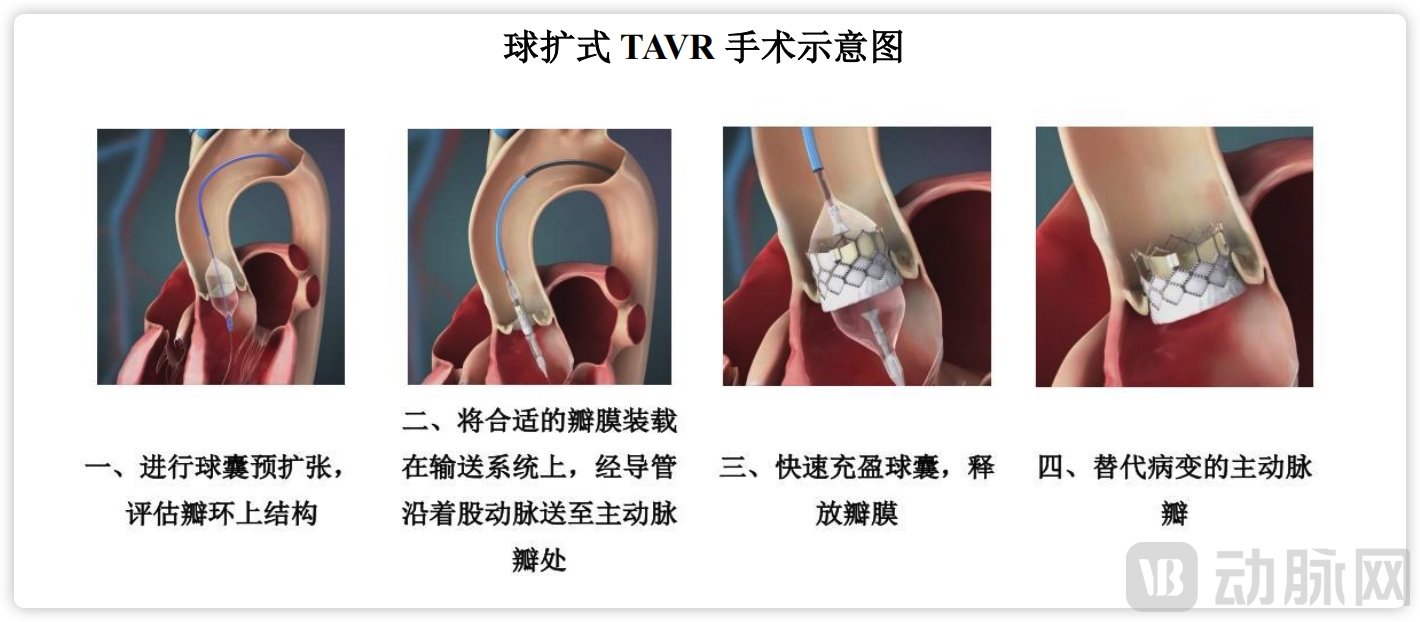
Balloon-expandable TAVR Procedure, Image Source: Prospectus
The domestic market has long been dominated by self-expanding valves, with well-known companies such as Venus Medtech, MicroPort CardioFlow, and Peijia Medical all following the self-expanding technology route.
Why choose the path of balloon-expandable valves? This must be understood from the historical context of the company's founding.
NewMed was founded in 2015, at a time when domestic companies were already rapidly advancing along the self-expanding TAVR pathway. Venus Medtech completed clinical trials for its self-expanding TAVR valve in 2017; MicroPort CardioFlow leveraged the resources of its listed parent company to advance related product development; and Peijia Medical pursued a dual-pronged strategy, making significant inroads in both neurointerventional and valvular disease sectors.
These pioneers have already established clinical data, physician preferences, and distribution networks. If NewMed follows the same path, it will only become trapped in a price war and a red ocean of homogenized competition.
In terms of product features, the advantage of balloon-expandable valves lies in their precision, as they are deployed through a single balloon expansion, allowing the physician to fully control the positioning. In contrast, self-expanding valves are released gradually, with the valve slowly expanding on its own.
For severely calcified annuli, balloon-expandable valves provide stronger radial force, resulting in less postoperative paravalvular leak and a lower pacemaker implantation rate. Clinical data from NewMed shows that the incidence of moderate-to-severe or greater paravalvular leak immediately after Prizvalve implantation is only 0.8%. The rate of implanting more than one valve is just 0.22%.
Market feedback is the most honest.
In 2025, the first full year since Prizvalve's market launch, NewMed's balloon-expandable valve products captured approximately 21.43% of the domestic balloon-expandable valve market. By the end of May 2026, NewMed's balloon-expandable valves had been commercially implanted in over 1,100 cases, covering more than 180 hospitals.
These achievements are also inseparable from the core team of NewMed. Its key members have long been deeply engaged in the heart valve sector, maintaining extensive industry insights into the clinical pain points and technological barriers associated with the two global TAVR approaches, thereby building a comprehensive proprietary patent system from the ground up. To date, NewMed and its subsidiaries have obtained 295 domestic and international patents, with five products having entered the NMPA's Special Review Procedure for Innovative Medical Devices.
It is this team that has enabled NewMed to demonstrate a level of maturity and efficiency in R&D and commercialization that far surpasses that of emerging industry players.
NewMed not only successfully entered the market but also rapidly gained recognition.
Currently, although the company's net profit remains negative, the loss margin continues to narrow. Meanwhile, the gross profit margin climbed from 40.65% in 2023 to 72.56% in 2025.
The narrowing loss is attributed to the scaled commercialization of high-margin core products, which drove rapid revenue growth. Concurrently, the surge in sales volume enabled economies of scale in production, thereby reducing unit costs and improving gross profit margins.
The success of a product can be attributed to luck. Whether a company possesses long-term value depends on its ability to replicate this success and build its own moat.
VCBeat has observed that NewMed's footprint clearly extends beyond aortic valves. Its product pipeline already covers multiple key areas of the heart. In addition to its commercially launched aortic valve products, its transcatheter mitral valve replacement (TMVR) system, Mi-thos, and its percutaneous ventricular assist device (pVAD) system are both among the leading contenders in terms of clinical development progress in China.
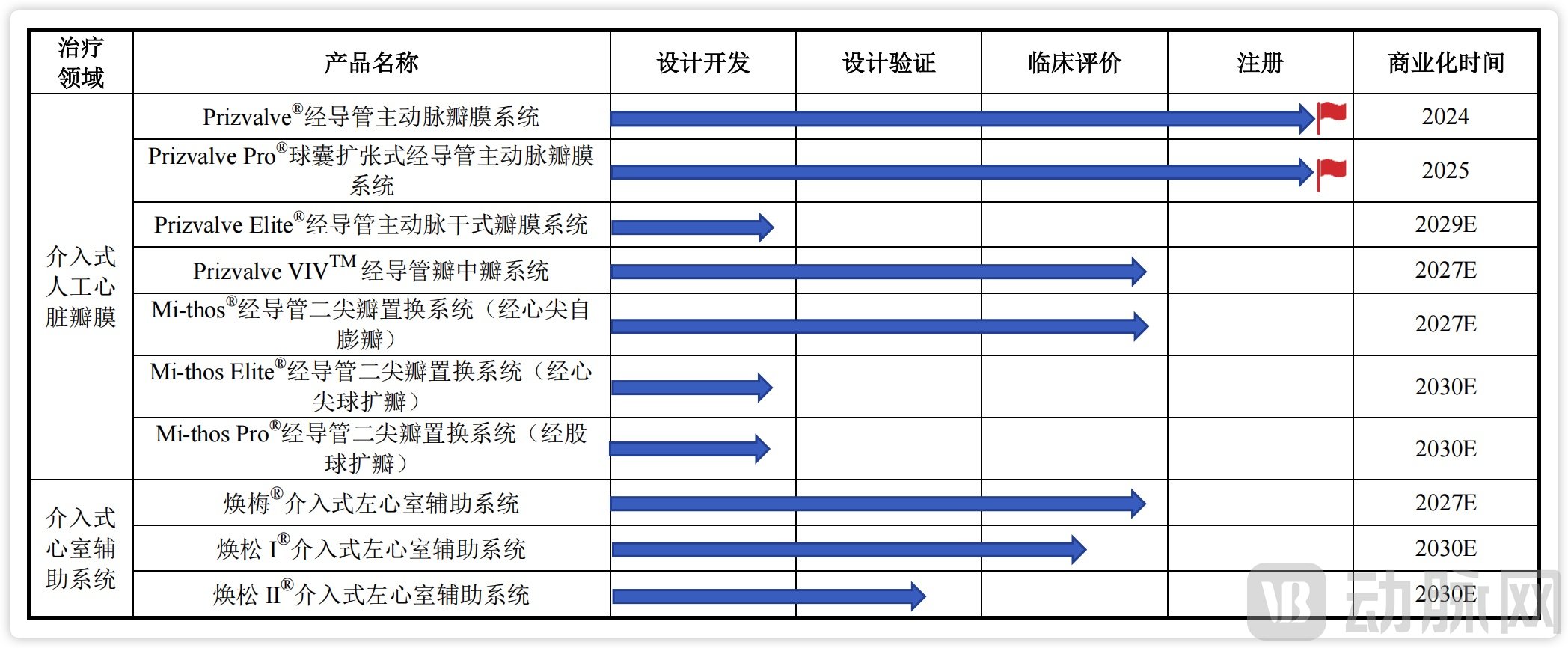
Corporate Product Portfolio, Image Source: Prospectus
TMVR presents greater technical challenges than TAVR due to the complex anatomy of the mitral valve, irregular annulus, and high risk of left ventricular outflow tract obstruction, with anchoring and sealing constituting two major technical hurdles. Currently, only Abbott's Tendyne and Edwards' SAPIEN M3 have received global regulatory approval.
Currently, there are no commercially available TMVR products in China. Whoever launches first will define the next-generation market landscape.
NewMed's Mi-thos system completed Asia's first transcatheter mitral valve replacement surgery in 2019, but multiple domestic companies are still in the clinical enrollment phase, and the competitive landscape remains unclear.
Evolving from a single-product company into a platform-based enterprise covering structural heart repair and functional assistance, NewMed aims to build an ecosystem for "whole-heart" therapy.
Building such an ecosystem requires the patient support of capital.
In the shareholder list of NewMed, OrbiMed holds a 12.13% stake, Temasek holds a 7.03% stake, Lilly Asia Ventures holds a 3.33% stake, and there are also funds with state-owned backgrounds.
They are betting on the certainty of balloon-expandable valves in the Chinese market, focusing on the logic of domestic substitution for high-end medical devices.
Valvular heart disease is a rigid burden of aging.
There are currently approximately 4.8 million patients with aortic stenosis in China, and about 12 million patients with moderate-to-severe mitral regurgitation.
This patient population is predominantly elderly with multiple comorbidities, making them unable to tolerate open-heart surgery. Pharmacological therapy can only alleviate symptoms and cannot reverse the structural lesions of the valves. Open-heart surgery involves significant trauma and a prolonged recovery period, often excluding elderly patients from surgical intervention.
TAVR offers an excellent minimally invasive alternative. However, while the market size for TAVR products in China reached approximately RMB 1.51 billion in 2025, the number of TAVR procedures performed that year was only 19,000. Compared to a potential patient population in the millions, the penetration rate remains low.
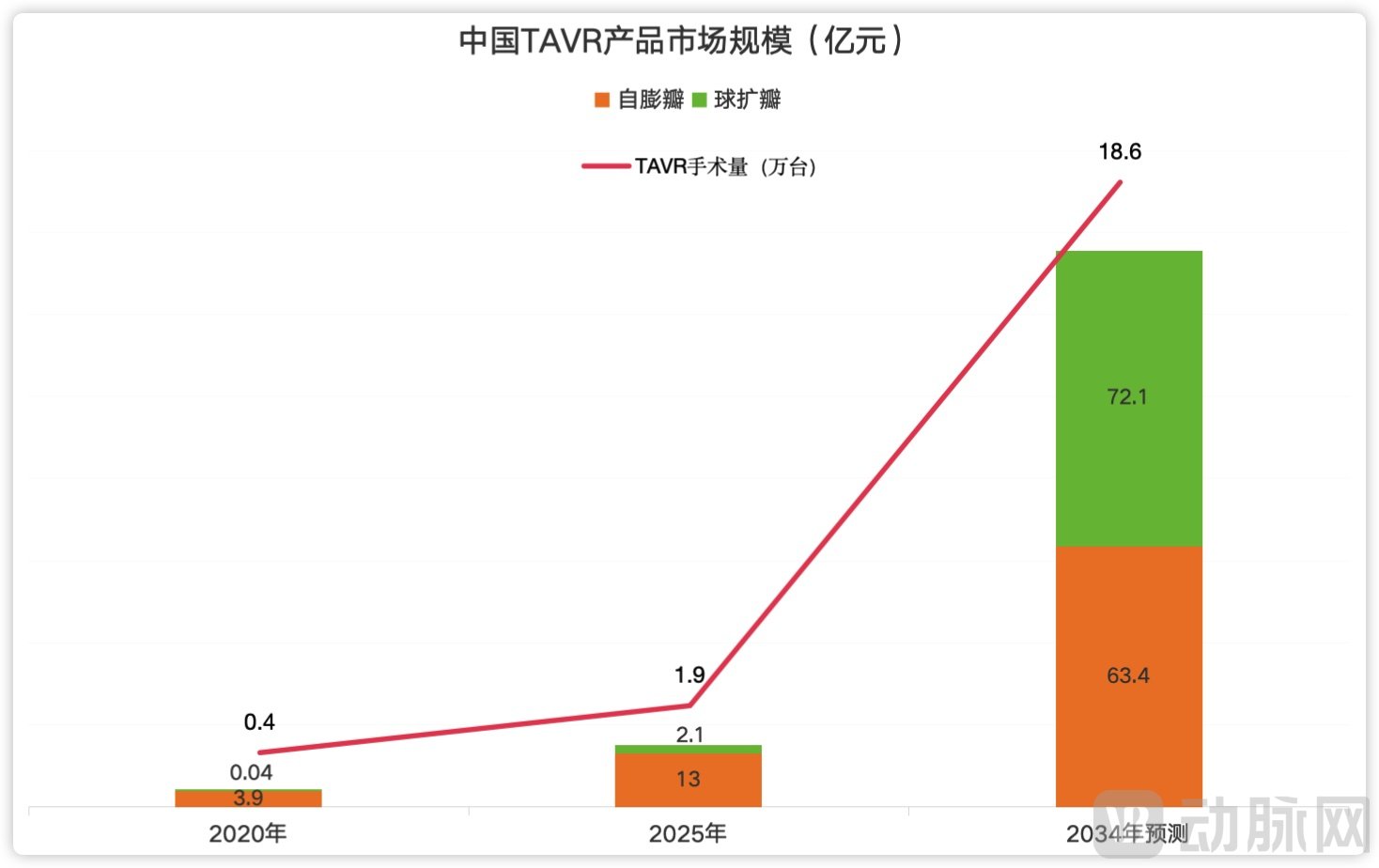
The Rapid Growth of the Balloon-expandable Valve Market Has Only Just Begun, According to Charts in the Prospectus
The market is far from saturated; the real bottleneck lies not on the demand side, but in supply and payment capacity.
The number of hospitals in China capable of performing TAVR is limited, and there are high requirements for the experience of lead surgeons. In the past, TAVR consumables were prohibitively expensive; following national medical insurance negotiations at the end of 2025, prices for TAVR products from various manufacturers began to decline.
In the short term, price reductions compress corporate profits; however, in the long run, they expand patient accessibility. Only when more patients can afford the treatment will surgical volumes increase. It is only after surgical volumes rise that companies can realize economies of scale.
NewMed has kept pace with industry development, capitalizing on the dividends in a rapidly growing market through its differentiated technological approach.
In its fundraising plan, RMB 768 million of the total RMB 1.364 billion will be invested in the R&D center, accounting for over 56%; RMB 277 million is allocated to the valve production base; and RMB 153 million will be used to build the marketing network.
It is evident that NewMed plans to allocate substantial funding to research and development, which is an essential step in evolving into a platform-based company. If it only sells a single product, its growth ceiling will be low. Only by relying on a diversified product portfolio can it achieve the resilience needed to navigate economic cycles.