

In the RMB 10 Billion Ophthalmic Consumer Market, Domestic Brands Finally Break Through!

Eyebright Medical
Ophthalmic Medical Product R&D Provider

Maider
Developer, Manufacturer, and Distributor of Intelligent Equipment for Medical Consumables
A thin lens becomes the "hidden champion" on China's medical device registration list since 2025: soft hydrophilic contact lenses surpass various high-demand devices and consumables in approval volume, ranking first in number of Class III certificates.
The trends toward daily disposable and cosmetic-oriented contact lenses have spurred a surge in new product launches. Among these, particularly noteworthy is a niche market long dominated by international giants: silicone hydrogel lenses, with high oxygen permeability as their core advantage, are poised for a domestic breakthrough.
In the domestic silicone hydrogel contact lens market, Johnson & Johnson, Bausch + Lomb, CooperVision, and Alcon are the absolute key players. In fact, companies in mainland China have already secured dozens of registration certificates, with the earliest one approved as far back as seven years ago (i.e., in 2019). However, most domestically branded silicone hydrogel contact lenses previously sold on the market were manufactured by overseas contract manufacturers, and this product, approved in 2019, is nowhere to be found on the market.
With registration certificates in hand, why has the launch of independently developed lenses been delayed? Where exactly is the bottleneck for domestic breakthroughs?
Silicone hydrogel, as a next-generation material for contact lenses, features dual oxygen transmission channels compared to traditional hydrogels. In addition to relying on water content for oxygen delivery, silicone molecules establish an independent pathway for oxygen conduction, further ensuring the oxygen supply required for corneal metabolism. This makes it more suitable for maintaining eye health during long-term wear.
Currently, the market share of silicone hydrogel contact lenses in Europe and the United States has exceeded 80%, whereas in China's nearly RMB 20 billion soft contact lens market in 2025, silicone hydrogel lenses accounted for only 14% overall, with particularly low penetration rates for silicone hydrogel colored contact lenses.
This brings us to another characteristic of silicone materials: silicone molecules themselves lack hydrophilic groups. With the introduction of organosilicon compounds, both the thickness and surface roughness of contact lenses increase. While a higher silicone content indeed enhances the lens's oxygen permeability, it concurrently compromises the surface's water-retention and moisturizing performance.
For a long time, the domestic silicone hydrogel market has been dominated by four major brands—Johnson & Johnson, Bausch + Lomb, CooperVision, and Alcon—as well as some brands from Taiwan, China. Their products have already established a favorable wearing experience and high market recognition. In contrast, independently developed products from mainland China have had minimal market presence. Industry insiders revealed that previously, some products merely incorporated silicon into hydrogels to increase the oxygen permeability coefficient, but this resulted in insufficient lens softness and moisture retention, directly impacting wearing comfort and repurchase intent.
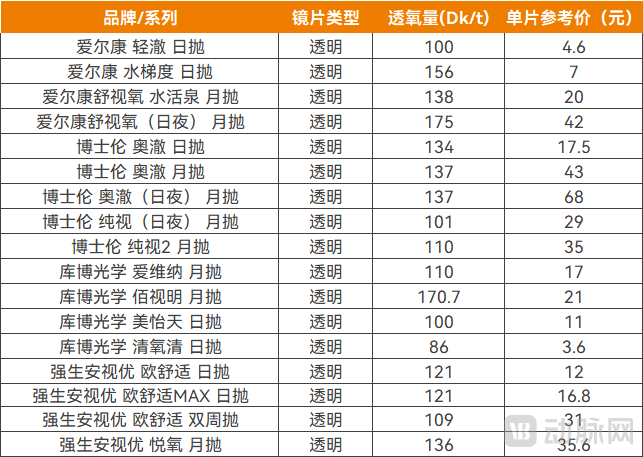 Overview of Silicone Hydrogel Contact Lenses from the Four Major International Brands. Data sources: Corporate Public Disclosures and E-commerce Platforms.
(Prices are for reference only, subject to fluctuations in promotional offers across various platforms)
The scarcity of high-quality domestically produced products and significant material bottlenecks are key reasons for the low market penetration of silicone hydrogel in China. As contact lenses fit directly onto the eyeball, only superior all-day wearing comfort can attract consumers and boost repurchase rates.
Currently, more mainland Chinese enterprises are entering the silicone hydrogel sector, including listed companies such as Eyebright Medical and Maider, as well as innovative firms like OSigen, Iris Science, Robotrak, and Dearer Group. More importantly, the industry has reached a consensus: silicone hydrogels must not focus solely on oxygen permeability values; market acceptance can only be enhanced by improving the balanced performance of oxygen permeability, hydration, and softness.
As a long-term supplier of silicone hydrogel monomers to overseas brands, OSigen is one of the earliest companies in China to achieve independent research and development of silicone hydrogel materials. Zhang Aijun, the founder, told VCBeat that the first and second generations of silicone hydrogel relied on "bulk silicon incorporation + plasma surface treatment" to mitigate surface hydrophobicity. The third-generation technology directly grafts hydrophilic groups onto the main chain of silicone molecules, harmonizing oxygen permeability and wettability at the molecular structural level, while simultaneously reducing the material's modulus to balance lens softness.
Leveraging a novel technological pathway, OSigen has optimized its formula through 100,000 experiments to directly incorporate hydrophilic groups into the silicone backbone, achieving a balance between high oxygen permeability and hydrophilic comfort. Building on a high oxygen transmissibility of 166 Dk/t, it significantly reduces tear evaporation rate, ensuring sustained hydration during extended wear.
Robotrak has independently developed the AquaMatrix material technology, which utilizes a long siloxane chain architecture and optimizes the arrangement of functional groups to enhance oxygen transmissibility. This approach achieves high-efficiency oxygen transmission with only a small amount of silicone material, thereby avoiding common drawbacks associated with the simple addition of silicone raw materials, such as lens stiffness, ocular irritation, and hydrophobicity. After years of material and product research and development, Robotrak's first silicone hydrogel clear lens, "RoadTo Vision®," was approved in March 2026.
Xu Mengchen, co-founder of Robotrak, stated candidly, "The Dk/t value of our first-generation product approaches 100, benchmarking against mainstream international silicone hydrogel soft contact lenses. The target oxygen permeability for our second-generation product under development will be increased to 150–200. However, we believe that once the oxygen permeability of silicone hydrogel soft contact lenses reaches a certain threshold, simply increasing the Dk/t value does not yield a linear improvement in actual wearing experience. The evaluation of lens performance should not be limited to a single metric but should comprehensively consider multiple dimensions, including high oxygen permeability, material hydrophilicity, sustained surface wettability, mechanical flexibility, and long-term wearing stability. Ultimately, this aims to provide wearers with a safer, more comfortable, and stable long-term wearing experience—what we refer to as pursuing a holistic 'sensory-free comfort' experience."
In summary, as many manufacturers independently establish their own material R&D systems and achieve breakthroughs in monomer synthesis, formulation blending, and performance optimization, mainland Chinese enterprises are able to continuously iterate and adjust formulations based on user wear feedback, optimize lens performance, and independently develop products better aligned with market demands.
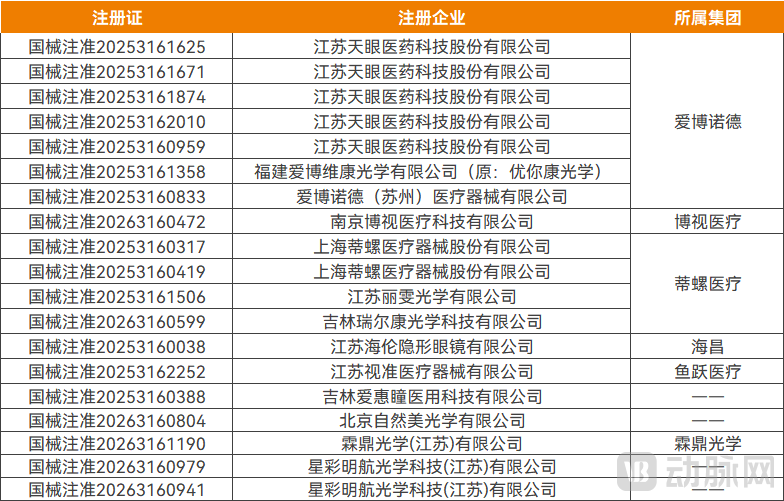 Domestically Produced Silicone Hydrogel Contact Lenses Approved Since 2025, Source: National Medical Products Administration, Public Corporate Information
As a result, the approval process for silicone hydrogel contact lens products has also entered a fast track. In 2025 alone, 19 new products have been approved, bringing the total number of registered domestic silicone hydrogel contact lenses to over 40. As Chinese companies break through product performance bottlenecks, they are expected to provide more high-quality options to the market in the future, thereby promoting an increase in the penetration rate of silicone hydrogel lenses.
Obtaining the medical device registration certificate marked the starting point for the domestic production of silicone hydrogel contact lenses in China. Next, mass production presents a more complex challenge. Taking OSigen as an example, the company obtained the registration certificate for silicone hydrogel contact lenses as early as 2019, but the product was delayed in officially entering the market. The key obstacle was the bottleneck in mass production caused by equipment shortages (compounded by factors from the three-year special period).
In the laboratory, R&D personnel can fine-tune processes on a lens-by-lens basis and manually screen out defective products, making it not difficult to produce samples that balance oxygen permeability, hydration, and softness. However, once scaled up to the mass-production threshold of 50,000 lenses per day, achieving stable output of qualified lenses becomes fraught with challenges.
Xu Mengchen introduced that the mainstream production method for silicone hydrogel lenses is compression molding. The entire process involves several core steps: injection and mold closing, where the prepared monomer mixture is precisely injected into the mold and the mold is closed; polymerization and cross-linking, where photopolymerization or thermal curing processes initiate the monomer polymerization reaction to form a silicone hydrogel polymer with a specific structure; demolding and lens removal, which can be performed using either dry or wet methods depending on the material system and process characteristics, with the wet method imposing higher requirements on production efficiency and process control; and hydration and extraction, where the lenses typically undergo multiple processing stages to remove residual substances from production while completing hydration to achieve the designed water content, thereby ensuring product safety, stability, and wearing comfort.
Compared to traditional hydrogel lenses, silicone hydrogel lenses impose higher requirements on manufacturing processes and production control standards. Due to the more complex material system, precise control is required throughout the entire process—from polymerization and molding to demolding and post-processing. Even slight fluctuations in any process parameters can affect the dimensional accuracy, surface quality, and final performance of the lenses, thereby impacting mass production yield rates.
Furthermore, there is no standardized manufacturing process for silicone hydrogel lenses that can be directly replicated. Material formulations, polymerization systems, and process routes vary across different companies; therefore, production equipment, process parameters, and automation control solutions often require customized development, followed by long-term process validation and continuous optimization. "This also makes the industrialization of silicone hydrogel lenses not only a competition in material R&D capabilities, but also a comprehensive reflection of capabilities in process development, equipment manufacturing, and large-scale production."
In short, stable manufacturing processes require dedicated, high-quality equipment and efficient production lines; the lack of supporting equipment has been the root cause of previous mass-production shortcomings. In recent years, this situation has begun to improve thanks to the concerted efforts of all parties across the industrial chain.
Zhang Aijun recalled that the company had previously purchased molds from South Korea and Taiwan, China, but compatibility issues resulted in severe lens burrs and extremely low yield rates. To bridge the gap in production line construction, OSigen collaborated with a team of overseas-returnee PhDs and domestic equipment manufacturers to tackle key technical challenges. After eight generations of iterations, they finally developed production equipment benchmarking against top-tier international manufacturers in 2025, increasing the yield rate from an initial 20% to over 80%. "All told, it took nearly six years from obtaining certification to preparing for mass production. By the end of 2026, our daily production capacity is expected to reach 50,000 to 80,000 units, and we are currently in negotiations with several well-known brands."
Xu Mengchen expressed deep reflections on the changes in the equipment supply chain: "Over the past three years, with the gradual maturation of ultra-precision machining technologies in Suzhou and Shanghai, domestically produced high-precision mold bases specifically for contact lenses have been able to meet customized demands, significantly reducing reliance on imports; meanwhile, domestic automated production equipment has undergone rapid iterative upgrades, with some high-quality non-standard automation equipment manufacturers gradually acquiring the capability for custom development of silicone hydrogel lens production lines."
Amid this trend, domestic contact lens companies are accelerating the construction of their own production lines. Robotrak's dedicated mass-production facility for silicone hydrogel soft contact lenses in Jiangning, Nanjing, features fully automated production lines tailored to its proprietary long-silicone-chain formula, with stable large-scale production expected by the end of 2026. Dearer Group is also expanding its product portfolio into silicone hydrogel lenses through its subsidiary Jilin Ruierkang factory. Iris Science has established an intelligent manufacturing system, bringing its craftsmanship and quality control on par with international standards.
Notably, compared to standard clear silicone hydrogel lenses, the mass production of colored silicone hydrogel contact lenses presents even greater challenges. Incompatibility between silicone-based materials and commonly used inks can lead to colorant molecules disrupting the hydrophilic molecular structure on the lens surface, resulting in reduced oxygen permeability and dryness during wear. Additionally, weak ink adhesion poses a risk of color fading.
To address this pain point, OSigen optimized the base material formulation, ensuring that the finished colored lenses do not fade after 100 cotton swab rubs, thereby balancing color vibrancy with performance. Dearer Group developed a proprietary inner-surface coating patent technology that encapsulates the pigment layer within the lens sandwich, achieving physical isolation of the colorants from the eyeball.
Overall, the domestic silicone hydrogel industry chain is progressing in a coordinated manner.
"The industrial chain is closely interlinked; materials, formulations, and precision manufacturing are all indispensable. To date, it has taken us 20 years to achieve breakthroughs across the entire industry chain," remarked Zhang Aijun.
The domestic silicone hydrogel contact lens sector is developing a clear pattern of industrial chain division.
In recent years, the domestic contact lens market in China has seen a proliferation of brands. Established manufacturers such as Haichang and Weicon coexist with emerging consumer brands like Kilala, LaPeche, and moody. However, at present, most silicone hydrogel lenses sold by these brands are still manufactured by overseas contract manufacturers. As mainland China achieves breakthroughs in materials and production technologies, the diverse array of brands will form closer synergies with these advancements.
Xu Mengchen believes that in the coming years, as domestic silicone hydrogel technology continues to mature, more independently developed silicone hydrogel soft contact lens products will enter the market, ushering the industry into a new stage of development. However, from an overall industrial perspective, China's silicone hydrogel supply chain is still undergoing continuous improvement. Clear professional specialization will persist over the long term across material R&D, mass production processes, and market promotion. Upstream companies will focus on core areas such as R&D and innovation in materials and products, process iteration, production line construction, and regulatory registration and filing, characterized by heavy investment and high technical barriers. Brand owners, on the other hand, will prioritize channel development and operations, user market education, agile alignment with end-market demands, and expansion of product application scenarios. Only a few enterprises may possess the capability to integrate both upstream and downstream operations. At the current stage, the ODM/OEM model, which leverages specialized expertise and facilitates professional division of labor and collaboration, is more conducive to enhancing the overall efficiency of the industrial chain. "With the maturation of supporting infrastructure, technological breakthroughs, and market expansion, integrated vertical integration across the entire industry chain will be a long-term trend in industry development. In China, there is potential for a cohort of comprehensive leading enterprises to emerge, integrating independent material R&D, autonomous production, and proprietary brand operations."
Zhang Aijun stated that contact lenses are mass-market consumer products with a slow iteration cycle. Silicone hydrogels have been marketed overseas since the early 21st century, and no other new materials can replace them so far. The product life cycle is expected to last at least another two to three decades. Going forward, capital will become a significant force shaping the industry's trajectory. "Overseas giants operate hundreds of production lines with substantial capacity, whereas domestic companies have experienced slower growth due to technological constraints. With capital support, OSigen's end-to-end proprietary technology will accelerate the scaled production of silicone hydrogel contact lenses and hasten their replacement of traditional hydrogel lenses."
Notably, silicone hydrogel materials boast broader application prospects in both consumer and medical sectors. They have also been included in the "Open Competition" list for innovative tasks regarding biomedical materials, jointly launched by the MIIT and the NMPA. On the consumer side, silicone hydrogels can be utilized to develop functional lenses for astigmatism, presbyopia, and myopia control, thereby enhancing wearing health for specific populations while providing correction. On the medical side, they can be fabricated into ophthalmic bandage contact lenses for postoperative recovery or serve as drug carriers for drug delivery applications.
Once upstream R&D and mass production achieve comprehensive independent breakthroughs, domestic enterprises can leverage core silicone hydrogel technology to unlock additional growth in niche market segments. In the vast eye health market, domestically produced silicone hydrogels have only just taken their first step, with ample room for future growth yet to be unleashed.