CoreMed's Fully Magnetically Levitated Biventricular Artificial Heart DuoCor 2 Cleared for Clinical Trials, Entering the 'No-Man’s Land' of Global Heart Failure Treatment

Core Medical
Artificial Heart Series Product Developer

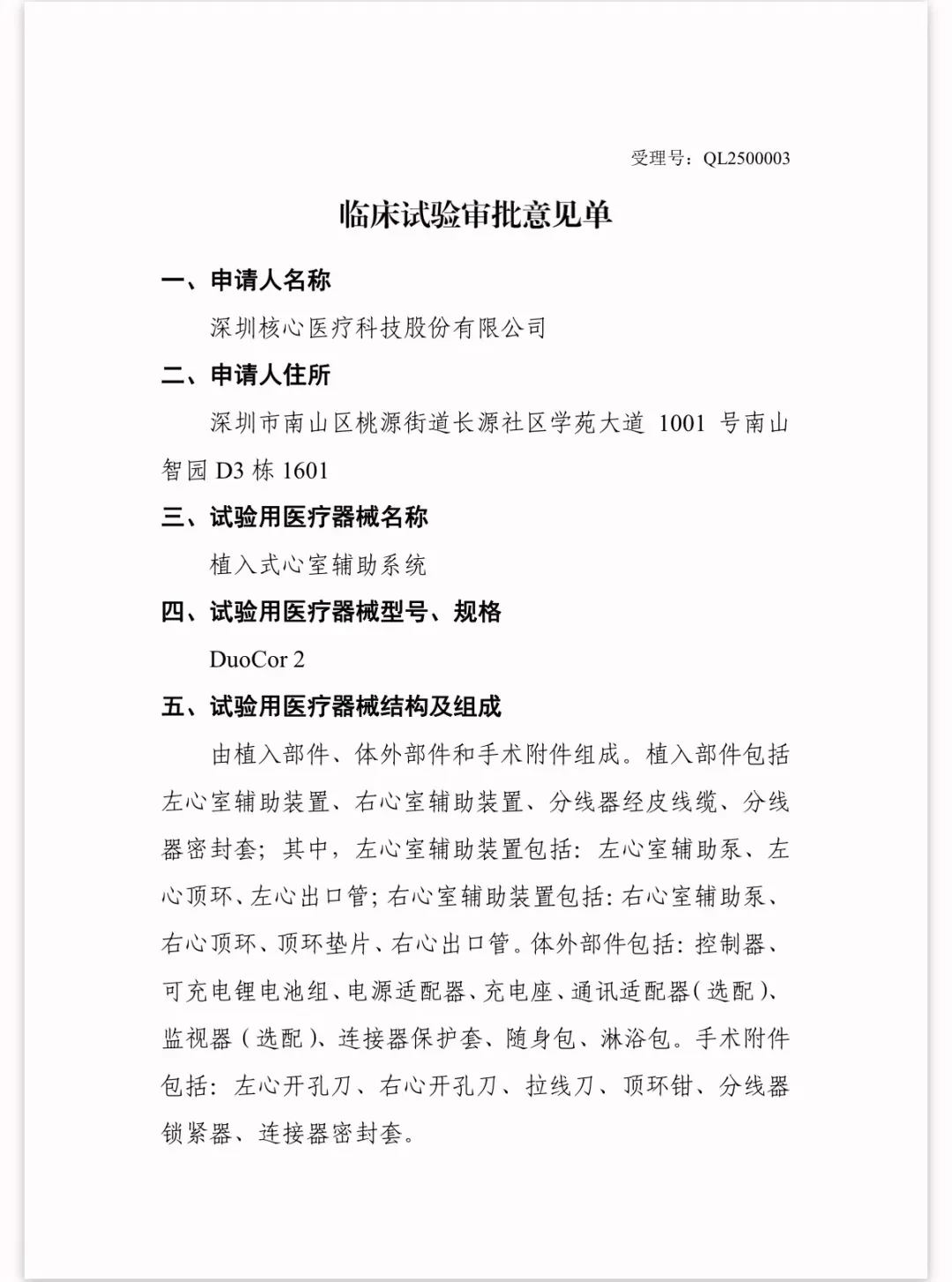
Recently,Center for Medical Device Evaluation, National Medical Products Administration"Implantable Ventricular Assist System ("QL2500003) Clinical Laboratory Test Approval Opinion Form》, byShenzhen Core Medical Technology Co., Ltd.(abbreviated as "Core Medical")Self-developed"Implantable Ventricular Assist System(ModelDuoCor 2)”Officially approved to conduct clinical trials.This meansChina's First Implantable Biventricular Assist SystemOfficially EnterClinicalValidation Phase,What warrants deeper investigation is:In the field of artificial hearts, which has been developing for decades, why is there still no product globally thatAllMagnetic Levitation Dual-Ventricular AssistSystemApproved for Market Launch? Core MedicalThe Pioneering Path of International Firsts, after allWhat is the level of prestige??
The artificial heart industry has focused almost exclusively on left-sided heart failure over the past few decades.,Left Ventricular Assist Device (LVAD)Therefore,To become the mainstream approach for mechanical circulatory support in end-stage heart failure.
However, end-stage heart failure is not limited to left-sided heart failure.Heart FailureBy Site of OnsetCan be divided intoLeft Heart Failure, Right Heart Failure, and Global Heart Failure,ExistsVast and Unmet Clinical Needs。According to Frost & Sullivan data,2024# Global Annual End-Stage Heart Failure Patients Approximately605.910,000 people, China exceeds15010,000 people4Annual Survival Rate Approximately10%。ThisPatientPopulationSignificant Internal Fragmentation:An epidemiological survey on end-stage heart failure revealed that approximately32%patients with end-stage heart failure who have moderate or greater right ventricular dysfunction require biventricular circulatory support therapy or prophylaxis;Patients with Pan-Heart Failure2Annual survival rate only23%,Significantly lower than in patients with left heart failure71%of2Annual survival rate.AdditionallyAccording to the classification of patients with end-stage heart failure in China, the proportion of patients with end-stage global heart failure is approximately40%,The related clinical needs are more urgent.
YesPanheart FailureFor patients, simpleLeft Ventricular Assist Device'sSupportYuan YuanInsufficient. "Guidelines for the Diagnosis and Treatment of Heart Failure in China"2024》AlsoIt is clearly stated that biventricular assist devices should be considered for patients with combined right heart failure,ButDedicated Solutions in the True Sense Remain Absent to Date。
It is not entirely hopeless in clinical practice. Currently, a common workaround is to use two independent sets ofLVADCombined Use——One set is rerouted to the right heart.However, the problem alsoIn Plain Sight: Patients are required to bring2Percutaneous lead,2a controller, usually4bulky battery, numerous components, high risk of failure and infection, and extremely poor portability;Based on the complex physiological structure of the right heart and high hemocompatibility requirements, blood compatibility and hemodynamic management in right ventricular assist scenarios also faceLargerChallenge,RelatedClinical data showIn current treatment regimensIncidence of Pump ThrombosisHighDa36%-37%,There is an urgent need for better treatment options.
Currently,Globally, there are no approved products on the marketAllMagnetic Levitation Dual-Ventricular AssistSystem, only implantable left ventricular assist devices are available in the marketSystemApproved for market launch; currently, there are no effective ventricular assist devices specifically targeting end-stage right heart failure and biventricular heart failure.SystemApproved for market launch.ThisIBehind the blank lies the long-standing technical barrier that dual-ventricular assist devices have struggled to overcome.
UnderstandingDuoCor 2To understand the innovative value, it is first necessary to clarify why biventricular assist devices are challenging.——ThisalsoYes"Global No-Man's Land"Causes。
One of the challenges isBoth Sides of the HeartFundamentally asymmetrical physiologically.The left heart is responsible for systemic circulation, requiring it to overcome approximately120mmHgArterial pressure; the right heart is responsible for pulmonary circulation, with a pressure of only about25mmHg, but the flow must precisely match that of the left heart.ImplantableDesign of the Bi-Ventricular Artificial HeartMust meet"Must simultaneously accommodate the physiological differences between the systemic and pulmonary circulations (e.g., pressure, flow, compliance)"This core requirement, once the flow rates of the left and right pumps become unbalanced, it may cause mild impairment of pulmonary and renal functions, or in severe cases, lead to circulatory failure, device malfunction, or multiple organ failure.——This imposes far more stringent accuracy requirements on the control algorithm than a single-heart system.
The second challenge,YesRight Heart Itselfof“Harsh” Environment。The right heart wall is thin and has weak contractility. Its physiological and anatomical structure is more constrained than that of the left heart, imposing stricter requirements on pump volume and weight. The right heart operates in a venous blood environment characterized by slow blood flow, predisposition to stasis, and high risk of thrombosis, thus demanding higher hemocompatibility.Ultimate. This determines the existingofLVADDifficult to truly adapt to the right heart; it must be redesigned according to the physiological characteristics of the right heart.
The third challenge is the triangular constraint of volume, power consumption, and reliability.ImplantationStyleA biventricular artificial heart necessitates housing two pump units simultaneously within the human thoracic cavity, where space is extremely limited. The power consumption required to drive both pumps is significantly higher than that for a single pump, which demands that the biventricular artificial heart achieve sufficient flow output while maintaining ultra-low power consumption.thereby ensuring excellent blood compatibility and achieving long-term efficacy and reliability,Moreover, the extracorporeal device must be sufficiently lightweight,TalentEnable patients toWith Greater Comfort"Living with a Pump"。
These threefold constraints, when superimposed, constitute the fundamental reason why biventricular assist devices have long remained confined to the laboratory, and represent the core technical challenges that Core Medical is systematically overcoming.
Core Medical's starting point for solving the above-mentioned problems is itsApprovedListing、Fully Clinically ValidatedofCore Technology ProductsCorheart 6,This system adopts a highly innovative axial full magnetic levitation motor structure and an internationally original"Time-Segmented, Zone-Based Dynamic Axial Fully Magnetically Levitated Control Technology"。
The core breakthrough of this technology lies in the fact that traditional magnetically levitated artificial hearts rely on multiple sets of coils to separately achieve suspension and rotation, resulting in a complex structure.、Large Volume, high power consumption; Core Medical innovativelyUsing Only One Set of CoilsSimultaneously achieving impeller rotation drive and levitation control significantly simplifies the motor structure, enabling synergistic optimization of size, power consumption, and blood compatibility.
This technology has beenCorheart 6Completed aboveClinical andCommercializationMultipleVerification.
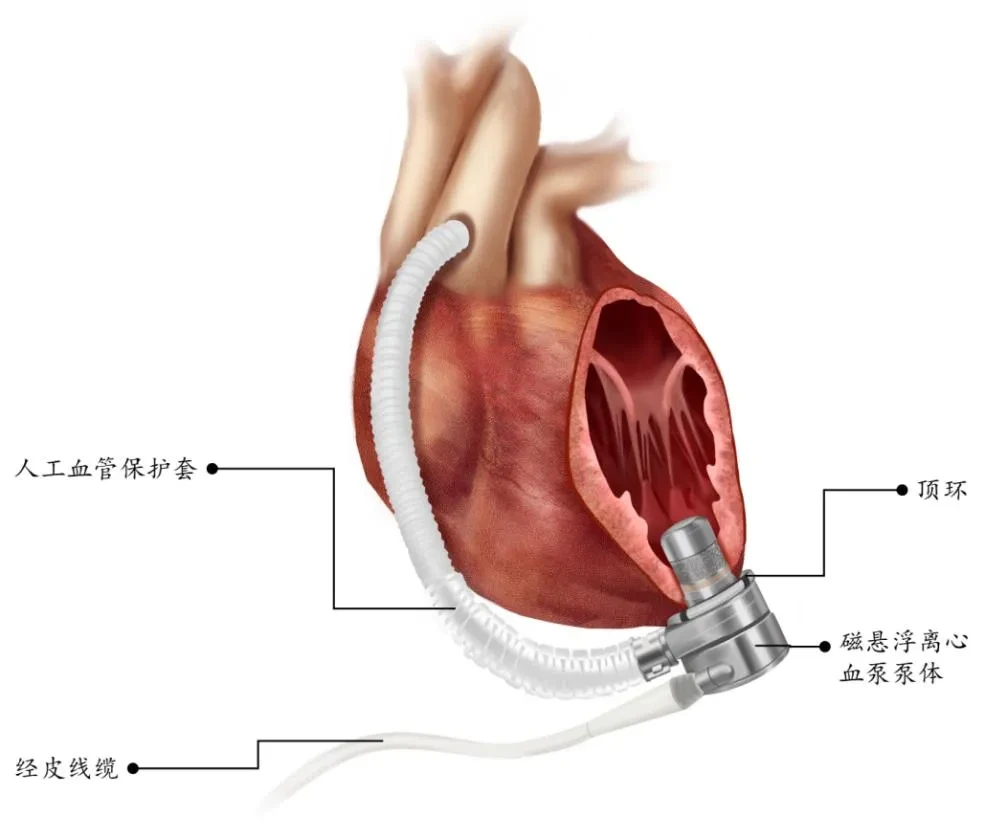
Corheart 6 Implantable Left Ventricular Assist System - Schematic Diagram of Implant Components
Corheart 6at2023Approved for marketing in [year],It is currently the smallest in volume and lightest in weight among commercially available products worldwide.FullMagnetic Levitation Implantable Artificial Heart, with a diameter reduced by approximately compared to international competitors30%, weight loss exceeding50%. In terms of terminal implantation volume,Corheart 6In2024Annual domestic market share exceeds45%,2025Year1-5MonthDomestic market share exceeds52%。As of the date of signing the prospectus, a cumulative total of over1300Example of clinical application,2025Annual Operating Revenue1.64100 million yuan.
Regarding clinical data,Corheart 6Registration of Long-Term Follow-Up Extension Study for Clinical Trials2Annual results have been published inEuropean Journal of Cardio-Thoracic Surgery:Post-Implantation2Annual Survival Rate86%,2during the annual follow-up period,Corheart 6No pump thrombosis, hemolysis, or device failure events occurred。This long-term follow-up study, based on a prospective registered clinical cohort, represents the first global long-term study of artificial hearts in the Chinese population. The registered clinical cohort is regarded as the evaluation of medical devices'"Gold Standard": This study ensured the authenticity, integrity, and traceability of data through unified screening criteria, independent monitoring, and standardized management across the entire process.
Thismeans,DuoCor 2It is not about building a dual-heart system from scratch,but rather after being validated by Core MedicalPassBased on the miniaturized, low-power, fully magnetically levitated artificial heart technology, continue to address the unique challenges of biventricular assistance。
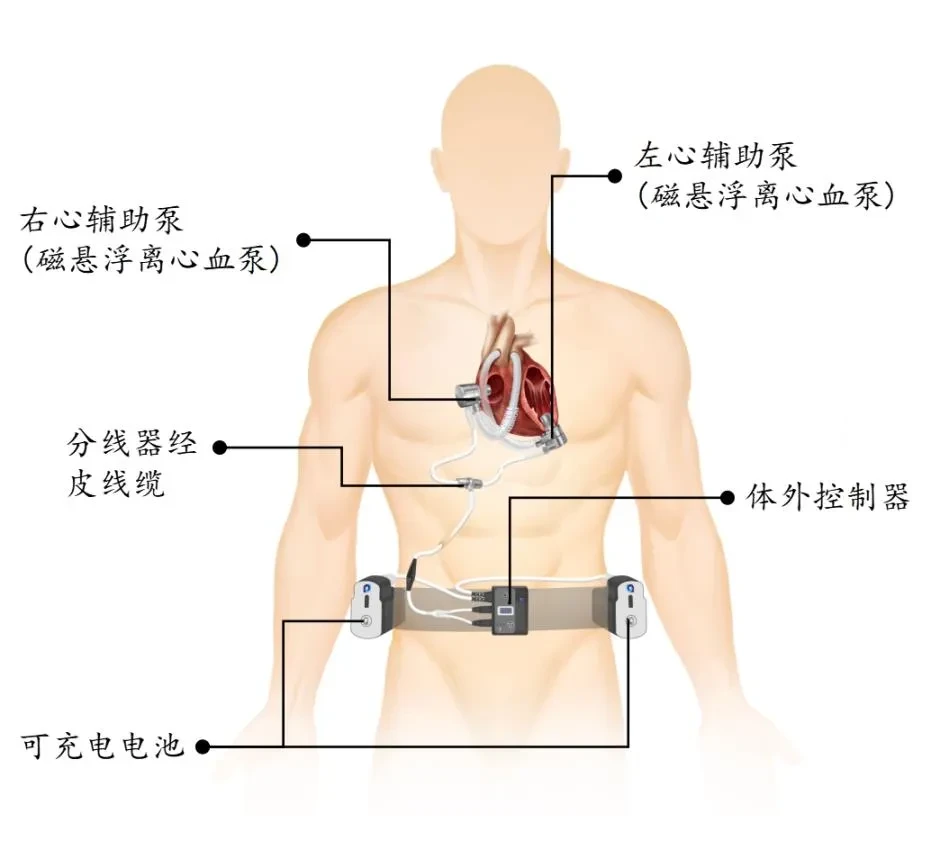
Schematic Diagram of the Main Components of the DuoCor 2 Implantable Biventricular Assist System
Underpinning this expansion is Core Medical’s years of accumulatedSolidR&DBase:RelatedData shows that,2023To2025YearCompanyCumulative R&D Investment4.73100 million yuan,As of2025Year-end, Total Authorized Patents Obtained in China253items, including domestically authorized invention patents115Item, under its banner4All of our core products have been included in the National Special Review Procedure for Innovative Medical Devices.
DuoCor 2technical design, which precisely addresses the aforementioned three major challenges.
For"Physiological Asymmetry Between the Left and Right Heart, Difficulty in Coordinated ControlPoint": Proprietary dual-pump intelligent collaborative control system.DuoCor 2Adopting an original dual-pump integrated and intelligent design, uniformly coordinated and managed by a single external controller, to achieve left and right pump flow ratesPrecision Monitoring andDynamic adjustment to maintain left and right heart functionFlow Ratebalance, thereby reducing the risk of adverse events caused by imbalance between systemic and pulmonary circulation——This fundamentally resolves the dualLVADTwo Independent Controllers in the Splicing SolutionofCollaboration Challenges.
For"Right HeartComplexPhysiologyStructure and High Hemocompatibility": Global original magnetic levitation right heart pump design.The prospectus disclosed,The company has implemented a specialized innovative structural design for the right heart, reducing the weight of the right pump to68g(Left pump73g), fully aligning with the physiological and hemodynamic characteristics of the right heart; in conjunction with intelligent control technology, it enables precise regulation of right heart flow, reduces the risk of pump thrombosis, and enhances blood compatibility. This targeted design is precisely what addresses the limitations of existing solutionsHigh riskThe Key to Thrombus Issues in the Right Heart Pump.
For"DoublePumpFacingVolume、Power Consumptionand Reliability Challenges": Integrated, lightweight system.The entire system uses only1An external controller,1a percutaneous cable, replacing the dualLVADRequired for splicing2root cable,2a controller,4Battery module, effectively reducing the risk of component failure and infection, enhancing system reliability and long-term operational stability; The miniaturized biventricular design also reduces the requirements for patient body surface area and thoracic volume, thereby broadening the eligible patient population.
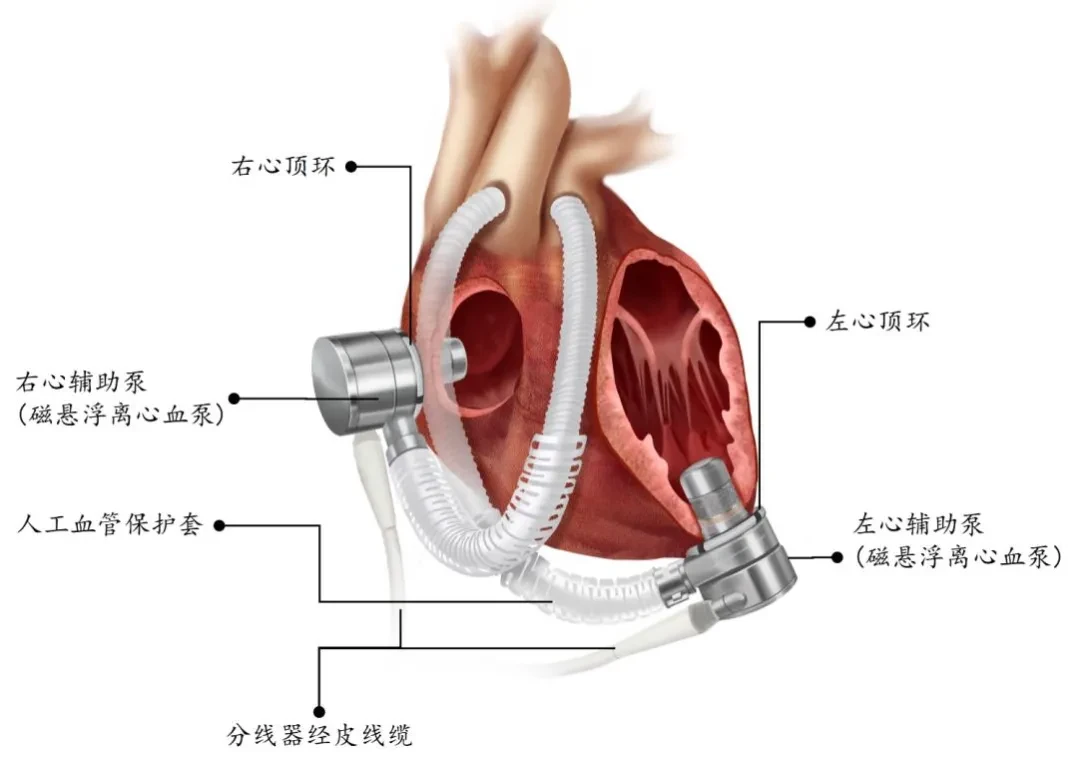
DuoCor 2 Implantable Biventricular Assist System - Schematic Diagram of Implanted Components
From the perspective of product design logic,DuoCor 2Several Key Aspects in the Treatment of Patients with Heart Failure Attempting to ChangePain Points,Delivering superior solutions.
In terms of infection risk,From2The root cable is reduced to1Root, meaning reduced skin wounds and smaller exposed cable areas, directly lowering the risk of percutaneous cable infection after artificial heart surgery.ImportantIncidence of Complications.
In terms of hemocompatibility,The right heart’s specialized design optimizes the flow path to address the characteristics of slow venous blood flow and susceptibility to stasis, working in conjunction with intelligent control to achieve superior flushing efficacy.Reduce the risk of pump thrombosis and improve hemocompatibility。
In terms of system reliability,Integrated control replaces the combination of dual systems,Helps toEnhance Long-Term Product Stability。
In terms of patient quality of life,Integrated, lightweight extracorporeal components can reduce the burden of long-term device carriage, providing better...Convenient。
These changes, in comparison with patients with pan-cardiac failure2Annual survival rate is only23%the current status, as well as the specific issues exposed in clinical practice by existing solutionsPain Points, constitutesDuoCor 2SignificantClinical BenefitofFoundation.
In terms of the pace of advancement,DuoCor 2Yu2024Year11entered the Special Review Procedure for Innovative Medical Devices in China; the recent domestic approval for clinical trials marks its entry into the clinical evaluation phase;In terms of the international market,DuoCor 2 Clinical Trials Launched in Europe。Relevant information shows that,2025In the autumn of that year, the Leipzig Heart Center in Germany treated a67-year-old patient with end-stage heart failure completedDuoCor 2implantation surgery. As the patient was not a candidate for heart transplantation due to their physical condition, this device served as their last therapeutic option. The patient has recovered and been discharged postoperatively, marking the third such procedure in Europe.。The product is expected to become the first approved implantable biventricular assist system globally, offering a significant first-mover advantage.
Conclusion
From an industry perspective, past breakthroughs in domestically produced artificial hearts primarily addressed the transition of left ventricular assist devices (LVADs) from non-existence to availability, and from regulatory approval to clinical application. In contrast, biventricular support involves managing more complex patient cases, more challenging hemodynamic parameters, and stricter requirements for long-term implantation reliability.,propelling the research and development and application of domestically produced artificial heart technology into a new phase。DuoCor 2the emergence of,resulting inThe applicability of artificial hearts will no longer be limited to left heart failure, but will further extend to total heart failure, a condition that has long lacked effective product coverage.Massive Population。
For patients with end-stage biventricular heart failure, this clinicalQuasi, meaningA regimen truly designed at the system level for biventricular heart failure is transitioning from the laboratory to clinical validation.Global Biventricular Assist Devices"No Man's Land"Whether this gap can be filled depends on subsequent clinical data. At the very least, this long-standing unresolvedWorldwideA Challenging Problem, Now with a Systematic Approach to Solutions,Seized the opportunity to break the deadlock.