NeuroXess Secures Approval for Pivotal Clinical Trial of 'SanQuan' Brain-Computer Interface; Domestic Surgical Robots Achieve Over 90% Localization and Deployed in 1,000+ Hospitals

NeuroXess
Invasive Brain-Computer Interface Developer

Wuzhou Medical
Developer of Exhalation Diagnostic Equipment
'%20fill='%23FFFFFF'%3E%3Crect%20x='249'%20y='126'%20width='1'%20height='1'%3E%3C/rect%3E%3C/g%3E%3C/g%3E%3C/svg%3E)
Comprehensive Medical News
1. NeuroXess's Sanquan Brain-Computer Interface Approved to Enter Class III Medical Device Registration Clinical Trials
NeuroXess’s Self-Developed “Three-Complete” Brain-Computer Interface System Officially Launches GCP Registration Clinical Trials at Huashan Hospital Affiliated to Fudan UniversityRecently, the “Three-Complete” brain-computer interface (BCI) system, independently developed by NeuroXess, officially launched its Good Clinical Practice (GCP) registration clinical trials at Huashan Hospital Affiliated to Fudan University. Led by Professor Mao Ying’s team at Huashan Hospital, the multi-center study involves 15 top-tier (Grade 3A) hospitals across China, with data directly supporting the Class III medical device registration application to the National Medical Products Administration (NMPA). The NMPA has issued guidelines specifying that invasive BCI products are uniformly regulated as Class III medical devices. The product adopts a subdural implantation approach, where flexible electrodes are affixed to the surface of the cerebral cortex without penetrating brain tissue. It features a full-link latency of less than 50 milliseconds and achieves a brain-controlled cursor decoding performance of 5.2 bits per second (BPS). Its split-design places heat-generating components, such as the battery and wireless charging module, in the subcutaneous tissue of the chest, away from the brain. (Source: Xinmin Evening News)
2. Bioheart's Bioresorbable Coronary Stent Approved for Market Launch
Recently, the Bioheart bioresorbable sirolimus-eluting coronary stent system, independently developed by Shanghai Baixinan Biotechnology Co., Ltd., received market approval from the National Medical Products Administration (NMPA). Featuring an ultra-thin wall design with a minimum wall thickness of 90 micrometers, the significantly reduced wall thickness improves vascular hemodynamics and accelerates endothelial healing. The stent backbone is made of poly-L-lactic acid (PLLA), a bioresorbable material that gradually degrades and is absorbed within 2 to 3 years after implantation. This product addresses the industry-wide challenge of high thrombosis risk associated with earlier-generation bioresorbable stents, ushering in a new era of "intervention without implantation." (Source: Medical Device Wind Vane)
3. Wuzhou Medical’s Cross-Industry Acquisition of Chip Firm Xuanzhi Technology Triggers Trading Halt Effective Immediately
Wuzhou Medical Announces Plan to Acquire Controlling Stake in Xuanzhi Technology, a Motor Control Chip Firm Formerly Part of Fairchild Semiconductor’s US DivisionRecently, Wuzhou Medical, a manufacturer of single-use sterile infusion medical devices, announced its plan to acquire a controlling stake in Xuanzhi Technology, a motor control chip company that originated as a division of Fairchild Semiconductor in the United States. The company’s stock has been suspended from trading since July 8, with the transaction details to be disclosed within ten trading days. This cross-industry merger marks the extension of traditional medical device enterprises into the core components sector of semiconductors, reflecting an acceleration in the trend of domestic substitution in the upstream segment of the medical device industry chain. Market attention is focused on the subsequent integration plan and the synergistic effects on the intelligent upgrading of existing infusion products. (Source: Securities Times)
4. Zhejiang Medical Insurance Introduces Measures to Support the High-Quality Development of Innovative Pharmaceuticals
Recently, the Zhejiang Provincial Healthcare Security Administration issued the “Several Measures to Support the High-Quality Development of Innovative Pharmaceuticals,” outlining ten initiatives centered on a full-chain strategic deployment for the innovative drug, medical device, and biopharmaceutical industries. These measures include streamlining online listing services for pharmaceutical products, enhancing the efficiency of access to the provincial centralized pharmaceutical procurement platform for innovative drugs and medical devices, and ensuring that processing times do not exceed 10 working days. By leveraging the strategic purchasing and payment functions of healthcare security, these actions aim to promote the clinical application of innovative pharmaceutical products and drive the high-quality development of the province’s biopharmaceutical industry. (Source: Zhejiang Provincial Healthcare Security Administration)
5. Over 90% of surgical robots deployed in more than 1,000 hospitals are domestically produced in China
CCTV Finance Recently Featured the Industrialization Progress of Domestic Surgical RobotsCCTV Finance recently published a special report on the industrialization progress of domestically produced surgical robots. The localization rate of complete domestic orthopedic surgical robot systems exceeds 90%, with costs amounting to only one-third of those for imported counterparts. These systems have been deployed in over 1,000 hospitals across China and have cumulatively served more than 10,000 patients. Meanwhile, domestically produced single-port serpentine-arm surgical robots have successfully entered public hospitals in Germany and Spain to perform clinical surgeries. The global cumulative number of clinical cases involving Jingfeng Medical’s surgical robots has exceeded 20,000. China’s surgical robot industry is transitioning from technological self-reliance to large-scale clinical application and is now competing in the international market. (Source: CCTV Finance)
6. Johnson & Johnson Medical Signs Agreement with Beijing Anzhen Hospital to Advance Industry-Hospital Collaboration in Cardiovascular Care
Johnson & Johnson MedTech and Beijing Anzhen Hospital, Capital Medical University, Officially Sign Strategic Cooperation AgreementRecently, Johnson & Johnson MedTech and Beijing Anzhen Hospital, Capital Medical University, formally signed a strategic cooperation agreement. As one of the implemented projects under Beijing’s 2026 “Pairing Project” linking renowned enterprises with prestigious hospitals, both parties will deepen collaboration in four key areas: tackling high-level clinical research challenges, promoting the standardized development of new technologies and establishing clinical training systems, facilitating industry standards and academic exchanges, and accelerating the market access and standardized clinical application of new technologies. This signing aims to foster medical-enterprise collaborative innovation in the cardiovascular field, accelerate the clinical translation of cutting-edge technologies, and enhance the intraoperative application level of Chinese-made high-end medical devices. (Source: Xinhua News Agency)
7. R&D Design Services Accelerate the Clinical Translation of Medical Research Achievements
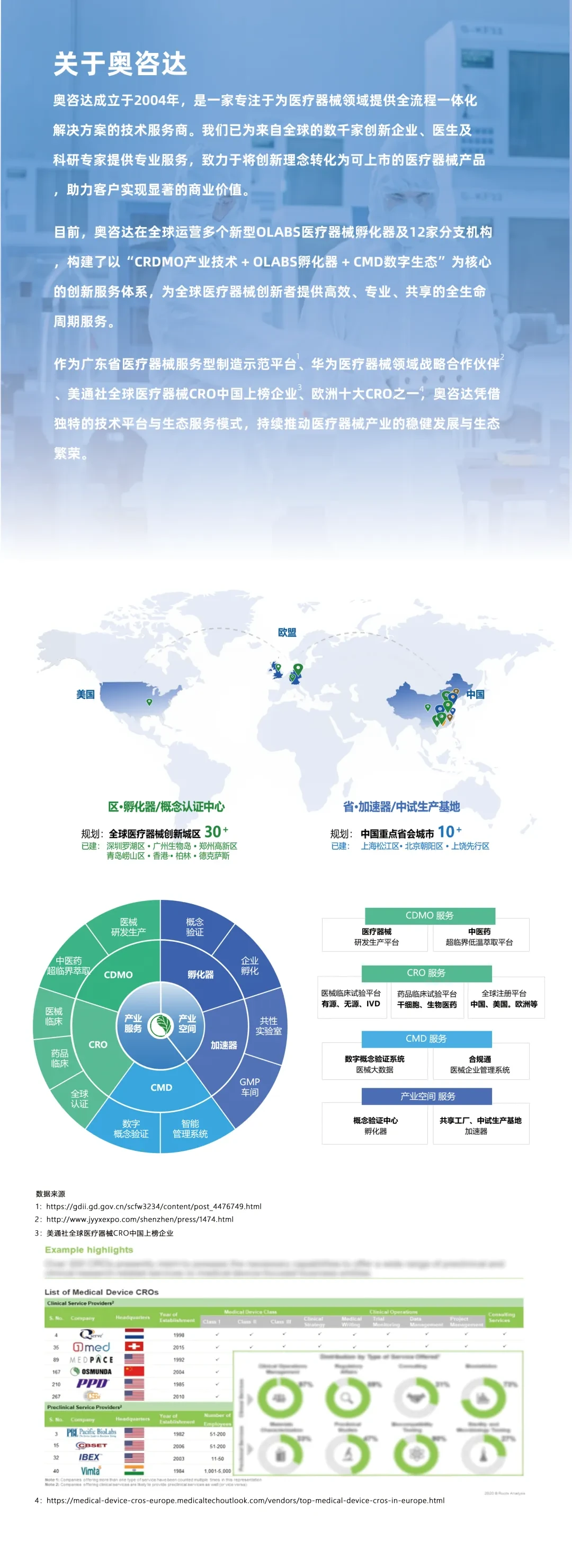
Medical device R&D is a complex and rigorous process involving multiple aspects, including technology, regulations, and clinical applications. Osida boasts a 20,000-square-meter science and technology innovation center and has established a Medical Device Research Institute dedicated to the clinical translation of medical research achievements. It possesses a high-level, international, multidisciplinary team proficient in the entire lifecycle of R&D, regulatory affairs, clinical trials, registration, and manufacturing, capable of developing and producing various complex and innovative products. With extensive project experience and industry resources, Osida has built a standardized, regulated, and digitalized full-process service system. It provides one-stop services ranging from preliminary market research, product concept generation, and product design and development to prototype production and testing. To date, more than 200 projects have entered the review stage at Osida, with over 100 projects under development, maintaining a consistently high success rate in translation. (Compiled by Osida)
8. GuanJun ZhiChuang Completes Multi-Million-Dollar Angel Round to Deploy Medical-Grade Flexible Sensing
Soft Sense (Xiamen Guanjun Zhichuang Technology Co., Ltd.), a developer of medical-grade flexible sensing platforms, has recently completed an angel funding round worth several million US dollars. Centered on its proprietary machine-washable flexible sensing technology, the company has built a medical-grade wearable platform encompassing hardware, algorithms, and data services, with a strategic focus on four key application areas: cardiovascular monitoring, elderly care, neuromuscular rehabilitation, and sports health. Its products integrate sensors into clothing via a thermal bonding process, maintaining signal attenuation within 5% after 100 standard machine wash cycles. Preliminary product validation has already been conducted at multiple Grade A tertiary hospitals in China. (Source: Arterial Network)