Xinkainuo Medical's SkyPort®: China's First Domestic Self-Expanding, Anti-Thrombotic Coated Intracranial Stent Gains Market Approval

Skynor Medical
Vascular Minimally Invasive Intervention Product Developer
Source: Medical Device Business Review
Author: Lin Xi

China's First!
New Intracranial Stent Approved for Market Launch
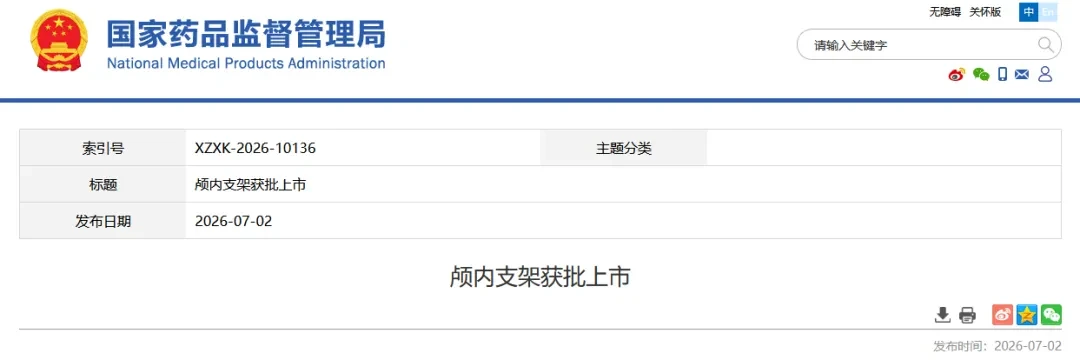
On July 2, 2026, the National Medical Products Administration officially approvedSkynor Medical (Shanghai) Co., Ltd. "Intracranial Stent" (Tianxing SkyPort®)the registration application for its innovative product. The approval and market launch of this product mark a new breakthrough in China’s neurointerventional medical device sector, providing patients with intracranial aneurysms with more precise and safer treatment options.
Intracranial stents are not new.Johnson & Johnson Cordis、StrykerWhile multiple products from foreign brands have long been deeply established in the Chinese market, domesticSino Medical、MicroPort NeuroTechBalloon-expandable intracranial stents have also been approved. However, all products currently marketed in China are balloon-expandable, which have certain limitations in their applicable scenarios. In contrast, self-expanding intracranial stents, made of nitinol alloy, offer better conformability, retrievability during deployment, a smaller delivery outer diameter, lower risk of intraoperative vascular injury, and more stable long-term apposition to the vessel wall, making them suitable for various complex intracranial aneurysms.
As of May 31, 2026, no domestically produced self-expanding intracranial stents have been approved in China.The launch of SkyPort®, the first self-expanding intracranial stent in China equipped with an antithrombotic coating, fills this market gap.。
Skynor's "Intracranial Stent" System consists of two components: the stent and the delivery system.TargetedEmbolization devices used in conjunction for the treatment of wide-necked saccular aneurysms in the intracranial anterior circulation, enhancing the success rate and long-term stability of aneurysm embolization therapy through auxiliary support.
Compared with self-expanding stents, balloon-expandable stents provide stronger radial support for stenotic lesions in clinical applications. Particularly in the tortuous intracranial vasculature, the advantages of self-expanding stents in terms of flexibility and wall apposition are more prominent.Skynor Medical’s “intracranial stent” features a spiral closed-cell mesh design, offering exceptional flexibility to conform seamlessly to the natural course of tortuous vessels while maintaining excellent wall apposition at bends.。
SkyPort® is indicated for intracranial anterior circulation saccular wide-neck aneurysms (neck width ≥4 mm or dome-to-neck ratio <2). When used in conjunction with embolization devices, it provides mechanical support to the aneurysm neck during coil embolization, preventing coil herniation into the parent artery. ThroughThree Proprietary Structural Designs: Spiral Closed-Cell Mesh, Closed-Loop Body, and Full-Length Radiopacity, establishing technical differentiation by addressing three core clinical pain points: prevention of device migration, long-term vascular apposition, and precise intraoperative manipulation. It is specifically tailored to the complex anatomical scenarios of wide-necked aneurysms in the anterior circulation of the intracranial arteries in the Chinese population, representing a core competitive advantage that distinguishes it from similar auxiliary stents domestically and internationally.
Currently, Skynor Medical’s “intracranial stent” has passed clinical trials, verifying the product’s excellent characteristics.
In multicenter clinical trials,SkyPort Intracranial StentClinical implantation achieves excellent vessel wall apposition while supporting intraoperative stent repositioning and retrieval., significantly reducing the operational difficulty of stent deployment in tortuous intracranial vessels, with higher positioning accuracy and reduced risk of intraoperative complications.
As the 19th Class III innovative medical device approved for market launch in Shanghai in 2026, Skynor’s intracranial stent addresses the clinical pain points of traditional stents, namely poor navigability in tortuous intracranial vessels and inaccurate positioning, thereby enriching the product portfolio of high-end neurointerventional devices in China.
From the perspective of the market environment, the domestic market for endovascular treatment of intracranial aneurysms has long been dominated by imported products, with a relative scarcity of domestically produced alternatives.With the promotion of clinical application of this product, it is expected to bring benefits to more patients suffering from intracranial anterior circulation saccular wide-neck aneurysms, and enhance the overall level of minimally invasive treatment for cerebrovascular diseases in China.。

Full-chain Layout,
Skynor Medical Fills Multiple Gaps in Domestically Produced Products!
The successful approval and subsequent clinical adoption of the SkyPort® intracranial stent are attributable to Skynor Medical’s robust R&D capabilities and strategic market positioning.
It is understood that,Skynor Medical ( Shanghai ) Co.,LtdFounded in August 2014 in the International Medical Park of Zhangjiang Science City, Pudong New Area, Shanghai, it is a high-tech enterprise dedicated to the research, development, and manufacturing of interventional devices for stroke and peripheral vascular diseases.
The company's core management and R&D team is led by the founderZhao ZhenxinUnder the leadership of a team whose members all possess over ten years of hands-on experience in R&D, quality control, production, and marketing at leading medical device companies both domestically and internationally, the company had accumulated a total of60 itemsAuthorized patents; core technologies are fully independently controlled.
From the perspective of patent layout, Skynor Medical’s recently published patents include “A Balloon Guide Catheter” and “An Intratumoral Flow Disruption Device.” The former pertains to access devices, while the latter is directly related to the intratumoral embolization sector in which Taijie Weiye’s Tulip ED® operates. This also indicatesSkynor Medical is not content with a single stent product but is building a comprehensive product portfolio spanning from access to treatment.。
In the field of neurointervention, the company has established a comprehensive product portfolio covering "ischemic, hemorrhagic, and access" solutions: in the ischemic segment, it possessesSkyFlow®/SkyFlowX® Intracranial Thrombectomy Stent、SkyDragon™ Intracranial Thrombus Aspiration Catheterand other core products; strategic layout in the distribution channelSkySurfer® Distal Access Catheter、SkyWay™ Microcatheter、SkyGuard® Balloon Guide Catheter...and the full range of neurovascular access devices; the intracranial stent approved in this instance fills a product gap in hemorrhagic indications, specifically designed for endovascular treatment of wide-necked saccular aneurysms in the anterior circulation of the brain. When used in conjunction with embolization devices, it enables safer aneurysm embolization outcomes.
In the field of peripheral interventions, the company has completed its core product portfolio covering “arterial + venous + carotid artery” segments, with products approved for market launch in 2025.SkyNova® Peripheral Vascular StentYesChina's First DomesticLong peripheral lower extremity artery stents with a zero fracture rate in clinical trials, breaking the long-term monopoly of imported products, combined withHydrus® Series Peripheral Balloon Dilatation Catheter, forming a comprehensive portfolio of peripheral vascular therapy products.
Currently, the company has officially launched six products, with its business covering 29 provincial-level administrative regions in China. Meanwhile, multiple products have obtained EU CE certification and are exported to many countries overseas.。
Leveraging its robust R&D capabilities and product portfolio, Skynor Medical has also garnered significant recognition in the capital market. In 2022, Skynor MedicalCompleted hundreds of millions in Series C financing, with the funds raised specifically allocated to expanding domestic and international markets, as well as advancing the research, development, and commercialization of new products in neurovascular and peripheral interventions. The substantial capital continues to empower commercial implementation and channel expansion. Building on the solidified market foundation established through this round of financing, the company has now set upA mature sales network covering 29 provincial-level administrative regions in China and reaching over 600 hospitals, with multiple products having obtained EU CE certification and being sold to many countries overseas.。
The newly approved SkyPort® domestically manufactured self-expanding intracranial stent can rapidly penetrate clinical endpoints, forming product synergy with existing intracranial thrombectomy and access devices, providing clinicians with a one-stop interventional solution for intracranial vascular diseases.

The Second Half of Neurointerventional Therapy,
How Can Domestic Medical Device Companies Achieve Successful Commercialization?
Currently, the domestic neurointerventional sector has entered the second half of its development phase, with the industry reaching overall maturity and the substitution of domestic products for imports fully advancing into a critical stage.
In 2025, the overall market size of intracranial stents in China was approximatelyRMB 2.3–3 billion, expected to expand to in 20262.7–3.75 billion yuan; the prevalence of unruptured intracranial aneurysms in the Chinese population aged 35 to 75 years is approximately7%, total number of patientsOver 56 million, coupled with medical insurance support and the widespread adoption of minimally invasive interventional procedures, the sector has maintained long-term high prosperity.
The market structure is significantly differentiated; the ischemic disease sector is mature with rising penetration of domestically produced products, while the aneurysm stent sector for hemorrhagic conditions remains in its early growth stage.Medtronic, Stryker, Johnson & JohnsonForeign brands still maintain an advantage in the traditional installed base at top-tier Grade A tertiary hospitals.
However, as the process of domestic substitution accelerates and industry competition intensifies, Chinese manufacturers are gradually shifting from single-dimensional price competition to differentiated technological breakthroughs, with multiple stakeholders making concerted efforts to break the monopoly held by foreign companies.
Minimally Invasive NeurosciencesIndependently DevelopedTubridge Flow Diverter, iteratively launchedWorld's FirstA high-end product featuring kink resistance and dual-mode visualization, for which the first dedicated mass-production platform in China has been established. It has achieved domestic substitution of 21 core materials, breaking foreign monopolies. Related clinical studies have produced the highest level of global evidence-based medicine, increasing the six-month cure rate for large aneurysms from 24.5% to 75.3%.
Aico MedicalofLattice Flow Diverter StentAt 12 months postoperatively, the aneurysm occlusion rate reached 91.4%, and the in-stent stenosis rate was only 0.8%. Since its market launch, it has been adopted for clinical use in numerous hospitals across China, including those in remote counties and districts, significantly lowering the procedural threshold for primary-care institutions.
July 2026SkynorofIntracranial StentApproved, leveraging the design advantages of its antithrombotic coating and full radiopacity, it fills the gap in domestically produced self-expanding intracranial stents and further enhances the portfolio of Chinese neurointerventional products.
Breakthroughs in domestically developed technologies have opened the first breach in the neurointerventional track. However, the extent of this breakthrough depends on how Chinese enterprises can further advance their product portfolios, commercialization teams, and clinical promotion strategies.
As centralized procurement becomes routine, squeezing industry profit margins and eroding the price advantage of foreign companies, what path should Chinese-made neurointerventional devices take to achieve a commercial breakthrough? Currently, domestic medical device companies have already provided us with reference answers.
Leveraging Clinical Strengths for Rapid Market Penetration: Ake Medical’s Lattice flow diverter stent, with its low-threshold advantage that enables primary-care physicians to operate it independently, has rapidly expanded coverage to more than 1,000 hospitals at all levels across China, reaching remote county-level areas and breaking the limitation that imported products could only be used in top-tier tertiary Grade A hospitals.
Full Product Portfolio Synergy for Hospital Entry: Leveraging its comprehensive product portfolio of “access devices + coils + flow diverter stents,” MicroPort NeuroTech uses cost-effective access products as an entry point to facilitate the simultaneous hospital adoption of high-end intracranial stents, significantly enhancing per-hospital revenue efficiency.
Policy and Cost Advantages: The normalization of centralized procurement has forced a loosening of the pricing systems for imported products. Domestic products, leveraging lower pricing and more flexible localized services, are rapidly capturing the market in primary healthcare institutions. Meanwhile, they can expand into the global market through CE/FDA certifications, further amplifying their commercialization potential.
Technological Differentiation: Breaking Through: Changyida’s approved TaminoVIA® intracranial aneurysm-assisted embolization stent features a proprietary dual-end closed design to prevent vascular scratching,Resolved the issues of vascular injury and wall apposition.Target underserved market segments to rapidly facilitate the targeted hospital admission of specialized departments.
High Maturity of the Ischemic Intracranial Stent Stenosis Sector, the logic of domestic substitution is viable; in the short term, domestically produced products are expected to comprehensively surpass imports at the primary care level, while in the medium to long term, they are poised to achieve sustained penetration into tertiary A hospitals.Skynor, MicroPortWith the duopoly firmly established, small and medium-sized manufacturers rely on regional channels to capture incremental growth.
AndThe Stent Segment for Hemorrhagic Intracranial Aneurysms Enters a High-Growth Blue Ocean, Yet Remains in Its Early Stages; however, by leveraging clinical advantages and the normalization of centralized procurement, domestic market share is expected to increase in the niche segment of small and medium-sized aneurysms. Although foreign companies will continue to dominate the complex, high-end aneurysm field for the long term, sustained development will gradually enhance the overall capability to locally surpass imported products.