

Boling BCI Targets Millions of Stroke Patients with 87ms-Response Neurorehabilitation Devices
Cereblink
Brain-Computer Interface (BCI) Related Technology Developer
Since the beginning of this year, brain-computer interfaces have become one of the most closely watched sectors in medical technology.
On one hand, capital continues to pour in. Invasive brain-computer interfaces (BCIs) are repeatedly breaking fundraising records, with international giants and domestic startups frequently announcing breakthrough progress. On the other hand, policies continue to send positive signals, as national drug regulatory authorities begin to gradually improve the review system for BCI products, opening up the window for industrialization.
Beyond the hype, a more pressing issue has emerged for the industry:How many brain-computer interface products have truly entered hospitals and patients’ homes, continuously delivering clinical value?
Compared to the ever-breaking technical records in laboratories, this may be the true proposition that determines the future of the industry. This year, Cereblink (Hangzhou) Technology Co., Ltd. has provided its own answer.
Not long ago, the companySelf-developed "Upper Limb Active-Passive Motion Rehabilitation Training System" (Cyberlink AM5) Officially Obtains Class II Medical Device Registration Certificate, combined with the AC5 Upper Limb Motor Function Assistance and Enhancement System launched last year and the HC2 Hand Soft Exoskeleton Rehabilitation Training System newly introduced in May, Cereblink’s full product portfolio has already entered hospitals and households.
Co-founded by the listed company Innovation Medical and Professor Xu Kedi’s team from Zhejiang University, this brain-computer interface (BCI) company spent nearly five years transforming a laboratory technology into a device that enables stroke-induced hemiplegia patients to independently don it, conduct their own training, and perceive changes in their bodies.
1Targeting Millions of Families Affected by Stroke-Induced Hemiplegia
In 2021, when Cereblink was established in Hangzhou, brain-computer interfaces were not yet the "prominent field" they are today.
At that time, Elon Musk’s Neuralink had just captured global attention with a monkey that could play table tennis using “mind control.” Public imagination regarding brain-computer interfaces remained largely confined to futuristic scenarios steeped in technological allure, such as next-generation interaction, digital worlds, and human-machine integration.
However, Cereblink’s strategy from the outset eschewed these “future markets,” instead focusing on a more realistic and urgent domain: rehabilitation for stroke-induced hemiplegia.
The reasons are not complex. The Report on Stroke Prevention and Treatment in China (2023) shows that there are approximately 5.5 million new stroke cases annually in China, with the total number of patients exceeding 28 million, and the trend is becoming younger. A person's stroke often means a complete change in the rhythm of life for an entire family.
More critically, there has long been a gap in rehabilitation: while patients can receive professional rehabilitation training in hospitals, such training is often difficult to sustain after discharge. Due to the lack of professional guidance and effective tools, many individuals gradually fall into a vicious cycle of “use it or lose it,” thereby missing the critical window for neurological recovery.
Recognizing this gap, Cereblink has made rehabilitation its initial focus for brain-computer interface (BCI) applications. According to Ma Sanguang, Chairman of the Board, while tackling rare diseases demonstrates technological sophistication, addressing the real-world needs prevalent in high-incidence, widespread conditions means enabling a greater number of patients to truly benefit.
Therefore, since its inception, the company has proposed the vision of “making technology more attuned to human needs,” aiming to create brain-computer interface (BCI) products that are truly “perceivable, usable, and purchasable,” rather than leaving them as mere technological achievements confined to the laboratory.
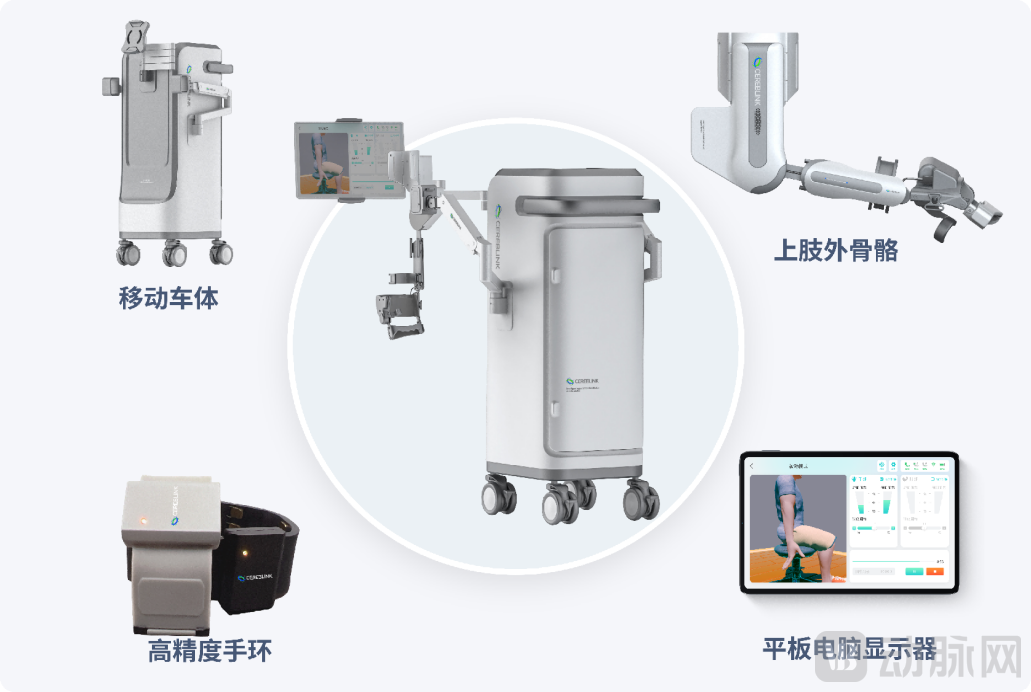
Upper Limb Exoskeleton Rehabilitation Training System AM5 (Medical Version)
2The Technical Hard Battle Within 200 Milliseconds: "Move Only When Intended, Move Immediately When Intended"
In the brain-computer interface (BCI) industry, a widely circulated saying goes: “Whoever has more channels possesses higher performance.” In the past, the development of invasive BCIs has revolved almost entirely around the number of electrodes, sampling precision, and channel scale.
However, Ma Sanguang believes that while domestic brain-computer interface (BCI) teams are all highly competent, there is currently an excessive focus on signal acquisition. In reality, signal acquisition, paradigm encoding, decoding algorithms, stimulation techniques, and system integration are all core BCI technologies, with no hierarchy among them. From a problem-solving perspective, acquiring neural signals is foundational, whereas deciphering the motor intentions behind these signals presents greater challenges and holds more significant value in addressing practical problems.
“Being able to hear sounds does not mean being able to understand their meaning.” He drew this analogy. The device collects neural signals; if it cannot accurately decode and identify the patient’s true motor intent, even numerous hardware channels will fail to establish effective rehabilitation interaction.
In many stroke patients, the brain does not completely lose its ability to issue motor commands. Motor intentions such as “raising the hand” and “grasping” are still generated; however, due to damage to the central nervous system, the resulting abnormal commands cannot be correctly interpreted and executed by the affected limbs.
The core R&D focus of Cereblink is preciselyReal-time acquisition and decoding of the brain’s actual motor intentions sent to the affected limb (without requiring “motor imagery”), synchronously driving the exoskeleton to assist the limb in completing movements, enabling patients to achieve “movement only when intended, and immediate movement upon intention.”。
Underlying this statement is a rigid medical metric: 200 milliseconds. After the human brain makes a motor decision, the corresponding limb must respond within 200 milliseconds. If this time threshold is exceeded, the brain will determine that "this outcome has no causal relationship with my decision," thereby preventing the establishment of new neural connections.
In June this year, the National Medical Products Administration (NMPA) issued the "Guiding Principles for the Classification and Definition of Brain-Computer Interface Medical Devices," explicitly stating that brain-computer interface products should possess key capabilities such as central nervous system signal acquisition, real-time decoding, and closed-loop feedback. These three criteria align precisely with what Cereblink has been dedicated to over the past five years.
Currently, the response time of Cereblink’s products has been reduced to as fast as 87 milliseconds, with an intention recognition rate for core upper-limb movements exceeding 95%. More importantly, it supports continuous real-time decoding, allowing patients to stop or resume movement at any point along their motion trajectory. The extent to which the arm is raised and the degree of hand opening and closing are entirely determined by the patient.
For individuals who have long lost voluntary control over their limbs, the sense of “regaining control” holds significance far beyond mere technical metrics.
3From Hospital to Home, from “Treating the Body” to “Healing the Mind”
For stroke patients, the true challenge of rehabilitation often arises after discharge.
In hospitals, patients can receive systematic and professional rehabilitation training; however, upon returning home, the lack of professional guidance and effective tools often leads to interruptions in their rehabilitation. Traditional rehabilitation equipment addresses the issue of “whether to train,” but struggles to answer “how to train at home” and “whether adherence can be maintained.”
What Cereblink aims to fill is precisely this missing segment of the rehabilitation journey. Thus, the AM5 delivers professional rehabilitation training in hospital settings, while the AC5 and HC2 extend such training into the home. Spanning from overall upper-limb movement to hand function recovery, and from gross motor skills to fine motor skills, Cereblink is progressively building a home-based product portfolio that covers different stages of rehabilitation, ensuring that recovery does not stop at discharge.
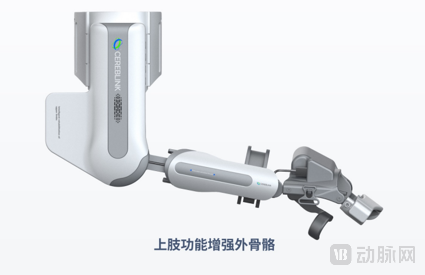
Upper Limb Motor Function Assistance and Enhancement System AC5 (Home Edition)
To ensure patients are genuinely willing to use the device at home, Cereblink has implemented extensive engineering optimizations to enhance the wearing experience. Taking the AC5 as an example, the entire unit weighs less than 1.5 kg, allowing proficient users to don it single-handedly in as little as two minutes without assistance.
Only by making the device sufficiently lightweight and simple can patients integrate it into their daily routines. Incorporating training into everyday activities such as sweeping, carrying water, and performing light household chores yields significantly higher adherence than dedicating specific time each day to tedious exercises.
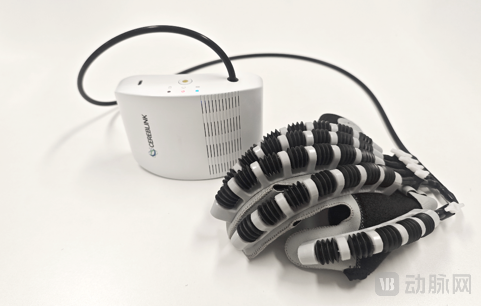
HC2 Hand Flexible Exoskeleton Rehabilitation System (Home Version)
In the interview, Ma Sanguang shared a story. A 39-year-old female patient underwent training with traditional rehabilitation methods after suffering a stroke, but she hit a plateau two months later, unable to lift her arm or exert strength in her hand. With elderly parents to care for above and young children below, she once felt so desperate after falling ill that she “had thoughts of ending her life.”
After two weeks of training with the Cereblink device, she was able to raise her arm again; three months later, she tore open a candy wrapper on her own for the first time. She told Cereblink staff, “This device has healed not only my body but also my heart.”
This statement deeply resonated with Ma Sanguang. He repeatedly emphasized one observation: “Patients do not lack the desire to recover; they lack the tools.” Many patients have not abandoned rehabilitation; rather, they are constrained by the limitations of traditional methods. When a new possibility emerges, they are willing to try and persist—provided that the path is truly viable.
This is precisely why Cereblink has dedicated itself to advancing non-invasive brain-computer interfaces. We transform the absence of assistive tools into their presence, shifting rehabilitation from a single hour in the hospital to every moment of patients’ daily lives.
4Movement Intent Recognition: Expanding into Broader Scenarios
Rehabilitation Is Just the Beginning. As products are gradually commercialized, Cereblink’s years of accumulated core capability—motion intent recognition—is stepping onto a broader stage beyond healthcare.
At the Canton Fair this May, Cereblink showcased a “Embodied Interaction” New Technology: After wearing a neural signal acquisition wristband, the operator performs actions such as making a fist, opening the hand, and flexing/extending individual fingers, with the dexterous robotic hand responding in real-time synchronization, achieving mapping for over ten types of gestures.
This means that,Human movement itself is becoming a new language of interaction.
This is not “cross-industry expansion.” Ma Sanguang stated that whether it is rehabilitation training, AI glasses, humanoid robots, or VR immersive interaction, although these applications appear to target different markets, they are fundamentally underpinned by the same core capability—understanding human movement intent.
Over the past few years, Cereblink has been focused on accurately identifying faint motor signals in stroke patients. As this capability continues to mature, it can also recognize movement intentions in healthy individuals, extending to a broader range of human-computer interaction scenarios.
Based on this assessment, Ma Sanguang believes that AI glasses are poised to experience their own “iPhone moment” within the next three to five years, with traditional human-computer interaction methods reliant on screen tapping and voice control gradually evolving toward more natural gesture-based interactions.
But even as it moves into consumer electronics, Ma Sanguang remains restrained in his expectations for brain-computer interfaces. Some hope this technology can directly read human thoughts, while others envision knowledge being written into the brain like downloading a file. “If we go by such expectations, it is still nowhere in sight.”
A truly mature industry continuously validates its value in specific scenarios. Products that address real-world problems, such as cochlear implants, neural stimulation, and motor rehabilitation, are also integral components of the brain-computer interface (BCI) industry.
Over five years, Cereblink moved from the laboratory to hospitals, and then into homes, beginning to explore possibilities beyond healthcare. Yet it was not until a 39-year-old patient said, “You’ve healed my heart,” that they could truly grasp what their work ultimately meant.
The candy wrapper torn open by her own hands comes closer to the answer than any technical indicator. The “candy wrapper moment” of brain-computer interfaces will not occur just once; it will recur in every instant when one regains their grip on life.
What Cereblink aims to do is make these moments more frequent.