

MindRank Secures $52 Million Series B Funding to Advance AI-Native Drug Discovery Engine and Phase III Clinical Development of MDR-001

MindRank
AI Drug Developer

WinX Capital
Investment Institutions in the Greater Health Field
VCBeat has learned that recently,MindRank, an AI-driven drug discovery technology company, announced the phased completion of its $52 million Series B financing round, with participation from multiple renowned investment institutions and industrial funds. Kaicheng Capital served as the exclusive financial advisor for this round.
The proceeds from this round of financing will be primarily invested in the deep technical iteration of the company’s proprietary, end-to-end AI drug discovery engine, MAP (Molecule Arts Platform). This includes continuously enhancing its industry-leading Multi-Agent collaborative system and Clinical Data-in-the-Loop framework, while advancing the Phase III clinical development and commercialization of MDR-001, a proprietary oral small-molecule GLP-1 receptor agonist (GLP-1RA). These efforts aim to accelerate the expansion of a differentiated innovative drug pipeline and further solidify and amplify the company’s absolute advantages in efficiency and cost offered by its next-generation AI-driven drug discovery paradigm.
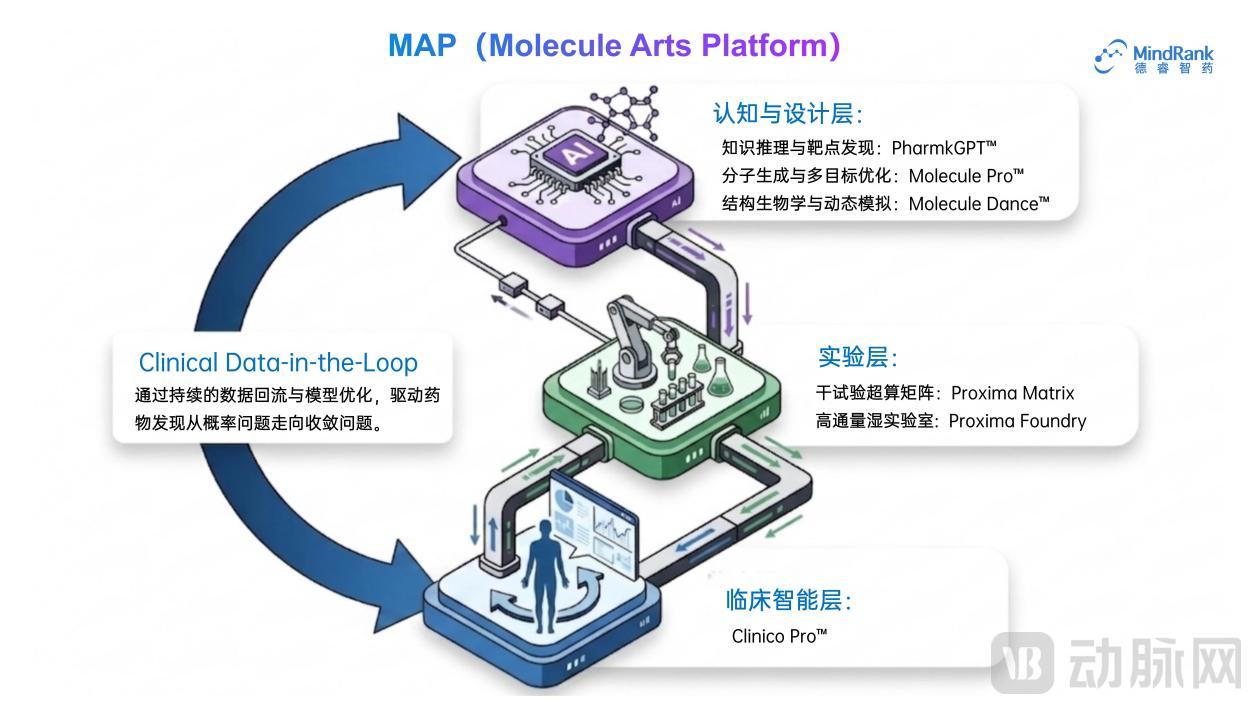
As a global pioneer in leveraging AI to reshape the innovative drug R&D industry, MindRank took the lead in early 2024 by deploying its self-developed multi-agent systems and large language models into new drug development.[2] Scenario. In 2026, the company successfully established MAP (Molecule Arts Platform), a multi-agent-driven pharmaceutical engine. Covering key stages of the pharmaceutical industry—including target research, molecular design, multi-parameter optimization, experimental validation, and clinical data analysis—the platform integrates multi-agent connected computational models with wet-lab experiments and clinical feedback. This integration ensures that predictive results are continuously validated and iterated upon using experimental and clinical data. Operating within an industrial environment, MAP continuously learns, validates, and evolves, forming a “growth compounding flywheel” driven by both data and algorithms, thereby consistently producing blockbuster innovative drugs.
Paradigm Shift: Moving from "Empirical Trial-and-Error" to Data- and AI-Driven "Standardized Engineering"
For a long time, the global pharmaceutical industry has been constrained by the “Double Ten Law”: an average R&D timeline of 10 years, investment exceeding $2.6 billion, and a clinical success rate of less than 10%.[1]Faced with a nearly infinite drug-like chemical space on the order of 10⁶⁰, the traditional R&D paradigm—relying on scientists’ individual experience, conventional biochemical experiments, and large-scale blind trial-and-error—has reached the physical limits of return on investment and an efficiency ceiling. The isolation, randomness, and high attrition rate inherent in drug development have become an unbearable burden for the industry.
The explosion of AI technology is fundamentally disrupting this traditional paradigm from the ground up. MindRank believes that the industrial value of AI lies not merely in serving as a point solution for efficiency, but in transforming drug R&D from an uncontrollable “empirical exploration” into a “standardized engineering creation” that is data-driven, computable, iterative, and convergent.

Industrialization Validation: China’s First AI-Enabled Class 1 Novel Drug Enters Phase III Clinical Trials, Achieving an Order-of-Magnitude Leap in Efficiency
Leveraging its MAP platform, MindRank has established a comprehensive R&D system covering target discovery, molecular design, multi-objective optimization, and clinical trials, delivering an industrialized achievement that has drawn significant attention from the global pharmaceutical community:
The company’s lead pipeline asset—MDR-001, an innovative small-molecule oral GLP-1 receptor agonist (GLP-1RA)—officially entered Phase III clinical trials in 2025. As China’s first AI-enabled Class 1 innovative drug to advance to Phase III clinical development, it is expected to achieve commercial launch within the next two to three years, positioning itself to compete in the global GLP-1 market, which is valued at hundreds of billions of dollars.
The MDR-001 project comprehensively and clearly demonstrated the order-of-magnitude advantages of the MAP engine over traditional pharmaceutical development models in terms of efficiency and cost:
Unparalleled Molecular Screening Efficiency: The team successfully identified a high-quality preclinical candidate (PCC) in just 8 months, synthesizing only 80 small molecules.
Unparalleled Clinical Development Speed: The approval cycle for IND (Investigational New Drug) applications has been significantly compressed to 19 months. From initial project initiation to Phase III clinical trials, the entire process took only 4.5 years;
Unparalleled Capital Efficiency: The cumulative R&D investment for this single product was controlled at approximately $23 million. In contrast, under traditional R&D models during the same period, similar drugs typically require an 8–12 year development cycle and cash investments ranging from $310 million to $400 million (this figure accounts solely for the direct capital expenditure in the pre-Phase III stages of this one drug that successfully reached Phase III).[3]。
The MAP engine’s exceptional performance on MDR-001 has achieved a tenfold leap in R&D investment efficiency. More importantly, this high efficiency is not an isolated case. At present, MindRank has obtained three IND approvals in China and the US, possesses five preclinical PCC molecules, and is simultaneously advancing 15 innovative pipelines featuring FIC (First-in-class) and BIC (Best-in-class) assets.
Among numerous traditional targets and fields considered “undruggable,” MindRank has demonstrated robust capabilities in cross-modal, cross-target scalable replication. The company’s pipeline assets comprehensively cover cutting-edge drug modalities, including GPCRs, molecular glues, allosteric inhibitors, and the world’s only dual-target small-molecule oncology therapeutics, all of which are currently in clinical development or at the preclinical candidate (PCC) stage.
To date, the company has filed over 200 patent applications, accumulated valuable clinical trial data from 1,300 cases, and published nearly 100 peer-reviewed papers on AI-driven drug discovery in top-tier international journals such as Nature Biomedical Engineering and Advanced Science, as well as at the International Conference on Machine Learning (ICML), a premier global conference on machine learning. This demonstrates its dual excellence and significant industry influence in both academic accumulation and industrial application.
Industry Vision: Building a Sustainable, Evolving AI-Native Pharma System
Niu Zhangming, Founder and CEO of MindRank, stated:“New drug development is akin to exploring a vast and unknown universe. Despite decades of accumulated experience in pharmaceutical R&D, humanity has truly understood and explored only a small fraction of the nearly infinite chemical, biological, and disease spaces. The emergence of each innovative drug represents an exploration into unknown principles; every significant success or failure helps humanity continuously refine its understanding of diseases and therapeutics.”
MindRank aspires to build not just an innovative pharmaceutical company, but an AI-Native Pharma system capable of continuous exploration, learning, and creation of novel drugs. To this end, we have developed the MAP Engine—a continuously evolving infrastructure for drug innovation. It provides high-precision navigational mapping for exploration within the vast chemical space, consolidating every molecular design calculation, experimental validation, and clinical feedback into new knowledge, thereby making each exploration a starting point for the next innovation. We believe that the value of AI lies not only in enhancing R&D efficiency but also in constantly expanding the boundaries of human exploration in life sciences, accelerating the discovery of innovative therapies, ensuring more diseases become treatable, and enabling more patients to benefit from these innovations.
With the continuous iteration of model algorithms, the deep accumulation of multi-agent collaboration mechanisms, and the accelerated feedback of real-world clinical data, MindRank aims to leverage its technological compounding effects to constantly break the boundaries of efficiency and success rates in traditional drug R&D, leading global new drug discovery to officially bid farewell to the empirical era of “looking for a needle in a haystack” and fully enter a new epoch of “following the map to find the horse” precisely navigated by AI.
References:
[1]PAUL S M, MYTELKA D S, DUNWIDDIE C T, et al. How to improve R&D productivity: the pharmaceutical industry's grand challenge[J]. Nature Reviews Drug Discovery, 2010, 9: 203-214. DOI:10.1038/nrd3078.
[2]Niu, Z, et al. “PharmaBench: Enhancing ADMET Benchmarks with Large Language Models.” Scientific Data, vol. 11, no. 1, 2024, pp. 1–15. Nature, https://doi.org/10.1038/s41597-024-03793-0.
[3] DiMasi, J. A., Grabowski, H. G., & Hansen, R. W. (2016). Innovation in the pharmaceutical industry: New estimates of R&D costs. Journal of Health Economics, 47, 20-33. The total out-of-pocket direct R&D costs for a successfully advanced drug candidate prior to Phase III clinical trials (covering preclinical studies, Phase I, and Phase II, while excluding Phase III, NDA approval, and post-marketing expenses) amount to approximately $310–400 million; the total capitalized comprehensive costs, which account for failure amortization (including not only the out-of-pocket R&D expenses but also the sunk costs from hundreds or thousands of other pipeline candidates that failed during preclinical, Phase I, or Phase II stages during the development period, as well as the time value of money and opportunity costs), amount to approximately $1.02–1.12 billion.