

A Buy and a Sell: Two Chinese Pharma Giants Are Playing a Strategic Game
Junshi Biosciences
Innovative Drug Developer

Fosun Wanbang Pharma Group
Drug Developer
Written by | Da Xue Ya Qing Song
In the era of China’s innovative drug “Great Voyage,” characterized by intertwined license-in and license-out deals, the transformation of traditional pharmaceutical companies is often accompanied by significant growing pains and ambition.
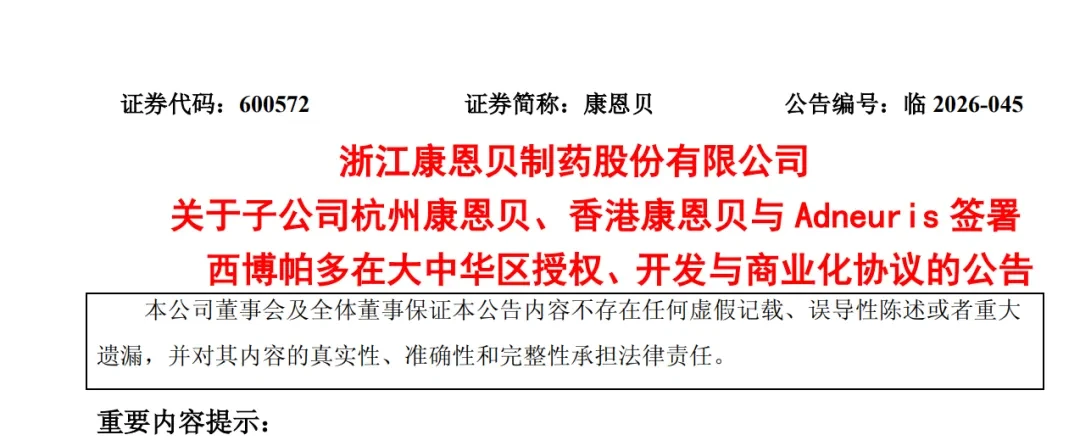
On July 6, Conba announced the acquisition of the Greater China rights to Cebranopadol, a first-in-class analgesic, from US-based Adneuris for a consideration of up to $111.5 million (approximately RMB 759 million).
This transaction is not only the largest innovative drug in-licensing deal by Zhejiang Conba Pharmaceutical Co., Ltd. in recent years, but also a decisive move by this long-established leader in traditional Chinese medicine to shed its label as the “Changyanning specialist” and carve out a foothold in the hospital market for innovative chemical drugs.
Conba"Buy": Breaking the Impasse Within Hospitals by Shedding Labels
For a company with an average annual net profit from regular operations of approximately RMB 512 million, a total transaction value of RMB 759 million is undoubtedly a high-stakes gamble.
However, Conba did not engage in reckless cash burning; this transaction adopted a typical milestone payment structure. In addition to the $17.5 million upfront payment, the remaining amounts are contingent upon regulatory approval of the product in both China and the United States and the achievement of agreed-upon sales targets.
This financial arrangement, which “trades time for space,” not only mitigates the risk of a short-term cash flow rupture but also reflects Conba’s complex mindset—both eager and cautious—toward its innovation pipeline after navigating multiple crises, including failed bids in centralized volume-based procurement and the suspension of core chemical drug operations.
Xibopadol, introduced as a dual-target (NOP+MOP) oral analgesic, directly addresses clinical challenges associated with traditional opioids, such as addiction and respiratory depression. This not only fills Zhejiang Conba Pharmaceutical Co., Ltd.'s gap in the field of potent in-hospital analgesia but also aims to upgrade its product portfolio from "OTC traditional Chinese medicines" to a combined system of "OTC traditional Chinese medicines plus innovative in-hospital chemical drugs" through bridging studies conducted over three to five years.
Junshi’s “Sale”: Leveraging Partnerships to Replenish Cash Flow Nearing Commercialization Milestones
However, Conba’s “buy” is merely a microcosm of the broader ecosystem of “buying globally, selling globally” in China’s innovative drug sector in 2026. Just days ago, another leading domestic pharmaceutical company completed a highly anticipated “sell.”
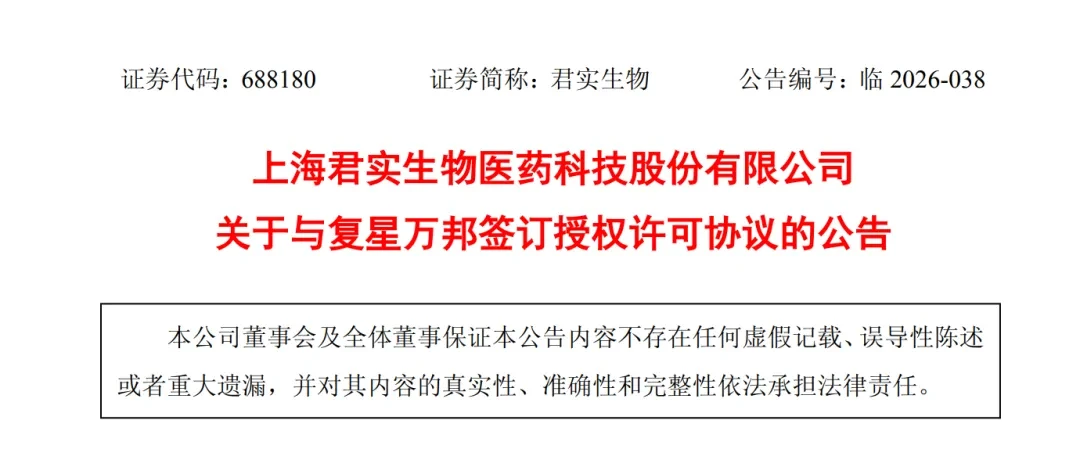
On July 1, 2026, Junshi Biosciences announced that on June 30, the Company had entered into a License Agreement with Fosun Wanbang Pharma Group, a wholly-owned subsidiary of Fosun Pharma, to exclusively out-license all rights for the development, registration, manufacturing, and commercialization of its self-developed anti-IL-17A monoclonal antibody, rucoxibart (JS005), in the Greater China region.
Under the agreement, Junshi Biosciences will receive a non-refundable upfront payment of RMB 215 million, as well as development and sales milestone payments of up to RMB 1.125 billion, with a total potential value capped at RMB 1.34 billion.
This transaction occurred during a critical window approaching the commercialization of the product. Nukacibart has completed its China registrational Phase III clinical study in adult patients with moderate-to-severe plaque psoriasis,
Demonstrating excellent efficacy and safety, its New Drug Application (NDA) was accepted by the National Medical Products Administration in December 2025. Through this move, Junshi Biosciences aims to leverage Fosun Wanbang Pharma Group’s mature commercialization team and channel advantages in the autoimmune disease sector to accelerate product launch, while also recouping funds to reinvest in upstream R&D.
Mutual Commitment
From Conba Pharmaceutical’s “buying blood” to sustain its operations, to Junshi Biosciences’ “selling blood” to recoup capital, and further to Bristol-Myers Squibb acquiring four early-stage candidate drugs from Hengrui Medicine for a total of $15.2 billion, and Innovent Biologics licensing out twelve early-stage oncology R&D projects to Pfizer for a total of $10.5 billion, the global strategic landscape of China’s innovative pharmaceutical industry has taken shape.
Leading biotech firms are frequently achieving high-value license-out deals for their first-in-class (FIC) pipelines, thereby earning overseas milestone payments; meanwhile, traditional pharmaceutical companies like Conba, which possess mature commercialization networks but face gaps in their R&D pipelines, are rapidly addressing these shortcomings through license-in arrangements.
The acquisition and divestiture by these two pharmaceutical companies, seemingly independent strategic choices, in reality jointly outline the clear trajectory of China’s pharmaceutical industry transitioning from “generic follow-on” to “innovative collaboration.” As more enterprises begin to seek their optimal ecological niches on a global scale, the next major move in China’s innovative drug landscape has only just been made.
In accordance with the relevant provisions of the Advertising Law of the People's Republic of China and the Measures for the Administration of Internet Drug Information Services, the content on this platform does not fall within the scope of drug advertising. The drug-related information provided herein is for objective informational purposes only and does not possess any commercial promotional attributes.
The content published on this platform represents only the academic views of the authors based on their professional knowledge and reflects their personal opinions. It does not represent the position of any organization or this official account. If there are any inaccuracies, please feel free to point them out. For reprinting, please credit the author and source: Ouryao (Pugongying).
Dandelion Ouryao Video Account
Submissions, Advertising, and Business Cooperation:

Qinrenlvcha