Qitan Nanopore Sequencing Enables Xinjiang Agricultural University to Fully Resolve mcr-8.2-Carrying Resistance Plasmid from Layer Chickens in Landmark Poultry Science Publication

QitanTech
Gene Sequencing Technology R&D Provider

Illumina
Diagnostic Product Developer

# QITANTECH #
Recently, a team from the College of Veterinary Medicine at Xinjiang Agricultural University, leveraging QitanTech’s nanopore long-read sequencing platform, completed an epidemiological study and complete genomic analysis of *Klebsiella pneumoniae* isolated from laying hens in Xinjiang. This study marks the first detection of high-risk ST147 clonal *K. pneumoniae* carrying the *mcr-8.2* gene in laying hen farms in Xinjiang, comprehensively elucidating the genetic background, transferability, and host adaptability features of the resistance plasmids. By combining short-read Illumina sequencing with QitanTech nanopore long-read sequencing for hybrid assembly, the researchers accurately reconstructed the full-length structures of resistance plasmids, insertion elements, and the genetic environments of core resistance genes. This provides complete genomic evidence for assessing the risk of cross-species transmission of mobile colistin resistance genes of livestock and poultry origin. The related findings were published in *Poultry Science*, an internationally authoritative journal in the field of poultry science, offering a standardized research paradigm using domestically produced sequencing technologies for “One Health” monitoring of antimicrobial resistance in livestock farming in western China.

Research Background
*Klebsiella pneumoniae* is a zoonotic opportunistic pathogen that widely colonizes the intestinal tracts of poultry and can be transmitted to humans through the food chain. Multidrug-resistant strains, particularly those carrying plasmid-mediated colistin resistance *mcr* genes, can directly render colistin—the “last line of defense” in clinical treatment—ineffective, posing a significant public health risk.
1. Regional Monitoring Gaps: While eastern China has a well-established surveillance system for antimicrobial-resistant bacteria in poultry, there is a lack of systematic data on the prevalence and molecular resistance characteristics of Klebsiella pneumoniae in large-scale layer farms in Xinjiang;
2. Prominent risk of mcr-8.2 transmission:mcr-8.2 can be transmitted across bacterial species and hosts via conjugative plasmids; it has been detected in human, avian, and environmental samples from multiple regions worldwide, with the high-risk ST147 clone frequently causing nosocomial infections;
3. Limitations of Short-Read Sequencing:Second-generation short-read sequencing fails to fully assemble large IncFII resistance plasmids, making it difficult to resolve the complete genetic context of insertion sequences and resistance gene clusters; thus, there is an urgent need for long-read sequencing to address these technical limitations.
4. Domestic Nanopore Sequencing Applied to Livestock Pathogens:QitanTech’s QNome nanopore platform, with its advantages of ultra-long reads, real-time sequencing, and low cost, is well-suited for comprehensive whole-genome mapping of large-scale antimicrobial-resistant bacteria in livestock and poultry, filling the gap in domestic third-generation sequencing applications in veterinary antimicrobial resistance genomics.
Overview of Research Findings
1.Epidemiology and Antimicrobial Resistance Phenotype Results
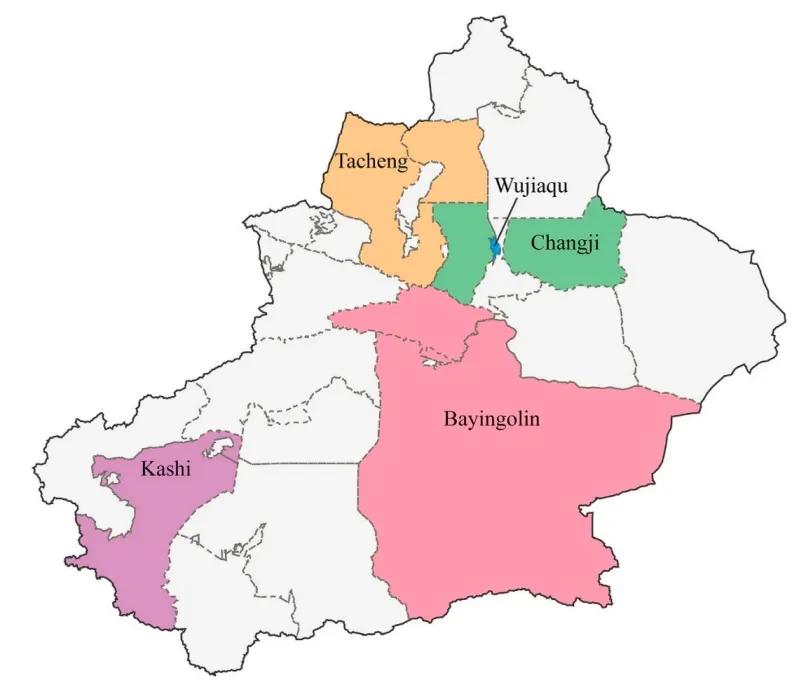
Figure 1. Sample collection sites in Xinjiang, China, for this study
The research team collected 1,115 chicken fecal samples from six layer hen farms across five regions in Xinjiang—Wujiaqu, Changji, Kashgar, Tacheng, and Bayingolin—and isolated 408 strains of Klebsiella pneumoniae, yielding an overall isolation rate of 36.6%, with the highest rate of 57.3% observed in the Tacheng region. The colistin resistance rate among the isolates was 55.0%, and the florfenicol resistance rate was 50.0%. Multidrug-resistant strains accounted for 28.9% of the isolates, while 9.8% produced extended-spectrum β-lactamases (ESBLs). The detection rate of ESBL-producing strains in Tacheng was as high as 26.2%. Only two carbapenem-resistant strains were identified, and no blaNDM carbapenem-resistance genes were detected. PCR screening of all samples for 24 classes of resistance genes revealed that blaSHV and oqxA each had a detection rate of 97.8%, emerging as core resistance markers for layer hen-derived K. pneumoniae strains in Xinjiang. The overall detection rate of mcr genes was only 0.5%. Ultimately, two mcr-8.2-positive strains were screened and identified: CD19 (ST147, a high-risk clone) and CX36 (ST3410).
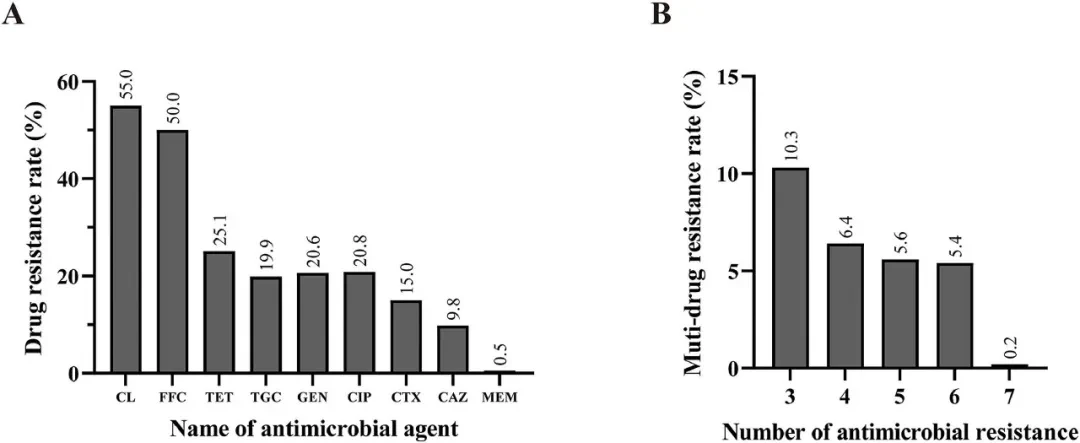
Figure 2(A) Antimicrobial resistance profile of Klebsiella pneumoniae; (B) Distribution of multidrug resistance in Klebsiella pneumoniae
2.Long-Read Sequencing Fully Resolves the mcr-8.2-Positive Plasmid
The study employed a hybrid sequencing strategy combining Illumina short reads and QitanTech nanopore long reads. Leveraging the ultra-long read advantage of the QNome platform, we assembled a complete full-length genome and a 95-kb IncFII-type conjugative plasmid, pCD19-mcr8, thereby addressing the limitation of second-generation sequencing in assembling large antibiotic resistance plasmids:
Precise Localization of the Complete Genetic Backbone of mcr-8.2:The conserved core elements IS903B-dgkA-baeS-copR-ISEcl1-mcr-8.2-ISKpn26 were clearly identified, fully restoring the arrangement of insertion sequences mediating horizontal transfer of resistance genes;
Plasmid Homology Alignment:The backbone of the pCD19-mcr8 plasmid is highly conserved among global mcr-8.2-positive plasmids of chicken, human, and environmental origins, with a maximum sequence identity of 99.98%, confirming the potential of these plasmids for cross-host and cross-regional transmission;
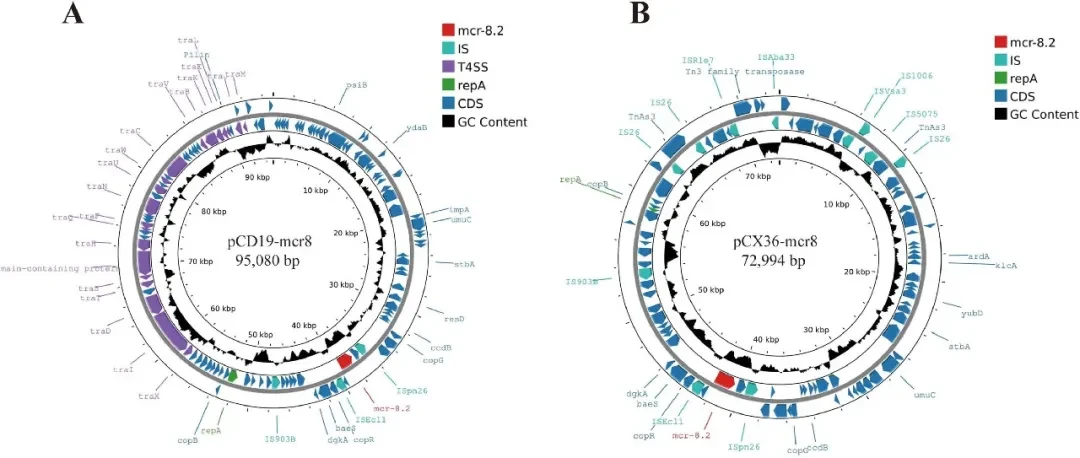
Figure 5. Plasmid maps of two mcr-8.2-positive strains. The maps illustrate the structural features of the plasmids from each strain, including various genetic regions and the antibiotic resistance genes they carry.
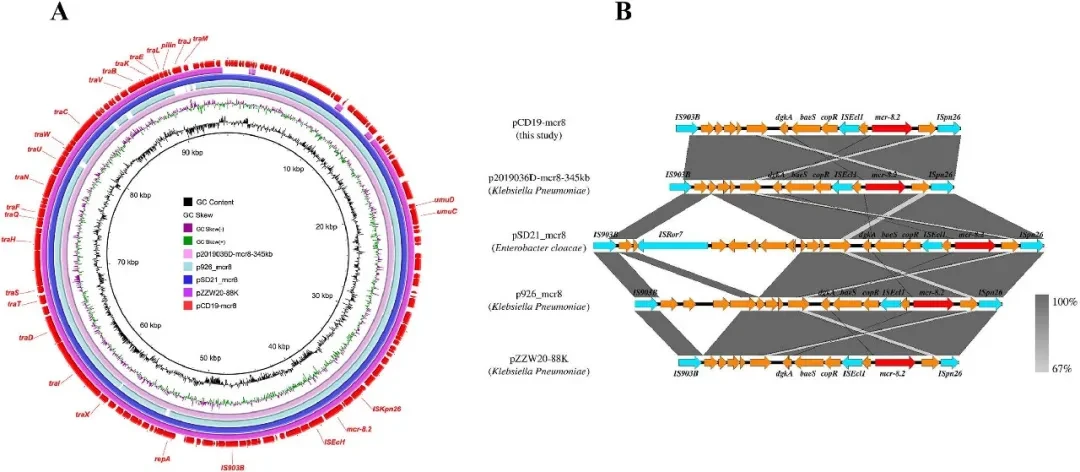
Figure 6. Circular alignment map of the plasmid and the genetic environment of the mcr-8.2 gene. (A) Circular alignment of plasmid pCD19-mcr8 with other plasmids of chicken, human, and environmental origins in the NCBI database; the outermost circle uses the mcr-8.2-positive plasmid pCD19-mcr8 as the reference plasmid. (B) Comparative analysis of the mcr-8.2 gene-carrying fragments in plasmid pCD19-mcr8 and other plasmids of chicken, human, and environmental origins in the NCBI database.
Analysis of Structural Differences:pCD19-mcr8 carries the complete type IV secretion system *tra* gene cluster and possesses autonomous conjugative transfer capability; in contrast, the other plasmid, pCX36-mcr8, lacks transfer genes, thereby explaining the difference in transfer capabilities between the two strains.
3. Conjugation Assay + Growth Competition Assay Confirm No Significant Fitness Cost of the Plasmid
Functional Validation Based on Complete Plasmid Information Obtained via QitanTech Nanopore Sequencing:
Conjugation experiments demonstrated that pCD19-mcr8 could be stably transferred to Escherichia coli C600, enabling cross-species dissemination of the resistance gene;
Growth curves and 72-hour competition assays showed no statistically significant difference in growth rates between plasmid-bearing transconjugants and empty-vector strains (p > 0.05), indicating that the mcr-8.2-positive plasmid imposes no fitness cost on the host. It can remain stably maintained over the long term even in the absence of antibiotic selection pressure, thereby substantially increasing the difficulty of controlling and preventing antimicrobial-resistant bacteria.
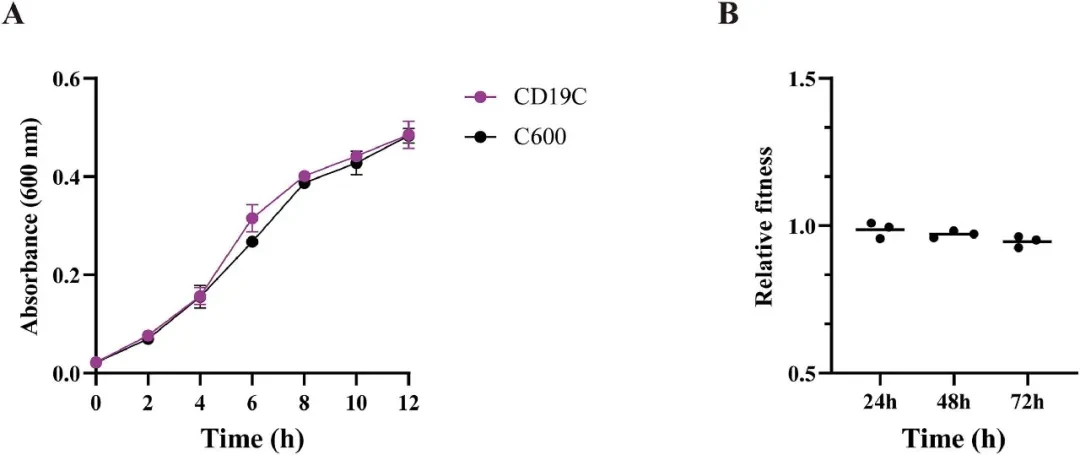
Figure 7Analysis of the fitness cost imposed by plasmid pCD19-mcr8 on strain C600. (A) Comparison of growth curves between the recipient strain C600 and the transconjugant CD19C carrying the pCD19-mcr8 plasmid; (B) Determination of the relative fitness of the transconjugant CD19C carrying the pCD19-mcr8 plasmid.
4.Whole-Genome SNP Phylogenetic Tracing
Leveraging QitanTech’s long-read sequencing to assemble high-quality, complete genomes, a core-genome phylogenetic tree was constructed for 51 mcr-8.2-positive strains worldwide:
Globally, mcr-8.2-positive strains are predominantly of human origin, with China reporting the highest number of isolates. The ST147 strain in this study exhibited substantial single-nucleotide polymorphism (SNP) differences compared to human-derived strains from Australia and Thailand, indicating that it does not belong to a recent transmission cluster; however, these findings confirm the potential for intercontinental spread of high-risk clones.
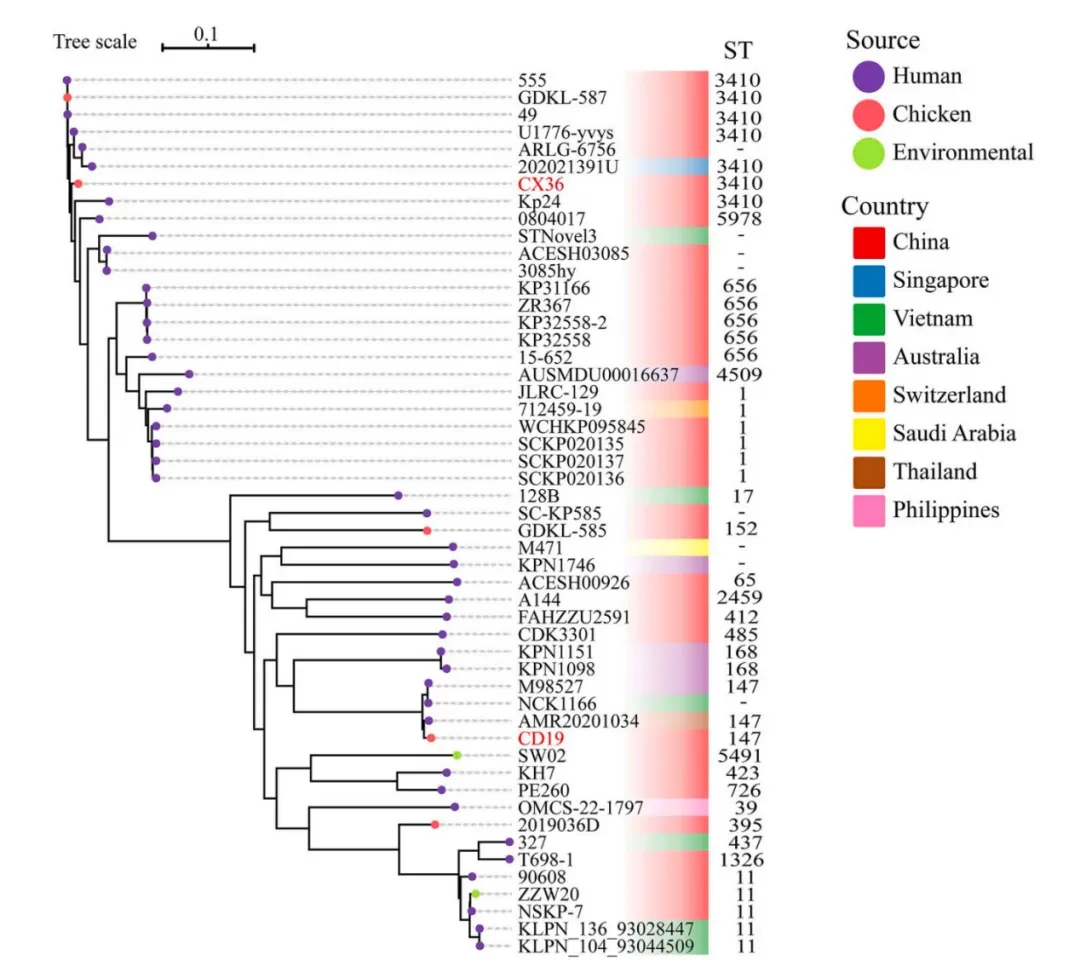
Figure 4 Phylogenetic analysis of 51 mcr-8.2-positive Klebsiella pneumoniae strains. The strains include two isolates obtained in this study and 49 genome drafts downloaded from the NCBI database, derived from diverse hosts and geographic regions. The purple, magenta, and light green rings represent different strain sources; the red, blue, light purple, orange, yellow, brown, and pink rectangles distinguish the countries where the strains were isolated.
Identifying poultry farms as key intermediate reservoirs for the cross-transmission of antimicrobial-resistant bacteria between animals and humans, providing genomic tracing evidence for integrated "One Health" surveillance.
Research Conclusions
1. The multidrug resistance rate of Klebsiella pneumoniae isolated from laying hens in five regions of Xinjiang to nine tested antimicrobial agents was 28.9%. The detection rates of resistance genes for β-lactams and plasmid-mediated quinolones were both as high as 97.8%, and the detection rate of extended-spectrum β-lactamase (ESBL)-producing strains was 9.8%.This study represents the first detection of mcr-8.2-positive Klebsiella pneumoniae in laying hens in Xinjiang, China.
2. Plasmids Play a Key Role in the Dissemination of the mcr-8.2 GeneThe IncFII-type plasmid carrying mcr-8.2 is capable of autonomous conjugative transfer without imposing a fitness cost on the host bacterium. This plasmid exhibits high similarity to homologous plasmids found in chicken-derived, human-derived, and environmental isolates, suggesting that resistance genes can be transmitted to humans via the food chain. Therefore, there is an urgent need to establish routine genomic surveillance of antimicrobial resistance in livestock and poultry.
3. Mobile genetic elements have greatly promoted the cross-host transmission of colistin resistance.In response to the emergence of mcr genes in poultry farming, a long-term, routine surveillance system must be established. Meanwhile, leveraging the “One Health” framework, data from animal, environmental, and human surveillance should be integrated to scientifically formulate guidelines for antimicrobial use in livestock and poultry production, thereby interrupting the transmission chain of resistant bacteria and resistance genes.
4. This study represents the first complete genomic characterization of a high-risk ST147 clone harboring mcr-8.2, isolated from layer chickens in Xinjiang, using domestically produced nanopore sequencing technology in China.QNome nanopore long-read sequencing is one of the core technologies for comprehensively characterizing antimicrobial resistance plasmids and mobile genetic elements in livestock and poultry., ultra-long reads enable one-time assembly of large IncFII conjugative plasmids, accurately resolving the complete genetic context of antibiotic resistance genes and addressing the fragmentation limitations of second-generation short-read sequencing assembly;Validated the stable application capability of the QitanTech nanopore platform in veterinary microbiology and whole-genome research on foodborne antimicrobial-resistant bacteria., providing a reference for domestically produced sequencing solutions for antimicrobial resistance monitoring in China's livestock sector.

Literature Retrieval
Reply to the official account with “Xinjiang Agricultural University"Access More Research Findings"
References:
[1]Rui Tian, Mengqi Yang, Yujie Yang, Shuqin Xu, Wanzhao Chen, Lining Xia,Emergence and genomic characterization of mcr-8.2-positive Klebsiella pneumoniae from layer chickens in Xinjiang, China,Poultry Science,Volume 105, Issue 1,2026,106190,ISSN 0032-5791.
https://doi.org/10.1016/j.psj.2025.106190.