Safety Margins of Myopia Control Devices Vary by Over 16,000-Fold: Comparative Laboratory Study Published in JAMA Ophthalmology
Runer Health
Service Provider for Myopia Prevention and Control in Adolescents and Children and Amblyopia Rehabilitation
Red light therapy is one of the niche sectors garnering significant attention in the field of myopia prevention and control at the current stage. Multicenter clinical trials in Asia have demonstrated that standardized use can slow myopia progression by 60%–75%, with some children even exhibiting a reduction in axial length.However, discussions regarding the risk of retinal damage, long-term safety, and differences among various devices continue to persist.
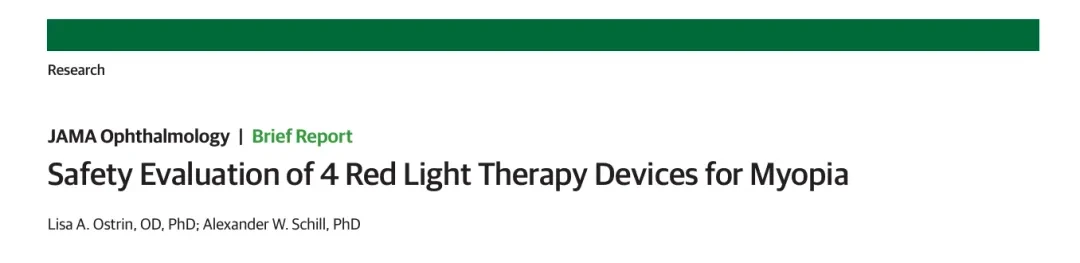
Recently,JAMA OphthalmologyPublished the research by Lisa A. Ostrin and Alexander W. Schill from the University of Houston College of Optometry,Four commercially available red light devices—Sky-n1201 (Mingren Shikang), Runer Health, EyeRising, AirDoc——Included in the unified standards for laboratory testing. The results showed that,The time required for different products to reach the safety limit can vary by more than 16,000-fold.。
This study did not evaluate the relative merits of the products; its core issue is:Why Do Safety Windows Vary Across Different Devices Under the Same Wavelength Conditions?
# Research Content
Unlike previous studies that focused on axial length control rates, this study did not conduct clinical trials but instead utilizedANSI Z80.36-2021 (Standard for Ophthalmic Instruments) and ANSI Z136.1-2022 (Standard for Laser Products)Dual-track international standards: laboratory optical measurements were conducted on four commercially available devices.
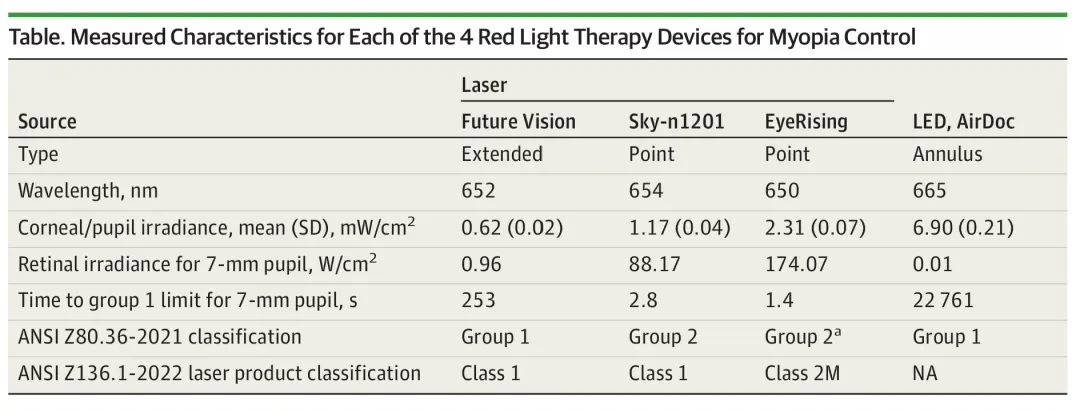
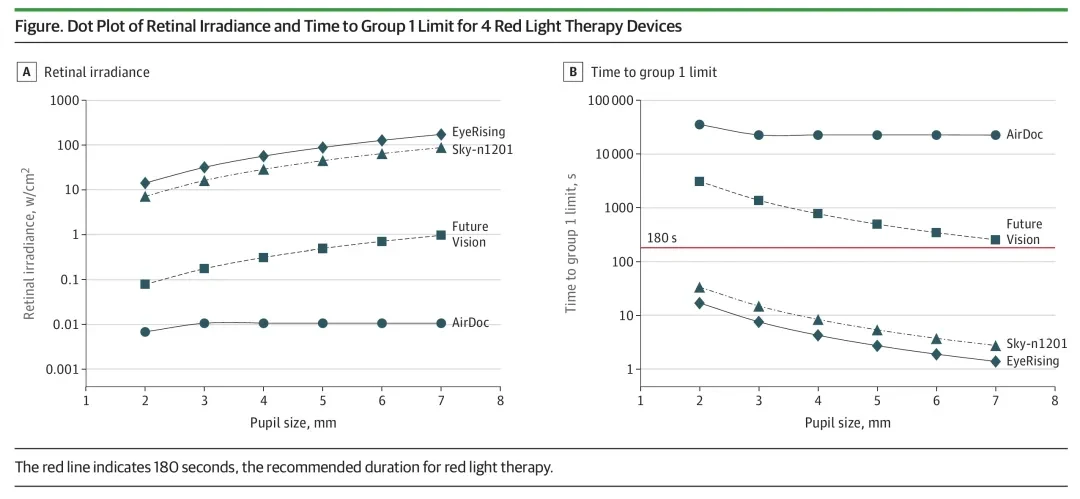
The core metrics of interest to the researchers are based on the ANSI Z80.36-2021 Standard for Ophthalmic Instruments,Exposure Time Required for the Device to Reach Group 1 Safety Limits—namely, how long continuous fixation takes to reach the safety threshold.
Laser devices (Sky-n1201, Runer Health, EyeRising):
EyeRising: Under a 7 mm pupil condition, the Level 1 safety limit is reached in 1.4 seconds; the standard treatment duration of 180 seconds exceeds the Level 2 limit (when the pupil diameter is greater than 5.6 mm).
Sky-n1201: Under a 7 mm pupil condition, the Class 1 limit is reached in 2.8 seconds, classifying it as a Class 2M laser product.
Future Vision: Under a 7 mm pupil condition, the Class 1 limit is reached at 253 seconds, and the treatment duration of 180 seconds complies with the ANSI Group 1 standard.
LED-type devices (AirDoc):
Under a 7 mm pupil condition, the Class 1 limit is reached at 22,761 seconds (approximately 6.3 hours), classifying it as a Group 1 ophthalmic instrument.
Researchers also found that there were orders-of-magnitude differences in retinal irradiance among different devices—EyeRising exhibited retinal irradiance approximately 17,000 times higher than that of AirDoc in the study.
These results suggest that,Even with identical wavelengths, differences in light energy distribution and output methods across devices may result in varying safety windows.。
The aforementioned data are all measurement results obtained under the laboratory condition of "continuous fixed gaze." The study authors explicitly stated that this condition represents an extreme laboratory setting and is not entirely equivalent to real-world clinical environments.
# Analysis of Causes for Discrepancies
Research suggests that,The difference mainly stems from the nature of the light source.。
Lasers are coherent light sources with energy highly concentrated in a small area, whereas LEDs are extended light sources with more dispersed light energy distribution. This directly determines the order-of-magnitude difference in retinal irradiance.
Although the two technological approaches have similar wavelengths, their patterns of energy deposition on the retina differ.
The study authors also emphasized that the experimental conditions represent an extreme laboratory scenario of "continuous fixed gaze," which is not entirely equivalent to real-world clinical environments. Ocular movements in children, such as blinking and microsaccades, alter energy distribution; therefore, experimental results cannot be simply equated with clinical risk. Due to the point-source nature of coherent lasers, their theoretical risk of photothermal or photochemical injury is higher than that of extended light sources.
# What Do These Differences Mean?
Compared with comparing different products, the greater significance of this study lies inIt has prompted the industry to focus on safety design itself.。
From an engineering perspective, the safety margins of different light source designs vary in width, providing a reference basis for equipment selection and product iteration.
Significant Differences Also Exist Within Laser Devices, Future Vision’s 253-second window is approximately 180 times that of EyeRising’s 1.4-second window, indicating that laser devices can enter different safety ranges through power optimization;
LED solutions demonstrate a prolonged theoretical safety window under laboratory conditions, but clinical efficacy data regarding its role in myopia prevention and control still need to be further accumulated. There is no necessary correlation between the width of the safety window and clinical efficacy.
In recent years, the field of red light therapy has focused more on efficacy data. However, as products enter a stage of larger-scale application, merely proving effectiveness is no longer sufficient.
How to expand the safety window? How to reduce local energy deposition through power optimization? How to enhance active safety capabilities by utilizing pupil monitoring, gaze tracking, and automatic interruption mechanisms? How to establish a long-term safety database?These issues may be becoming the technical propositions that need to be addressed in the next phase.
# What Does It Mean for the Industry?
In June 2023, the National Medical Products Administration (NMPA) reclassified laser-based myopia and amblyopia treatment devices from Class II to Class III (high-risk medical devices), granting a one-year transition period with formal implementation effective July 1, 2024. LED-based myopia control devices remain regulated as Class II medical devices and are unaffected by this reclassification.
Meanwhile, the 2024 edition of the Guidelines for Myopia Prevention and Treatment updated the measures for myopia correction and control, adding evidence-based interventions such as orthokeratology lenses, multifocal soft contact lenses, and low-concentration atropine eye drops, but did not include red light therapy.
It should be noted that Class III management represents more stringent approval requirements and more comprehensive safety evidence requirements, and products certified under Class III have a more complete safety profile in a regulatory sense.The distinction between Class II and Class III classifications reflects differences in regulatory pathways and risk management levels, and should not be directly equated with a hierarchy of product safety.。
For companies that are laying out or iterating their products, research has revealed several areas for improvement worth exploring:
Light Source Engineering: LED extended light sources demonstrate a prolonged theoretical safety window under laboratory conditions, but issues regarding illumination uniformity and energy density need to be addressed. Ring arrays, diffuse optical design, and precise wavelength modulation (optimized within the 650–665 nm range) represent one engineering pathway, though their clinical efficacy remains to be verified.
Intelligent Safety System: In addition to static power limits, a dynamic monitoring mechanism is introduced—real-time pupil diameter recognition (automatic power adjustment for dilated pupils), gaze tracking (warnings or interruption when fixation exceeds time limits), and recording of single and cumulative doses. These features add dynamic response capabilities beyond static power limits, but their reliability in real-world usage scenarios needs to be verified.
Clinical Validation Upgrade: Beyond short-term efficacy data, a more comprehensive safety monitoring system must be established, including high-resolution adaptive optics imaging (to detect subclinical changes), multifocal electroretinography (to assess local function), and longitudinal cohorts with follow-up of more than 2 years (to observe long-term effects). These investments are essential for Class III registration and form the basis for product technological differentiation.
# Eye Future Observation
The significance of this JAMA study lies in the questions it raises. The research suggests that even with the same 650 nm red light, different optical designs can result in distinct energy distributions and safety margins. For the industry as a whole, the dimensions of future competition are expanding: efficacy in controlling axial length is merely the entry ticket; the key determinant of a product’s longevity will be the ability to widen the safety window while maintaining therapeutic efficacy, and to build more robust long-term evidence.
The experimental data, technological directions, and industry observations cited in this article are based on publicly available academic literature and regulatory policy documents, and do not represent the stance of the author or the publishing institution toward any specific product, technological pathway, or enterprise.Performance of devices based on different technological approaches may vary in real-world clinical settings; experimental data cannot replace individualized medical decision-making.
Source:https://jamanetwork.com/journals/jamaophthalmology/fullarticle/2844586?guestAccessKey=420f86ff-3c0e-44c1-90ba-988121136633&utm_source=twitter&utm_medium=social_jamaopht&utm_term=19948183956&utm_campaign=article_alert&linkId=924101563

Ophthalmic Solutions Case Studies