Keya Medical Secures FDA Clearance for AI-Powered Coronary Plaque Analysis Tool
Keya Medical
International AI Medical Technology Service Provider

Cardiovascular disease has long been the “number one killer” threatening the health of the Chinese population.
Many people undergo annual physical examinations and cardiac screenings, yet still fail to detect latent vascular risks—the core issue lies in:Traditional examinations lack sufficient detail, risk prediction is insufficiently accurate, and screening processes are not convenient enough.
In July 2026, a major medical breakthrough made headlines across the global cardiovascular community!
Keya Medical’s New AI Coronary Plaque Analysis Tool Officially Receives U.S. FDA Clearance!
This means that this domestically developed, self-researched cardiac AI diagnostic technology has once again secured an authoritative pass to the world’s most stringent medical market, bringing a disruptive upgrade to global coronary heart disease screening and risk assessment!
01 One CT Scan! Achieve Dual Assessment of Cardiac "Anatomy + Function"
Prior to this, cardiovascular examination has long faced a persistent challenge:Assessing structure and testing function often require separate examinations, which are time-consuming, labor-intensive, and increase inspection costs.
Many patients who undergo routine coronary CT scans can only receive a rough assessment of whether their vessels are narrowed or have plaques, but cannot accurately determine the risk level of the plaques or whether they will cause myocardial ischemia. To further evaluate vascular function, invasive examinations are often required, which not only involve complex procedures but also impose additional burdens on the body.
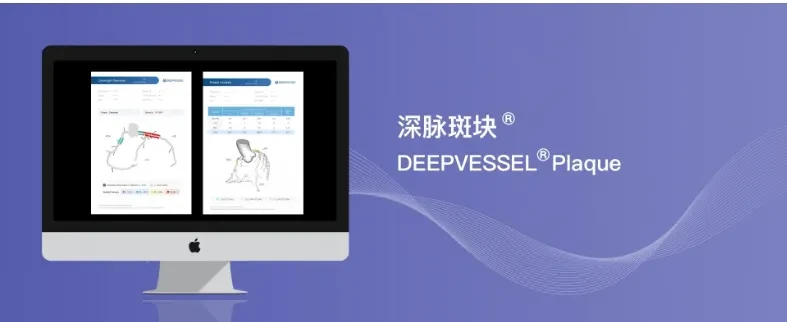
And Keya Medical’s recent approval ofDeepVessel Plaque AI Quantitative Analysis Technology, completely breaking down this barrier!
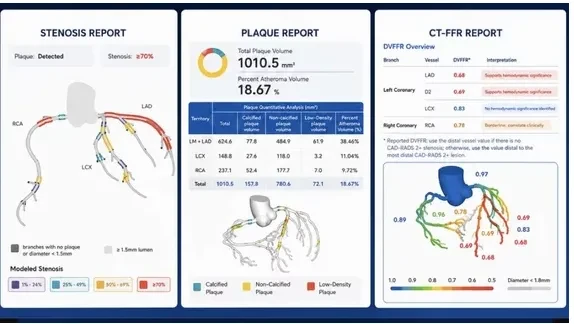
Combined with its FFR-CT coronary functional assessment algorithm, which received FDA clearance as early as April 2022, this AI system has now achieved a major breakthrough in the industry:A single non-invasive coronary CTA scan simultaneously enables anatomical analysis of cardiac vessels + hemodynamic functional assessment!
No need for multiple imaging scans or invasive procedures; a single examination comprehensively screens for core risks in cardiac vessels, thoroughly addressing the limitations of traditional methods—namely, their fragmented nature, cumbersome process, and insufficient accuracy.
02 AI Precisely Quantifies Plaque, Bidding Farewell to "Vague Judgments"
The most perilous aspect of coronary heart disease has never been "mild vascular stenosis," but ratherOccult High-Risk Plaque。
Some plaques, though small in volume, are unstable and highly prone to rupture, potentially triggering myocardial infarction or cerebral infarction; in contrast, certain calcified plaques, although larger in size, pose a relatively controllable risk. Traditional manual image interpretation relies heavily on physicians’ individual experience, making it difficult to accurately quantify and differentiate plaque types and associated risks, which frequently leads to missed diagnoses and misdiagnoses.
And this AI tool has achieved cardiac plaque assessmentRefined, data-driven, and standardized.
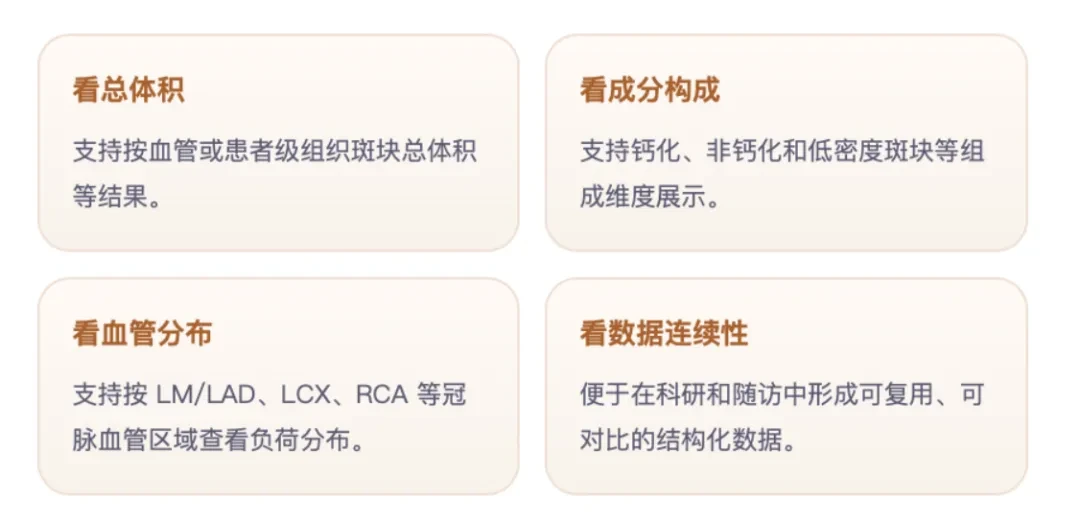
It can automatically generate professional and comprehensive plaque analysis reports, accurately calculating multiple core metrics:
Total Plaque Volume
Precise Segmented Quantification of Calcified and Non-Calcified Plaques
High-Risk Low-Density Plaque Volume (Core Trigger for Myocardial Infarction)
Overall Plaque Burden
Single-Vessel Segmentation + Whole-Patient Global Risk Stratification
In addition, system reports can be automatically generated.CAD-RADS Standardized Grading of Coronary Artery Disease, combined with AI-powered intelligent visualization maps for vascular and lumen segmentation, the lesion location, degree of stenosis, and risk level are all clear at a glance, enabling even ordinary patients to quickly understand the core examination results.
03 Backed by Authoritative Clinical Evidence! Diagnostic Accuracy Rivaling Top-Tier Experts
Securing the rigorous FDA approval is far from a mere gimmick; it is underpinned by robust multi-center clinical validation studies conducted in the United States.
Core clinical data supporting this approval demonstrate:The quantitative plaque analysis and vascular stenosis assessment results of DeepVessel Plaque are highly consistent with the collective judgments of top global cardiovascular experts.
This means that the diagnostic accuracy of this AI tool has reached a level comparable to that of top cardiovascular specialists worldwide, while perfectly avoiding fatigue-induced errors and experience-based biases associated with manual image interpretation, resulting in more stable, precise, and standardized diagnostic outcomes.
The full findings of this study will be officially released at the SCCT 2026 International Cardiovascular CT Conference, to be held in San Diego this year, where they are expected to draw significant attention from the global cardiovascular medical community.
Matthew Budoff, Professor at the Lundquist Institute and lead investigator of this study, stated bluntly:
“This AI tool enables more precise identification and quantification of coronary plaques, facilitating refined patient risk stratification and making preventive treatment for heart disease more accurate and efficient.”
04 Reshaping the Landscape of Cardiovascular Screening! Early Detection, Early Intervention, and Traceability
From the perspective of top global cardiovascular experts, the widespread adoption of this AI technology is far more than just the addition of a new diagnostic tool; rather, it isFundamentally restructure the underlying logic of screening and clinical diagnosis and treatment for coronary heart disease.
Traditional cardiac examinations are mostly "treat after detection," representing passive diagnosis and treatment; whereas this AI system truly achieves proactive prediction, dynamic monitoring, and personalized diagnosis and treatment.
Its core value is manifested in two key scenarios:
1. Detect hidden lesions in advance to enable ultra-early intervention
Many patients with early-stage coronary heart disease exhibit no symptoms, yet atherosclerotic plaques are silently forming and progressing slowly. AI can precisely quantify plaque characteristics and risk, proactively identifying high-risk threats that are difficult for humans to detect, thereby enabling preventive interventions before lesion deterioration and fundamentally reducing the risk of myocardial infarction and sudden cardiac death.
2. Dynamically track disease progression and accurately assess treatment efficacy
For patients with confirmed coronary artery disease undergoing interventional treatment, repeated CT follow-ups combined with AI-based comparative analysis enable precise monitoring of plaque stability, regression, or progression. This approach provides intuitive validation of the efficacy of pharmacological and clinical interventions, assisting physicians in timely optimization and adjustment of personalized diagnosis and treatment plans.
05 Chinese-Made AI Goes Global with Hard Core Strength! Showcasing China’s Medical Technology Prowess
It is a source of national pride that Keya Medical, the recipient of this FDA clearance, is by no means an ordinary sci-tech innovation enterprise, but rather a **leading benchmark company and industry pioneer** in China’s AI-driven cardiovascular medical sector.
Keya Medical, established in 2016, is a national-level high-tech enterprise in ChinaThe First Company to Hold a Class III Medical Device Certificate for AI, thoroughly breaking the early monopoly of overseas AI medical technologies in the domestic market. The company has been deeply engaged in the field of precision cardiovascular diagnosis and treatment for many years, focusing on empowering medical imaging diagnosis with artificial intelligence and big data technology. It concentrates on early screening, precise diagnosis, and efficacy evaluation of cardiovascular and cerebrovascular diseases such as coronary heart disease, addressing clinical real needs and solving pain points and challenges in traditional cardiovascular diagnosis and treatment.
Leveraging a top-tier R&D team (including multiple overseas-educated PhDs and senior industry technical experts), Keya Medical has not only participated in the formulation of the National Medical Products Administration’s industry standards for AI-based medical devices and won numerous national and municipal medical technology awards, but also completed its global qualification layout. As one of the very few companies in the industry and the first in China to simultaneously possessChina NMPA, US FDA, EU CE, Singapore HSAA cardiovascular AI healthcare enterprise with multiple authoritative certifications, whose technological prowess, product safety, and efficacy have gained consistent recognition from healthcare systems in many countries worldwide.
Keya Medical has cultivated deep roots in both the Chinese and U.S. markets, adhering to independent research and development of core technologies while maintaining a long-term focus on the niche of AI-driven precise diagnosis for coronary arteries. From the FDA clearance of its FFR-CT hemodynamic assessment algorithm in 2022 to the recent approval of its DeepVessel Plaque analysis technology, Keya Medical continues to iterate its technologies, firmly establishing itself among the global leaders in AI-based cardiovascular diagnosis and treatment.
In the future, the widespread adoption of this technology will help countless patients worldwide overcome the various limitations of traditional cardiac examinations:Lower examination costs, shorter diagnosis and treatment cycles, more precise risk assessment, and personalized treatment plans.
Final Remarks
The core of cardiovascular disease prevention and control has never been passive treatment after onset, but rather precise prevention and scientific diagnosis and treatment.
The ultimate significance of AI in healthcare is to standardize and democratize top-tier medical resources, enabling every individual to access precise, efficient, and safe cardiac health screening services.
This latest FDA approval of domestically developed AI technology marks a significant breakthrough in China’s independent innovation in medical technology and delivers substantial benefits to cardiovascular patients worldwide. With the comprehensive empowerment of AI, early screening, diagnosis, and treatment of heart diseases will fully enter a new era characterized by precision and accessibility.


CCI Cardiovascular Physicians Innovation Club
Long-press the QR code to follow us
This Issue's Feature: Shen Li
Responsible Editor: Chen Baolin
Author of this article: Yunyexuan
Post-production: Zhang Lirong