Medical Device Regulatory Updates and Industry Developments – Daily Brief No. 4240, July 7, 2026

Skynor Medical
Vascular Minimally Invasive Intervention Product Developer

JD Health
Internet Medical and Health Service Platform Provider

yuwell
Developer and Manufacturer of Basic Medical Devices

Comprehensive Medical News
1. New NMPA Regulations on Clinical Trial Exemptions Benefit Class II Medical Device Registration
Recently, the National Medical Products Administration (NMPA) clarified the conditions for exemption from clinical trials for Class II medical devices in 2026, covering basic products such as blood glucose meters, electronic blood pressure monitors, and ultrasound equipment. The new regulations simultaneously optimize the pathway for equivalence comparison with predicate devices; manufacturers may apply for exemption based on data from already marketed similar products. Imported devices that have been approved in the United States, Europe, or Japan and have completed clinical trials in compliance with Good Clinical Practice (GCP) requirements may also submit overseas data to apply for exemption. The NMPA regularly updates the exemption catalog, and six major categories of Class II passive medical devices, including passive surgical instruments and neurovascular surgical instruments, have been fully incorporated into the exemption scope. (Source: Official Website of the National Medical Products Administration)
2. Approval of Intracranial Stents for Market Launch Fills the Gap in the Treatment of Wide-Neck Aneurysms
Recently, the National Medical Products Administration (NMPA) approved the market launch of an intracranial stent independently developed by Skynor Medical (Shanghai) Co., Ltd. This product is classified as an innovative medical device and is intended for use in conjunction with embolization devices to treat wide-necked saccular aneurysms in the anterior circulation of the brain. The stent features a closed-cell helical wire interlaced structure combined with a fully radiopaque design, providing more precise imaging navigation for interventional procedures and improving the success rate of surgeries for complex aneurysms. (Source: Official Website of the National Medical Products Administration)
3. Exporting Medical Device Companies Face Strict Regulatory Constraints Amid Multi-Country UDI Compliance Deadlines
July 2026 Becomes a Critical Milestone for Medical Device Export Compliance. The EU MDR UDI system became fully mandatory in May, prohibiting non-compliant products from entering the EU market; Switzerland’s UDI system was fully implemented in July, meaning customs clearance will be denied without compliant UDI; Australia’s TGA UDI requirements officially became enforceable in July, requiring imported devices to complete database registration and update labels for compliance. The Nanjing Municipal Administration for Market Regulation launched the “Director’s Service Express Lane” to provide local medical device companies with specialized guidance on overseas registration and compliance system development. (Source: Nanjing Municipal Administration for Market Regulation)
4. JD Health and Yuwell Launch 15-Million-Unit Smart Connectivity Initiative
JD Health and Yuwell Upgrade AI + Medical Device Partnership, Officially Launching Three-Year Plan for 15 Million Smart Connected Health DevicesRecently, JD Health and Yuwell further upgraded their collaboration in the field of AI-powered medical devices, officially launching a three-year initiative to connect 15 million smart health devices. Since establishing a comprehensive strategic partnership in March this year, the two parties have targeted a sales goal of RMB 10 billion over three years. Core categories saw significant growth in the first half of the year, with continuous glucose monitoring (CGM) systems and electrocardiogram (ECG) monitors registering year-on-year increases of over 200%, alongside the addition of 20 new JD-exclusive products. In the second half of the year, both sides will promote direct data connectivity between devices and the JD Health APP, achieving a full-chain upgrade from device connection and data management to health services. Yuwell ventilators will also be integrated into JD Internet Hospital and the HomeCare service system, streamlining the entire process of online consultations, device guidance, data interpretation, and follow-up management. Within three years, Yuwell is poised to become one of the leading brand partners in JD Health’s smart connected ecosystem in terms of the volume of directly connected devices. (Source: China Economic News Network)
5. Financial leasing companies enter the surgical robot sector with innovative leasing models
Financial leasing companies are accelerating their expansion into the medical equipment industry, with leased devices extending from large-scale imaging equipment to technology-driven and intelligent solutions such as surgical robots and exoskeletons. Data shows that China's medical equipment market reached 1.44 trillion yuan in 2025, a year-on-year increase of approximately 7%. With the price of a single surgical robot often reaching tens of millions of yuan, Zhongguancun Technology Leasing has introduced a "service leasing" model, allowing hospitals to pay based on the number of activations, thereby significantly reducing the burden of upfront procurement costs. Beijing Jishuitan Hospital has already planned to lease three orthopedic surgical robots with a budget of 9.3 million yuan. At the policy level, multiple departments in Beijing have jointly issued measures promoting innovative leasing models for surgical robots and incorporating them into the performance monitoring system for public hospitals. (Source: China Business News)
6. GE Healthcare Tianjin Branch Recalls Two Models of Magnetic Resonance Imaging Systems
NMPA Announces Voluntary Recall of MRI Systems by GE Healthcare Systems (Tianjin) Co., Ltd. Involving Specific Batch ModelsRecently, the National Medical Products Administration (NMPA) announced that GE Healthcare Systems (Tianjin) Co., Ltd. has voluntarily recalled certain magnetic resonance imaging (MRI) systems involving specific batch models. The recall was initiated due to potential safety hazards associated with the products, necessitating software upgrades or hardware replacements. The regulatory authority has advised healthcare institutions to promptly inspect relevant equipment, properly reschedule patient appointments, and cooperate with the manufacturer to complete the recall process. (Source: Official Website of the National Medical Products Administration)
7. R&D and Design Services Accelerate the Clinical Translation of Medical Research Achievements
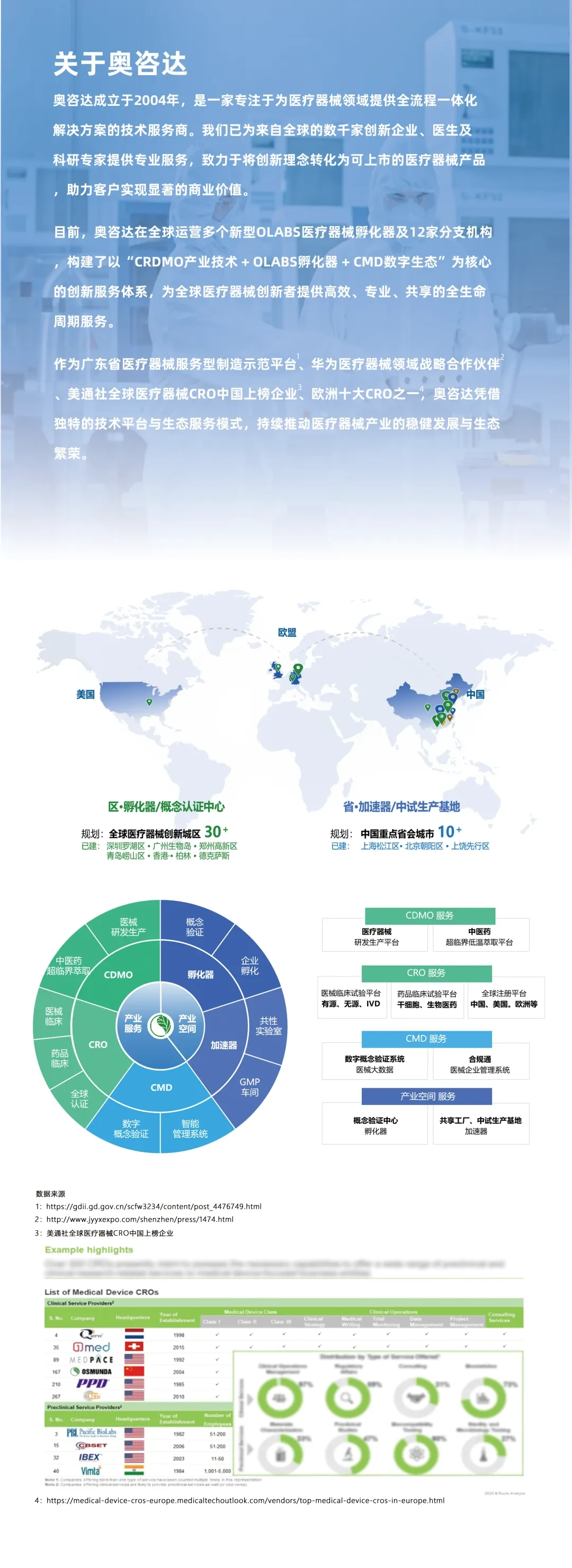
Medical device R&D is a complex and rigorous process involving multiple aspects, including technology, regulations, and clinical applications. OSCDA boasts a 20,000-square-meter sci-tech innovation center and has established a Medical Device Research Institute dedicated to the clinical translation of medical research achievements. It possesses a high-caliber, international, multidisciplinary team proficient in the entire lifecycle of R&D, regulatory affairs, clinical trials, registration, and manufacturing, capable of developing and producing various complex and innovative products. With extensive project experience and industry resources, OSCDA has constructed a standardized, regulated, and digitalized full-process service system. It provides one-stop services ranging from preliminary market research, product concept generation, and product design and development to prototype production and testing. To date, more than 200 projects have undergone review at OSCDA, with over 100 projects currently under development, achieving a 100% success rate in translation. (Compiled by OSCDA)
8. Gestalt Tech Secures 420 Million Yuan in Funding to Boost Ultrasound Brain-Computer Interface
Gestalt Tech, an early mover in China’s ultrasonic brain-computer interface (BCI) sector, announced the completion of a RMB 420 million Angel+ round of financing. The round was led by Huaying Capital, with participation from Sequoia China, Lens Technology, and CEC Health Fund, among others. This follows a RMB 150 million Angel round closed in March, bringing the company’s total funding to RMB 570 million within just six months of its establishment. The funds will be used to advance clinical trials for its first-generation product, which targets chronic pain management, with the goal of obtaining Class III medical device registration for its ultrasonic BCI system in the first half of 2028. (Source: Yicai)