

AI Virtual Cell Developer GENESIGHT Secures Tens of Millions of Yuan Seed Funding Led by Tsinghua Innovation Ventures

GENESIGHT
Developer of AI Virtual Cell (AIVC) Technology

Tsinghua Innovation Ventures
Professional Investment Institutions for Industrialization of Scientific and Technological Achievements
July 7—GENESIGHT, a native AI life sciences startup, has raised tens of millions of yuan in seed financing, with Tsinghua Innovation Ventures serving as the sole lead investor.
The newly secured capital will fuel development of three core competitive moats: proprietary datasets, proprietary AI models and clinical validation frameworks. It will further expedite the firm’s cooperation and commercial deployment alongside China’s highest-ranked tertiary hospitals, supporting its long-term strategic vision: constructing a full-stack life science operating system built on world models simulating human cellular behavior.
To date, GENESIGHT has established deep collaborative ties with numerous elite tertiary hospitals. It builds disease-specific, model-tailored closed-loop datasets leveraging tissue samples collected from real patients pre- and post-medication.
GENESIGHT has rolled out its technology across three commercial tracks. First, clinical patient stratification: it partners with GCP-certified clinical trial centers at top hospitals to support multiple treatment cohorts and drug pipelines. Second, monetization of modeling capabilities: it delivers target identification, drug repurposing and proprietary model tool services to domestic pharmaceutical enterprises and multinational corporations(MNCs). Third, data platform collaboration: automated sequencing continuously expands its high-quality training datasets, which in turn iterate and upgrade its foundational model architecture.
Startup Opportunity: Fundamental Flaws in the Traditional AI Drug Discovery Sector
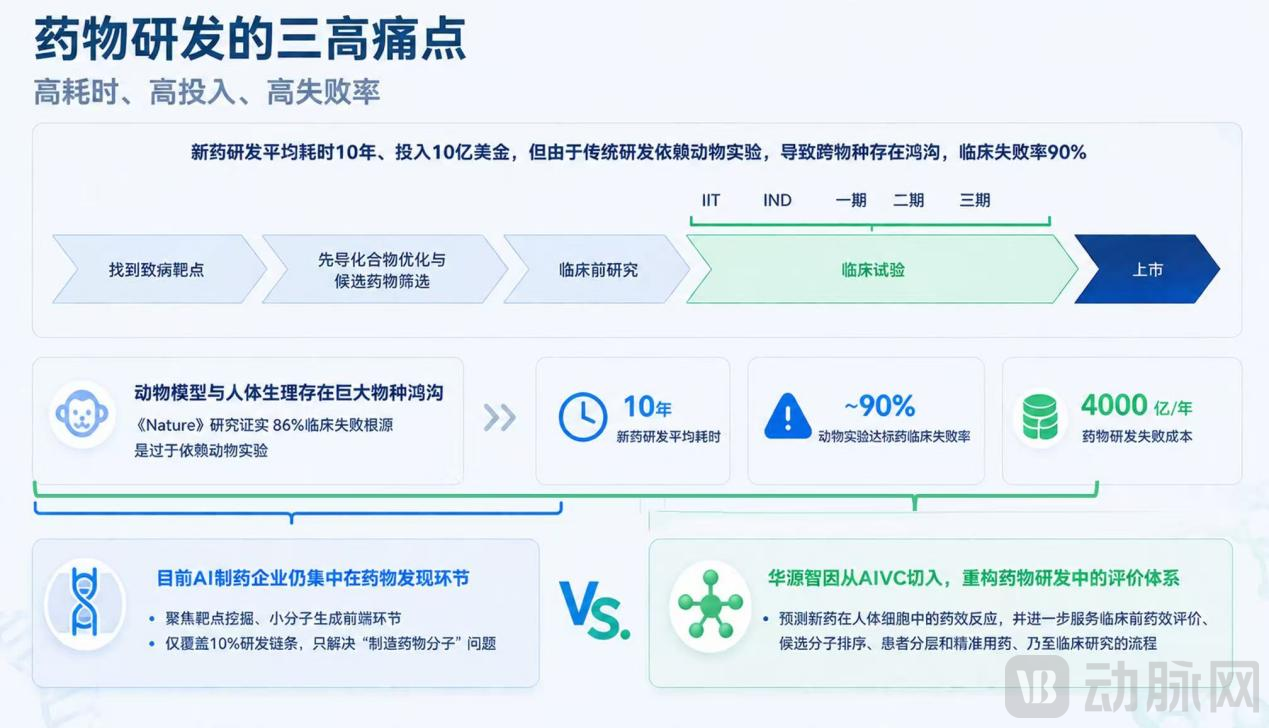
Global annual R&D spending on pharmaceuticals exceeds RMB 2 trillion, yet losses stemming from failed clinical trials hit RMB 400 billion annually. Research published in Nature confirms that 86% of new drugs fail clinical testing due to stark physiological disparities between human beings and animal models such as mice and primates. Roughly 90% of pharma R&D budgets are burned through Phase I to III clinical trials. Developing a single new medicine takes at least a decade and USD 1 billion, with clinical success rates lingering at merely 10%.
Most AI drug discovery players in the industry concentrate solely on early-stage target mining and molecular structure generation, covering just 10% of total R&D costs. Their technology only solves molecular creation, failing to answer the pivotal question: will a drug deliver tangible therapeutic effects inside the human body? This core challenge lies at the heart of GENESIGHT’s technological mission.
Since its founding, GENESIGHT’s founding team has shifted the industry’s focal point downstream: before massive, costly clinical trials kick off, its platform predicts candidate drugs’ efficacy responses inside human cells. Its technology further powers pre-clinical efficacy assessment, candidate molecule ranking, patient stratification and precision medicine. “Pharmaceutical firms can generate dozens of new molecular candidates on their own; what they truly crave is clarity on which molecule merits costly clinical investment,” said Du Runshi, Founder of GENESIGHT.
Under traditional drug development workflows, even candidates demonstrating strong performance in in vitro cell assays and animal studies often fail human trials, driven by systematic biological mismatches between animal models, organoids, cell lines and genuine human disease microenvironments. For drug developers, the steepest costs and highest risks emerge in clinical phases, not early molecular discovery.
GENESIGHT fills this critical industry gap. It does not position itself as a generic AI contract research organization(AI CRO), nor does it merely streamline early drug discovery workflows. Instead, it aims to overhaul the entire pharmaceutical efficacy evaluation system and emerge as the universal industry gold standard.
To draw an analogy: legacy AI drug discovery tools function as “key makers,” while GENESIGHT’s core value lies in testing whether each “key” turns smoothly inside the complex lock of the human body.
Overseas, the AI+life sciences sector has spawned a cohort of highly valued, well-capitalized enterprises.
Pioneers including Arc and CZI hold advantages in public transcriptomic dataset scale and open-source ecosystems. Following its merger with Exscientia, Recursion has expanded from phenotypic imaging to end-to-end drug development, with explicit plans for virtual cell and multi-omics platforms. Tempus AI has built a self-reinforcing data flywheel based on real-world clinical medical records, clinical texts, medical imaging and diagnostic offerings.
GENESIGHT differentiates itself sharply from these global peers. It is neither a pure clinical text data vendor nor an imaging-focused phenotypic enterprise. Instead, it builds an interpretable therapeutic efficacy prediction system built entirely on cellular multi-omics data.
The company’s leadership explains that clinical text and imaging data can only reveal final treatment outcomes yet struggle to unpack mechanistic root causes. Cellular multi-omics datasets, by contrast, dissect the biological mechanisms driving drug responses, delivering fundamental biological insights to guide pharmaceutical R&D decisions.
This philosophy underpins GENESIGHT’s core principle of “in vivo clinical alignment.” High-throughput in vitro screening data powers candidate filtering, while in vivo human therapeutic efficacy data calibrates model outputs, forming an endlessly iterative closed data loop.
Technical Route: From In Vitro Fitting to In Vivo Alignment, Building the Industry’s Only End-to-End Closed Loop Spanning In Vitro and In Vivo
GENESIGHT’s two flagship core products are UniOme, its multi-modal virtual cell data infrastructure, and Wise-Perturb, its intelligent drug perturbation platform.
Virtual cell technology simulates dynamic cellular states under diverse external stimuli. For instance, it models genome, transcriptome and proteome-level cellular shifts triggered by drug administration, and maps these molecular changes to ultimate therapeutic outcomes.
The industry’s biggest bottleneck, however, lies in data quality.
Conventional virtual cell models predominantly rely on engineered, standardized immortalized cell line datasets. While scalable for lab experiments, these cell lines have undergone years of laboratory passaging, losing unique individual patient signatures and failing to replicate the complex disease microenvironments present inside human patients.
GENESIGHT maintains that a virtual cell model’s performance ceiling stems not from model parameter count, but how closely its training data mirrors real clinical tasks and the diversity of biological samples incorporated.
The firm has pioneered a three-tier progressive data architecture: the base layer comprises single-cell and multi-modal foundational datasets; the middle layer covers gene and drug perturbation datasets; the top layer stores paired pre- and post-treatment in vivo efficacy data collected directly from human patients. The base layer defines full cellular profiles, the middle layer models cellular reactions to drug exposure, and the top layer calibrates models against authentic human medication response readouts.
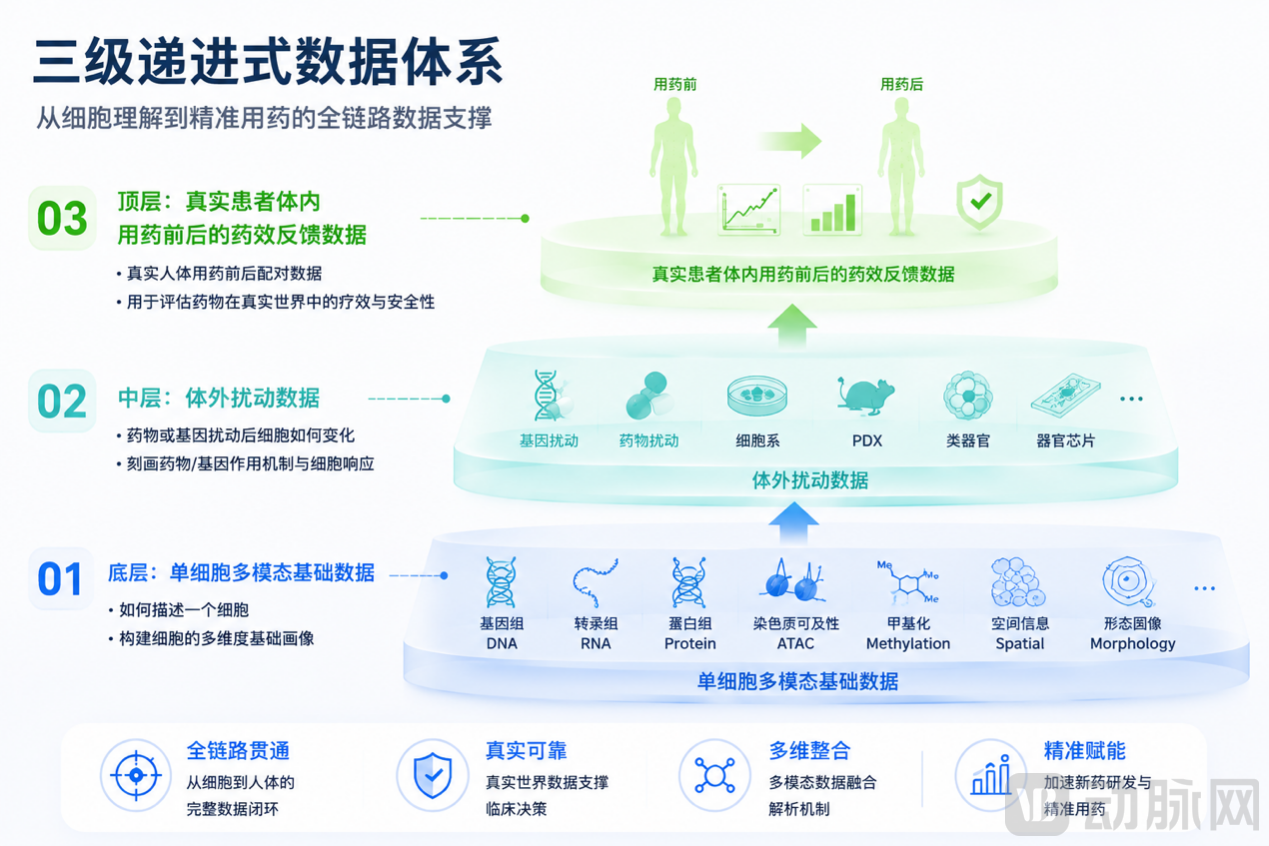
Most critically, GENESIGHT independently develops UniOme, the first proprietary high-throughput single-cell cross-modal sequencing technology. Traditional sequencing protocols destroy target cells, preventing simultaneous capture of DNA, RNA and protein data from a single cell; researchers are forced to splice datasets from separate cell populations, inherently introducing measurement noise. Through innovations in cellular preparation and sequencing workflows, GENESIGHT’s platform precisely aligns DNA, RNA and protein readouts extracted from one identical cell.
To simplify the analogy: legacy sequencing profiles a human subject only by weight, whereas UniOme captures height, skin tone, facial features and dozens of other dimensions simultaneously. For AI models, this multi-dimensional data enrichment delivers greater performance gains than simply expanding model parameter scale.
Traditional new drug screening relies on repetitive, labor-intensive wet lab experiments, featuring lengthy cycles, steep costs and frequent oversight of rare yet highly effective molecular candidates.
GENESIGHT’s proprietary workflow feeds multi-dimensional candidate compound encodings and target cell sequencing data into its platform to run virtual perturbation simulations. The system predicts full-transcriptome gene expression shifts post-drug exposure, calculates standardized therapeutic efficacy scores for each candidate, and ranks molecules by predicted performance.
Under this framework, pharmaceutical developers will first deploy GENESIGHT’s model to shortlist top-performing candidates, then advance only a small subset for physical lab validation, slashing experimental workloads and screening cycles.
Wise-Perturb supports predictive analysis covering roughly 20,000 genome-wide gene response profiles. Under uniform benchmark testing, its core predictive metrics outperform leading public international models by 40% to 130%. In trials using large proprietary internal datasets, the platform cuts prediction error for differentially expressed genes by approximately 41.77% and lifts correlation coefficients of gene expression variation by 129.43%, generating perturbation profiles far more consistent with physical biological lab results. Additionally, Wise-Perturb exhibits robust generalization capacity, enabling accurate zero-shot prediction across disparate drugs, cell types and patient populations.
“Meaningful performance metrics must be derived from real clinical contexts and underlying biological logic, not fine-tuned to overfit isolated datasets—this determines whether a model retains accuracy when tested on new drugs or patient cohorts,” commented Wang Yixuan, Chief Technology Officer of GENESIGHT.
Clinical Validation: World’s First, China’s Sole Platform Delivering Consistent Molecular & Human Clinical Outcome Prediction
GENESIGHT maintains deep cooperation with multiple top-tier tertiary hospitals, building disease-specific closed-loop datasets using patient tissue samples collected before and after medication administration.
In a joint research program with teams from the National Cancer Center/Cancer Hospital, Chinese Academy of Medical Sciences, GENESIGHT leveraged pre-treatment lung cancer patient samples and drug molecular structures to forecast treatment efficacy rankings for individual patients. The platform’s efficacy stratification outputs aligned closely with real clinical observations recorded by physicians across live patient treatment cohorts.
This case stands out beyond incremental benchmark gains on public datasets, as it validates the technology within authentic pre-clinical clinical decision workflows.
In a separate predictive trial for DS-8201 therapeutic response, GENESIGHT’s model—which had never processed DXD-related samples before—ran inferences using bulk RNA-seq expression data from PDX samples to rank candidate drug responses. The company stated that predictive rankings matched in vivo efficacy results from physical PDX model experiments, demonstrating robust zero-shot generalization across novel therapeutic indications and patient populations.
For pharmaceutical enterprises, this capability unlocks direct use cases including patient stratification and clinical trial enrollment management.
During innovative drug clinical trials, identifying patients most likely to respond to a therapy upfront raises trial success rates while eliminating unnecessary patient recruitment and resource waste.
Founding Team: A cross-disciplinary combination of top-tier talent in AI, virtual cells, and clinical resources
Du Runshi, Founder and CEO of GENESIGHT, was born in 2004 and attended undergraduate studies at UCLA. He suspended his studies after completing his third year to build the company and work full-time as an entrepreneur, with a track record of successive AI startup ventures and profound industry insights into AI-driven life sciences. Wang Yixuan, Chief Technology Officer, is a PhD candidate in Computer Science at the Chinese University of Hong Kong. He has long specialized in single-cell AI and drug perturbation prediction, having led model development for multiple domestic and global virtual cell startups, making him a rare native expert in virtual cell technology. Chen Cong, Chief Financial Officer, boasts over a decade of experience across the healthcare and biopharma sectors, with extensive industrial connections and a robust capital market network.
The two additional co-founders, Huang Shiyun and Zhuo Xinkai, attended Beijing National Day School alongside Du Runshi throughout middle and high school. Huang Shiyun, Chief Innovation Officer, earned her degree from UC Berkeley and participated in gene perturbation generative model training at world-class biomedical research institutions including the Gladstone Institutes and UCSF’s Theodoris Lab. Zhuo Xinkai, Chief Liaison Officer, holds an interdisciplinary academic background from Brandeis University, delivering quantitative analysis and commercial support for core business lines including therapeutic efficacy evaluation and target discovery.
“We are fortunate to assemble a team truly passionate about and rigorously skilled in virtual cell technology. Most team members hail from leading global labs and industry players in this niche. Our skill sets are highly complementary: technical R&D, algorithm design, proprietary data pipelines and industrial commercial resources each have dedicated, experienced leaders. Each team member stays focused on their core responsibilities while collaborating seamlessly, allowing us to advance at a rapid pace with minimal internal friction. We are also deeply grateful to senior academic and industry advisors including Professor Li Yu and Professor Jin Guoqing, who guide us to avoid common industry pitfalls,” Du Runshi noted.
For early-stage AI for Science startups, a balanced founding team configuration is pivotal: advanced modeling sets the performance ceiling, proprietary sequencing and data infrastructure build sustainable competitive moats, and hospital and pharmaceutical partnerships determine commercialization speed.
Unlike traditional AI CROs that rely on one-off service fees, GENESIGHT aims to align its revenue model more closely with core profit streams of pharmaceutical clients.
The firm currently operates across three commercial verticals: first, clinical patient stratification in partnership with GCP-accredited clinical trial centers at top hospitals for diverse treatment cohorts and drug pipelines; second, monetization of proprietary modeling tools via drug repurposing, target identification and platform subscriptions for domestic pharma firms and MNC clients; third, collaborative data platform development, where automated sequencing continuously expands high-quality training datasets to iteratively upgrade its foundational AI model base.
Looking ahead, GENESIGHT plans to build a comprehensive operating system for life sciences: a complete simulation framework for all biological reactions. Beyond simulating human cellular responses to pharmaceutical treatment, the platform will eventually model bodily physiological shifts triggered by everyday stimuli such as coffee consumption, positioning it as a foundational base model for the broader AI digital health sector.
“Building a business at the intersection of AI and life sciences was a carefully weighed decision,” said Du Runshi, GENESIGHT’s Founder. “My long-term vision for GENESIGHT is advancing health equity across human life. We aim to turn untreatable diseases into curable conditions, delivering certainty and peace of mind to patients and families navigating difficult treatment decisions, cutting down costly trial-and-error and premature loss of life.”