Beijing Releases Implementation Plan to Accelerate AI-Driven Scientific Research; DP Technology Strengthens AI for Science Infrastructure and Submits Prospectus

DP Technology
Simulation R&D Platform Developer
On June 30, 2026, the Leading Group for Education, Science and Technology, and Talent of the Beijing Municipal Committee of the Communist Party of China issued the “Implementation Plan for Accelerating the Empowerment of Scientific Research by Artificial Intelligence in Beijing (2026–2028)” (hereinafter referred to as the “Implementation Plan”). The plan systematically deploys initiatives across areas including the development of autonomous laboratories, application of benchmark scenarios, construction of scientific models, provision of scientific data, and cultivation of an innovation ecosystem, thereby comprehensively promoting the innovative development of AI for science.
The “Implementation Plan” centers on five major directions, encompassing 18 specific tasks such as establishing autonomous laboratories, promoting the intelligent upgrading of major scientific and technological infrastructure and research instruments, and developing intelligent agents and toolkits for scientific research:
First, accelerate the development of an independent laboratory system.Coordinate the construction of autonomous laboratories, the intelligent upgrading of major scientific and technological infrastructure and research instruments, and the research and development of scientific research agents and toolkits. Create intelligent experimental platforms capable of autonomous operation across the entire workflow, establish a new paradigm of dry-wet closed-loop scientific research with bidirectional feedback between computation and experimentation, and build autonomous laboratories equipped with capabilities for autonomous perception, decision-making, and execution. Complete the iterative upgrading and open sharing of a batch of major scientific and technological infrastructure.
Second, promote benchmark applications in high-value scenarios.Focusing on six key areas—high-energy physics, materials science, healthcare, life sciences, quantum technology, and biological breeding—we are strategically deploying intelligent research initiatives to establish benchmark scenarios. This approach aims to accelerate the generation of innovative outcomes, leveraging artificial intelligence to empower fundamental frontier research and industrial R&D, thereby shortening development cycles and reducing experimental costs.
3. Strengthen the hierarchical collaborative scientific model system.By adopting a three-tiered progressive layout encompassing foundational theories, general-purpose scientific foundation models, and specialized domain-specific models, we aim to breakthrough core technologies such as multi-scale modeling and novel neural networks. This approach promotes the deep integration of AI models embedded with physical laws and traditional scientific computing, establishes a collaborative adaptation mechanism between foundation models and specialized models, achieves significant original breakthroughs in foundational theories and key technologies for AI-empowered scientific research, and builds a “foundation model + specialized model” collaborative scientific modeling system that aligns with international top-tier standards.
Fourth, consolidate the foundational infrastructure for standardized scientific data.Coordinate the development of scientific data centers, improve Beijing’s scientific data management system, and consolidate multi-source research data resources; establish an intelligent scientific data processing tool system to create high-quality, standardized, and reusable foundational scientific datasets in basic disciplines.
Fifth, foster an open innovation ecosystem.By integrating four key initiatives—namely, the recruitment and cultivation of interdisciplinary talent, international scientific and technological exchange and cooperation, regional coordination, and computational power assurance—we will establish a global academic exchange platform, coordinate and allocate Beijing’s computational resources, and construct an integrated support system encompassing talent, computing power, and open collaboration. This will foster a scientific intelligence innovation ecosystem characterized by the aggregation of high-end talent, open-source openness and sharing, and deep integration of industry, academia, research, and application.
As evident from the aforementioned deployment, the development path for AI in science outlined in the Implementation Plan covers the entire workflow of scientific research, from problem formulation and knowledge acquisition to model computation, experimental validation, data accumulation, and output of results. Over the years, DP Technology has continuously advanced its layout in technologies, products, and services centered on AI for Science. Guided by its mission to “accelerate scientific discovery and unlock scientific value,” the company is committed to building AI Scientists and intelligent systems capable of autonomous scientific discovery.
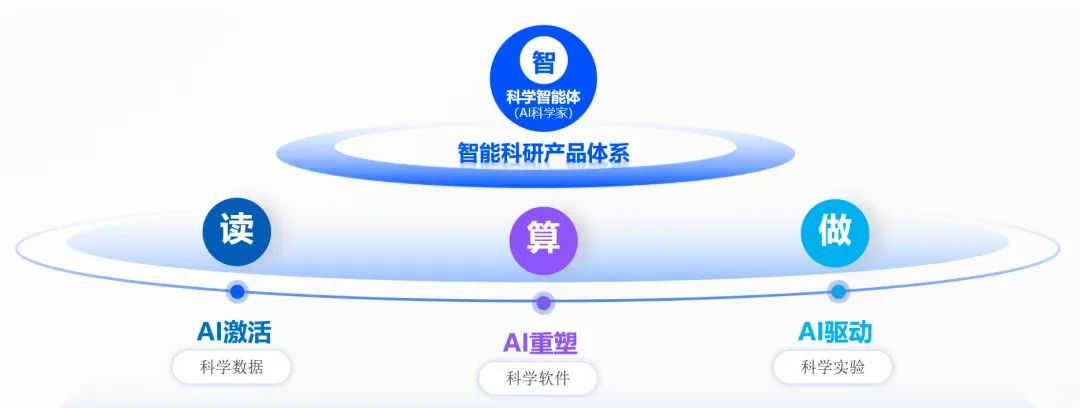
In response to the infrastructure needs for AI-empowered scientific research and the long-term vision of AI scientists, DP Technology has developed a suite of AI for Science R&D infrastructure based on its “DeepModeling·Universe” intelligent engine for scientific discovery. Bohr·Science Navigator supports researchers throughout the workflow from problem formulation to output, covering tasks such as scientific query retrieval, literature tracking, paper reading, review writing, and scientific figure generation. Bohr·Science Encyclopedia focuses on data and literature, serving as an “autonomously evolving” knowledge system that provides a robust and reliable foundation of scientific data for research. Intelligent R&D platforms such as Hermite and Piloteye offer intelligent computing and R&D tools for fields including life sciences and physical sciences. Bohr·Transition Laboratory addresses experimental processes in the real physical world, integrating the complete research loop of “reading, computing, and doing” to advance the development of intelligent experimental capabilities.
Meanwhile, DP Technology has also launched SciMaster, a scientific AI agent for basic research; PharmMaster, a medicinal chemistry AI agent for the field of pharmaceutical chemistry; MatMaster, a materials science AI agent for materials R&D; and BioMaster, an AI agent for life sciences, among other vertical-domain research AI agents.Continue to advance the practical implementation and application of AI for Science in specialized vertical domains such as drug discovery, materials design, and life sciences research.
In terms of innovation ecosystem and talent cultivation,DP Technology’s Bohr Singularity Classroom is dedicated to empowering the educational ecosystem,Covering the full spectrum of educational scenarios—“teaching, learning, practicing, competing, and evaluating”—to cultivate interdisciplinary innovators adapted to the development of AI for Science.Talent.Additionally,DP Technology has always supported the construction of an open-source and open ecosystem, currentlyProviding a continuous stream of momentum for the cultivation of interdisciplinary research talent and the open-source community.
Under the systematic deployment and policy guidance of the “Implementation Plan,” DP Technology will further deepen technological innovation and scenario-based application, continuously promote the deep integration of artificial intelligence with scientific research, accelerate the transformation of scientific research paradigms, and contribute to Beijing’s development into a globally influential hub for AI-driven scientific innovation.
About DP Technology