BioMap Showcases AI Foundation Models for Virtual Cell Research at HKUST's 'The Frontier of Biotech' Symposium

BioMap
Developer of Innovative Drug R&D Platform
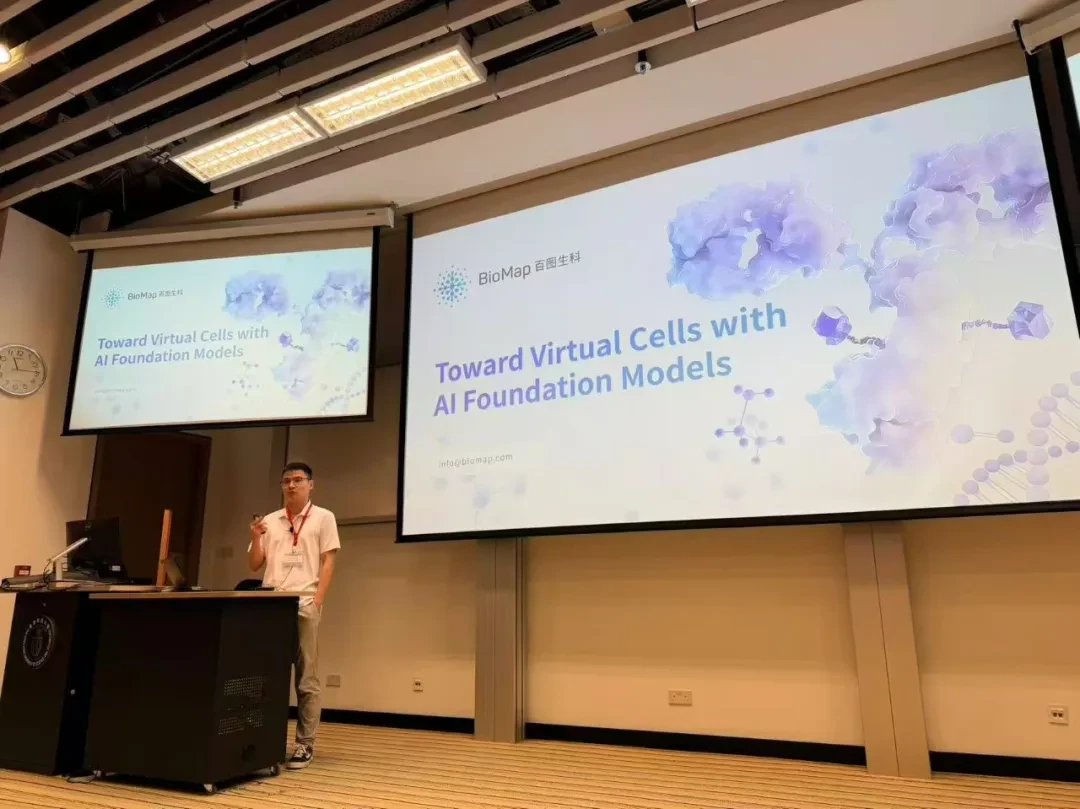
2026Year6Month28Sunrise30Day, hosted by The Hong Kong University of Science and Technology“The Frontier of Biotech: From System Biology to Whole Cell Methodology”The academic symposium was successfully held on the campus of HKUST. The event brought together experts, scholars, and young researchers from the fields of systems biology, biophysics, computational biology, and artificial intelligence to jointly explore frontier trends in the deep integration of AI and life sciences.
As a pioneer in global foundational large models for life sciences,BioMapBioMap was invited to share insights at this symposium. BioMap Solutions ExpertDr. He Zhaoren published a paper titled "Toward Virtual Cells with AI Foundation Models》academic presentation, sharing BioMap'sAILatest Advances and Technical Insights in the Field of Virtual Cell Research.
From Correlation Analysis to Causal Modeling
AILarge Models Initiate a New Paradigm in Virtual Cell Research
Dr. Zhao Zhaoren pointed out in his speech,The rapid advancement of large-scale biological foundation models and multimodal omics data is driving virtual cell research toward a critical turning point.Traditional bioinformatics analyses are largely based on correlational statistics, making it difficult to truly understand the causal mechanisms underlying changes in cellular states. BioMap, through the construction ofxTrimoLife Science Foundation Model Family——Including protein language modelsxTrimoProtein、DNAModelxTrimoDNA. Genomic Regulation ModelxTrimoGenomeand single-cell foundation modelsscFoundation, systematically enhancing multimodal cross-scale representation and reasoning capabilities from the molecular to the cellular level.
Dr. He provided a detailed overview of BioMap’s technological evolution in virtual cell modeling: starting from single-cell pre-training and progressively advancing to cell models equipped with perturbation-awareness and morphology-awareness capabilities.By deeply integrating prior biological knowledge with foundation models, the model achieves significant improvements in causal reasoning and generalization to unknown perturbations.This technological breakthrough provides a novel tool for understanding disease-related mechanisms and predicting cellular responses to drug perturbations.
In the latter part of his speech, Dr. He candidly sharedCore Technical Challenges in Virtual Cell Research——Causal Inference, Differentiation between Biological Noise and Technical Noise, and Establishment of Evaluation Metrics.He pointed out that the challenge of virtual cell models lies not only in scaling up parameter size, but more importantly in extracting verifiable causal relationships from single-cell, multi-omics, and phenotypic data that primarily exhibit correlations, thereby enabling inference of unknown cellular states and responses under unobserved perturbations. Meanwhile, current omics technologies still commonly suffer from noise such as batch effects, dropouts, sampling bias, and platform differences; therefore, models must maintain robust generalization by distinguishing biological signals from technical noise.
Regarding model evaluation, Dr. He stated that the metric design for virtual cell models should not be limited to reconstruction error or correlation coefficients. Instead, it should incorporate dimensions such as perturbation response prediction, cross-dataset generalization, mechanistic consistency, and experimental verifiability to assess whether the model truly possesses interpretable and generalizable virtual cell capabilities. He emphasized that constructing a truly"Available"virtual cells, which must rely on the accumulation of high-quality data and the integration of a closed loop between dry and wet experiments. Currently, BioMap has launchedAIBioMap-Driven Life Science Discovery SystemBioMap OS, integrating knowledge assistants, prediction and design, intelligent experiments, and data and model training into a complete closed loop to provide infrastructure for next-generation life science discovery.
In his speech, he also showcased BioMap’s2025YearWorld Virtual Cell ChallengeInterim data from internal projects for the cell model that ranked first demonstrate that this model can provide more actionable computational support for drug perturbation prediction, target mechanism analysis, and experimental prioritization.
Deep Roots in Hong Kong, Building TogetherAILife Science Ecosystem
BioMap2024In [Year], established a partnership with Hong Kong Investment Management Co., Ltd. and set up an International Innovation Center in Hong Kong (BioMap InnoHub) has continued to deepen its collaboration with Hong Kong universities and research institutions. BioMap’s invitation to deliver a speech this time not only marks a continuation of its academic exchanges with The Hong Kong University of Science and Technology, but also demonstrates the company’s commitment to promoting Hong Kong’s development asAIContinuous efforts to build a highland for bio-computation innovation. BioMap will continue to leverage itsxTrimoFoundational Large Model for Life Sciences andBioMap OSDry-Wet Closed-Loop Discovery System, Collaborating with Global Research Institutions to Explore TogetherAIBoundless Possibilities in Drug Design, Synthetic Biology, and Disease Mechanism Research