

TIDES Weekly Report: Sarepta's DMD Therapies Receive FDA sNDA Acceptance; CSPC and AstraZeneca Announce $1.77B siRNA Collaboration
CSPC
Innovative Drug Research and Development, Manufacturer

AstraZeneca
Pharmaceutical Technology Research and Development Provider
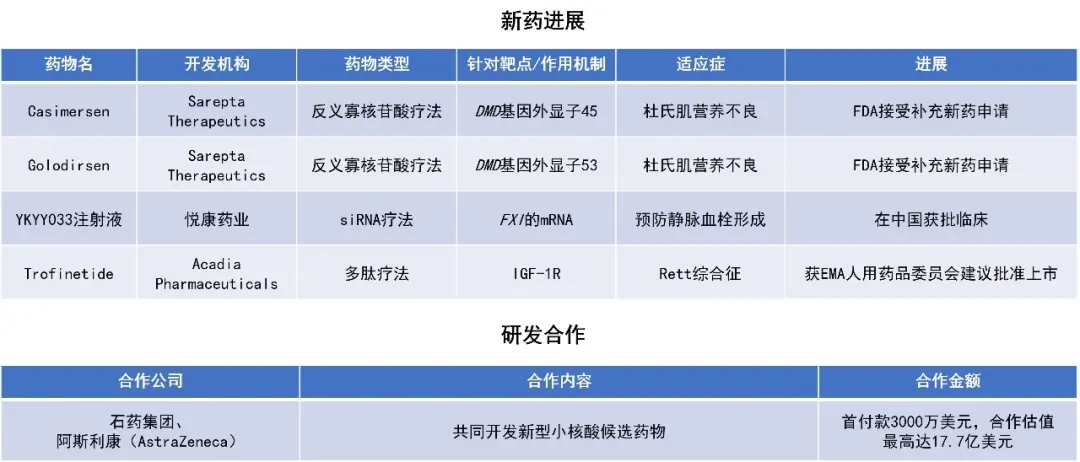
RecentPhase,FullBallMultiplePeptideandOligoNucleusGlycosideAcid (TIDES)CollarDomainWelcomeComeSystemColumnEnterExhibition. The U.S. FDA has accepted two antisense oligonucleotide drugs for Duchenne muscular dystrophy (DMD)Supplemental New Drug Applications (sNDAs) for the ASO drugs Amondys 45 (casimersen) and Vyondys 53 (golodirsen). CSPC reaches $1.77 billion small nucleic acid drug collaboration with AstraZenecaThe European Medicines Agency’s (EMA) Committee for Medicinal Products for Human Use (CHMP) has recommended granting marketing authorization for Daybu (trofinetide) for the treatment of neurobehavioral symptoms associated with Rett syndrome.This article will excerptSelect the middle sectionA Brief Overview of Significant AdvancesIntroduction, for readers' reference only.
Casimersen, Golodirsen: FDA Accepts Supplemental New Drug Applications
Sarepta Therapeutics Announces FDA Acceptance of sNDAs for Amondys 45 (casimersen) and Vyondys 53 (golodirsen) for Duchenne Muscular Dystrophy, Seeking Conversion from Accelerated to Full Approval; PDUFA Date Set for February 28, 2027Both drugs utilize Sarepta’s proprietary phosphorodiamidate morpholino oligomer (PMO) chemistry and exon-skipping technology, targeting respectivelyDMDPatients with gene mutations suitable for exon 45 and exon 53 skipping therapy are treated by promoting the production of truncated dystrophin.
This application is based on the confirmatory study data from ESSENCE, a substantial body of published real-world evidence, and the favorable and consistent safety profiles of the two exon-skipping therapies. In the ESSENCE studyAt Week 96,Multiple post-hoc analyses showed that treatment was associated with increased dystrophin expression levels and a slower decline in four-step stair climbing ability., and it was well tolerated during the 144-week dosing period, with no new safety signals identified. Furthermore, a substantial body of published real-world evidence further supports its clinical benefits: golodirsen treatment is associated with a 7.5-year delay in the need for nocturnal ventilation, while casimersen treatment shows a statistically significant correlation with a marked slowing of pulmonary function decline.Data from the overall PMO therapeutic pipeline also indicate that the treatment confers multi-year survival benefits, delays loss of ambulation by 3 to 4 years, significantly reduces the risk of left ventricular ejection fraction falling below 55%, and markedly decreases emergency department visits and hospitalizations.
CSPC and AstraZeneca Reach $1.77 Billion Collaboration on Small Nucleic Acid Drugs

CSPC Announces Collaboration, Option, and License Agreement with AstraZeneca to Establish R&D Partnership and Develop Novel Small Nucleic Acid Drug Candidates Using CSPC’s siRNA Drug Discovery Platform and Extrahepatic Targeted Delivery Platform
In accordance with the terms of this Agreement,CSPC and AstraZeneca will jointly discover and develop preclinical candidate (PCC) drugs targeting two specific targets, with the potential to treat multiple indications of kidney diseases.For each PCC project, AstraZeneca shall have the option to acquire exclusive rights for development, manufacturing, and commercialization either globally or outside China. CSPC shall retain the rights to develop, manufacture, and commercialize one of the PCCs in China.
CSPC will also receive an upfront payment of $30 million under the agreement and is entitled to receive potential R&D milestone payments of up to $540 million and potential sales milestone payments of up to $1.2 billion, among other amounts.
Trofinetide: Recommended for Approval by the EMA’s Committee for Medicinal Products for Human Use

Acadia Pharmaceuticals announced that the Committee for Medicinal Products for Human Use (CHMP) of the European Medicines Agency (EMA) adopted a positive opinion, recommending approval of the marketing authorization for Daybu (trofinetide), following a re-examination procedure.Indicated for the treatment of neurobehavioral symptoms associated with Rett syndrome in pediatric patients aged ≥5 years and adults.The press release noted that if the European Commission ultimately grants the marketing authorization, Daybu will become the first therapy approved in the EU for this indication. The European Commission will review this opinion and is expected to make a decision within the coming months.
Trofinetide is a novel analog of the N-terminal tripeptide of IGF-1, designed to treat the core symptoms of Rett syndrome by reducing neuroinflammation and supporting synaptic function.Trofinetide can stimulate synaptic maturation, addressing the immaturity of synapses and neurons—a pathophysiological hallmark of Rett syndrome. In the central nervous system, IGF-1 is primarily produced by neurons and glial cells, and IGF-1 in the brain is critical for normal developmental processes as well as responses to injury and disease.Trofinetide has been shown to inhibit the production of inflammatory cytokines, suppress the overactivation of microglia and astrocytes, and increase the amount of available IGF-1 that can bind to the IGF-1 receptor.
The CHMP’s recommendation is primarily based on the results of the Phase 3 Lavender trial,Medications Can Significantly Improve the Core Features of Rett Syndrome. Data shows that,The change in the total score of the Rett Syndrome Behavior Questionnaire (RSBQ) from baseline to Week 12, as well as the Clinical Global Impression-Improvement (CGI-I) scale scores, showed significant improvement compared with the placebo group.These findings indicate that trofinetide can effectively address the core symptoms of Rett syndrome that impact the quality of life for patients and their caregivers.
Integrated Platform Empowers Oligonucleotide Drug Development
As an enabler of pharmaceutical innovation, the WuXi TIDES platform, under WuXi AppTec’s Chemistry business, has established a one-stop service platform for compound synthesis, process development, and manufacturing focused on oligonucleotide therapies such as siRNA and ASO. Covering the entire lifecycle from drug discovery and CMC development to commercial-scale production, the platform accelerates the translation of partners’ innovative concepts into reality, thereby better serving patients worldwide. The following case study demonstrates how the integrated WuXi TIDES platform accelerates the development of partners’ ASO drugs.
For example, a biotechnology company collaborated with WuXi TIDES on early-stage screening research for antisense oligonucleotide (ASO) drugs. WuXi TIDES’ medicinal chemistry team provided over 400 ASO compounds featuring backbone chemical modifications to help identify the most promising candidates. However, early studies revealed that these novel backbone modifications introduced new impurities into the candidate compounds. During the initial synthesis process, these impurities accounted for up to 25% of the total, not only reducing yield and purification efficiency but also posing potential toxicity risks, thereby presenting challenges for subsequent clinical development.
To address this challenge, the WuXi TIDES medicinal chemistry and process development teams worked in close collaboration to tackle the problem from two angles. On one hand, the medicinal chemistry team collaborated with partners to explore the potential causes of impurity formation, designed customized amidites and molecular building blocks to circumvent key synthetic mechanisms leading to impurities, and rapidly produced these new building blocks to assist the process development team in accelerating the validation of process design strategies for effective impurity control. Furthermore, the process development team systematically reduced impurity generation by optimizing process parameters. Ultimately, through continuous process optimization, the impurity level was successfully reduced from 25% to 5%, while the final yield increased from an initial 0.5 g/mol to 3.4 g/mol.
In this project, the various teams at WuXi TIDES collaborated efficiently, not only completing lead optimization, process development, and GMP manufacturing within 12 months, but also enabling partners to make rapid data-driven decisions in selecting an ASO candidate with superior potency, stability, and development potential, thereby laying a solid foundation for subsequent clinical studies. As an increasing number of ASOs and other oligonucleotide therapeutics enter clinical development, this model of industrial synergy will become a significant driver in accelerating R&D progress.
WuXi AppTec’s Department of Drug Metabolism and Pharmacokinetics (DMPK) has developed an integrated solution centered on high-sensitivity bioanalysis and mechanism-driven characterization to address the key challenges associated with the complex in vivo metabolism of oligonucleotide therapeutics, particularly the difficulty in distinguishing and quantifying active metabolites. Unlike traditional small molecules, oligonucleotides are primarily degraded in vivo by endonucleases and exonucleases, readily generating active metabolites such as N-1 and N-2 species. These metabolites exhibit structural and physicochemical properties highly similar to those of the parent drug, significantly complicating their separation and quantification. To overcome these challenges, WuXi AppTec DMPK has established a highly selective analytical platform based on liquid chromatography-tandem mass spectrometry (LC-MS/MS). By integrating multiple separation strategies—including ion-pair reversed-phase liquid chromatography (IP-RPLC), hydrophilic interaction liquid chromatography (HILIC), and ion-exchange chromatography (IEC)—this platform enables high-resolution separation and precise quantification of oligonucleotides and their various active metabolites.
Meanwhile, WuXi AppTec DMPK effectively addresses analytical challenges associated with oligonucleotides—such as high polarity, multiple charge states, and matrix interference—by systematically optimizing sample preparation, chromatographic conditions, and mass spectrometry parameters. This approach enables the simultaneous detection and spectral interpretation of parent drugs and their metabolites in complex biological matrices. Building on this foundation, WuXi AppTec DMPK further integrates metabolite identification (MetID), exposure quantification, and cross-species comparative studies to support a comprehensive characterization of the in vivo metabolic pathways and activity contributions of oligonucleotide therapeutics. Leveraging this integrated capability of “high-sensitivity analysis + multi-strategy separation + metabolic mechanism elucidation,” WuXi AppTec DMPK helps clients enhance the accuracy and interpretability of pharmacokinetic studies for oligonucleotide drugs, thereby accelerating the efficient translation of innovative nucleic acid therapies from early research to clinical development.
[1] Center for Drug Evaluation (CDE), National Medical Products Administration of China. Retrieved July 3, 2026, from https://www.cde.org.cn/main/xxgk/listpage/4b5255eb0a84820cef4ca3e8b6bbe20c
[2] DAYBU (trofinetide) Recommended for Approval in the European Union by CHMP®. Retrieved July 3, 2026, from https://secure.businesswire.com/news/home/20260625821736/en/DAYBU-trofinetide-Recommended-for-Approval-in-the-European-Union-by-CHMP
[3] Sarepta Announces FDA Acceptance of sNDAs for AMONDYS 45® and VYONDYS 53®. Retrieved July 3, 2026, from https://secure.businesswire.com/news/home/20260630779541/en/Sarepta-Announces-FDA-Acceptance-of-sNDAs-for-AMONDYS-45-and-VYONDYS-53
[4] CSPC and AstraZeneca Enter into Collaboration, Option, and License Agreement for the Development of siRNA Therapeutics. Retrieved July 3, 2026, from https://mp.weixin.qq.com/s/re6zzwwu9FfLX0h5Wvy1Fg
Copyright Notice: Individuals are welcome to share this article on their WeChat Moments. Media outlets or institutions are prohibited from reposting it to other platforms in any form without prior authorization. To request permission for reposting, please reply with “Repost” on the WuXi AppTec WeChat official account to obtain the guidelines.

Share,PointLike,Viewing, Focusing on Global Innovation in Biopharmaceuticals and Health