Q1 BD Deals Surpass $7.1B as China's Small Nucleic Acid Pipelines Account for Nearly 40% of Global Total
Sanofi
Pharmaceutical Manufacturer
Ribo Life Science
Small Nucleic Acid Drug Developer

Sino Biopharm
Pharmaceutical R&D Developer
CSPC
Innovative Drug Research and Development, Manufacturer

AstraZeneca
Pharmaceutical Technology Research and Development Provider

Small nucleic acids are emerging as the most certain answer in the field of innovative drugs.
In 2025, the total global sales of marketed small nucleic acid drugs surged to $7.122 billion, representing a year-on-year increase of nearly 40%. Three products joined the ranks of "blockbuster" drugs—Amvuttra generated $2.314 billion in annual sales, while Spinraza achieved a global peak exceeding $2 billion.,Leqvio Rakes in $452 Million in a Single Quarter in Overseas Markets, a 76% Year-on-Year Surge.
EnterIn 2026, the sector hit the accelerator.On January 5, Sanofi’s APOC3 siRNA novel drug, Plozasiran, was approved for market launch in China; on January 9, Ribo Life Science, known as “China’s first small nucleic acid stock,” listed on the Hong Kong Stock Exchange, surging 40% on its debut and reaching a market capitalization of over HK$13 billion; subsequently, Sino Biopharm acquired Hejia Bio for RMB 1.2 billion, securing the world’s first clinically validated liver-targeted delivery platform enabling once-yearly dosing.
Two More Major Events This Week.
On June 30, VSA001, jointly submitted by Arrowhead and Sanofi, was proposed by the CDE for inclusion in the Breakthrough Therapy Designation program, targeting severe hypertriglyceridemia—a condition with a large patient population but a scarcity of effective treatments.
Two days later, CSPC and AstraZeneca reached$1.77 billionCollaboration to tackle kidney diseases using its proprietary siRNA platform.
Giants Are Betting, China Is Playing Its Cards Intensively.The Golden Age of Oligonucleotide Therapeutics Is Not Just Around the Corner——It has arrived.
01
Three Blockbuster Drugs Surpass $1 Billion in Sales as Giants Ramp Up Investments in the Oligonucleotide Therapeutics Sector
2025,Total sales of marketed oligonucleotide drugs surged to $7.122 billion, a year-on-year increase of nearly 40%.Amvuttra®(vutrisiran)、Spinraza®(Nusinersen Sodium)、Leqvio®(Inclisiran)Three Products Enter the SuperRank Among $1 Billion Blockbuster Drugs。
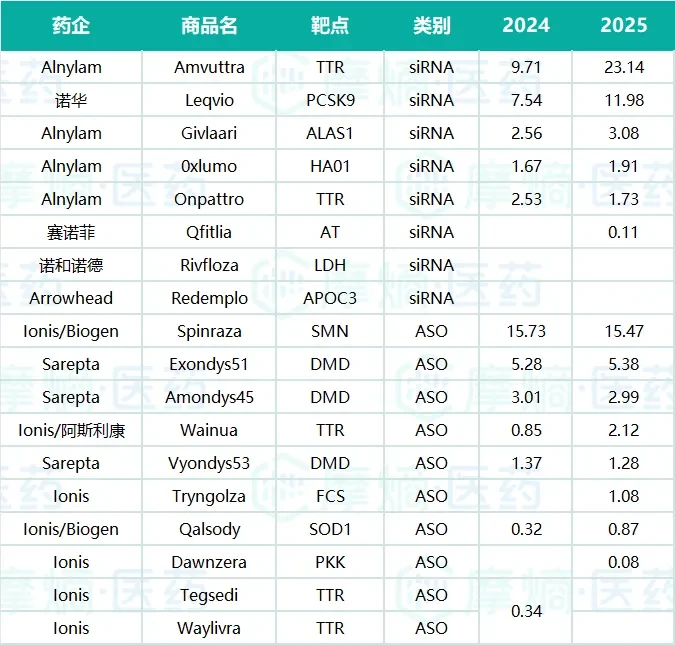
Amvuttra demonstrated the strongest growth momentum, with full-year 2025 sales reaching $2.314 billion, propelling it to the top of its therapeutic class in terms of revenue. In the first quarter of 2026, Alnylam’s total product revenue surged to $1.036 billion, representing a year-over-year increase of 121% and successfully entering the billion-dollar quarterly revenue tier.
As the world’s first disease-modifying therapy for spinal muscular atrophy, Spinraza continues to demonstrate strong momentum despite being on the market for many years, with global peak sales exceeding $2 billion and peak hospital-end sales in China approaching RMB 600 million.
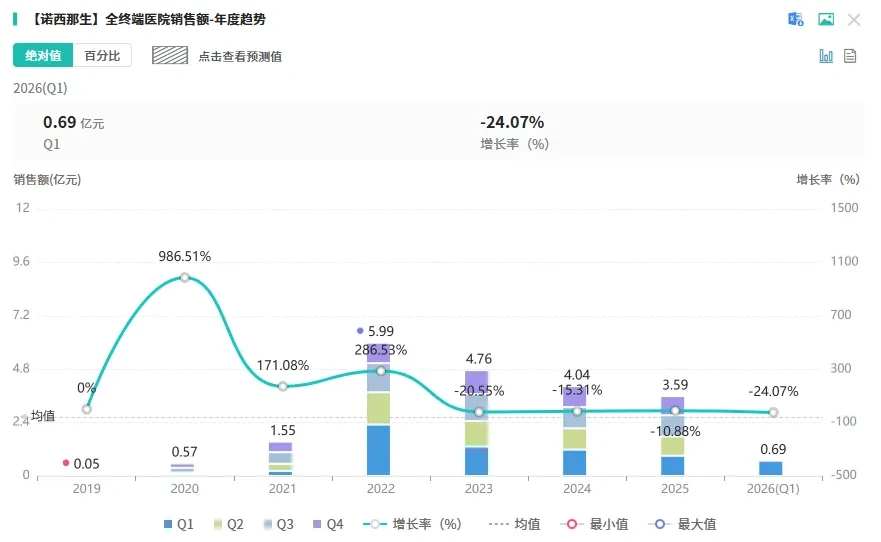
Source of Screenshot: Menet Pharmaceutical Full-Terminal Pharmaceutical Sales Database (Check Data, Find Menet)
Leqvio’s sales approached $1.2 billion in 2025. In 2026, the drug continued to gain momentum, generating $452 million in revenue in markets outside the United States during the first quarter, a year-on-year increase of 76%. The advantages of this long-acting lipid-lowering therapy continue to unlock vast opportunities in the management of chronic diseases.
The trading end is also experiencing high enthusiasm,In 2025, approximately 23 representative collaborative transactions emerged in the oligonucleotide therapeutics field, with a total potential transaction value exceeding $36.4 billion; Novartis acquired Avidity for $12 billion, while giants such as GlaxoSmithKline, Roche, and Eli Lilly successively intensified their strategic investments, sparking a comprehensive surge in industry mergers, acquisitions, and licensing deals.
The collective bets of multinational giants declare that this is no longer “marginal exploration,” but a fiercely contested battleground."Mainstream Battlefield"。
02
Q1 BD Deals Reach $7.1 Billion as China Intensifies Its Moves
If the moves of overseas giants serve as a bellwether, then the performance of Chinese pharmaceutical companies is the most powerful engine in this wave.
According to Sullivan’s forecasts, the global small nucleic acid market is projected to surge at a compound annual growth rate (CAGR) of nearly 30%, reaching $25.1 billion by 2030. Within this expanding market, China is capturing an increasingly significant share.
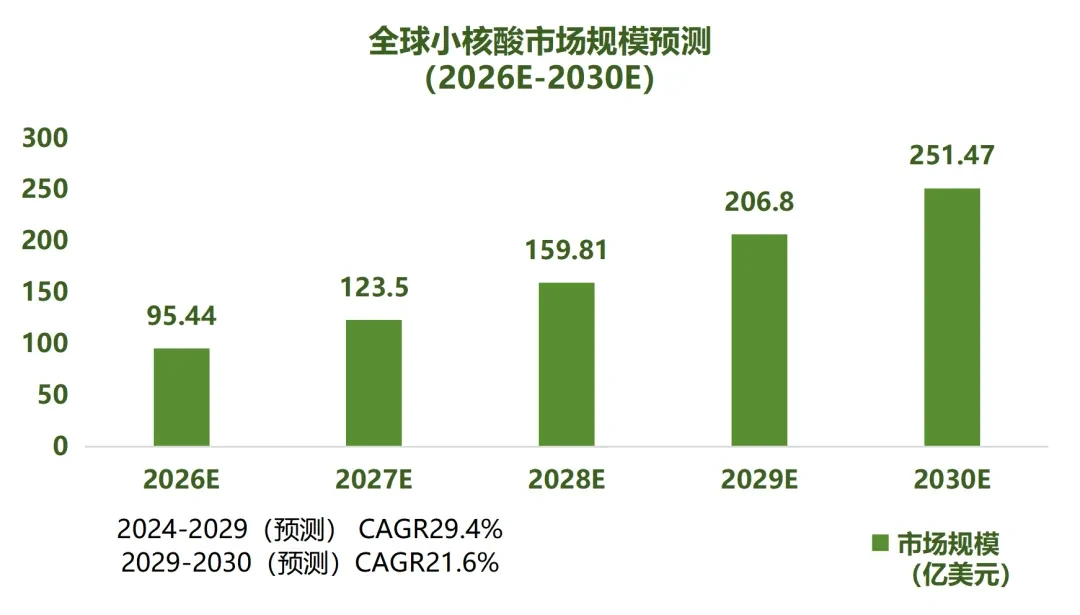
Data Source: Frost & Sullivan, Compiled from Public Information
The most intuitive evidence comes from BD transactions.
In the past two years, the domestic small nucleic acid sector has witnessed a surge in high-value business development (BD) deals. From Ribo Life Science’s $4.4 billion collaboration with Madrigal Pharmaceuticals on MASH therapy, to Bowang Pharma’s record-breaking $5.36 billion licensing deal with Novartis, and further to Maiwei Biologics and Shengyin Biotech consecutively securing mega-deals exceeding $1 billion each—the total disclosed value of overseas licensing transactions for small nucleic acid therapies by Chinese companies has already surpassedThe $15 Billion Mark。
In the First Quarter of 2026, China's Small Nucleic AcidBDTotal Transaction Volume Reaches$7.1 billion, in one fell swoopBeyond...the pastFive-Year Cumulative Annual Total.
February 2, 2026ShengyinHand in HandRoche Genentech, Potential Total Amount$1.7 billion, with an upfront payment of approximately $200 million, representing an 11.8% upfront payment ratio, which is higher than the industry average of 5%-8%, focusing on metabolic diseases. In addition,November 2025Shengyin Just Signed with Eli Lilly$1.2 Billion Metabolic Disease Collaboration – Partnering with Two Global Top 5 Companies Within Months, for a Combined Potential Total Value of $2.9 Billion.
February 11, 2026,Under Ribo Life ScienceRibocure and MadrigalThat pen$4.4 billion, setting a new record for the highest single-license-out deal in China’s small nucleic acid sector. All six preclinical projects are targeted at MASH, while Ribo Life Science holds three delivery platforms: the liver-targeted RiboGalSTAR, the extrahepatic-targeted RiboPepSTAR, and the oncology-focused RiboOncoSTAR, offering the broadest coverage among domestic companies. In essence, Madrigal is not just acquiring a few pipelines, but a systemic capability to continuously generate them.
February 202616Day,Frontier Biologics andGSKApprox.$1 Billion to Enter the Kidney Disease siRNA Market.Three Deals Total $7.1 Billion。
Furthermore, China’s share of the global clinical-stage siRNA pipeline has approached40%, soon to surpass ADCs and bispecific antibodies.
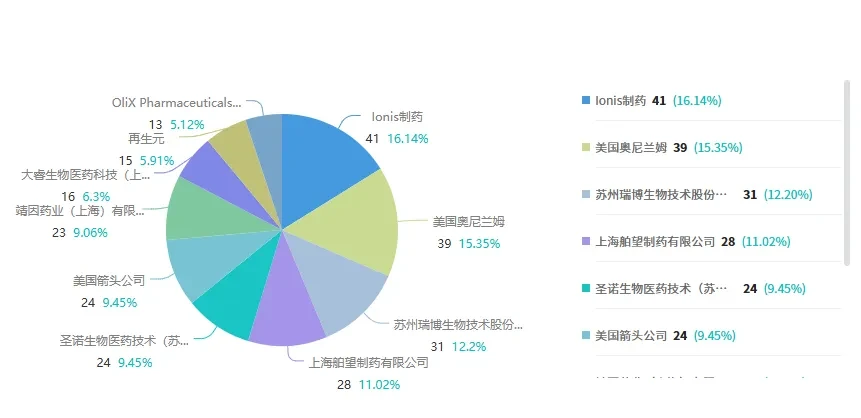
Source of screenshot: PharmCube Global Drug R&D Database (For data inquiries, consult PharmCube)
This marks the transition of Chinese innovative pharmaceutical companies from “followers” in the field of small nucleic acids to indispensable “key players.”
03
26 Approved Globally, with Three Classes of Small Nucleic Acid Drugs Leading the Way
The potential of small nucleic acids is no longerThe Ins and Outs of “Orphan Drugs”
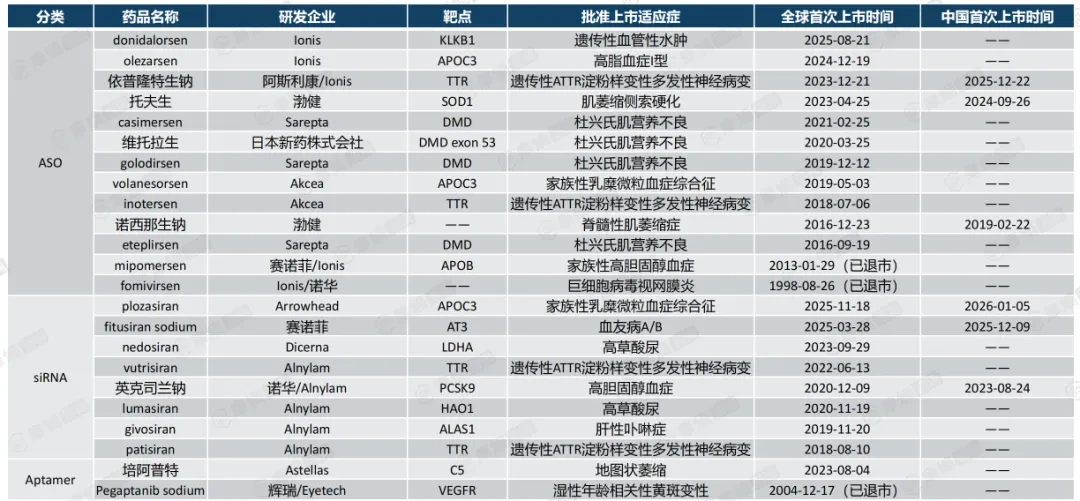
The Mingshang Pharmaceutical Database shows that the number of small nucleic acid drugs approved globally has reachedOf the 26 products, antisense oligonucleotides, siRNA, and antisense RNA rank among the top.
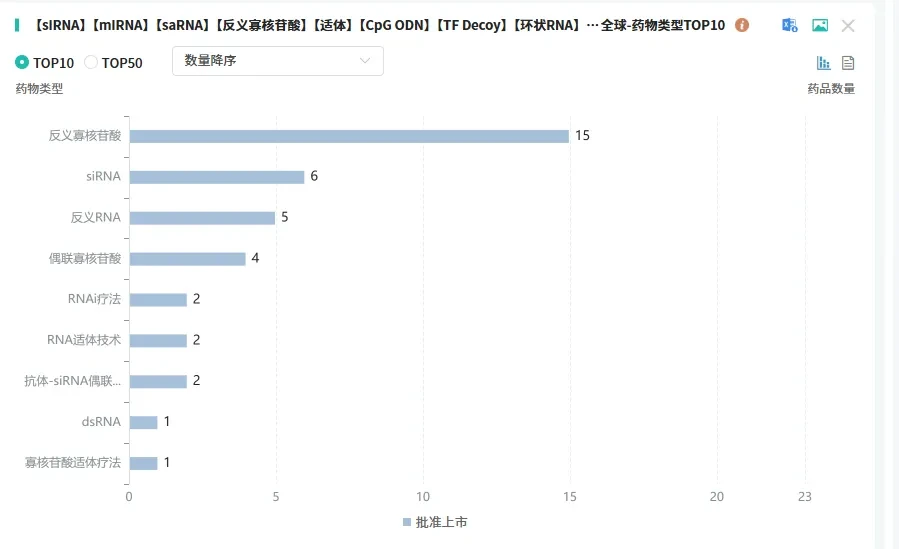
Source of screenshot: PharmCube Global Drug R&D Database (Search Data. Find PharmCube)
CurrentlyApproved ASO and siRNA drugs are primarily concentrated in the field of rare diseases. The sector exhibits a highly concentrated competitive landscape, with Ionis and Alnylam firmly maintaining their industry dominance and holding the largest number of approved drugs, leveraging their first-mover advantages and patent portfolios.
Moses Consulting’s Observation of the Oligonucleotide Drug Sector: A Briefing on the Shift from Druggability Breakthroughs to Platform-Based Competition
As the global landscape accelerates its reshaping, Chinese power is being demonstrated through heavyweightBD Deal, FastLayout thisMainstream Battlefield.
June 30Arrowhead Pharmaceuticals and Sanofi(Sanofi)Jointly Applied forVSA001 has been proposed by the Center for Drug Evaluation (CDE) for inclusion in the Breakthrough Therapy Designation program. Targeting APOC3, it is indicated for severe hypertriglyceridemia. This siRNA drug aims to reduce the production of apolipoprotein C-III. In August 2025, Sanofi acquired the rights for development and commercialization in the Greater China region through a collaboration.
Two days later, CSPC and AstraZeneca reached$1.77 Billion Collaboration to Develop Novel Small Nucleic Acid Drug Candidates Targeting Kidney Diseases Using CSPC’s Proprietary siRNA Drug Discovery Platform and Extrahepatic Targeted Delivery Platform. CSPC Will Receive a $30 Million Upfront Payment, Plus Up to $540 Million in R&D Milestone Payments and $1.2 Billion in Sales Milestone Payments, as Well as Single-Digit Royalties on Sales.
These platforms rely on CSPC's proprietaryAI-driven molecular design models and fully automated high-throughput screening systems enable the efficient identification of nucleic acid drug molecules with high potency and enhanced extrahepatic targeting potential.
Two deals, one targeting metabolism and the other targeting kidneys. The therapeutic landscape of small nucleic acids is expanding from“Rare Disease Islands” Connect to Form a “Chronic Disease Continent.”
Three blockbuster drugs have proven that the commercialization pathway for small nucleic acid therapeutics is now viable.A potential $11.3 billion business development deal validates the global industry’s reassessment of China’s innovation capabilities. Meanwhile, accounting for nearly 40% of the global clinical pipeline signals the formation of an irreversible trend—
China is transforming from a follower in the field of small nucleic acids into an indispensable core player in the global race.
Nusinersen Sodium in China NearA sales peak of RMB 6 billion is merely the prologue. As Leqvio continues to penetrate the chronic disease sector, as VSA001 accelerates its approval through the Breakthrough Therapy designation pathway, and as an increasing number of Chinese companies’ pipelines transition from clinical development to commercializationGround——The Golden Age of Small Nucleic Acids Has Just Begun.
Third TimeThe Wave Has Arrived. This time, Chinese innovative drugs are not only present but also at the forefront of the wave.

END
This article is original; please leave a message to obtain authorization for reprinting.