Suzhou-Based Wushuang Medical's Domestic-First Implantable Cardiac Monitor Gains NMPA Approval

Singular Medical
Developer, Manufacturer, and Seller of Cardiac Rhythm Management Products
On July 1, the National Medical Products Administration announced the approval of the registration application for the “Implantable Cardiac Event Monitor” submitted by Singular Medical.
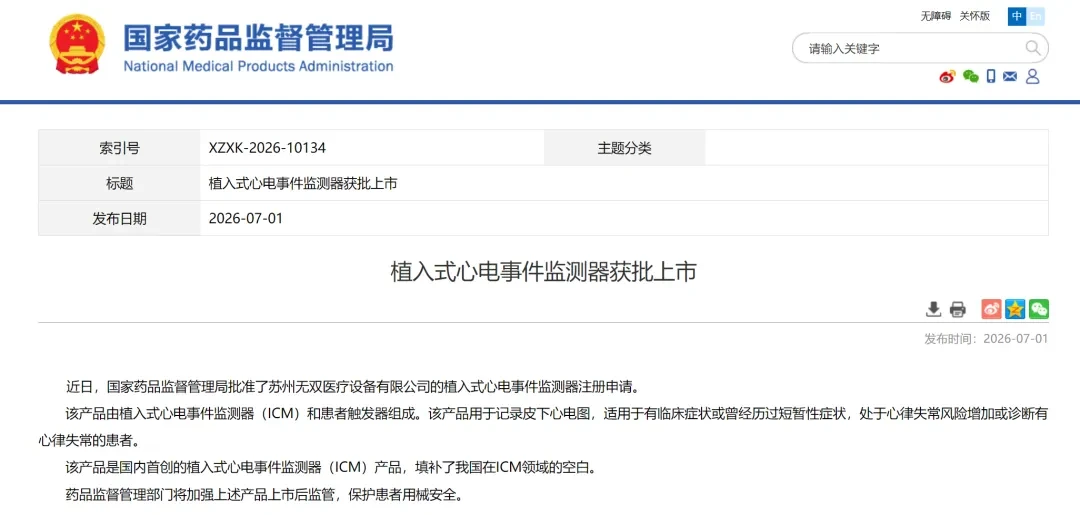
The announcement shows that the product is composed of an implantable electrocardiogram event monitor (ICM) and a patient trigger, designed to record subcutaneous electrocardiograms. It is indicated for patients with clinical symptoms or a history of transient symptoms, those at increased risk of arrhythmias, or those diagnosed with arrhythmias. The National Medical Products Administration has also clarified that this product is the first domestically developed implantable cardiac monitor (ICM) in China, filling a gap in the country’s ICM field.。
Compared with pacemakers and implantable cardioverter-defibrillators (Unlike therapeutic cardiac rhythm management devices such as ICDs, an ICM functions more like a long-term “recorder.” It is typically implanted subcutaneously in the chest via a minimally invasive procedure to continuously record the patient’s cardiac rhythm over an extended period. When patients experience symptoms such as palpitations or syncope, physicians can retrieve electrocardiographic data from the corresponding time frame to determine whether abnormal heart rhythms are associated with these symptoms. Materials from the Mayo Clinic also highlight that the value of implantable loop recorders lies in helping physicians understand changes in cardiac rhythm during patients’ daily activities.

Diagnosis of Arrhythmias: The Challenges Lie in“Just in time”
Many arrhythmias do not occur during examination“Just-in-time occurrence.” Patients may experience recurrent palpitations, syncope, or chest tightness, but the symptoms are short-lived, and heart rhythm has already returned to normal by the time they reach the hospital. While conventional electrocardiograms (ECGs) and Holter monitoring are certainly valuable, short-term monitoring may not capture sufficient evidence when dealing with low-frequency, sporadic arrhythmias.
The value of ICM lies here. ItNotRather than directly treating arrhythmias, the approach extends the monitoring duration to comprehensively record patients’ symptoms alongside corresponding electrocardiographic evidence. For patients with unexplained syncope, suspected concealed atrial fibrillation, or abnormalities that are difficult to detect through short-term examinations, long-term monitoring provides data that more closely reflect real-life scenarios.The Mayo Clinic also notes that implantable loop recorders can detect heart rhythm changes that other cardiac monitoring devices might miss, such as brief or intermittent irregular heartbeats.
In the detection of atrial fibrillation after cryptogenic stroke,There is already a substantial body of research on implantable cardiac monitors (ICMs). The CRYSTAL-AF study was a randomized controlled trial that enrolled 441 patients.According toPubMed abstracts indicate that electrocardiographic monitoring using an implantable cardiac monitor (ICM) is superior to conventional follow-up for detecting atrial fibrillation after cryptogenic stroke. It should be noted that this conclusion applies to specific study populations and designs, and cannot be simply extrapolated to imply that all patients with arrhythmias require ICM use.

Singular Medical has been supplemented first."Monitoring Terminal"
Singular Medical, which has received approval this time, has long focused on cardiac rhythm management (CRM) sector. Public financing documents indicate that the company’s product portfolio covers implantable cardioverter-defibrillators (ICDs), implantable cardiac monitors (ICMs), pacemakers, and other devices, with the aim of building comprehensive capabilities in monitoring, diagnosis, treatment, and follow-up care centered around CRM systems.
According to the company's disclosure, the approved product is SiLv, independently developed by Singular Medical.®MA01-100 Implantable Cardiac Event Monitor, which has obtained the NMPA Class III Medical Device Registration Certificate.
In previous financing disclosures, Singular Medical also revealed that Silu®ICM initiated clinical trials in late 2023, has completed all enrollment and follow-up, and is equipped with Bluetooth telemetry to support real-time cloud transmission via mobile phones.
At the capital level, Singular Medical hasIn March 2025, it was announced that the company had completed its Series C financing round, raising nearly RMB 150 million. The round was led by Tasly Capital, with continued support from existing shareholders including Qiming Venture Partners, Suzhou New District Financial Holding Group, and Kangyu Capital. Related reports indicated that the funds would be used for the research and development of next-generation products and commercialization efforts. For companies specializing in high-end implantable medical devices, regulatory approval is merely the first step toward market entry; subsequent challenges include mass production, hospital access, physician training, and the establishment of patient follow-up and service systems.

Competition in the ICM market no longer hinges solely on the devices themselves.
From a global market perspective,ICM is not an entirely new market segment. According to a report by Global Market Insights, the global implantable cardiac monitor market was valued at USD 910.4 million in 2024 and is projected to reach USD 1.7 billion by 2034, representing a compound annual growth rate (CAGR) of 6.3% from 2025 to 2034. The agency also identified the Asia-Pacific region as the fastest-growing market and listed key players such as Medtronic, Abbott, Biotronik, and Boston Scientific.
The product portfolios of leading overseas enterprises also indicate that,Competition in the implantable cardiac monitor (ICM) market has shifted from “miniaturization and recording capability” to algorithms, remote connectivity, and data management. Medtronic’s LINQ II ICM features the AccuRhythm AI algorithm for long-term cardiac monitoring; Abbott’s Jot Dx ICM enables remote connectivity and data transmission via the myMerlin mobile app; Boston Scientific’s LUX-Dx ICM system emphasizes a two-stage algorithm that automatically detects and validates data before transmitting results; and Biotronik’s BIOMONITOR IV leverages SmartECG, combining AI and detection algorithms to reduce false positives in major arrhythmic events.
This reflects a very practical issue: long-term monitoring generates a large volume of ECG events and alert information. If the device merely“More data recorded,” yet algorithms cannot filter out invalid data, potentially overwhelming hospital staff with excessive alerts; if the remote platform is user-unfriendly, patient compliance and physician follow-up efficiency will also be compromised. Therefore, signal quality, recognition algorithms, false-positive control, remote connectivity, and physician workflow are becoming the core competitive factors for ICM products.

Following the First Domestic Product,To be evaluatedHow to Use in Clinical Practice
Singular MedicalThe approval of the ICM signifies that domestically produced ICMs have progressed from R&D and clinical trials to the registration and market launch stage, providing Chinese hospitals with a new domestic option for long-term arrhythmia monitoring. For China’s cardiac rhythm management industry, this represents not merely the launch of a single product, but a strategic complement to its monitoring capabilities.
However,“First in China” Does Not Mean the Market Is Already Open. The clinical adoption of ICM still depends on physicians’ recognition of the value of long-term monitoring, patients’ acceptance of subcutaneously implanted devices, whether remote data platforms can truly reduce the burden of follow-up, and whether the reimbursement system can support broader patient access.
For Singular Medical, this approval marks a significant milestone. It enables the company toThe first market-approved product in the CRM monitoring segment has enabled domestically produced implantable long-term cardiac rhythm monitoring devices to leap from “zero” to “approved.” Whether this product can truly enter clinical pathways and establish stable usage scenarios will depend on whether hospitals, patients, and follow-up systems can keep pace.

Competition Project Outcome Report
Medtronic Leads, Eli Lilly Follows! This Wuxi Medical Device Company Secures Another Hundred Million USD in Financing
Global First + Over RMB 1 Billion in Financing in Six Years! Medical Device Unicorn Surges Forward
Official Announcement of $200 Million in Series C Funding: Why Is Capital Frequently Betting on This Company?
No Chasing Trends, Already Seizing the Initiative! $500 Million in Overseas Financing Secured, Chinese Companies Lead the New Race