

Mazdutide, a Homegrown Dual-Target Anti-Obesity Drug, Achieves 18.55% Average Weight Loss in Phase III Trial Published in JAMA, Offering a Non-Surgical Option for Moderate-to-Severe Obesity

Innovent
High-end Biologics Developer
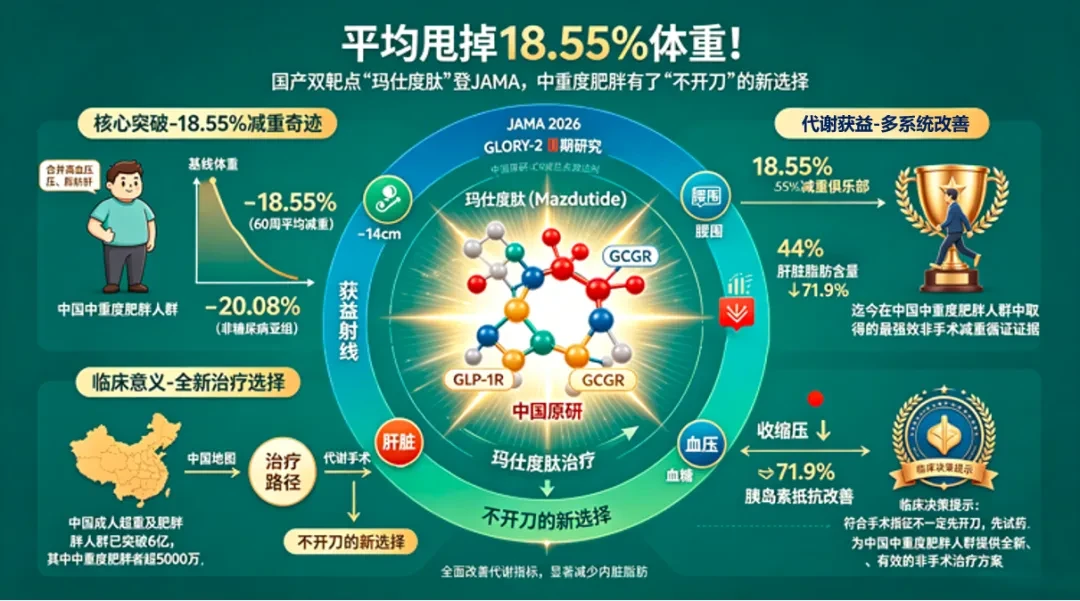
Image source: AI-generated
When the Journal of the American Medical Association (JAMA) rarely published data on a Chinese original weight-loss drug, the world realized that China's obesity treatment is shifting from "following Western guidelines" to "providing Chinese evidence to the world."
Have you ever pinched the ring of fat around your waist? If a tape measure wrapped around your navel reads over 85 cm (for men) or 80 cm (for women), doctors will seriously inform you that this is "abdominal obesity," with visceral fat quietly enveloping your liver, pancreas, and heart.
The Number of Overweight and Obese Adults in China Has Exceeded 600 Million, among whom those with a BMI ≥30 kg/m²Over 50 Million People with Moderate to Severe Obesity—Most of these patients present with comorbid hypertension, fatty liver disease, and insulin resistance. Conventional dietary restriction and exercise yield minimal benefits. Although they meet the indications for metabolic surgery (BMI ≥ 32.5), many are deterred by fears of surgical trauma or concerns about costs. Prior to the availability of mazdutide, this patient population had virtually no pharmacotherapeutic options.
On June 7, 2026, the full text of the GLORY-2 Phase III study, led by Professor Ji Linong from Peking University People’s Hospital, was published online in JAMA, with an oral presentation delivered simultaneously at the American Diabetes Association (ADA) Scientific Sessions.Innovent’s Global First-in-Class GLP-1/GCGR Dual Agonist Mazdutide(Mazdutide, brand name: Xinermei®) 9 mg, for use in Chinese patients with moderate to severe obesity (BMI ≥30), after 60 weeks of treatmentAverage body weight reduction of 18.55%, reaching 20.08% in the non-diabetic population; 44% of subjects achieved weight loss ≥20%; mean waist circumference was reduced by 14 cm, and liver fat content decreased by 71.9% from baseline.
This represents the most potent evidence-based, non-surgical weight loss data achieved to date among individuals with moderate-to-severe obesity in China, and alsoThe first GLP-1 drug to be published in the three leading journals: Nature, The New England Journal of Medicine (NEJM), and JAMA.

From Liraglutide to Mazdutide: A Brief History of the Century-Long Evolution of Weight-Loss Drugs
The exploration of “appetite-suppressing” drugs in humans has taken detours (withdrawal of amphetamine-like agents due to addiction, withdrawal of sibutramine due to cardiovascular risks); the era of truly safe, evidence-based medicine began with incretins:
2014: Novo Nordisk's Liraglutide(Saxenda®, a single-target GLP-1 agent) received FDA approval for weight loss indications, achieving an average weight reduction of approximately 8%, thereby ushering in the era of GLP-1-based weight management.
June 2021: Semaglutide 2.4 mg(Wegovy®) received FDA approval for adult obesity, with an average weight loss of approximately 15%–17%; that same year, Elon Musk posted on X (formerly Twitter) that he lost 9 kilograms in a month through fasting combined with Wegovy, igniting a global surge in demand for weight-loss medications and causing temporary worldwide supply shortages.
2022-2023: Eli Lilly's Tirzepatide(Zepbound®/Mounjaro®, dual GIP/GLP-1 receptor agonist) approved, with an average weight loss of 20%–22.5% over 72 weeks, setting a new record for single-agent weight reduction.
China's Catch-up in Original Drug Development:In 2023, Renhui Bio’s benaglutide (Feisumei®) was approved as China’s first domestically developed GLP-1 for weight loss; in 2026, Xianweida Bio’s enoglutide (Xianweiying®) received approval for the weight loss indication. However, no Chinese-made drug had previously completed Phase III validation in patients with moderate-to-severe obesity (BMI ≥30) in China and been published in a top-tier international journal.
The breakthrough of mazdutide is filling this gap—and pursuing a mechanism distinct from that of tirzepatide.

Image source: AI-generated

GLP-1/Glucagon Dual Target: Why Is "Adding a Switch" So Important?
Traditional single-target GLP-1 drugs (semaglutide) primarily reduce intake by suppressing appetite via the hypothalamic satiety center and delaying gastric emptying. Mazdutide, building upon GLP-1 receptor agonism,Additional activation of the glucagon receptor (GCGR), forming a dual-pathway synergy:

In layman's terms:GLP-1 is responsible for "reducing your food intake," while GCGR is responsible for "increasing your calorie expenditure."—The synergistic effect not only amplifies weight loss but also specifically targets abdominal obesity and fatty liver, which are highly prevalent among the Chinese population (the proportion of intrahepatic fat accumulation in obese individuals in China is significantly higher than that in Western populations with the same BMI). The 71.9% reduction in hepatic fat and the 14-cm decrease in waist circumference observed in the GLORY-2 trial are clinical manifestations of this mechanism.
Safety:The main adverse events were mild to moderate nausea, vomiting, and diarrhea, which mostly occurred during the early titration phase and were transient. Only 2.9% of patients discontinued treatment due to adverse reactions, with no new safety signals identified, making it suitable for long-term weight management.

GLORY-2 Hard Data: “Approaching Surgical Efficacy” in Patients with Moderate to Severe Obesity
The study enrolled 462 Chinese participants with a body mass index (BMI) ≥30 kg/m² (63.3% had a BMI ≥32.5, meeting surgical indications; 16.1% had comorbid type 2 diabetes). Participants were randomized in a 2:1 ratio to receive either mazdutide 9 mg or placebo, combined with lifestyle interventions, in a double-blind manner for 60 weeks:
Primary Endpoint: Mean Percentage Change in Body Weight at Week 60—Mazdutide Group -18.55%(approximately 17.4 kg), -3.02% in the placebo group, with a between-group difference of -15.53% (p<0.001)
Non-diabeticPopulation:Meaningful weight loss: -20.08%, 48.7% of subjects achieved ≥20% weight loss
Key Secondary Endpoints:Weight reduction ≥5% (85.7% vs 33.2%), ≥10% (71.4% vs 14.5%), ≥15% (59.5% vs 6.5%), ≥20% (44.0% vs 2.6%)
Body Circumference and Metabolism:Waist circumference: -13.98 cm; systolic blood pressure: -10.65 mmHg; triglycerides: -25.44%; non-HDL-C: -16.53%; serum uric acid significantly decreased; MRI-PDFF showed a 71.9% reduction in liver fat among participants with baseline liver fat ≥10%.
Sustained Weight Loss Trend:At 60 weeks, the weight curve had not yet reached a plateau, suggesting that extending treatment may yield further benefits.
Notably, the previous head-to-head Phase III DREAMS-3 study demonstrated that in patients with type 2 diabetes and obesity, mazdutide 6 mg achieved a dual endpoint rate of 48.0% for both HbA1c <7.0% and weight reduction ≥10%, which was approximately 2.3 times that of the semaglutide group (21.0%).Confirm the differentiated advantages of the dual-target mechanism in the Chinese population.

Why Does This Matter for National Health and Industrial Competitiveness?
Obesity is the “root cause of all diseases” and a public health economic black hole
China has a population of 600 million individuals who are overweight or obese, which is associated with type 2 diabetes (140 million patients), hypertension (270 million), non-alcoholic fatty liver disease (approximately 200 million), and cardiovascular and cerebrovascular diseases. If individuals with moderate to severe obesity can achieve a 5%–10% reduction in BMI through pharmacological intervention, it can significantly delay or avoid the need for metabolic surgery and reduce the incidence of myocardial infarction and stroke events. Mazdutideproviding an additional non-invasive option for patients who meet the surgical indications,It is of great significance in reducing the burden of long-term care—this represents "preventive treatment" at the public health level.
From Me-too to First-in-class: China’s Voice in Metabolic Drugs
Mazdutide isThe World's First GLP-1/GCGR Dual-Target Weight Loss Drug to Enter Clinical Trials and Gain Approval(Boehringer Ingelheim’s Survodutide, targeting the same mechanism, remains in Phase III trials), and GLORY-2 was designed and enrolled exclusively in the Chinese population—rather than extrapolating Western data to China, it leverages Chinese data to address questions specific to the Chinese context. The achievement of a “grand slam” of publications in three top-tier journals signifies that, for the first time, an original Chinese drug has been recognized by the international academic community as a source of mechanistic innovation, rather than a follower, in the high-stakes field of metabolic diseases.Innovent Biologics is simultaneously advancing its metabolic pipeline, including oral small-molecule GLP-1 agonists, amylin analogs, and siRNA therapies, marking the transition of domestic Big Pharma from “importing” to “global exporting.”
National Competition Dimension: Whoever Defines the Treatment Standards for Metabolic Diseases Controls the High Ground of the Bioeconomy
The global weight-loss drug market is projected to exceed $100 billion by 2030. Historically, industry standards were defined by Novo Nordisk and Eli Lilly; the emergence of mazdutide demonstrates China’s capacity to participate in setting global standards through mechanistic innovation and clinical evidence. “Healthy China 2030” prioritizes the prevention and control of major chronic diseases. Enhancing the accessibility and affordability of domestically produced innovative weight-loss and antidiabetic medications—now under consideration for national medical insurance reimbursement negotiations—is an integral component of the national strategy to reduce the burden of metabolic diseases among the Chinese population.

Image source: AI-generated

The Future: From "Weight Loss" to "Metabolic Remodeling"
Mazdutide is not the end, but a gateway:
Indication Expansion:MASH (metabolic dysfunction-associated steatohepatitis/NASH), heart failure with preserved ejection fraction (HFpEF) with obesity, and polycystic ovary syndrome (PCOS)-related infertility—GCGR activation confers hepatoprotection and enhances energy expenditure, giving it a unique position in the metabolic disease landscape
Follow-up on Oral Formulations:Innovent Biologics is developing oral non-peptide GLP-1 receptor agonists, which are expected to form sequential or complementary regimens with injectable formulations in the future, thereby improving patient adherence.
Combined/Sequential Strategy:Combination with SGLT2 inhibitors, statins, or novel amylin analogs to explore the validation of benefits on "hard cardiovascular endpoints" (currently mostly surrogate endpoints)
Standardized Use Reminder:This medication is indicated for chronic weight management in adults with a BMI ≥28 kg/m², or a BMI ≥24 kg/m² with comorbidities, and must be used under the guidance of a specialist. It is contraindicated in pregnant individuals and those with a history of medullary thyroid carcinoma or multiple endocrine neoplasia type 2 (MEN2). Its misuse as a cosmetic "slimming injection" is not recommended.

Image source: AI-generated
Conclusion
From “You’re Fat Because You’re Lazy” to “This Is a Chronic Metabolic Disease Requiring Long-Term Management”: A Century of Evolving Human Understanding of Obesity. Mazdutide offers us more than just a figure of -18.55%—it assures patients with moderate-to-severe obesity that they do not need to undergo surgery immediately, and it demonstrates to China’s pharmaceutical community that we now possess the capability to provide original metabolic solutions to the world.
The JAMA paper, which documents weight changes in 462 Chinese individuals, embodies a nation’s solemn commitment to the health of its people.
The next time you pinch the ring of fat around your waist, may you feel a bit more confident—science is catching up to your expectations.

Image source: AI-generated
(This article is based on the GLORY-2 study [JAMA 2026], the DREAMS-3 study, and publicly available information from Innovent Biologics, Inc., and is intended for scientific popularization reference only. Please follow medical advice for medication.)