

Soft Sense Completes Angel Round to Accelerate Fully In-House Washable Medical-Grade Flexible Sensing Platform

Soft Sense
Washable Medical-Grade Flexible Sensing Platform
Soft Sense, a developer of medical-grade flexible sensing platforms, has recently completed a multi-million-U.S.-dollar angel financing round.
Soft Sense delivers a fully self-developed medical-grade flexible sensing platform, committed to building smart apparel that enables long-term, continuous monitoring of human physiological signals. With exclusive proprietary machine-washable flexible sensing technology at its core, the company has built a complete medical-grade wearable system integrating hardware, algorithms and data services, covering four key application directions: cardiovascular monitoring, elderly care, neuromuscular rehabilitation and sports health management.
“This financing will accelerate the productization and deployment of our core technology, rapidly validate the commercial capability of our medical-grade washable wearable platform, and build a dedicated medical data ecosystem,” said Dr. Zhou Guanqian, Founder and CTO of Soft Sense. “Over the next two years, we aim to standardize and scale our smart apparel products, and continuously popularize high-end medical-grade technologies in consumer markets. Through uninterrupted continuous monitoring, we can capture early risks of critical illnesses and bring professional medical guardianship into daily life.”
1Fundamental Tech Breakthroughs Needed for Clinical-Grade Wearables
The global market for medical-grade wearable devices is undergoing explosive growth.
According to Global Market Insight, the market size is projected to reach $543.9 billion by 2034, sustaining a compound annual growth rate of over 16.5%. China’s market also maintains rapid growth, with its 2026 scale expected to surpass RMB 112.6 billion. Growing aging populations, widespread chronic disease management and normalized telemedicine continue to generate massive demand for continuous health monitoring.
Nevertheless, amid surging market demand, few wearable products can fully meet professional medical scenario requirements.
The industry currently follows two major technical routes. The first features medical-grade wearable products represented by Hexoskin and Myant, which deliver high-precision data collection but come with high pricing, limited application scenarios, poor long-term wearing experience and high daily maintenance barriers.
The second consists of consumer-grade devices such as smartwatches and smart bands. While these products have popularized health monitoring, they serve merely as basic health management tools, falling short of professional medical standards in data continuity, anti-motion interference capability and clinical consistency.
This has created an industry paradox: clinical precision requires compromised daily practicality, while improved daily durability sacrifices clinical credibility. This fundamental dilemma explains why wearables, despite years of market penetration, have failed to become the underlying data infrastructure for digital healthcare.
Soft Sense’s proprietary technical roadmap precisely targets this critical market gap.
2Textile-Integrated Sensing Architecture: Solving Precision, Durability and Cost Barriers Simultaneously
Nearly all mainstream flexible wearable products adopt traditional post-attached electrodes and external sensing modules, a structural design that imposes inherent limits on user experience and overall performance.
Instead of making incremental tweaks to existing product forms, Soft Sense has rebuilt its entire sensing system from the bottom up at the material and craftsmanship level. Its sensors are thermally bonded and fully integrated with garments, replacing disposable skin-attached electrodes and cumbersome external wiring with functional sensing layers fixed inside apparel.
Leveraging its self-developed TPU electrode textile integration architecture, Soft Sense achieves seamless integration between sensors and fabrics. The integrated structure deforms synchronously with human movements, minimizing motion-induced signal interference and enabling stable data output for long-term continuous monitoring.
This underlying architectural overhaul delivers substantial improvements in medical-grade monitoring performance. Clinically, the device controls ECG measurement error within 3%, achieves a 98% accuracy rate for arrhythmia identification, and maintains over 95% detection accuracy for critical conditions including myocardial infarction, atrial fibrillation and ventricular fibrillation. The products have completed preliminary pre-clinical verification at multiple top-tier tertiary hospitals.
In terms of long-term durability, signal attenuation remains below 5% after 100 standard machine washes, with a single product lifespan reaching approximately one year. The sensing layer is merely 0.2 millimeters thick with a damage-free stretch rate exceeding 100%, adapting to diverse body types and complex motion states.
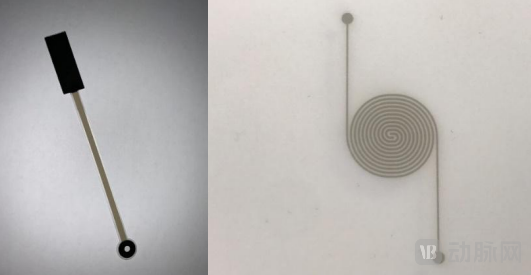
Stretchable thin-film sensor: 0.2 mm printing precision, <10% impedance variation under 60% linear stretching.
On the algorithm front, the platform fuses multi-modal physiological signals including ECG, EMG, IMU, PCG and force sensing. It adopts 5,000 personalized and regional feature models to effectively correct motion artifacts, enhancing data stability in complex scenarios and providing reliable data support for cardiovascular disease early warning, chronic disease management and telemedicine.
Most importantly, the roll-to-roll mass manufacturing process cuts core component costs by 60%, granting Soft Sense a two-order-of-magnitude cost advantage over overseas peers. The company holds five valid Chinese and U.S. invention patents, with another five patent applications in progress to consolidate its technological moat.
The robust technological strength is backed by a cross-functional team with solid R&D expertise and industrial landing capabilities. Dr. Zhou Guanqian graduated from the Institute of Mechanical Engineering, National Taiwan University. He previously led the R&D center and medical business department at Compal Electronics, accumulating over a decade of in-depth experience in flexible sensing technology.
Core team members hail from leading pan-Asian electronics manufacturers and AliHealth, with expertise spanning electronic manufacturing and internet healthcare. The team possesses full-stack capabilities covering original technological research and development, as well as large-scale industrial commercialization.
3Mass Production Imminent: Capturing the New Growth Cycle of Medical-Grade Wearables
Empowered by mature underlying technology and mass production systems, Soft Sense has accelerated its commercialization drive.
Per the company’s roadmap, its first-generation smart apparel will launch small-batch mass production in July 2026, paired with ongoing medical device registration. Continuous validation in real medical scenarios will optimize product performance and lay a solid foundation for large-scale market promotion.
Meanwhile, the second-generation smart apparel is under joint R&D with top-tier tertiary hospitals. The upgraded product iterates from single-lead ECG to three-lead ECG, integrating cardiac sound sensors, IMU modules, edge AI computing units and a cloud-based medical platform to enable comprehensive perception of cardiac signals.
In terms of scenario deployment, Soft Sense has landed its products in multiple top-tier tertiary hospitals across more than 10 core departments, covering post-discharge follow-up, elderly home monitoring, post-operative rehabilitation assessment and professional sports posture analysis. The business footprint covers medical treatment, elderly care and sports health sectors.
The company has formulated a clear three-phase commercial strategy. In the early stage, it will drive revenue growth via B2B and B2C models (including OEM cooperation), focusing on hospital channels, chronic disease management and AI medical partnerships. In the mid-term, it will launch SaaS-based health data analytics services to build sustainable cash flow. In the long run, it will expand business into precision medical data cooperation, pharmaceutical remote patient monitoring (RPM) data services and insurance actuarial scenarios.
The construction of a three-layer profit system covering hardware, software and data will drive Soft Sense’s strategic upgrade from a product-centric enterprise to a professional health data platform.
Dr. Zhou offered his long-term industry outlook: over the next three to five years, competition in the medical-grade wearable sector will shift from hardware parameter rivalry to software and data capability competition. “The core competitiveness of medical wearable enterprises will lie in four dimensions: high-quality data acquisition, multi-modal data fusion, clinically verified AI models, and software platforms embedded in standard medical care workflows.”
This full-stack capability has been Soft Sense’s core development focus since its inception.