China's First Domestically Developed Implantable Cardiac Monitor Approved, Filling Critical Gap in CRM Diagnostics

Singular Medical
Developer, Manufacturer, and Seller of Cardiac Rhythm Management Products
Source: Medical Device Business Review
Author: Jin Fan
Reproduction without authorization is prohibited
Long-term Continuous ECG Monitoring: China’s First ICM Is Here!
Recently (July 1, 2026), the National Medical Products Administration announced the formal approval ofSuzhou Singular Medical Equipment Co., Ltd. (hereinafter referred to as “Suzhou Singular”) Implantable Cardiac Monitor (ICM)marketing application.
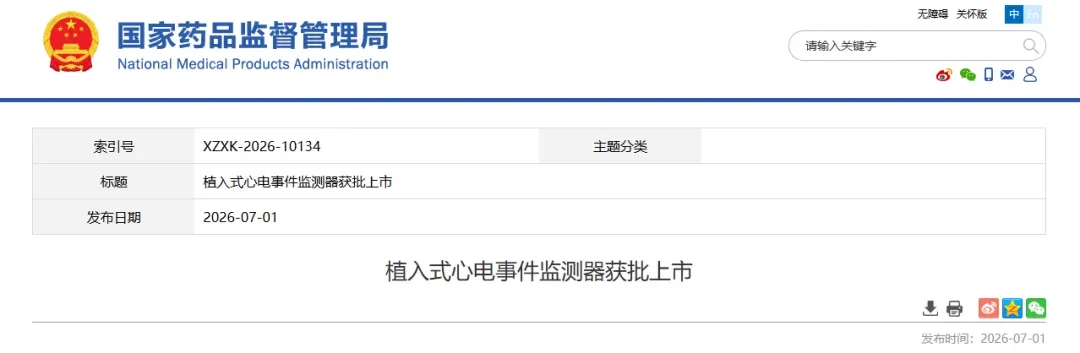
It is reported that the product entered the innovation channel in June 2024 and was successfully approved after two years, making itChina's First ICM Product, filling the domestic gap in this niche sector at once,It also marks a key breakthrough for domestically produced cardiac rhythm management (CRM) devices in the monitoring and diagnostic phase.
This ICM consists of an implanted main unit and a patient activator. It is implanted subcutaneously in the pre-sternal area via minimally invasive surgery, enabling long-term continuous recording of electrocardiographic signals.Suitable for patients at risk of arrhythmias or who have experienced symptoms such as transient syncope and palpitations., used to capture sporadic ECG abnormalities and assist in clinical diagnosis.
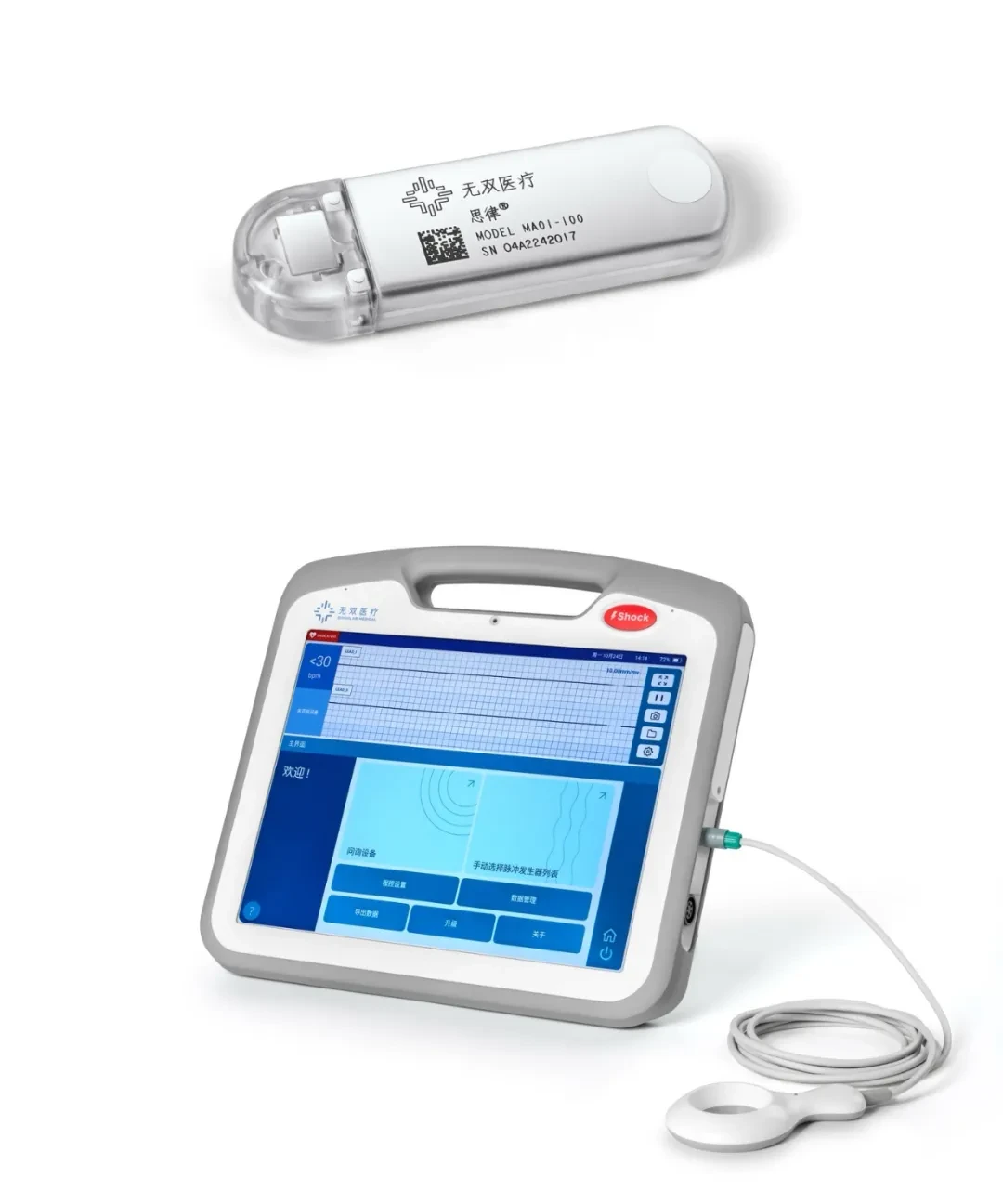
Singular Medical ICM
Singular Medical’s recent certification not only ends the history of “zero products” for domestically produced implantable cardiac monitors (ICMs), but also holds the promise of redefining the competitive landscape of the cardiac rhythm management (CRM) sector.

Long-term Implantable Monitoring
Reconstructing the Diagnostic Pathway for Arrhythmias
Arrhythmia is a highly prevalent condition in the field of cardiovascular medicine, among which concealed arrhythmia remains a diagnostic challenge in clinical practice due to its irregular onset and short duration.
Previously, clinical diagnosis of such conditions in China relied heavily on external ambulatory electrocardiographic devices (Holter monitors). However, due to limitations in wearing duration, their ability to detect infrequent arrhythmias with very low episode frequency was limited, resulting in a detection rate of less than 20% for paroxysmal atrial fibrillation and unexplained syncope, which easily delayed timely diagnosis and treatment for patients.
The emergence of ICM has fundamentally overcome this limitation.After implantation, the device is virtually imperceptible to the patient. It can automatically detect and record various arrhythmic events, including atrial fibrillation, bradycardia, and tachycardia, significantly enhancing the detection rate of occasional electrocardiographic abnormalities.
Especially in the evaluation of cardiogenic syncope, ICM has become the industry-recognized "gold standard" solution. Public clinical data show that for patients with unexplained syncope, the etiology detection rate of ICM is much higher than that of traditional external monitoring methods, which can help clinicians quickly clarify the diagnosis of cardiogenic syncope and reduce unnecessary repeated examinations and misdiagnosis.
In addition,The application boundaries of ICM continue to expand, now covering multiple core scenarios such as long-term follow-up after atrial fibrillation surgery and etiological tracing of cryptogenic stroke.
As the first domestically developed and independently researched ICM, Singular Medical has not only achieved full control over core technologies across the entire chain,Furthermore, targeted optimizations have been implemented to enhance diagnostic performance and localize the user experience.
One of its core advantages is the precise and clear display of P waves—the direct manifestation of atrial electrical activity and the key basis for clinically identifying atrial arrhythmias such as atrial fibrillation and atrial flutter. This feature enables the product to more accurately capture and classify various arrhythmic events.Provides high-quality diagnostic support for physicians, with performance reaching international top-tier standards.
Meanwhile, the device supports storage of arrhythmia events for up to 100 minutes and features a dual-channel remote transmission mechanism via home monitoring and mobile Bluetooth, ensuring real-time upload of ECG data without loss.
Furthermore, cloud-based AI algorithms can perform secondary analysis of uploaded ECG data, thereby reducing physicians’ manual diagnostic workload and alleviating the burden on patients of traveling to and from the hospital.Establish a complete diagnostic and therapeutic closed loop of “monitoring-diagnosis-intervention,” facilitating the practical implementation of long-term home monitoring and remote follow-up, tailored to the needs of patients with chronic conditions requiring long-term rhythm management.
The reliability of Singular Medical’s ICM product has been validated through rigorous clinical trials: according to publicly available corporate information, its multicenter confirmatory clinical trial involved participation from several leading domestic medical institutions, including Zhongshan Hospital Affiliated to Fudan University.
Data shows that,The product achieves 100% accuracy in detecting asystole and bradycardia, 84.2% accuracy in detecting tachycardia, and 90.4% accuracy in detecting atrial fibrillation.. In the long-term follow-up phase, its stability in long-term monitoring and data accuracy were further validated in head-to-head comparative studies with dynamic electrocardiography.

Multi-Billion Blue Ocean Market
Domestic ICMs Accelerate Widespread Adoption
From a market perspective, ICM is a typical niche segment where technological breakthroughs drive market expansion.
According to epidemiological data,In China, the total number of patients with arrhythmia exceeds 20 million, including over 10 million patients with atrial fibrillation., coupled with the large annual number of new cases of unexplained syncope and patients with cryptogenic stroke requiring exclusion of cardiogenic causes, together constitute the core target population for ICM.The potential market size could reach the tens of billions.
Prior to the approval of Singular Medical’s ICM, the domestic ICM market was entirely dominated by imported brands such as Medtronic, Abbott, and Boston Scientific. The high unit price of these devices resulted in a clinical penetration rate in China that was less than one-tenth of that in developed overseas markets.
Following the market launch of domestically produced implantable cardiac monitors (ICMs), their localized supply chain advantages are expected to significantly reduce end-user pricing, alleviate procurement cost pressures for hospitals, and facilitate the dissemination of this cutting-edge technology to prefecture-level and municipal hospitals.
However, for high-end implantable devices, regulatory approval is merely an entry ticket; the true test lies in commercial implementation. Three hurdles must still be overcome to achieve widespread adoption of ICMs:
FirstThe clinical value of ICM has not been fully disseminated, and some clinicians have insufficient awareness of its indications and diagnostic value.Market education still requires time.
SecondlyIt is due to the current imperfection of supporting policies for medical insurance payment,The predominantly self-pay model in the short term will constrain the rapid scale-up of product categories.If domestically produced ICMs can significantly reduce the per-case treatment cost, they will greatly lower the barrier to patient access and cover a broader patient population.
FinallyIt is the establishment of a long-term follow-up system. The value of ICM lies not only in implantation, but also in subsequent data management, event alerts, and follow-up services. Localized cloud-based systems and management solutions tailored to the workflows of domestic hospitals,will be the core lever for domestic products to achieve differentiated competition.

Completing the CRM Diagnostic Puzzle
Domestic Sector Enters Full-Chain Competition
Beyond the dimension of a single product, the approval of Singular Medical’s ICM represents a highly symbolic industrial turning point in the domestic cardiac rhythm management (CRM) sector.
For a long period, breakthroughs in domestically produced cardiac rhythm management (CRM) devices have been concentrated in mature segments such as electrophysiology interventional consumables and conventional pacemakers. High-end categories with high implantation thresholds and strong algorithmic barriers, such as implantable cycle monitors (ICM) and implantable cardioverter-defibrillators (ICD), have been almost entirely monopolized by imported brands, representing the most challenging “hard nut to crack” in the process of domestic substitution.
In recent years, the R&D pace of domestic innovative medical device companies has accelerated, and the entire CRM sector has presented a clear stratified landscape:
Electrophysiology Consumables:The domestic substitution rate continues to rise, with leading enterprises having achieved large-scale volume production;
Pacemaker:Multiple domestically produced products have been approved for market launch, gradually penetrating the grassroots market with their price advantages;
High-End CRM Devices: Domestic breakthroughs are being achieved in categories such as ICDs and ICMs, shifting the competitive landscape from mere availability to usability and performance.
Singular Medical, established in 2017, built a comprehensive CRM technology platform from its inception, with its product line simultaneously covering the three core categories of ICMs, ICDs, and pacemakers.It is one of the few domestic CRM companies in China to have completed a full product pipeline layout.
The launch of the first domestically produced ICM in China,Completes the final key piece of the puzzle for domestically produced CRM in the "long-term monitoring and diagnosis" segment, also signifies that industry competition has officially shifted from breakthroughs in single productsShifting toward comprehensive competition encompassing a full-chain product portfolio and end-to-end service capabilities across “monitoring–treatment–follow-up.”
As more domestic companies continue to break through into the high-end "no-man's land" of cardiac rhythm management (CRM), the import substitution process in China’s cardiac rhythm management market is advancing at full speed into deeper waters, far exceeding industry expectations.