

Four Major Pharma Collaborations Announced on the Same Day: CSPC, Insilico Medicine Among Key Players
CSPC
Innovative Drug Research and Development, Manufacturer

AstraZeneca
Pharmaceutical Technology Research and Development Provider

BD Opportunity Arrives!


![]()
![]()
![]()
![]()
![]()
![]()
![]()
![]()
![]()
![]()
![]()
![]()
![]()
![]()
![]()
![]()
![]()
![]()
![]()
![]()
![]()
![]()
![]()
![]()
![]()
![]()
![]()
![]()
![]()
![]()
![]()
![]()
![]()
![]()
![]()
![]()
![]()
![]()
![]()
![]()
![]()
![]()
![]()
![]()
[Chinese Companies Seeking Antibody Products] CEACAM5 antibody (CMC completed) or HER2 antibody (GMP-ready), preferably lacking Fc function.
Interested pharmaceutical companies are welcome to contact the DrugTimes BD team immediately!
BD@drugtimes.cn
BD Opportunity Arrives!![]()
![]()
![]()
![]()
![]()
![]()
![]()
![]()
![]()
![]()
![]()
![]()
![]()
![]()
![]()
![]()
![]()
![]()
![]()
![]()
![]()
![]()
![]()
![]()
![]()
![]()
![]()
![]()
![]()
![]()
![]()
![]()
![]()
![]()
![]()
![]()
![]()
![]()
![]()
![]()
![]()
![]()
![]()
![]()
[Chinese Companies Seeking Antibody Products] CEACAM5 antibody (CMC completed) or HER2 antibody (GMP-ready), preferably lacking Fc function.
Interested pharmaceutical companies are welcome to contact the DrugTimes BD team immediately!
BD@drugtimes.cn
BD Opportunity Arrives!
[Chinese Companies Seeking Antibody Products] CEACAM5 antibody (CMC completed) or HER2 antibody (GMP-ready), preferably lacking Fc function.
Interested pharmaceutical companies are welcome to contact the DrugTimes BD team immediately!
BD@drugtimes.cn

$1.77 billion!
CSPC and AstraZeneca Reach New Partnership
On July 2, CSPC announced that it had entered into a collaboration, option, and license agreement with AstraZeneca to establish a strategic R&D partnership and leverage CSPC’s proprietary siRNA drug discovery platform and extrahepatic targeted delivery platform to develop novel small nucleic acid candidate drugs.
Source of screenshot: CSPC announcement
Leveraging CSPC’s proprietary AI-driven molecular design models and fully automated high-throughput screening systems, these platforms enable the efficient identification of nucleic acid drug molecules with high potency and enhanced extrahepatic targeting potential.
In accordance with the agreement,AstraZeneca and CSPC to Discover and Develop Preclinical Candidate Drugs with the Potential to Treat Multiple Indications of Kidney Diseases Around Two TargetsFor each project, AstraZeneca shall have the option to obtain exclusive rights for development, manufacturing, and commercialization either globally or outside China. CSPC shall retain the rights for development, manufacturing, and commercialization of one such project within China.
In return, CSPC will receive$30 million upfront payment, and shall be entitled to receive up to$540 millionpotential R&D milestone payments and maximum$1.2 billion in potential sales milestone payments, and potential single-digit sales royalties based on the annual net sales of the relevant products.
Historically, Chinese small nucleic acid companies have primarily expanded overseas by licensing out mature clinical-stage assets. In contrast, CSPC’s direct export of a reusable, end-to-end drug discovery and delivery technology platform signifies that multinational pharmaceutical companies now recognize China’s independent commercialization capabilities in foundational nucleic acid delivery and AI-assisted molecular screening. This marks a formal upgrade in the global expansion of nucleic acid therapeutics, shifting from single-product monetization to platform-based value output.

Abbisko Therapeutics Joins Hands with AstraZeneca,
Initiating Joint Clinical Research on Lung Cancer
On July 2, Abbisko Therapeutics announced the signing of a strategic cooperation agreement with AstraZeneca,Jointly Advance the Oral Small-Molecule PD-L1 Inhibitor ABSK043(lumipodlin)Combined with AstraZeneca's third-generation EGFR-TKI, Tagrisso(Osimertinib)Clinical Study on the Treatment of Non-Small Cell Lung Cancer. This study is a multicenter, open-label Phase I/II clinical trial, and the IND was approved by the NMPA on May 20.。

Source:Abbisko Therapeutics Official Website
ABS043 is a first-in-class oral small-molecule PD-L1 inhibitor independently developed by Akeso, Inc.. This collaboration with AstraZeneca marks the commercialization of ABSK043The third major clinical collaboration on EGFR pathway combination therapy.A Phase II clinical trial of combination therapy with Allist’s furmonertinib has previously been conducted, and the clinical trial application for combination therapy with Allist’s KRAS G12C inhibitor, gulelesel, has also been approved.
The significance of this collaboration lies in the cross-disciplinary synergy between targeted therapy and immunotherapy.Osimertinib is one of the most widely used third-generation EGFR-TKIs globally. Its combination with Abbisko Therapeutics’ oral PD-L1 inhibitor targets a precise patient population: those with non-small cell lung cancer (NSCLC) harboring EGFR mutations and PD-L1 positivity. Through a multi-platform, multi-partner collaboration strategy, Abbisko has successfully achieved comprehensive coverage of its pipeline combining leading EGFR-targeted therapies.。

$600 million!
Insilico Medicine and Takeda Pharmaceutical Reach AI-Driven New Drug Development Collaboration
The collaboration between Insilico Medicine and Takeda Pharmaceutical willChina's AI Drug Discovery Platform Once AgainPropelled to the Center of the Global Stage。
On July 2, Insilico Medicine announced a global strategic collaboration with Takeda Pharmaceutical Company, leveraging its independently developed integrated end-to-endPharma.AIplatform, jointly advancing the development of candidate drugs in multiple therapeutic areas selected by Takeda。By applying advanced generative AI models to the early stages of drug discovery, the two teams aim to comprehensively enhance the quality of candidate molecule design and conduct structural optimization, with the goal of achieving best-in-class efficacy and ideal safety profiles.
Source:Insilico Medicine Official Website
Insilico Medicine will receive approximately$60 millionproject initiation fees and recent milestone payments.In addition, it is eligible to receive milestone payments based on preclinical, clinical, commercialization, and sales progress.The total transaction amount can reach up to approximately US$600 million.; and tiered royalties based on future sales after product commercialization. Takeda Pharmaceutical will obtain exclusive global rights to develop, manufacture, and commercialize the novel therapies selected through this collaboration.
This marks the disclosure by Insilico Medicine since 2026Fourth Major Collaboration: January with Servier ($888 million), March with Eli Lilly ($2.75 billion), June with SK Biopharmaceuticals ($2.5 billion), plus Takeda’s $600 million, the total potential value of these four collaborations has approached $7 billion.。
BD Review:
New Year’s First BD Deal: $888 Million! Servier Bets on AI Drug Discovery
$2.75 Billion! Eli Lilly and Insilico Medicine Announce New Collaboration
$2.5 Billion! Insilico Medicine Partners with SK Biopharmaceuticals

Harbour BioMed and Lonza Collaborate to Develop BBB Penetration Technology
Harbour BioMed and Lonza(Lonza)collaboration, representing another type of collaborative paradigm:Joint Research on Technical Platforms。
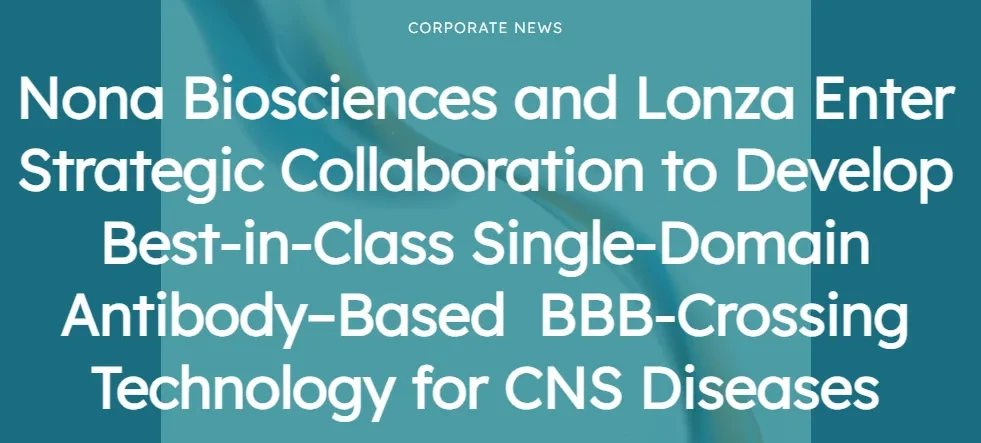
On July 2, 2026, Harbour BioMed and Lonza entered into a strategic partnership, focusing on the treatment of central nervous system (CNS) diseases,Joint Development of Next-Generation Blood-Brain Barrier (BBB) Penetration Technology Based on Single-Domain Antibodies。
Source:Harbour BioMed Official Website
The blood-brain barrier (BBB) is the most formidable obstacle in central nervous system (CNS) drug development, causing numerous promising molecules to fail at the preclinical stage due to their inability to cross it. This collaboration is primarily based on Harbour BioMed’s proprietary fully human heavy-chain-only antibody (HCAb) Harbour Mice platform.®Platform: The world’s first clinically validated fully human heavy-chain-only antibody technology platform, capable of efficiently generating HCAb and VHH single-domain antibodies with both high affinity and favorable developability. Lonza leverages its expertise in protein development and the GS Gene Expression System®Expression System and GlycoConnect®Deep expertise in bioconjugation technology provides critical technical support for the optimization and broad application of candidate molecules.
The precise complementarity of technologies and capabilities between the two parties points to a clear business objective:Developing licensable and commercially viable BBB-penetrating solutions to pave new pathways for CNS drug delivery.
Under the agreement, Harbour BioMed will receive the upfront payment and option payments from Lonza. If a platform license agreement is further reached based on this collaboration in the future, both parties will also share the long-term benefits arising therefrom.
Summary:
Viewing the four collaborations within a broader industrial context makes the trends clearer.
Beyond rapid growth in scale, the industry’s business development (BD) collaboration paradigm has also undergone profound iteration: from out-licensing of complete technology platforms and joint clinical development of differentiated pipelines, to global collaborations on AI-integrated R&D platforms and joint breakthroughs in underlying delivery tool technologies. Collaboration models continue to diversify, with deal structures increasingly shifting toward earlier stages of drug discovery and development, while the depth, breadth, and commercial complexity of partnerships rise in tandem.
The interwoven industrial landscape corroborates that the core competitiveness of China’s biopharmaceutical sector has long transcended single-point competition based on individual molecules or single pipelines.A complete innovation ecosystem with clear hierarchical structure, diversified models, and deep integration with global markets is rapidly taking shape.。
References:
1.https://mp.weixin.qq.com/s/TDtNJOsCfIIPg0T3xpTrIQ
2.https://www.abbisko.com/cn/newsDetail/400.html
3.https://insilico.com/news_sc/a48o6xxvv1-6ai
4.https://mp.weixin.qq.com/s/tw5C68vs0A5Bur_jVWjPqQ
5.Chinese Pharma Companies Are on a Frenzy! Securing Nearly $100 Billion in Overseas Deals in Half a Year (WeChat Official Account: DXY Insight Database)
6. Other Public Information
Cover image source: Doubao AI

2026-07-01

2026-06-30

2026-06-29

2026-06-26

Copyright Statement / Disclaimer
This article is a compilation.
This article is for informational purposes only and does not provide any commercial, medical, or investment advice.
Images, videos, fonts, music, and other materials featured in this article are either licensed authentic works purchased by PharmaTimes, sourced from the WeChat public image library, or obtained from corporate official websites or the internet. Some materials are used under the CC0 license. Copyright belongs to the respective owners, and PharmaTimes makes every effort to cite the sources.
Should you have any questions, please contact us.
Sincere thanks!
Drug Times Official Website: www.drugtimes.cn
Contact Information:
Tel: 13651980212
WeChat: 27674131
Email: contact@drugtimes.cn
![]()
![]()
![]()
![]()
![]()
![]()
![]()
![]()
![]()
![]()
![]()
![]()
![]()
![]()
![]()
![]()
![]()
![]()
![]()
![]()
![]()
![]()
![]()
![]()
![]()
![]()
![]()
![]()
![]()
![]()
![]()
![]()
![]()
![]()
![]()
![]()
![]()
![]()
![]()
![]()
![]()
![]()
![]()
![]()

![]()
![]()
![]()
![]()
![]()
![]()
![]()
![]()
![]()
![]()
![]()
![]()
![]()
![]()
![]()
![]()
![]()
![]()
![]()
![]()
![]()
![]()
![]()
![]()
![]()
![]()
![]()
![]()
![]()
![]()
![]()
![]()
![]()
![]()
![]()
![]()
![]()
![]()
![]()
![]()
![]()
![]()
![]()
![]() ClickDiscover More Exciting Content!
ClickDiscover More Exciting Content!
Copyright Statement / Disclaimer
This article is a compilation.
This article is for informational purposes only and does not provide any commercial, medical, or investment advice.
Images, videos, fonts, music, and other materials featured in this article are either licensed authentic works purchased by PharmaTimes, sourced from the WeChat public image library, or obtained from corporate official websites or the internet. Some materials are used under the CC0 license. Copyright belongs to the respective owners, and PharmaTimes makes every effort to cite the sources.
Should you have any questions, please contact us.
Sincere thanks!
Drug Times Official Website: www.drugtimes.cn
Contact Information:
Tel: 13651980212
WeChat: 27674131
Email: contact@drugtimes.cn
![]()
![]()
![]()
![]()
![]()
![]()
![]()
![]()
![]()
![]()
![]()
![]()
![]()
![]()
![]()
![]()
![]()
![]()
![]()
![]()
![]()
![]()
![]()
![]()
![]()
![]()
![]()
![]()
![]()
![]()
![]()
![]()
![]()
![]()
![]()
![]()
![]()
![]()
![]()
![]()
![]()
![]()
![]()
![]()
![]()
![]()
![]()
![]()
![]()
![]()
![]()
![]()
![]()
![]()
![]()
![]()
![]()
![]()
![]()
![]()
![]()
![]()
![]()
![]()
![]()
![]()
![]()
![]()
![]()
![]()
![]()
![]()
![]()
![]()
![]()
![]()
![]()
![]()
![]()
![]()
![]()
![]()
![]()
![]()
![]()
![]()
![]()
![]() ClickDiscover More Exciting Content!
ClickDiscover More Exciting Content!
Copyright Statement / Disclaimer
This article is a compilation.
This article is for informational purposes only and does not provide any commercial, medical, or investment advice.
Images, videos, fonts, music, and other materials featured in this article are either licensed authentic works purchased by PharmaTimes, sourced from the WeChat public image library, or obtained from corporate official websites or the internet. Some materials are used under the CC0 license. Copyright belongs to the respective owners, and PharmaTimes makes every effort to cite the sources.
Should you have any questions, please contact us.
Sincere thanks!
Drug Times Official Website: www.drugtimes.cn
Contact Information:
Tel: 13651980212
WeChat: 27674131
Email: contact@drugtimes.cn