First Implantation in Karamay! Domestic Premium Trifocal IOL 'LiangShiAn Trifocal PLUS' Expands into Tier-3 and Tier-4 Cities

Vision Pro
High-end Ophthalmic Consumables Developer

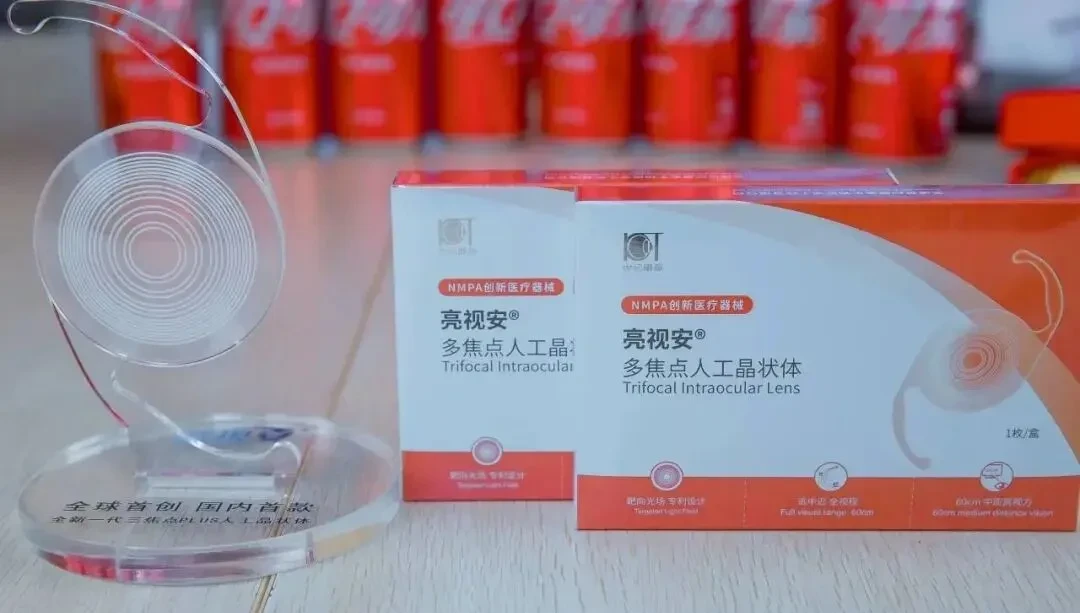
June 29, 2026,Xinjiang Karamay Shanyun Eye HospitalCompleted a case of phacoemulsification combined with intraocular lens implantation, the implanted lens isTianjin Century Kangtai Biomedical Engineering Co., Ltd.Developed by"ClearView An Tri-Focal PLUS" Trifocal Intraocular Lens. According to the hospital's public information, this is the first clinical application of this product in Karamay City.

# Article 2Domestic Trifocal Intraocular Lens
"Liangshi'an Trifocal PLUS" was approved for market launch in January 2025 through the National Medical Products Administration's special review procedure for innovative medical devices and is classified as a Class III medical device.
According to the company's public information, this product adopts "Intelligent Targeted Light Field Distribution"Technology (Patent No. CN202110610310.5),"Light energy utilization rate is nominally greater than 90%, with a focal design featuring a 40 cm close-range and a 60 cm mid-range distance.。
In the field of trifocal intraocular lenses, imported products entered the market earlier: the Zeiss AT LISA tri series was launched in 2012, followed by the entry of Alcon PanOptix and Johnson & Johnson TECNIS Symfony into China.
Approval of domestically produced trifocal intraocular lenses (IOLs) occurred relatively late: In September 2024, Vision Pro’s first domestically produced trifocal IOL, “Shi Quan Ji,” received approval; in January 2025, Century Kangtai’s “Liang Shi An” Trifocal Plus was approved, becoming the second domestically produced trifocal IOL to gain approval in China.
# Registration Certificate Status of High-End Domestic IOLs
According to statistics from the National Medical Products Administration's medical device database, more than 260 intraocular lens products have been approved in China, with domestically produced products accounting for over one-third.Domestic intraocular lenses are predominantly monofocal products, accounting for approximately 75%-80% of the total registered volume; high-end products such as multifocal and extended depth-of-focus (EDOF) lenses collectively account for approximately 15%-20% of registered units.。
In terms of high-end product portfolio, Aierbo Nuode launched the first domestically produced bifocal intraocular lens in 2022, filling the gap in domestic multifocal lenses.. From 2025 to 2026, multiple domestically produced high-end intraocular lenses were successively approved for market launch:
September 2025,Aier Medicalextended depth-of-focus intraocular lens approved for market launch;
October 2025,Century KangtaiThe extended depth of focus (EDoF) intraocular lens (Wan Shi An® Ultra-EDoF) has been approved for market launch;
April 2026,Haohai Biological TechnologyWholly-owned subsidiaryHenan UniverseThe multifocal aspheric intraocular lens (Quanshijia®) has been approved for market launch;
June 2026,Haohai BiotechSubsidiarySaimeishiTrifocal Intraocular Lens (Xiang Wujie®) Approved for Market Launch.
The aforementioned products have all been approved through the National Medical Products Administration’s Special Review Procedure for Innovative Medical Devices, marking that domestically produced intraocular lenses have entered an accelerated approval phase in the high-end sector.
# Current Status of the Cataract Surgery Market
China has the largest number of cataract patients globally. According to industry research data, in 2021, there were approximately 135 million cataract patients in China, with an incidence rate of about 80% among individuals aged 60 to 89. In 2024, the national volume of cataract surgeries in China was approximately 4.7 million, and the Cataract Surgical Rate (CSR) per million population was around 3,273.The "14th Five-Year" National Eye Health Plan requires the CSR to reach above 3,500 by 2025.。
In a cross-country comparison, the CSR in the United States is approximately 12,100, in Japan about 11,800, and in India around 5,800. China's CSR level is roughly one-fourth that of the United States, indicating a growth potential of two to four times.
In terms of surgical structure, monofocal intraocular lenses (IOLs) account for approximately 70% of the usage in China, while refractive IOLs, including bifocal, trifocal, and extended depth of focus (EDOF) types, collectively account for about 30%. Functional IOLs (including multifocal and EDOF types) represent approximately 10% of the overall IOL market.
The adoption rate of refractive cataract surgery in primary hospitals is less than 15%. The CSR index in western provinces is approximately 20% lower than the national average.。
# Eye Future Observation
The timeline from approval to clinical implementation for domestically produced trifocal intraocular lenses (IOLs) is shortening. The case in Karamay may reflect an attempt to penetrate third- and fourth-tier cities with high-end IOLs, but market acceptance still depends on subsequent surgical volumes, patient satisfaction, and long-term clinical data. Whether domestically produced high-end IOLs can increase their market share under the volume-based procurement policy hinges on product quality stability, accumulation of clinical data, and the completeness of physician training systems.
Statement:This article is intended solely for the compilation of industry information and reporting on market dynamics; it does not constitute advice on the purchase of medical devices, recommendations for medical treatment plans, or investment advice. Information regarding product approvals, technical specifications, and corporate data mentioned herein is sourced from the public databases of the National Medical Products Administration (NMPA), publicly available corporate materials, and reports from industry research institutions. Statistical methodologies may vary; please refer to the latest NMPA announcements and official corporate releases for authoritative information. Intraocular lens implantation is a medical procedure. The specific surgical approach and lens selection must be comprehensively evaluated by qualified ophthalmologists based on individual patient conditions. Patients should make decisions in accordance with medical advice at accredited healthcare institutions and must not rely on the information in this article for self-diagnosis or independent judgment.

Ophthalmic Solutions Case Studies