

NGS Tumor Testing Firm Geneseeq Revives Domestic IPO Bid

Geneseeq
Genetic Testing Product Developer
Nanjing Shihejiyin Technology, Inc.(Geneseeq) resubmitted its IPO prospectus for the Shanghai STAR Market at end-June 2026.
Over the past two years, there have been barely any IPO filings from domestic next-generation sequencing(NGS) oncology players. Back in 2020, Burning Rock Dx and Genetron Holdings Limited went public on the Nasdaq in quick succession, stoking industry-wide hype. Yet within just a few years, Burning Rock’s share price collapsed drastically, while Genetron moved forward with full privatization.
The domestic capital market has also turned cold. Genecast Group Inc. filed for Hong Kong IPO three separate times, only to see all three applications lapse. A queue of other candidates including GENECHEM and LC-BioTechnologies also saw their STAR Market listing attempts stall at the final hurdle, leaving the sector mired in a three-year slump.
Investors grew wary of NGS stocks, while industry insiders lost optimism over listing prospects.
More than two years on, Geneseeq has submitted a revised filing to make another run at the STAR Market.
After such a prolonged industry downturn, why is Geneseeq the first to return to the IPO pipeline? How have its core commercial narratives, financial performance and regulatory credentials evolved since its last filing? Its renewed prospectus may hold key insights into the entire domestic oncology NGS industry.
To unpack Geneseeq’s renewed listing push, one must first trace the sector’s turbulent evolution.
2015–2020 marked the first major boom for oncology NGS. Capital flooded into the space, and Laboratory Developed Test (LDT) models dominated the market. Companies avoided the lengthy medical device registration process; they only needed to run sequencing tests in-house and market services via hospital distribution channels, pitching narratives centered on precision medicine and untapped blue-sky market demand.
The tide shifted from 2020 to 2025 as LDT models hit clear structural ceilings. Absent unified national standards, LDT services could not be included in medical insurance programs, while hospitals faced mounting compliance risks. When Burning Rock and Genetron debuted in the U.S., they marketed themselves as leading Chinese oncology NGS testing service providers, yet global investors framed unproductized testing labs as labor-intensive service operators with limited scalable value.
A pivotal industry turning point came in late 2025. The National Healthcare Security Administration incorporated high-throughput gene sequencing into a unified national pathological billing framework, eliminating fragmented regional pricing rules and laying foundational regulatory groundwork for broader NGS insurance reimbursement, alongside streamlined review pathways for NGS IVD kits.
Hainan Le Cheng Pilot Zone also opened import channels for overseas FDA-cleared in vitro diagnostic (IVD) reagents, unlocking a new growth vector for the industry. Geneseeq capitalized on this policy shift, securing approval to launch its Hainan Shihe Ningao Medical Laboratory in December 2025, followed by January 2026 clearance to import its U.S. FDA-cleared pan-solid tumor large-panel NGS assay as a clinically urgent imported medical device, eligible to process patient samples nationwide.
The sector has cycled through three distinct eras: explosive hype, prolonged stagnation, and a regulatory inflection point. Competition today no longer hinges on testing volume, but on which firms can secure IVD kit registrations and secure medical insurance reimbursement first.
Domestic peers have now diverged sharply in product development timelines. Following market setbacks, Burning Rock and Genetron shifted focus to U.S. regulatory clearances, slowing domestic pipeline progress. Genecast Group Inc. still lacks approved large-panel assays, with its commercialization window narrowing after three failed Hong Kong IPO attempts. Players such as Gene+ remain stuck in clinical validation phases. While Amoy Diagnostics Co. LTD. is a profitable listed firm, its core revenue stems from small-panel PCR tests rather than large-panel NGS, placing it in a separate subsegment.
Geneseeq stands among China’s rare firms with a full portfolio of approved large-panel, small-panel and pan-solid tumor companion diagnostic kits, holding concurrent regulatory approvals in China, the U.S. and EU for its flagship large-panel assay. Its liquid biopsy and pan-cancer early screening pipelines have entered China’s innovative medical device review track and secured U.S. FDA Breakthrough Device Designation respectively.
This robust product portfolio is clearly reflected in the firm’s shifting revenue mix.
In 2023, clinical testing services made up 58.43% of total revenue, with IVD kit product sales accounting for just 22.62% — a classic LDT service-lab revenue structure. By 2025, the ratio flipped entirely: product sales reached RMB 267 million, representing 46.6% of total revenue, while clinical testing services fell to RMB 225 million, or 39.4% of revenue. IVD kits have become the company’s primary growth driver.
This structural turnaround rests on four core national medical device registrations.
1. 2018: One of China’s first six-gene small-panel NGS kits for basic lung cancer targeted therapy profiling.
2. October 2023: GeneseeqOne, China’s first domestically approved large-panel NGS assay for tissue TMB detection in non-small cell lung cancer, filling a domestic gap in large-panel IVD products.
3. August 2025: GENESEEQPRIME pan-solid tumor large-panel assay obtained U.S. FDA clearance, making it one of the world’s only high-throughput large-panel tumor assays certified simultaneously in China, the U.S. and EU.
4.October 2025: NTRK gene fusion detection kit, China’s first NGS-based pan-solid tumor companion diagnostic for rare cancer target identification.
These four registrations transformed Geneseeq from a pure testing service lab into a vertically integrated IVD medical device manufacturer.
Separately, its EGFR/KRAS/MET circulating tumor DNA (ctDNA) liquid biopsy kit entered China’s Innovative Medical Device Special Review Program in 2024, representing a domestic first for multi-gene high-throughput sequencing liquid biopsy technology.
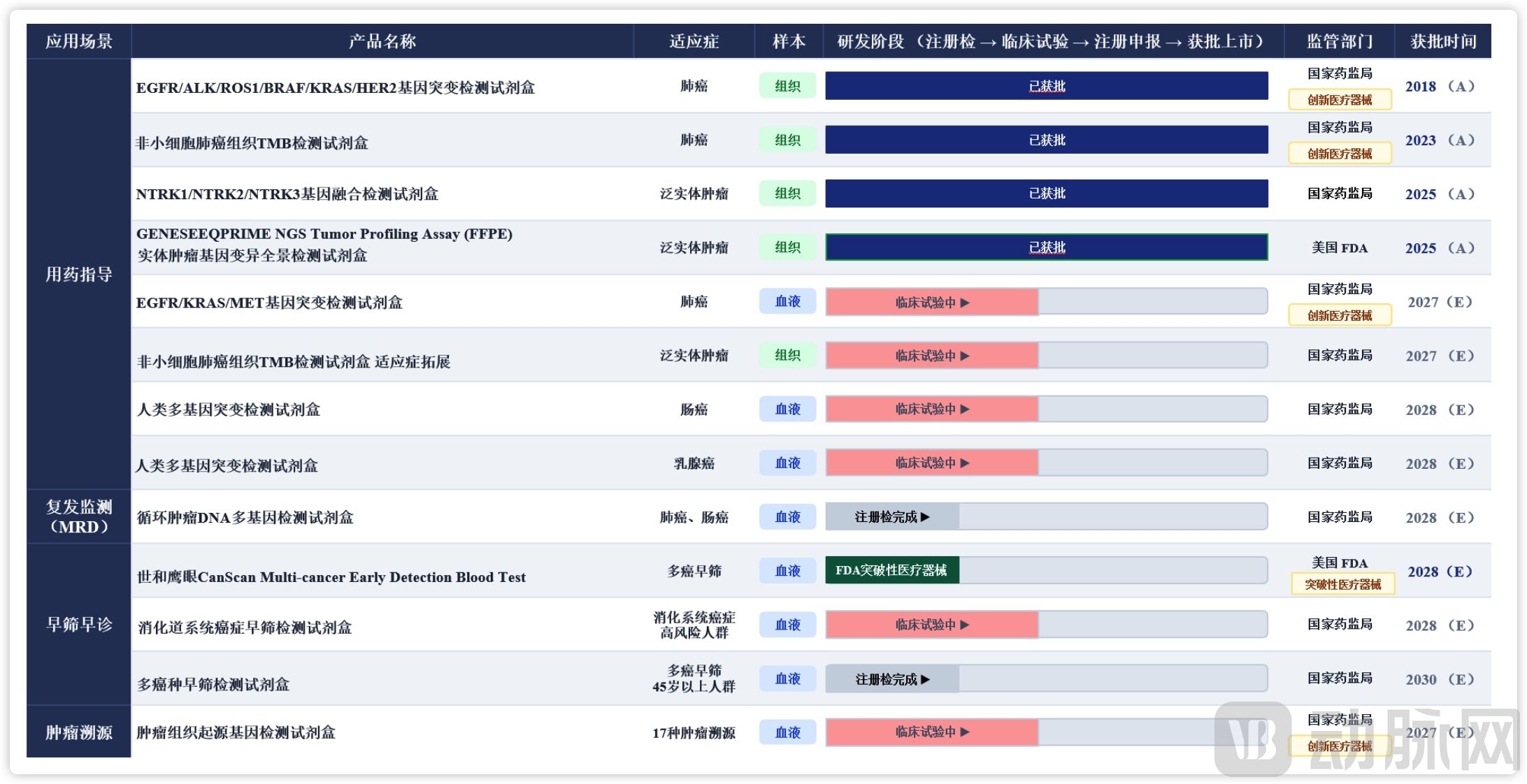
Corporate Product Pipeline Layout, Source: Company IPO Prospectus
Geneseeq’s product portfolio is backed by robust academic validation. Its CanScan pan-cancer early screening assay earned U.S. FDA Breakthrough Device Designation; results from its over 10,000-subject Jinling prospective clinical cohort were published in Nature Medicine; and its AI-powered genetic variant interpretation module was added to the FDA’s AI/ML medical device registry in 2026, forming a durable technical moat across all product lines.
That said, Geneseeq’s 2025 full-year revenue of RMB 577 million places it mid-tier in the sector, with clear room for scale expansion. Burning Rock’s revenue is comparable after its rollercoaster growth cycle, while Amoy Diagnostics posted higher full-year revenue in 2025.
Geneseeq’s current positioning is that of a successful transition player: having evolved from an LDT service lab to a regulated IVD enterprise with proprietary technical barriers, yet still mid-sized amid industry peers.
The company’s capital market narrative carries equally compelling context, rooted in its founding team’s academic background.
Chairman Shao Yang holds a PhD in Cancer Biology from the University of Toronto; his father Shao Huawu, a PhD in Medicinal Chemistry from the Chinese Academy of Sciences, previously worked as a research scientist at Canada’s National Research Council. His spouse Wang Xiaonan earned a Master’s degree in Cellular and Molecular Biology from the University of Toronto. The founding team forms a family-backed startup with dual academic and research credentials, a profile highly favored by STAR Market regulators.
STAR Market listing assessments weigh far more than academic pedigree, however, placing heavy scrutiny on valuation rationality.
Geneseeq’s financing journey has been highly volatile. Its pre-money valuation surged to RMB 5.5 billion during its Series D round in 2019. After withdrawing its IPO filing in April 2024, share repurchase clauses triggered for several institutional investors, placing heavy repayment pressure on the company’s actual controllers. Founders Shao Yang, Wang Xiaonan and Zhao Minchao subsequently set up two SPV vehicles, Prolog and Fenali, to consolidate legacy shareholder equity while introducing new institutional backers.
Industry capital from Ping An Life Insurance Company Of China’s affiliate Harmony Anrui Fund joined the cap table in late 2025.
Ping An’s decision to invest during the sector’s downturn stemmed not from generic enthusiasm for the NGS oncology concept, but tangible, de-risked product assets: domestically approved large-panel kits, FDA-cleared flagship assays, commercialized NTRK companion diagnostics, and fully operational IVD import channels via Hainan Boao Le Cheng. These represent tangible commercial assets rather than unvalidated pipeline concepts.
Per the prospectus, Geneseeq plans to raise RMB 1.7 billion via this IPO. Nearly 60% of proceeds will fund early screening and MRD kit R&D: RMB 660 million allocated to the Jinling clinical cohort and pan-cancer early screening assay development, RMB 180 million for minimal residual disease (MRD) detection kits, and RMB 130 million for proprietary oncology AI large model development. Its AI sequencing interpretation platform has passed relevant FDA reviews, serving as cross-cutting foundational technology for all product lines. Remaining capital will support nationwide hospital distribution expansion and general working capital reserves, aligning with the sector’s long-term high-R&D investment profile.
Early screening and MRD assays represent the next major growth vector for oncology NGS, yet their commercialization cycle stretches 5–8 years from clinical validation to insurance reimbursement; stable revenue contributions from these pipelines are unlikely to materialize until roughly 2030 under optimistic forecasts.
Near-term earnings catalysts will instead rely on rising domestic hospital adoption of its flagship large-panel kits and accelerating overseas market penetration. While its AI variant analysis module secured FDA listing, AI tools currently function primarily as operational efficiency aids rather than standalone billable medical services in oncology care workflows.
Though the fund allocation aligns with the sector’s long-term growth trajectories, investors face a multi-year lag before seeing meaningful returns on these R&D investments, requiring sustained long-term monitoring.
Ultimately, the oncology NGS sector has not lost its commercial viability—it has simply moved past an era defined by service-based speculative narratives into a new phase of competition centered on medical device registration and regulated IVD products.
The 2020 industry boom saw Burning Rock and Genetron prove genuine domestic clinical demand for Chinese oncology NGS technology to global investors. Geneseeq’s renewed STAR Market IPO bid aims to demonstrate a new milestone: Chinese biotech firms can translate cutting-edge sequencing technology into standardized, replicable, fully regulated medical devices.