

Chengdu Vaccine Hidden Champion Revives HK IPO Bid
olymvax
Human Vaccine Research and Development Manufacturer
Chengdu Olymvax Biopharmaceuticals Inc.(688319.SH) resubmitted its application for an H-share listing with the Hong Kong Stock Exchange on June 30, around seven months after its initial filing.
When the company first filed in November 2025, its recombinant Staphylococcus aureus vaccine had completed enrollment of all 6,000 trial participants and entered the follow-up phase. In the renewed prospectus, the firm notes the vaccine is expected to complete data unblinding in Q3 2026 and submit a New Drug Application (NDA) by the end of the same year.
Looking further back, Olymvax went public on the STAR Market in 2021, standing out as one of the handful of vaccine firms that turned profitable in their first trading year. Its financial filings show revenue climbed from RMB 494.3 million in 2023 to RMB 586.1 million in 2024, before hitting RMB 700.1 million in 2025. This steady upward operating performance lays solid groundwork for its second HK listing bid.
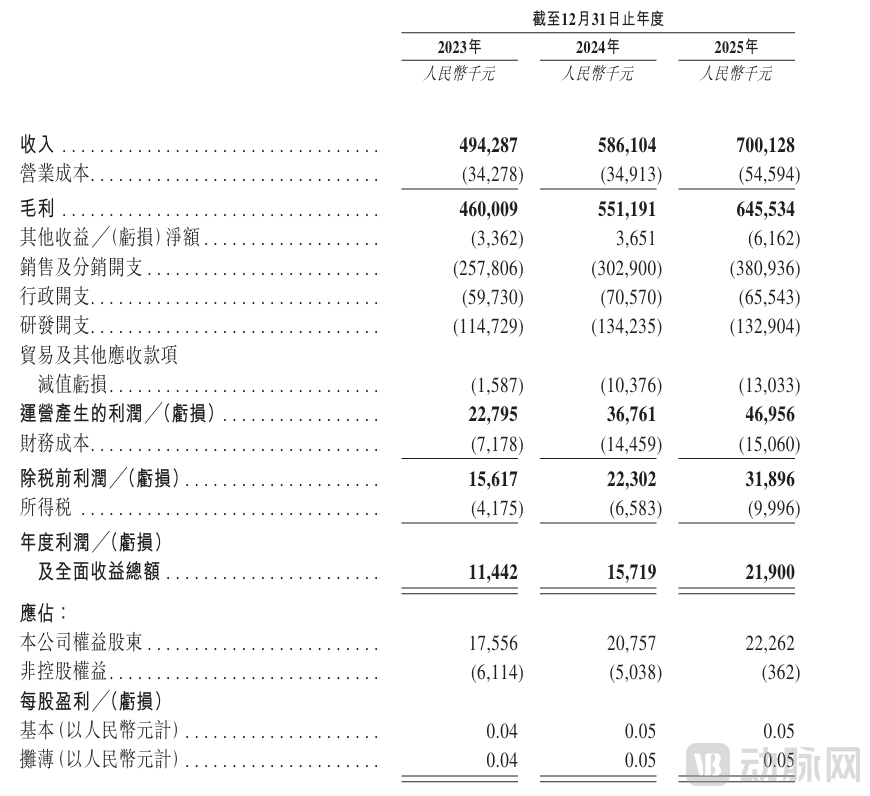
Olymvax Consolidated Statements of Profit or Loss and Other Comprehensive Income, 2023–2025
Mounting Pipeline Capital Demand, A+H Dual Listing Model Gains Traction
Three overlapping industry and corporate backdrops explain Olymvax’s renewed HK IPO push.
First, its innovative pipeline has entered a capital-intensive value realization cycle. Per the prospectus, the company’s core strategy covers advancing late-stage candidates—including rFSAV and quadrivalent split influenza vaccines—through clinical trials and commercialization, developing multiple preclinical vaccine candidates, and retaining market share for mature products such as adsorbed tetanus vaccines. All these parallel initiatives demand sustained, large-scale long-term capital spending.
The recombinant Staphylococcus aureus vaccine exemplifies this dynamic: the candidate wrapped up Phase III enrollment of roughly 6,000 subjects and now awaits data analysis. Subsequent steps, spanning clinical data interpretation, regulatory filings, manufacturing capacity buildout and market preparation, require continuous funding. Meanwhile, its Helicobacter pylori vaccine is moving toward an Investigational New Drug (IND) application, and its MDCK cell-based quadrivalent influenza vaccine has entered Phase III trials. Running multiple pipelines in tandem creates persistent demand for R&D and operational capital.
Financial disclosures reveal Olymvax’s R&D spending hit RMB 133 million in 2025, accounting for a larger share of total revenue. Its R&D team also expanded from 59 staff in 2020 to 143 by end-2025, signaling a steadily expanding research infrastructure and rising reliance on long-term innovation investment.
Second, the A+H dual-listing financing model has gained traction across the sector. Chinese biotech firms accelerated HK IPO filings throughout 2025, with 15 pharmaceutical companies submitting applications solely in November 2025. A-share listed drugmakers including Hengrui Medicine, Bailitianheng and Maiwei Biotech have all rolled out A+H dual-listing plans.
This trend reflects a broader industry shift: vaccine and biotech development now demands massive, long-cycle investment across parallel pipelines, limiting financing flexibility from a single stock exchange. Hong Kong stands out for its distinct investor base, differentiated valuation frameworks for innovative assets and streamlined secondary fundraising mechanisms, making it a vital supplementary funding channel for A-share issuers. A+H dual listings have become a mainstream strategy to optimize corporate capital structures.
Third, A+H dual listings serve as an extension of Olymvax’s global expansion blueprint. Company executives highlighted in public interviews that dual capital markets form a cornerstone of its two-way internationalization strategy. Under this framework, the STAR Market supports domestic R&D and commercial operations, while the Hong Kong platform strengthens ties with global institutional investors and industrial partners.
For vaccine developers, globalization extends far beyond overseas product sales, encompassing cross-border clinical collaborations, technology licensing, in-licensing deals and alignment with international regulatory systems. A capital market with robust global investor participation streamlines financing and communication for cross-industry global partnerships.
In short, surging R&D spending drives greater capital needs; constrained fundraising capacity on the A-share market pushes firms to tap Hong Kong’s alternative capital pool; enhanced global financing capabilities in turn fuel worldwide clinical and commercial rollouts, ultimately unlocking full pipeline value. Olymvax’s second HK filing represents the latest milestone in this self-reinforcing strategic cycle.
Three Core Assets Underpin the IPO Logic
Growth-stage vaccine firms seeking market credibility in Hong Kong must answer one core question: what underpins their long-term value? Olymvax lays out three progressive competitive pillars in its prospectus.
First pillar: Commercialized products generating stable cash flow. The company markets three approved vaccines: adsorbed tetanus vaccine, Haemophilus influenzae type b (Hib) conjugate vaccine, and Group A and C Meningococcal Polysaccharide Conjugate (ACYW) vaccine.
Launched in 2017, its adsorbed tetanus vaccine claimed a 98.8% domestic market share by revenue in 2025, ranking first in China’s adsorbed tetanus vaccine segment, per Frost & Sullivan industry reports. The product delivered RMB 463 million, RMB 536 million and RMB 614 million in revenue for 2023, 2024 and 2025 respectively, forming Olymvax’s core revenue base.
Its AC conjugate vaccine meanwhile posted 147.32% year-on-year revenue growth in 2025 to RMB 65.3469 million, cultivating a viable second growth driver.
Second pillar: Technical moat built on globally pioneering vaccine candidates. The firm advances eight key pipeline programs, five of which qualify as First-in-Class candidates targeting unmet clinical needs against multidrug-resistant superbugs, carving out a differentiated research roadmap.
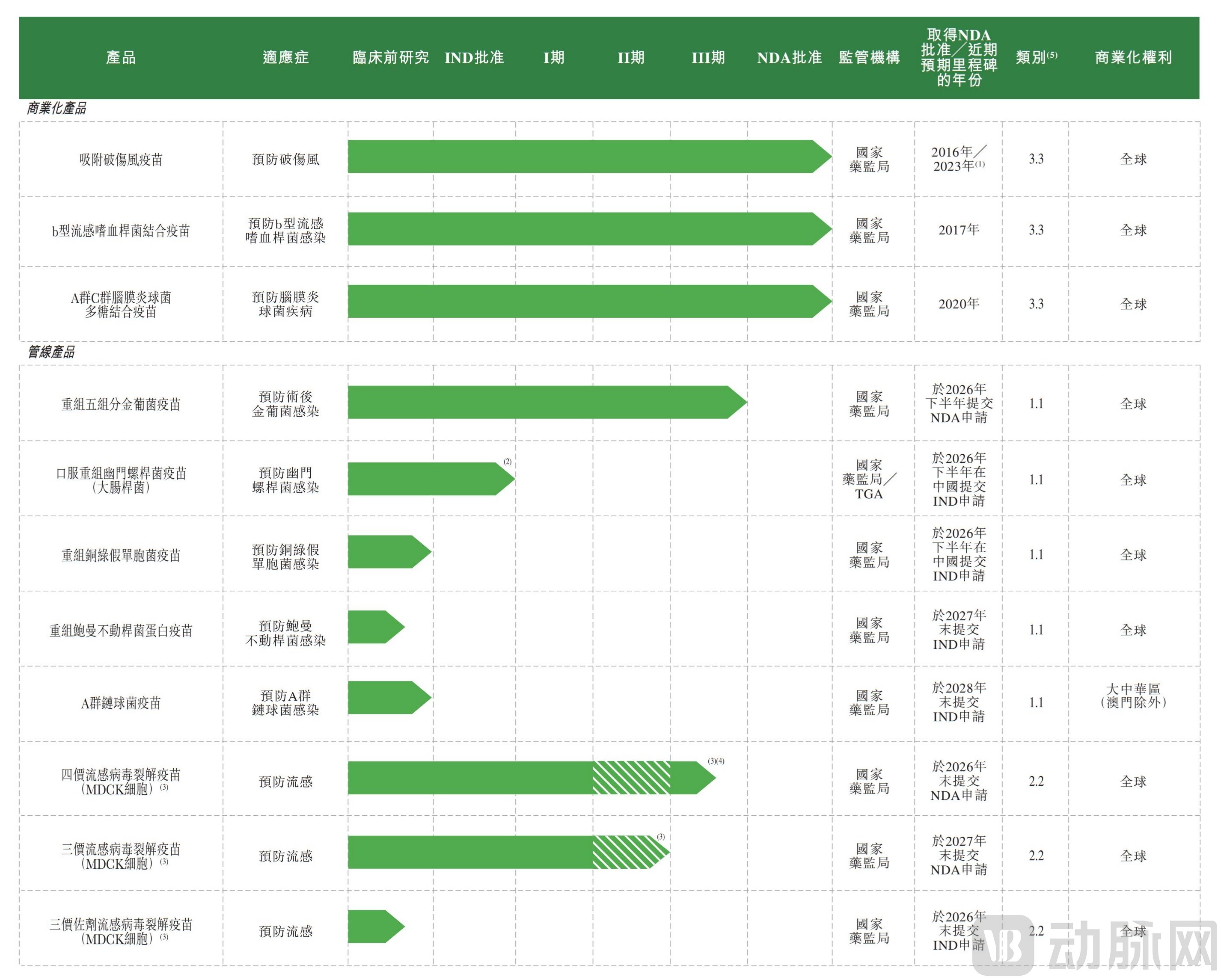
Olymvax’s Product Pipeline Portfolio
Its flagship program, recombinant Staphylococcus aureus vaccine (rFSAV), is the world’s only candidate of its kind to reach Phase III clinical trials. Staphylococcus aureus features on the WHO’s priority list of critical drug-resistant pathogens and has long been a top R&D target for global vaccine developers; numerous rival candidates failed in late-stage clinical trials previously.
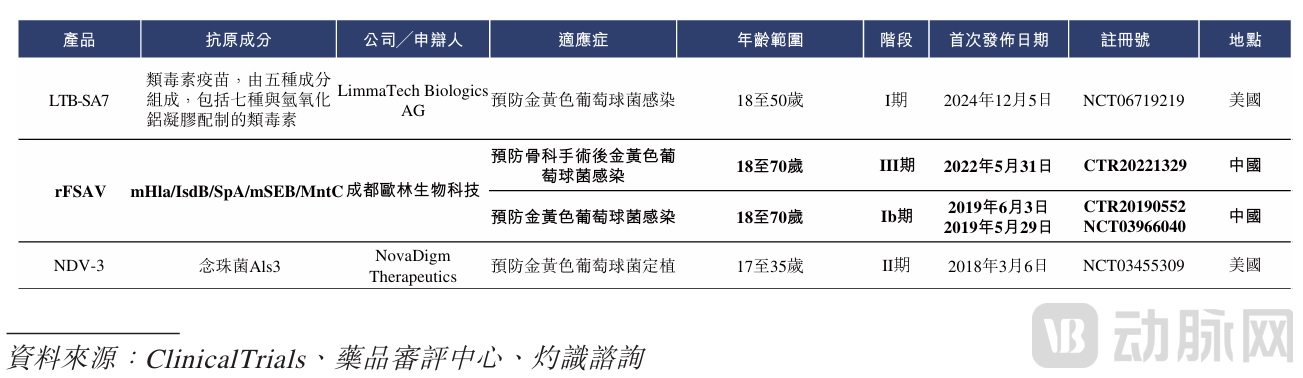
Candidate Comparison Chart: Global Staphylococcus aureus Vaccine Candidates in Clinical Development
Beyond its S. aureus program, Olymvax maintains pipelines targeting Helicobacter pylori, Pseudomonas aeruginosa, Acinetobacter baumannii and Group A Streptococcus, forming a full portfolio of vaccines against high-priority multidrug-resistant bacteria.
For adult immunization, its MDCK cell-cultured quadrivalent influenza vaccine has entered Phase IIIa trials, one of China’s earliest candidates adopting this novel manufacturing platform, complementing its five First-in-Class anti-superbug vaccine programs.
Third pillar: Substantial tangible progress in international deployment, rather than rhetorical overseas expansion plans.
In 2025, Olymvax passed an on-site inspection by the Philippines Food and Drug Administration, and secured its GMP compliance certification in 2026, laying regulatory groundwork for market entry across Southeast Asia. It also inked a collaboration with Griffith University for its Group A Streptococcus vaccine program, securing exclusive rights to contract manufacturing and commercialization across Greater China—external validation of its robust quality control and production capabilities.
Additionally, Olymvax exports finished vaccines and drug substance to markets including Pakistan, while continuously expanding its footprint in the Philippines and other Southeast Asian economies.
Material risks remain, however, as flagged in the prospectus. Rising penetration of combination vaccines threatens market demand for single-antigen shots such as standalone Hib vaccines. While its Staphylococcus aureus vaccine holds a leading global position, all novel vaccines carry inherent clinical trial uncertainties, divergent cross-border regulatory standards, steep manufacturing costs and lengthy post-launch market education cycles. Shifts in national immunization schedules or centralized procurement policies could also erode profitability for its mature established products.
From Overcapacity Price Wars to Race for Novel Scarce Targets
Olymvax’s renewed HK filing is not an isolated corporate move, but a microcosm of China’s broader vaccine industry transformation.
The sector recently endured a cycle defined by capacity expansion, fierce price competition and shrinking margins. Walvax’s bivalent HPV vaccine was priced as low as RMB 27.5 per dose in centralized procurement, representing a drop of over 90% from its 2022 price tag. Influenza vaccine tender prices fell to RMB 5.5 per dose in Beijing government procurement rounds. Chongqing Zhifei Biological Products Co., Ltd. suffered roughly RMB 40 million in daily losses amid mounting HPV vaccine inventory, with stockpiles swelling to RMB 20.2 billion.
These stark industry signals confirm a fundamental shift: the old business model centered on single blockbuster vaccines and capacity expansion is rapidly becoming obsolete. The core competitive paradigm has flipped from price-based rivalry to a race to develop untapped therapeutic targets and innovative technical platforms.
The new industry landscape demands dual core competencies for vaccine players: stable cash flow from mature commercial vaccines to sustain daily operations, and sustained high-risk R&D investment to pioneer novel targets and technology platforms that unlock second growth curves—and determine long-term corporate survival.
Olymvax’s A+H dual-listing strategy is engineered to build both strengths simultaneously: its STAR Market listing reinforces domestic commercial leadership, while the Hong Kong platform funds global innovation and international expansion.
The next three to five years will serve as a critical test of this transformation strategy. Will the Staphylococcus aureus vaccine deliver positive clinical readouts in 2026? Can its MDCK cell-based influenza vaccine become China’s first approved cell-cultured influenza shot? Will its Helicobacter pylori vaccine open a new market for digestive infection prevention? Answers to these questions will not only shape Olymvax’s HK market performance, but also offer a benchmark case for how Chinese vaccine developers can leverage dual capital markets to drive innovation breakthroughs.