

Ray Therapeutics Secures $125M Series B Financing to Advance Pioneering Optogenetic Vision-Restoring Therapies Led by Dr. Zhuo-Hua Pan
Ray Therapeutics
Developer of Therapeutics for Degenerative Retinal Diseases

Janus Henderson Investors
Global Asset Management Firm

Franklin Templeton
Conservatively Managed Funds

Invus
Equity Investment Firms

Marshall Wace
Alternative Investment Management Firm

4BIO Capital
An Emerging Asset Management Firm

Adage Capital Partners
Private Investment Fund

Deerfield
Investment Advisory Firm

MRL Ventures Fund
Innovative Therapy Investment Company

Norwest Venture Partners
Venture Capital Firms

Novo Holdings
Venture Capital and Asset Management Firms

Platanus
Software Product Developer
Recently, U.S. clinical-stage biotechnology company Ray Therapeutics (“Ray”) successfully completed an oversubscribed Series B financing round of $125 million.This financing round was led by established asset management giant Janus Henderson Investors, with participation from Adage Capital Management, Franklin Templeton, Invus, Marshall Wace, 4BIO Capital, Deerfield Management,Merck's MRL Ventures Fund、Norwest、Novo Holdings A/S, existing shareholders such as Platanus have all increased their stakes, continuing to demonstrate their support with substantial capital investments.
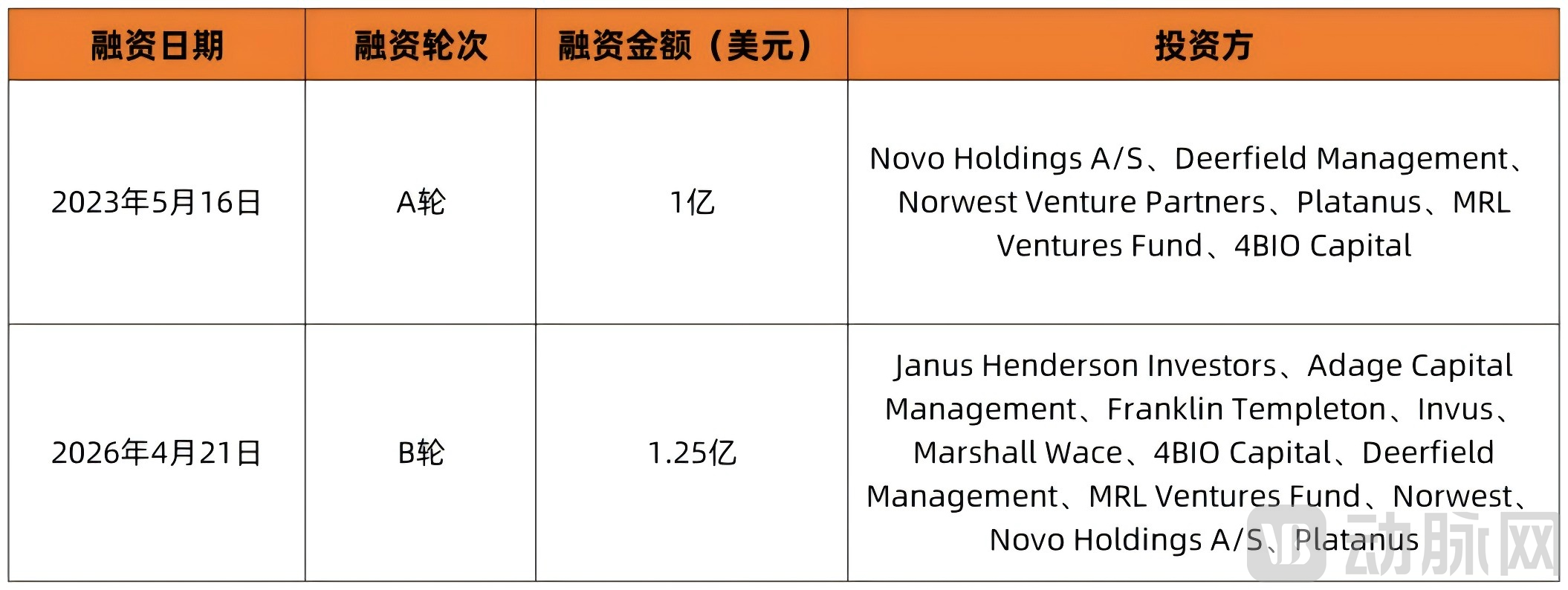
Financing History Chart
The funds will be used to advance the core pipeline candidate RTx-015 through late-stage clinical trials for retinitis pigmentosa, paving the way for commercialization; meanwhile, they will accelerate clinical exploration of RTx-021 in macular diseases such as Stargardt disease and geographic atrophy, uncovering additional application scenarios for the technology.
As the number of players in the ophthalmic gene therapy sector continues to grow, with various technological approaches each having their own focus, why has Ray Therapeutics continued to attract investor interest in this competitive landscape?
1Pan Zhuohua Leads Iterative Development of Photosensitive Proteins to Crack Technical Challenges
Degenerative retinal diseases are a leading cause of blindness worldwide, encompassing conditions such as retinitis pigmentosa and various forms of macular degeneration. The etiology of these disorders is complex; retinitis pigmentosa alone is associated with thousands of distinct genetic mutations. This complexity has placed traditional gene therapies in a predicament: most drugs are designed to target a single specific mutation, thereby benefiting only a limited subset of patients. Currently, mainstream treatment modalities can mostly only slow the rate of retinal cell degeneration and cannot restore vision that has already been lost. Once the disease progresses to an advanced stage, therapeutic options become virtually nonexistent. Meanwhile, certain cutting-edge approaches require the use of specialized optical devices, further increasing the daily burden on patients.
Faced with such clinical dilemmas, the research community has been seeking ways to break through.Chinese-American scientist and pioneer in the field of visual optogenetics, Pan Zhuohuais a pioneer in applying optogenetics technology to vision restoration.
As early as the beginning of this century, Zhuo-Hua Pan proposed a concept: to modify surviving retinal neurons with photosensitive proteins to replace damaged photoreceptor cells and reconstruct the visual pathway. In 2006, his team completed in vivo experiments on rodents for the first time, globally verifying the feasibility of restoring vision through optogenetics. Subsequently, he licensed the first-generation optogenetics patent to RetroSense Therapeutics, which leveraged the technology to carry outThe World's First Human Clinical Trial of Optogenetics in Ophthalmology.
However, the ChR2 (Channelrhodopsin-2) photosensitive protein used in the first-generation therapy had significant limitations, including insufficient light sensitivity, the need for high-intensity light for activation, and potential risks of phototoxicity, making it difficult for this approach to achieve widespread adoption. After RetroSense was acquired by the global pharmaceutical giant Allergan in 2016, progress on the project gradually slowed due to technical bottlenecks.
The pace of research and development has not stopped here.In 2019, Pan Zhuohua’s team published a pivotal study in *Molecular Therapy*, announcing another technological breakthrough.: The team completed site-directed mutagenesis optimization of the CoChR protein (a member of the channelrhodopsin family) derived from *Chlamydomonas ovalis*, and screened out two high-sensitivity variants.
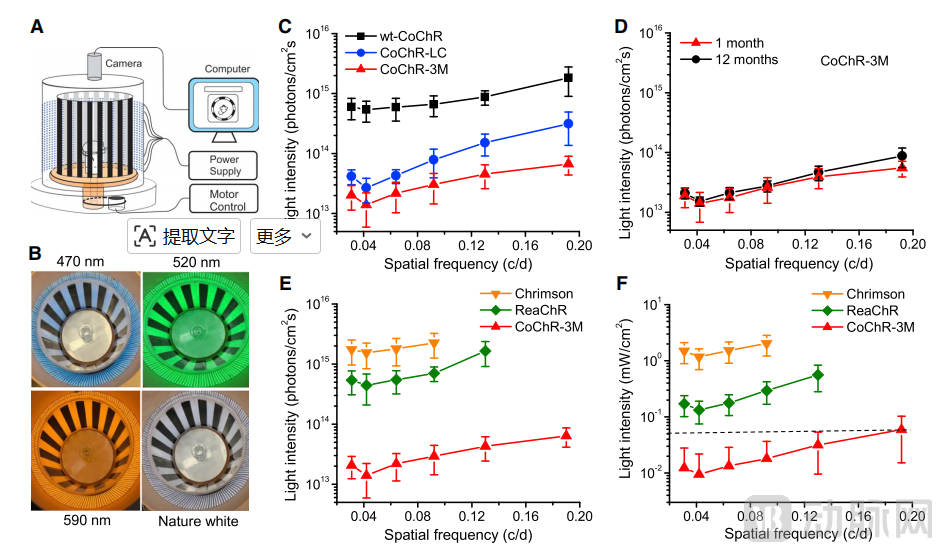 Figure F: Comparison curves of visual recovery thresholds under natural white light (Pan Zhuohua et al., Molecular Therapy, 2019, Figure 6.)
Experimental data demonstrate that the new generation of photosensitive proteins has overcome the limitations of high-intensity light and auxiliary equipment, is adaptable to ambient lighting conditions, and exhibits an excellent safety profile, thereby substantially addressing the core shortcomings of the first-generation technology. Subsequently, patents for related improved technologies were licensed to Ray Therapeutics, founded in 2021, which is advancing their clinical translation—
Ray Therapeutics’ founder, Paul Bresge, has long been deeply engaged in the ophthalmology sector. Motivated by his family member’s diagnosis with retinitis pigmentosa, he has remained committed to finding solutions for blinding eye diseases. The core team members have personally witnessed the early development of optogenetics; Chief Scientific Officer Peter Francis previously led clinical efforts for the first-generation therapy at RetroSense, granting him profound insights into technological iteration and unmet clinical needs. This team, combining scientific vision, clinical expertise, and commercialization capabilities, has become a robust force driving the translation of new technologies into practice.
Leveraging this general-purpose visual optogenetics platform, refined through two rounds of optimization, Ray has established a differentiated therapeutic system.The team employed a minimally invasive intravitreal injection approach, utilizing an adeno-associated virus (AAV) vector to deliver the gene encoding the engineered CoChR optogenetic protein to retinal neurons.Cells originally lacking photosensitivity were reengineered to perceive natural light and convert optical signals into electrical impulses transmitted to the brain, thereby reconstructing a complete visual pathway.
Compared with conventional therapies, this regimen offers distinct advantages: it is not constrained by the type of genetic mutation, thereby overcoming the limitation of one drug targeting a single mutation, and thus has a broader patient population; its therapeutic goal is not merely to slow disease progression but to directly reconstruct the visual pathway, offering treatment opportunities even for late-stage patients with complete photoreceptor apoptosis; the therapy requires only a single injection, holds promise for long-term efficacy, and eliminates the need for auxiliary optical devices or additional medications, significantly simplifying both treatment and post-treatment care.
2Dual-Pipeline Coverage for Various Refractory Fundus Diseases
Based on a mature foundation of optogenetics technology,Ray has mapped out two complementary positioning pipelines,Conduct clinical development targeting different lesion cells and types of eye diseases.
As a core pipeline asset, RTx-015 targets retinal ganglion cells and is administered via a single intravitreal injection. Its primary indication, retinitis pigmentosa, has advanced into the Phase II/III development stage, while Phase I clinical exploration is concurrently underway for other inherited retinal diseases, such as choroideremia. Leveraging positive early clinical data,RTx-015 Received U.S. FDA Regenerative Medicine Advanced Therapy (RMAT) Designation and European EMA Priority Medicines (PRIME) Status in 2026(PRIME) Two Major Regulatory Qualifications, benefiting from regulatory guidance and priority review, thereby accelerating the R&D pace.
The pipeline candidate RTx-021 adopts a differentiated target strategy, targeting retinal ON-bipolar cells and focusing on macular diseases such as Stargardt disease and geographic atrophy secondary to age-related macular degeneration. These diseases primarily damage the macular region of the eye, directly impairing central vision, and are a major cause of blindness in the population. The Phase I clinical trial of RTx-021 for Stargardt disease has been initiated, with the core objective of verifying its ability to restore central vision, thereby addressing the unmet therapeutic needs in the field of macular diseases.
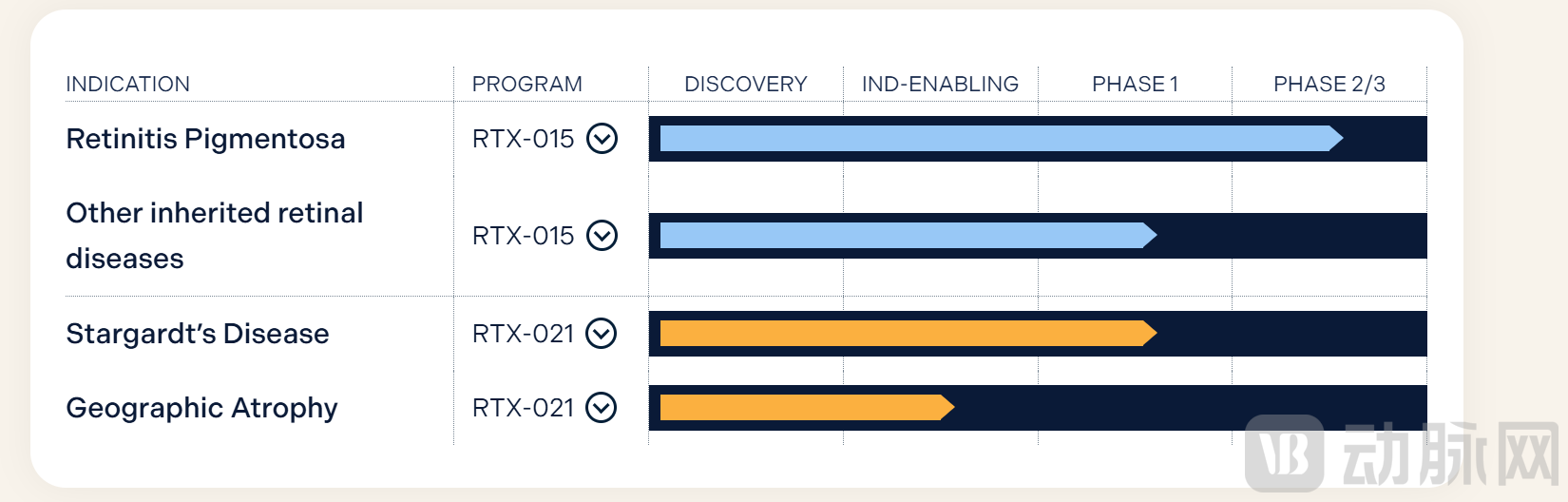 Existing Pipeline Diagram (Image sourced from the official Ray website)
The two pipelines share a common origin but diverge in their therapeutic targets, allowing for maximized reuse of the technology platform while reducing R&D risks. On the production front, Ray has partnered with Forge Biologics to establish a cGMP manufacturing system, with Forge Biologics undertaking the cGMP production of its AAV vectors and plasmid DNA. This collaboration provides stable capacity support for the clinical advancement of the pipeline and subsequent commercialization.
3A Song of Ice and Fire in Retinal Optogenetic Therapy
Currently, ophthalmic optogenetic therapy is in a critical window period transitioning from clinical exploration to commercialization. Numerous companies worldwide are actively entering the field, and the diversity of technical approaches and varying stages of R&D progress are gradually intensifying market competition. This technology breaks free from the limitations of traditional gene therapies by not being tied to specific genetic mutations, making it particularly well-suited to meet the treatment needs of patients with advanced retinal diseases. As a result, the value of early-mover advantage in this sector is becoming increasingly prominent.
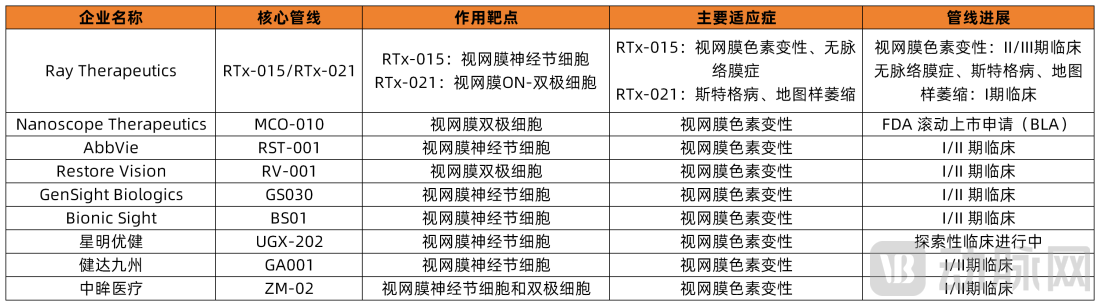 VCBeat’s Incomplete Statistics on the Pipeline of Ophthalmic Optogenetic Therapies in China and Abroad
Overall, this sector exhibits a landscape where Europe and the United States started earlier, while China is accelerating its catch-up. European and American companies have cultivated the field for many years, accumulating substantial technical expertise.Among them, Nanoscope’s MCO-010 is leading the way., most likely to be the first to market, its approval outcome and post-marketing clinical performance may well serve as a bellwether for the entire sector; early pipelines of companies such as AbbVie, GenSight, and Bionic Sight were constrained by the insufficient sensitivity of first-generation photosensitive proteins, necessitating the use of optical goggles for efficacy; Restore Vision has pursued a differentiated GPCR-based optogenetic approach, employing a next-generation chimeric rhodopsin protein design that holds promise for eliminating dependence on external assistive devices.
Although Chinese companies entered the field relatively late, they started with a high technological baseline and are demonstrating strong momentum in catching up: Jianda Jiuzhou’s GA001 pipeline has successively obtained FDA Fast Track designation and Orphan Drug designation, making it one of the most advanced domestically developed optogenetic gene therapy pipelines. Zhongmou Medical’s ZM-02 is simultaneously advancing clinical trials in both China and the United States; its exploratory clinical trial, led by Beijing Tongren Hospital, has completed a 52-week long-term follow-up, and the product received FDA IND approval in November 2025, initiating international multicenter clinical trials. Xingming Youjian’s UGX-202 has completed the first dosing in its exploratory clinical trial, and its Investigational New Drug (IND) application for Phase I registration was accepted by the Center for Drug Evaluation (CDE) in May 2026. Meanwhile, the company has licensed overseas rights to UK-based AviadoBio, marking the commencement of its global expansion strategy.
However, even as the industry becomes increasingly heated,As of June 2026, no ophthalmic optogenetic drug has been approved for market launch globally., the entire sector is still on the eve of commercialization.Technical shortcomings, regulatory rules, production costs, and other multifaceted challenges have become common obstacles facing all industry players.
From a technical perspective, the immunogenic risks associated with AAV vectors and the long-term safety of exogenous photosensitive proteins still require validation through long-term clinical trials. A globally unified standard for evaluating clinical efficacy has yet to be established. Coupled with the ongoing refinement of cross-disciplinary regulatory guidelines for gene therapy and neuromodulation, this has further prolonged the R&D and review cycles. Meanwhile, stringent production standards have driven up manufacturing costs. Future commercialization challenges, including product pricing and market education, also need to be addressed one by one by the industry.