DP Technology's BioMaster Achieves Global SOTA in Life Science AI Agent Benchmarks with Traceable, Self-Evolving, and Stable Execution Capabilities

DP Technology
Simulation R&D Platform Developer
· BioMaster is an execution-oriented agent designed for real-world biological research tasks;
· Supported by a comprehensive research infrastructure, including paper search databases and sandbox environments, BioMaster outperformed agents such as Biomni on independent evaluation datasets.;
· BioMaster is capable of self-evolution: With each completed real-world task, it accumulates reusable biological skills, enabling subsequent similar tasks to be executed more stably, efficiently, and reliably.
Over the past period, Biomni, STELLA,Claude Science As an increasing number of biomedical AI agents emerge, they are revealing to researchers a new paradigm for scientific work: the role of AI is expanding from literature summarization and code generation to task planning, tool invocation, data analysis, and result interpretation.
However, for real-life science projects,Merely "being able to speak" is far from sufficient.Single-cell analysis, spatial omics reproducibility, target evidence chains, and model benchmarking all require careful consideration of literature, databases, omics objects, R/Python environments, GPU resources, statistical criteria, as well as figures and reports. A failure at any step ultimately raises a critical question: Can these results still be trusted?
Addressing the Complex Execution Challenges of Cross-Data, Cross-Tool, and Cross-Environment in Real-Life Scientific ResearchDP Technology Officially Releases Life Science Research Agent BioMaster, Providing Intelligent Support from Task Decomposition, Tool Invocation, and Computing Power Support to Data Analysis, Result Tracing, and Verification.
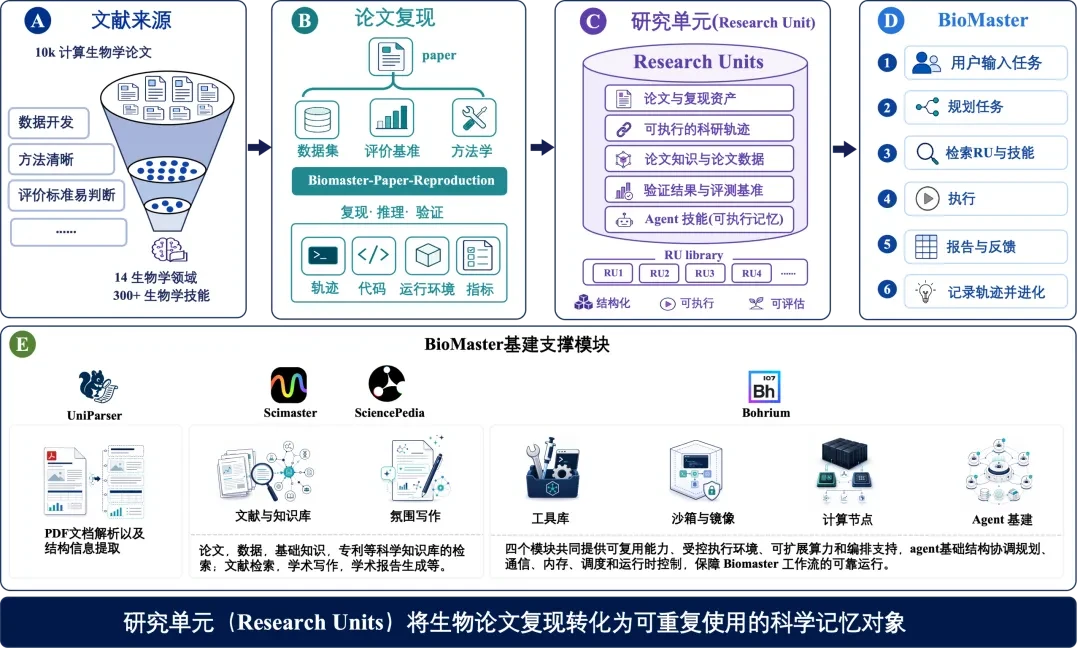
BioMaster archives data, parameters, logs, code, charts, evidence chains, and reports, transforming an open-ended question into a research version that is discussable, verifiable, and amenable to further iteration.
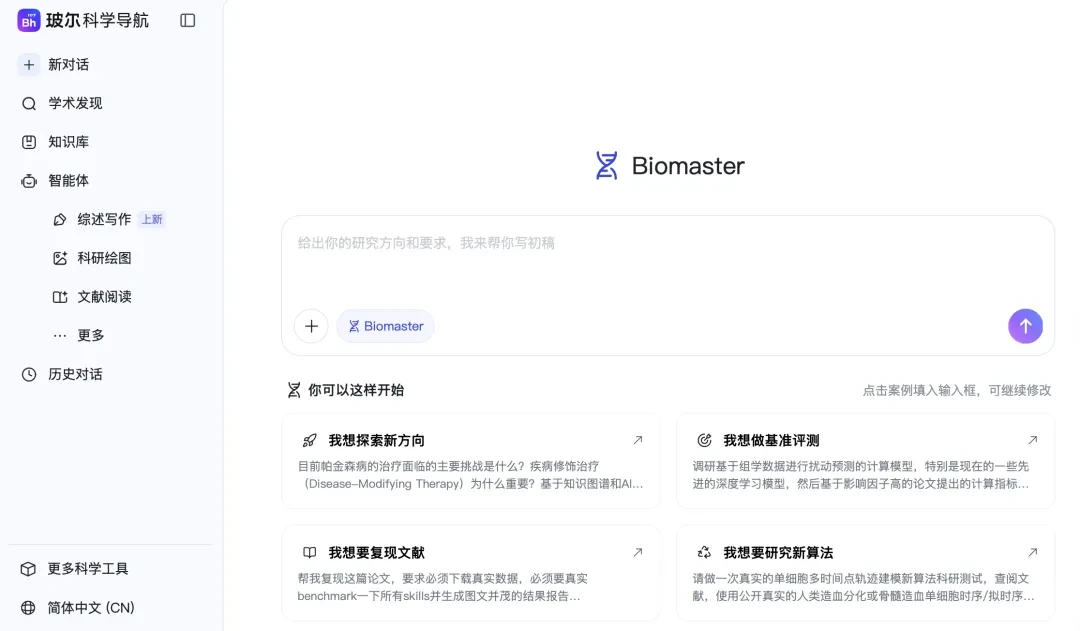
BioMaster:https://www.bohrium.com/agent/biomaster

BioMaster
On two benchmark datasets
All achieved the highest accuracy.
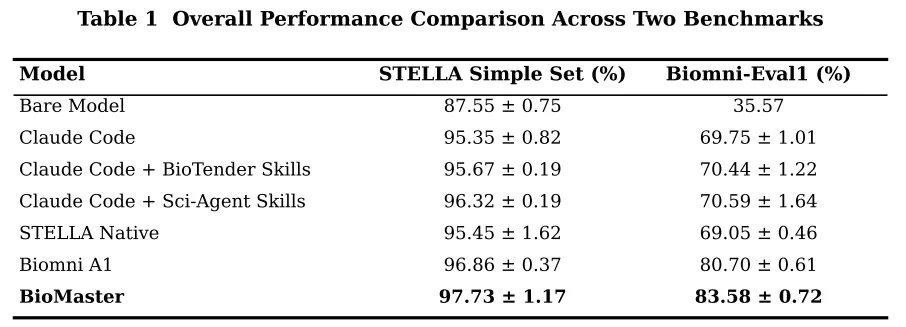
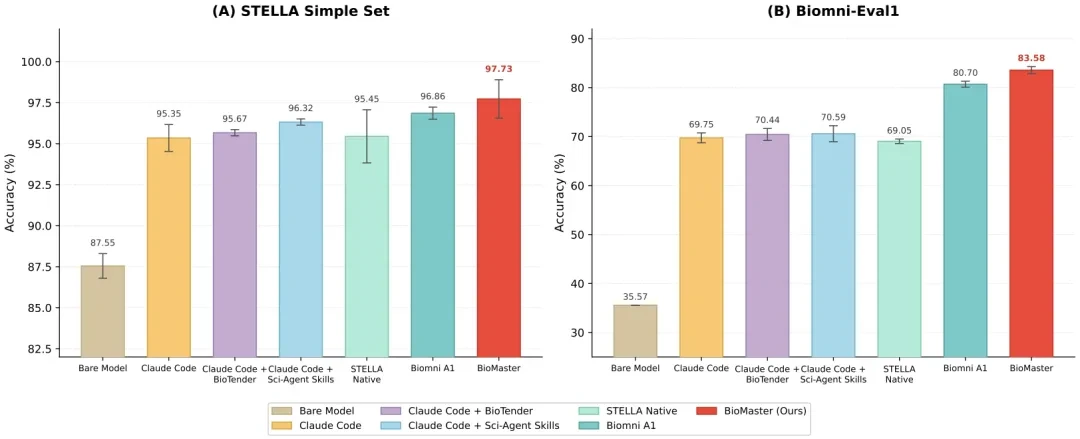
We evaluated BioMaster against Bare Model, Claude Code, Claude Code + BioTender Skills, Claude Code + Sci-Agent Skills, STELLA, and Biomni-A1 under a unified evaluation framework on two benchmarks: STELLA Simple Set (from the Princeton University and Stanford University teams) and Biomni-Eval1 (from the Stanford University Biomni team).
BioMaster achieves an accuracy of 97.73% on the STELLA Simple Set and 83.58% on Biomni-Eval1. This demonstrates that in complex biological tasks, the combined capabilities in stable environment management, tool invocation, domain-specific skills, and result verification collectively drive significant differences in delivery performance.

BioMaster
Possesses Stable Infrastructure
Supports Computational Stability and Accuracy
Infrastructure determines whether tasks can be executed stably in a real-world computing environment, including GPU scheduling, dependency management, model and tool invocation, error handling, and the generation of intermediate files, logs, and final reports.
This is also becoming an industry consensus. In “Paving the way for agents in biology,” Anthropic Research points out that one of the key bottlenecks for biological agents is the lack of stable, programmable, and reproducible biological data and execution infrastructure.
BioMaster is continuously investing in this area: by leveraging paper search databases, paper parsing, sandbox environments, tool invocation, computational resource scheduling, and result verification mechanisms, it advances biological research tasks from mere “comprehension” to “stable execution, verifiability, and deliverability.”
Case Showcase:
GPU-Supported Bioinformatics Model and Tool Invocation in a Stable Environment. Upon receiving baseline and scGPT comparative analysis tasks, BioMaster creates a stable sandbox, installs and verifies dependencies such as Scanpy and scGPT, adjusts the execution strategy in case of restrictions or errors, and generates traceable result files.。

BioMaster
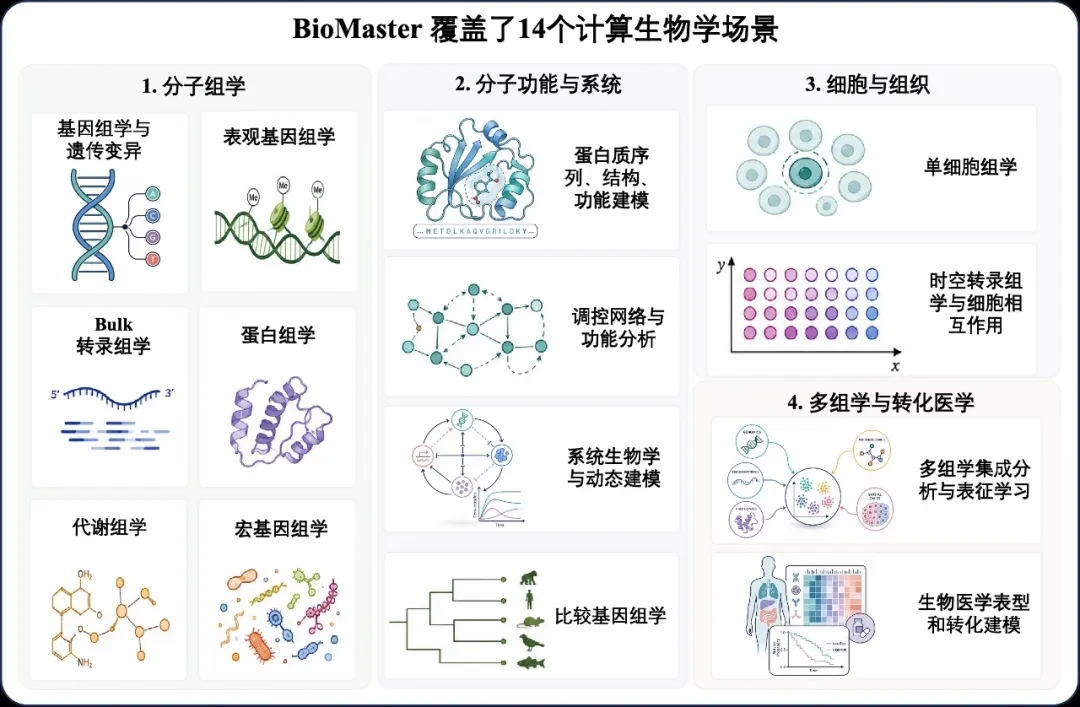
Accumulated 307 biological skills
Born for Biological Research

Several Real-World Tasks
Getting Started with BioMaster
Case Study: Replication Audit of Research Papers.
BioMaster demonstrates how to transform the question “Can this paper be reproduced?” into an executable, traceable, and verifiable process, covering paper analysis, SubAgent task allocation, real-data execution, performance logging, scorecards, and reproducibility reports.
Omics data can never be analyzed by simply “dumping it into a spreadsheet.” Single-cell objects, spatial coordinates, proteomics, phosphoproteomics, glycoproteomics, mutations, methylation, and clinical outcomes each have their own data structures, sources of noise, batch effects, and interpretational boundaries. The same pathway may carry entirely different meanings across different cell types, disease stages, and treatment conditions.
Case Study: Multi-Omics System Analysis of PDAC.
Starting from transcriptomic, proteomic, phosphoproteomic, glycoproteomic, mutation/copy number variation, methylation, and clinical data, BioMaster automatically orchestrates multiple SubAgents for analysis, generating mechanistic interpretations, figures, and initial drafts in LaTeX and PDF formats.
3. Benchmark for Biocomputational Models: From Surveying Novel Domain-Specific Methods to Establishing a Unified Evaluation Framework
BioMaster can investigate new models and representative methods within the field around a specific biological computation problem, analyzing their datasets, metrics, and code implementations; it then reproduces and compares different methods under the same task, data, and evaluator to form a verifiable, scalable, and continuously updatable benchmark.
Case Study: Automated Construction of Biological Computing Benchmarks
Starting from the problems of virtual cells and single-cell perturbation response prediction, BioMaster automatically surveys methods, designs evaluations, executes computations, aggregates metrics, and generates reports, PowerPoint presentations, and draft manuscript materials.
4. Automated Scientific Research with Biological Models: Seamlessly Integrating Model Design, Training, and Verification into the Next Step
In virtual cell and dynamic omics modeling, researchers often need to address dynamic questions such as how cells respond to perturbations and how developmental and disease states evolve. Such tasks require constructing dynamic models from single-cell data collected across multiple time points or under various perturbations, posing high barriers and involving lengthy workflows.
In line with this direction, the team led by Zhou Peijie and Li Tiejun at Peking University has conducted systematic research. Team members including Zhang Zhenyi and Wang Zihan have continuously advanced the development of related theories, algorithms, and tool systems, proposing the stDGM concept and CytoBridge. CytoBridge can be regarded as a domain-specific tool for dynamic modeling of virtual cells, responsible for key modeling steps such as data quality control, model training, result validation, and report generation.
Within this framework, BioMaster can invoke vertically specialized tools such as CytoBridge to continuously advance literature retrieval, algorithm design, model execution, and result interpretation, starting from real-world multi-time-point or perturbed single-cell data. This creates a closed-loop process of “posing biological questions – constructing dynamic models – interpreting model results – entering the next round of model iteration and experimental validation.”
(CytoBridge:https://github.com/zhenyiizhang/CytoBridge)
Case Study: Dynamic Omics-Driven Virtual Cell Modeling.
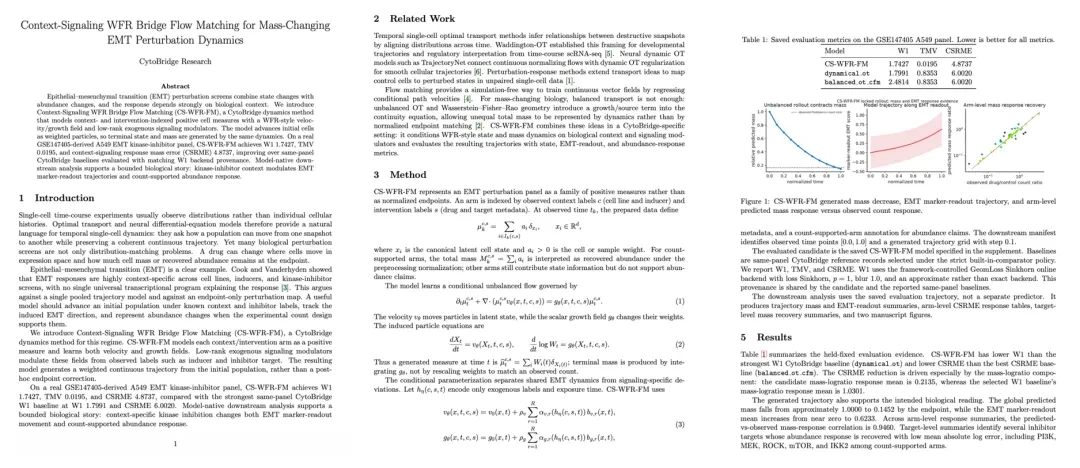
Using A549 cancer cell EMT kinase inhibitor perturbation data as an example, BioMaster orchestrates CytoBridge to construct a Context-Signaling Wasserstein-Fisher-Rao Bridge Flow Matching framework for simultaneously modeling cell state transitions and abundance changes under drug perturbation. The results demonstrate that this model outperforms standard dynamic modeling baselines on real-world perturbation panels and accurately predicts abundance responses between drug-treated and control groups.
Result Example:
Case Study: Proprietary Perturbation Response Model.
Based on K562 CRISPRi single-cell data, BioMaster automatically benchmarks methods such as GEARS, CPA, and scGen, designs an Attention-based Perturbation Predictor, trains multiple model versions, and delivers weights, evaluation JSON files, scripts, and visualization charts. Upon task completion, the Agent integrates user feedback and issues identified during execution to automatically perform Skill Evolution and generate Research Units for future reuse.
5. Group Meeting Assistant: Literature Review + Key Article Analysis + PPT Creation
Case Presentation: PDTargetFindings and Chain of Evidence Report.
BioMaster completes in-depth literature review, constructs knowledge graphs using Open Targets and STRING, ranks candidate targets, validates findings with real RNA-seq data, and outputs reproducible mechanistic evidence along with a presentation PowerPoint.
Leave these bioscience research tasks to BioMaster
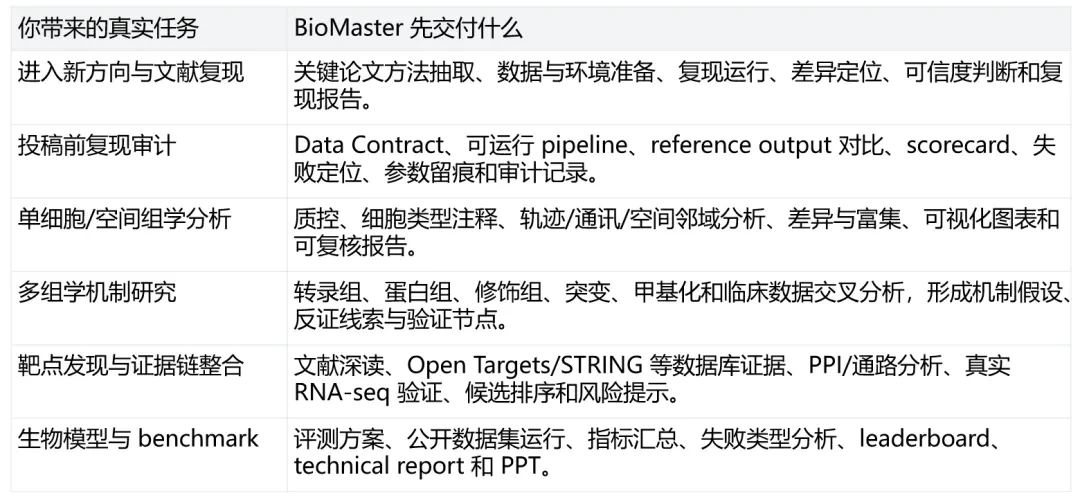
If you have a biological research task that you know is important but haven’t had the time to fully execute, BioMaster deserves to be your first-choice execution assistant. It will first run through the workflow, document the evidence, and deliver the report, leaving the professional judgment to you.
Limited trial spots available on a first-come, first-served basis: Bring a real biological problem to try it out! Surprises await!
Application Address:https://dptechnology.feishu.cn/share/base/form/shrcn7RwKelJwReocsPDjsjzUMe
It is recommended to apply with real-world tasks:A paper to be reproduced, a set of omics data to be analyzed, a target hypothesis to be validated, a model method to be benchmarked, or a project to be written up as a technical report.
The more specific the task, the more evident BioMaster’s value becomes:It will help you break down the problem, streamline the workflow, retain the evidence, and deliver the first version of the results to you.
Bring real-world tasks to the test—only then will BioMaster truly demonstrate its value!
References
[1] BioMaster’s Tech Report: https://doi.org/10.5281/zenodo.21064833
[2] Luebbert, L. Paving the way for agents in biology. Anthropic, 8 June 2026. https://www.anthropic.com/research/agents-in-biology
[3] Zhang, Z., Wang, Z., Sun, Y. et al. Deciphering cell-fate trajectories using spatiotemporal single-cell transcriptomic data. npj Systems Biology and Applications 12, 2 (2026). https://doi.org/10.1038/s41540-025-00624-9
Research Boundaries and Professional Review
BioMaster is currently positioned as an auxiliary tool for life science research. Its output results must be reviewed by professional researchers and shall not serve as the basis for clinical diagnosis, treatment recommendations, medication advice, or assessment of drug efficacy. When involving undisclosed data, collaborative data, or sensitive information, please use it within the authorized scope and specify data security and access permission requirements when applying for a trial.
About DP Technology