Autonomous AI Diabetic Retinopathy Screening Integrated into Endocrinology Clinic: Real-World Study Shows 95.7% of 256 Patients Achieved Definitive Results Without Pharmacologic Pupil Dilation
AEye Health
Provider of AI-Based Retinal Screening Solutions

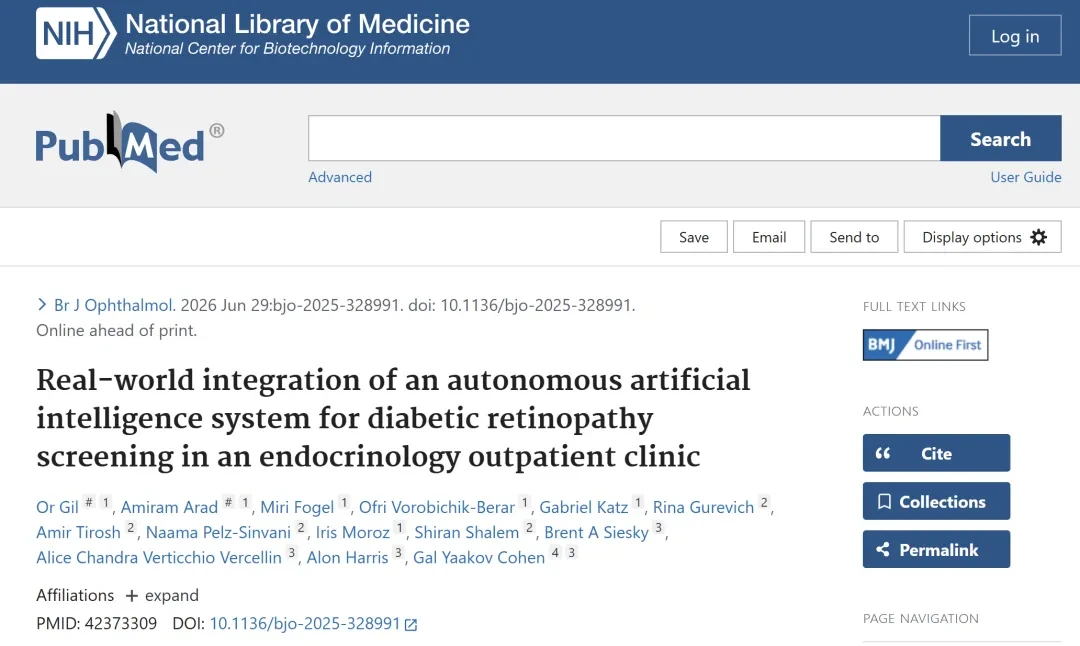
On June 29, 2026, the British Journal of Ophthalmology published online a real-world study. Researchers deployed AEYE-DS, an autonomous diabetic retinopathy screening software developed by AEye Health, in combination with the Topcon NW500 fundus camera, in endocrinology outpatient clinics.
Among the 256 participants, 245 (95.7%) obtained clear AI screening results without pharmacological mydriasis; 76 were identified as positive for “more than mild diabetic retinopathy,” accounting for 29.6% of all participants.
The study seeks to address another question that is closer to product commercialization:When AI-based diabetic retinopathy screening is truly implemented in endocrinology outpatient clinics and operated by non-ophthalmic personnel, how many patients can complete the screening? After a positive screening result, how many individuals actually proceed to ophthalmology departments for diagnosis and treatment?
Non-ophthalmic personnel operation, 95.7% of patients obtained clear results
This study included adult patients with type 1 or type 2 diabetes who were undergoing routine follow-up at endocrinology outpatient clinics, none of whom had previously reported diabetic retinopathy.
Fundus images were acquired by a staff member without prior experience in ophthalmic imaging. The operator used the Topcon NW500 to capture macula-centered, non-mydriatic fundus photographs, which were then analyzed by AEYE-DS to determine whether patients had more-than-mild diabetic retinopathy (mtmDR). Ultimately, 245 out of 256 participants received definitive results, yielding a non-mydriatic success rate of 95.7%.
For AI-based fundus screening products, while algorithm performance is undoubtedly important, once deployed in real-world clinical settings, these products must also address a range of more fundamental issues:Is pupil dilation mandatory for patients? Can non-ophthalmic personnel perform the imaging? How long does a single examination take? What percentage of images are unanalyzable due to insufficient quality? Can the system integrate into the hospital’s existing workflow?
Particularly in non-ophthalmic settings such as endocrinology departments, primary care institutions, and health examination centers, if a large number of patients require repeated imaging, pupillary dilation, or assistance from professional photographers, even the highest algorithm sensitivity will struggle to translate into practical screening capabilities.
In this study, over 95% of participants yielded clear results without the need for pharmacological mydriasis, indicating that this combination is feasible for operation by non-ophthalmic personnel in specific research settings. However, the study abstract did not provide detailed data on average imaging time, number of repeat scans, or ocular characteristics of patients in whom imaging failed; therefore, it is not yet possible to comprehensively assess the actual operational costs of this protocol.
29.6% screening positivity rate, which should not be interpreted as the prevalence of diabetes in the general population
Among the 245 subjects with definitive results, 76 were classified by AI as positive for more than mild diabetic retinopathy, accounting for 29.6% of all 256 subjects.
This study was conducted at the endocrinology outpatient clinic of a single medical institution. The composition of participants, duration of diabetes, glycemic control status, and prior adherence to fundus examinations may all influence the positive rate. The study was not designed to conduct a population-based epidemiological survey.
AI-generated positive results are not equivalent to a final diagnosis by an ophthalmologist. According to the study protocol, patients with AI-positive results will undergo consultation with a physician and be automatically referred to the institution’s retina clinic for confirmatory examination.
What truly warrants observation is the subsequent outcomes. Among the 76 AI-positive patients, 34 underwent confirmatory examinations by retinal specialists within the research institution, resulting in an in-hospital confirmation rate of 44.7%. Researchers indicated that some patients may have completed follow-up care outside the hospital, but such data were not captured by the study. Of the 34 patients who completed the in-hospital confirmatory examinations, 4 required treatment with intravitreal anti-vascular endothelial growth factor (anti-VEGF) injections or panretinal photocoagulation, accounting for 11.8% of those who underwent confirmatory examinations.
This means that among all 256 participants in this study, at least 4 were identified through the outpatient screening process as having eye diseases requiring further treatment.
The study also mentioned that ophthalmic confirmatory examinations identified previously unrecognized ocular conditions in some AI-positive patients, but the abstract did not disclose the specific disease composition or case numbers.
The Next Hurdle for AI Screening: Closing the Referral Loop
From an industry perspective, the 44.7% completion rate of in-hospital confirmatory examinations may be more worthy of discussion than the 95.7% non-mydriatic result output rate. The challenges facing traditional diabetic retinopathy screening are not entirely due to a lack of tools for identifying fundus lesions. Factors such as patients not undergoing annual fundus examinations, long distances between screening locations and ophthalmology departments, complex appointment procedures, and positive cases failing to follow up for further care can all lead to breaks in the screening continuum.
Deploying AI screening in endocrinology clinics allows fundus examinations to be performed concurrently during diabetes follow-up visits, thereby reducing the need for patients to make separate visits to ophthalmology departments for initial screening. However, screening is only the first step. For patients with positive screening results, healthcare institutions still need to address:
Who is responsible for interpreting the results? Can patients directly schedule appointments with ophthalmology? Does the ophthalmology department reserve a referral channel? Can medical findings from external visits be integrated back into the system? Who will follow up with patients who have not completed the referral process? Who bears the costs for screening and subsequent confirmatory diagnosis?
If these components are not established, the AI system may complete risk identification but may not necessarily improve final treatment outcomes.
Therefore, the product value of autonomous AI-based diabetic retinopathy screening cannot be measured solely by sensitivity and specificity. Actual clinical deployment requires attention to at least four sets of metrics:
First, whether images can be successfully acquired, including the non-mydriatic result rate and the retake rate;
Second, the completion rate of referrals for positive patients;
Third, the proportion of patients who truly require treatment after completing confirmatory examinations;
4. Whether the patient ultimately received treatment and underwent long-term follow-up.
This study provides data extending from screening to certain downstream outcomes, but also reveals referral attrition in real-world settings.
AEYE-DS has obtained two FDA 510(k) clearances, but the regulatory status of the NW500 combination needs to be distinguished.
AEYE-DS is a software medical device used for diabetic retinopathy screening. Its output results include detection of more than mild diabetic retinopathy, no detection of related lesions, or insufficient image quality.
In November 2022, AEYE-DS received a determination of substantial equivalence via the FDA 510(k) pathway, with clearance number K221183. It is indicated for adults who have been diagnosed with diabetes but have not previously been diagnosed with diabetic retinopathy, using the Topcon NW400 as the companion camera. According to publicly available FDA data, this version demonstrates a sensitivity of 93%, a specificity of 91.4%, and an image gradability rate of 99.1% when utilizing one macula-centered image per eye.
In April 2024, the FDA again cleared AEYE-DS via K240058, adding compatibility with the Optomed Aurora portable fundus camera. The publicly stated indications for use for this 510(k) clearance include the Topcon NW400 and the Optomed Aurora.
It is particularly noteworthy that the real-world study in question utilized the Topcon NW500. To date, the two publicly available FDA 510(k) documents referenced above explicitly list the Topcon NW400 and Optomed Aurora as the associated devices, excluding the NW500. When AEye Health and Topcon released relevant clinical data in 2025, they also stated that the companies were seeking further FDA approval for the combination of AEYE-DS and the NW500. Meanwhile, it should be noted that 510(k) clearance constitutes a determination of substantial equivalence and should not be conflated with the FDA De Novo or PMA pathways.
What Does It Mean for the Chinese Market?
In China, patients with diabetes are primarily managed within endocrinology departments, primary healthcare institutions, and chronic disease management systems, whereas fundus screening resources are more concentrated in ophthalmology departments. This implies that the potential value of AI-based fundus screening may lie not merely in improving the image-reading efficiency of ophthalmologists, but in deploying standardized screening capabilities to settings that traditionally lack ophthalmologists.
However, the actual implementation in the Chinese market still depends on several conditions: the registration scope of the software and supporting cameras, integration with hospital information systems, compliance of imaging data, screening fees, referral mechanisms for positive patients, and the allocation of interests and responsibilities between endocrinology and ophthalmology departments.
Furthermore, the AI diabetic retinopathy system only outputs results for specific diseases and risk levels, and does not equate to a complete ophthalmic examination. Even if the system indicates a negative result for diabetic retinopathy, patients may still have glaucoma, age-related macular degeneration, or other eye conditions.
References
Real-world integration of an autonomous artificial intelligence system for diabetic retinopathy screening in an endocrinology outpatient clinic. British Journal of Ophthalmology, published online June 29, 2026. FDA 510(k) K221183:AEYE-DS。 FDA 510(k) K240058:AEYE-DS。
Note: The paper discloses that one author previously served as the Medical Director of AEye Health, and another author holds an ownership interest in AEye Health. These relevant conflicts of interest should be considered when interpreting the study results.

Ophthalmic Solutions Case Studies