

Roche Acquires PathAI for $1.05 Billion to Strengthen AI-Powered Digital Pathology Leadership

PathAI
Artificial Intelligence Medical Diagnosis Technology Developer
A single pathology slide reviewed by two pathologists can sometimes yield two different conclusions. This subjectivity is not an isolated case; according to a 2017 study by Elmore et al. published in The BMJ, inter-pathologist concordance and accuracy fall below 50% even for diagnostically challenging lesion categories such as melanocytic lesions.
Meanwhile, the training cycle for pathologists is lengthy, their numbers are growing slowly, and the supply-demand gap is widening. As the “gold standard” becomes less secure, both clinical diagnosis and drug development are calling for a more objective and standardized solution.
PathAI is precisely the company dedicated to addressing these pain points—its team employs artificial intelligence algorithms to analyze pathology slides, aiming to eliminate subjective variability and achieve diagnostic standardization. It has currently launchedThe World's First AI-Driven Pathology Drug Development Tool with Dual FDA and EMA Certification。
On May 7, Roche Diagnostics announced that it had signed a definitive merger agreement with PathAI toA one-time payment of US$750 million (approximately RMB 5.099 billion)Acquire this AI pathology company, with additional attachmentsUp to $300 Million in Milestone Payments,Total consideration reaches US$1.05 billion(approximately RMB 7.139 billion). The transaction is expected to be completed in the second half of 2026.
The acquisition logic is grounded in the complementarity of both parties’ resources: Roche Diagnostics possesses a globally leading companion diagnostics business and an oncology drug pipeline, while PathAI provides a comprehensive technology stack spanning digital pathology image management, AI-assisted diagnosis, and endpoint assessment for drug clinical trials. The integration of the two will streamline the entire workflow from slide staining, scanning, and intelligent analysis to the issuance of companion diagnostic reports, thereby supplementing Roche Diagnostics’ existing digital pathology portfolio and enhancing laboratory efficiency.
According to the official announcement, Roche Diagnostics will leverage its global distribution channels to deploy AISight worldwide; meanwhile, PathAI can utilize Roche Diagnostics’ comprehensive infrastructure and compliance resources to accelerate the deployment of its products in laboratories and pharmaceutical companies both domestically and internationally.
Why Did Roche Diagnostics Choose PathAI? The Answer Lies in PathAI’s Assets, Team, Products, and Platform-Oriented Positioning.
PathAI is a company that develops AI software and digital pathology systems. Founded in 2016 and headquartered in the United States, its business spans diagnostic workflows, clinical research, and drug development. Its mission is to improve patient outcomes through AI-driven pathology—making diagnoses more accurate, matching patients with more effective treatment regimens, and accelerating the approval and market availability of more life-saving drugs.
Unlike most AI healthcare companies that focus on a single niche, PathAI established a dual-engine business model of “Diagnostics + Drug Development” from the outset: serving both anatomical pathology laboratories in the clinical setting and biopharmaceutical companies in the research sector.
Underpinning this business model are three core assets accumulated by PathAI.
First is the vast asset of annotated data.The company has established a proprietary network comprising over 450 board-certified pathologists, who have collectively contributed more than 32.5 million annotated medical images spanning over 20 organ types and multiple staining protocols for the training and validation of AI models.
Next is compliance capability covering the entire process。PathAI has obtained ISO 13485 and ISO 27001 certifications; its digital pathology platform, AISight Dx, has received FDA 510(k) clearance and CE-IVDR certification for use in primary clinical diagnosis. In the fields of drug development and assisted diagnosis, PathAI’s products have also been approved by the FDA and EMA. This demonstrates that PathAI’s products are not only suitable for laboratory use but can also serve directly as endpoint assessment tools in clinical trials, having gained acceptance from global regulatory authorities.
Third, end-to-end laboratory operational capabilities。Through acquisitions and in-house development, PathAI has mastered end-to-end capabilities spanning from wet lab services to clinical trial algorithm deployment, enabling it to provide customers with comprehensive solutions covering the entire workflow from tissue receipt to digital scanning and algorithm deployment.
In terms of market validation,90% of the top 15 global biopharmaceutical companies have adopted its technologyThe company has participated in over 100 translational research projects, with its algorithms currently being utilized in 26 clinical trials spanning two major fields: oncology and metabolic dysfunction-associated steatohepatitis (MASH). In 2025, the company launched the Precision Pathology Network, the world’s first digital anatomic pathology laboratory network, which aims to connect dispersed laboratories through a unified technology platform to unlock the value of real-world pathology data.
From data assets to compliance certifications, and from laboratory operations to pharmaceutical company collaboration networks, PathAI is building a comprehensive digital infrastructure centered around pathology. This is precisely what Roche Diagnostics values—It is not a fragmented set of technologies requiring integration, but rather a mature platform that can be directly and fully embedded into the Roche Diagnostics ecosystem.。
PathAI’s leadership team combines expertise across engineering, machine learning, life sciences, medicine, and regulatory affairs, with extensive industry experience at companies such as Roche Diagnostics and AI-driven healthcare startups.
Andrew Beck, Founder and Chief Executive Officer, holds a Bachelor of Arts in History from Brown University, as well as an M.D. and a Master’s degree in Biostatistics. He completed his specialty training in Anatomic Pathology and Molecular Genetic Pathology at Stanford University and earned a Ph.D. in Biomedical Informatics. Dr. Beck previously served on the faculty of the Department of Pathology at Harvard Medical School and has published more than 110 papers. His interdisciplinary career trajectory itself epitomizes PathAI’s mission to “reimagine pathology through technology.”
The core executive team bears a distinct “Roche Diagnostics imprint.”Before joining PathAI, Chief Medical Officer Eric Walk served as the Chief Medical and Scientific Officer at Roche Diagnostics/Ventana Medical Systems, where he led the development and FDA approval of over 20 IVD assays (including 510(k) and PMA submissions), companion diagnostics, and digital pathology algorithms. Chief Growth Officer Nick Brown joins from Flatiron Health, an oncology data platform acquired by Roche Diagnostics in 2018, where he served as Head of International Business. With this executive team’s strong Roche Diagnostics industry background, PathAI is poised to reduce integration friction and accelerate organizational alignment following the acquisition.
Furthermore, Chief Financial Officer Brandon Eldredge previously served as Chief Clinical Business Officer at Massachusetts General Hospital Brigham and Senior Vice President at Syneos Health; General Counsel Chris Kirby holds a Juris Doctor and a Master of Public Health, with over 20 years of legal and business management experience in the healthcare and life sciences sectors; Chief People Officer Liz Storti led the company’s $240 million financing round and drove multiple post-acquisition integrations. Together, they have established the governance foundation necessary for PathAI’s transition from a technology startup to a scaled enterprise.
From a technical perspective, machine learning expert Anand Sampat boasts an academic background from the University of California, Berkeley, and the Stanford Artificial Intelligence Laboratory. He co-founded Datmo, an open-source machine learning platform dedicated to ensuring environment consistency and experimental reproducibility in AI development. After joining PathAI, he spearheaded machine learning research and development for new product lines. Chief Product Officer Abdo Mahmoud brings over seven years of experience in building AI products. Vice President of Regulatory Affairs Nick Anderson, who holds a degree in Industrial Engineering from the University of Louisville, previously served at the FDA for more than a decade. Together, they cover the complete capability chain spanning algorithm development, product design, and regulatory implementation.

Leadership Team (Image source: PathAI official website)
In addition to its core management team, PathAI has built a proprietary network of contributors comprising more than 450 board-certified pathologists. These experts are deeply involved in data annotation and model validation, including the development of annotation guidelines, consensus reviews of challenging cases, and verification of algorithm outputs, ensuring that AI models iterate consistently along clinically relevant trajectories.
PathAI’s product suite is built around its core digital pathology platform, AISight. AISight is a cloud-native image management system compatible with major scanners and laboratory information systems.
Based on AISight, PathAI has built two synergistic business ecosystems. On one hand, it provides workflow management and AI-assisted diagnostic tools for anatomical pathology laboratories; on the other, it offers AI-driven translational research algorithms and clinical trial services to the biopharmaceutical industry.
1Anatomic Pathology Laboratory: Making Daily Workflows Smarter
On the laboratory side, PathAI provides a suite of tools to enhance daily diagnostic efficiency and quality control.
In terms of workflow optimization, the quality control tool ArtifactDetect can automatically screen for various slide artifacts, such as folds, air bubbles, and staining abnormalities, and recommend corrective actions like rescanning or remounting coverslips. To date, it has been deployed globally, processing over 1 million slides, which is equivalent to saving the labor of 1.5 full-time quality inspectors. Each laboratory can reduce the verification workload for 75 invalid slides per day.
TumorDetect is used for case prioritization, automatically identifying cases suspected of malignancy and moving them to the top of pathologists' worklists. A simulation study showed that TumorDetect increased the proportion of malignant cases reviewed in the morning from 50% to 71%. AIM-TC automatically calculates metrics such as total tumor area and tumor nuclear percentage on H&E slides, helping determine whether samples meet the requirements for NGS testing.
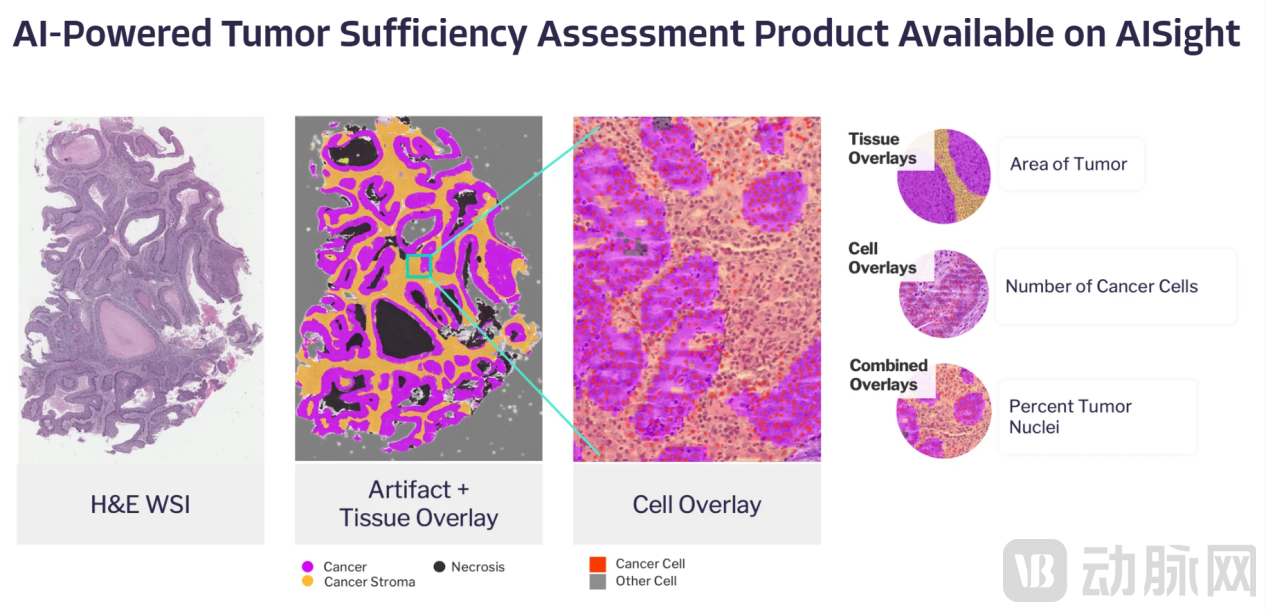
AISight’s AI-Powered Tumor Adequacy Assessment Product (Image source: PathAI official website)
In terms of biomarker quantification, the AIM-PD-L1 series covers multiple cancer types, including non-small cell lung cancer, head and neck squamous cell carcinoma, melanoma, and urothelial carcinoma, and is compatible with various antibody clones. The AIM-IHC Breast Panel integrates four key indicators—HER2, ER, PR, and Ki-67—to enable automated scoring.
In the area of assisted diagnosis, PathAssist Derm targets the field of dermatopathology, providing AI-based specimen orientation, prioritization, and key measurements, and received FDA Breakthrough Device designation in March 2026.
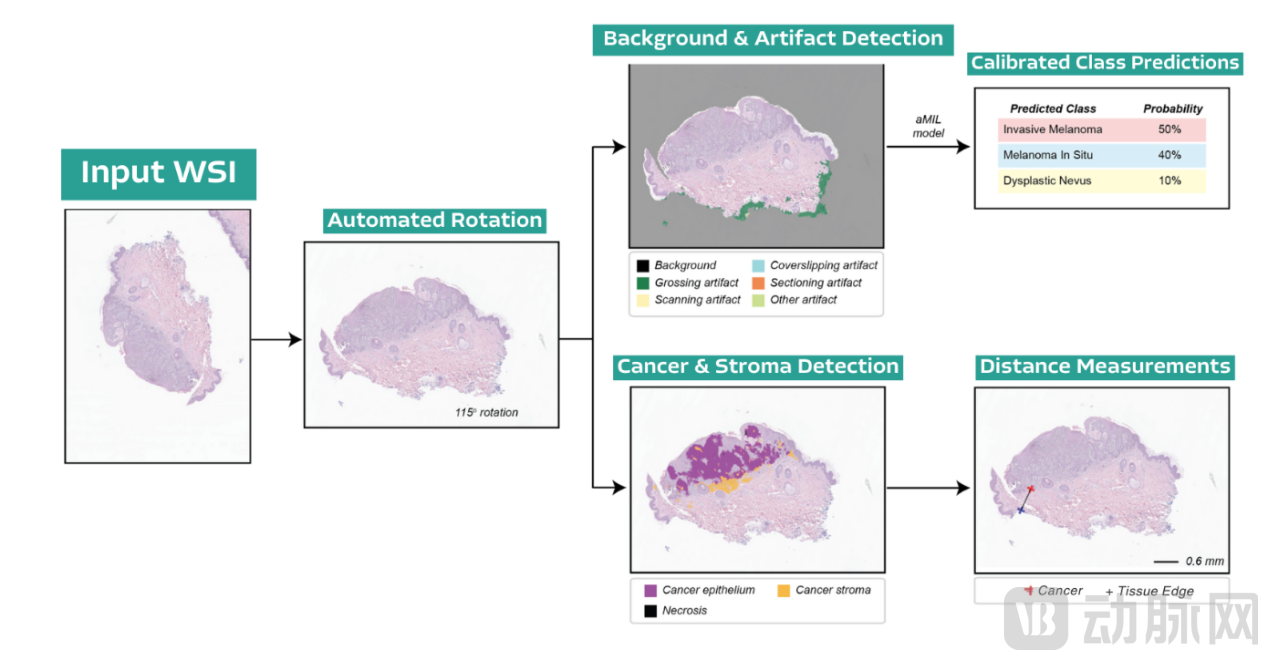
Example of PathAssist Derm’s AI Analysis Workflow (Image Source: PathAI Official Website)
Furthermore, AISight integrates over 40 third-party pathology algorithms from DeepBio, Mindpeak, Paige, and Visiopharm to create a one-stop AI integration platform. Laboratories can access various top-tier intelligent diagnostic tools on demand without switching between multiple systems.
2Biopharmaceuticals: Covering the Entire Chain from Translational Research to Clinical Trials
On the pharmaceutical side, PathAI’s value lies in transforming pathology images into quantifiable R&D assets.
In the realm of translational research, PathExplore leverages PathAI’s proprietary PLUTO model to decipher the tumor microenvironment at single-cell resolution. A single H&E slide can yield over 600 interpretable quantitative features, covering 14 cancer indications. To date, more than 150,000 slides have been analyzed, contributing to the publication of over 50 academic papers. Derived from the same technological framework, LiverExplore and IBDExplore target MASH and ulcerative colitis, respectively, providing quantitative analysis of over 1,000 features.

PathExplore Workflow (Image source: PathAI official website)
In terms of clinical trial services, PathAI operates a central pathology laboratory compliant with CAP/CLIA and GCP/GCLP standards, providing end-to-end services from tissue receipt to AI-assisted slide interpretation and report generation.
AISight, a compliant cloud-based platform, aggregates 80% of the world’s central laboratory vendors, enabling remote central image reading and AI metric calculation.
3The First AI-Driven Pathology Drug Development Tool with Dual FDA and EMA Approval
The most landmark product is AIM-MASH AI Assist. Trained on over 5,900 liver biopsy samples from six different clinical trials, it helps pathologists assess disease activity and fibrosis stage in MASH patients. Data shows that the algorithm is 100% reproducible and outperforms human pathologists across multiple performance metrics.
In 2025, it successively received dual approval from the EMA and the FDA, becomingThe First and Only AI-Driven Pathology Drug Development Tool Endorsed by Two Major Regulatory AgenciesThis means that in large-scale global clinical trials, sponsors can complete enrollment screening and endpoint assessment with fewer and more consistent pathologist resources, thereby accelerating the drug development process.
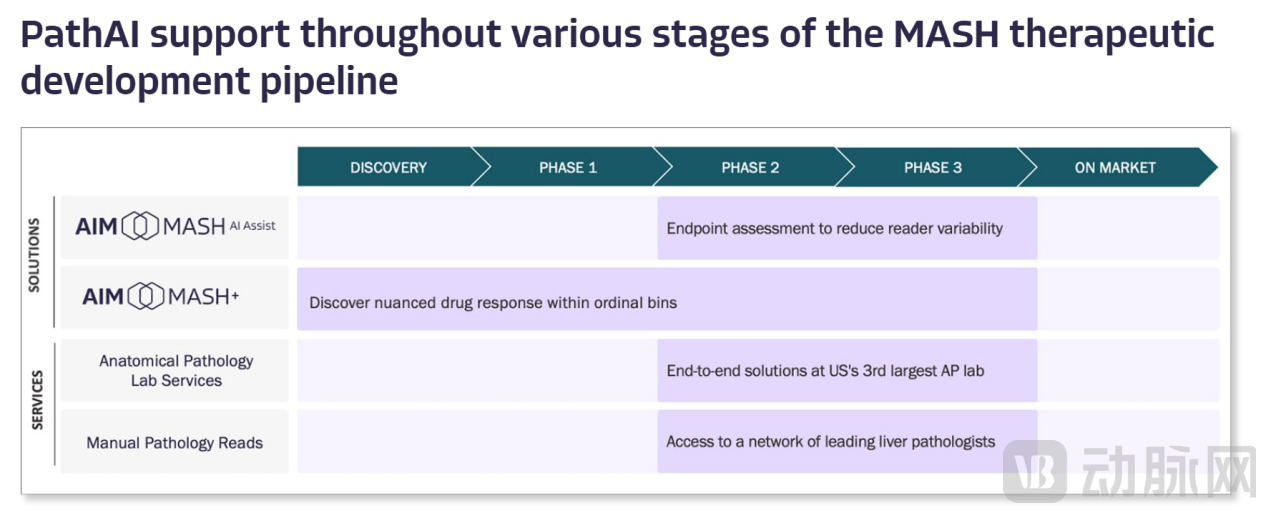
PathAI Provides Support Across All Stages of MASH Therapeutic Development (Image source: PathAI official website)
In fact, the two business lines leverage synergies to mutually reinforce PathAI’s proprietary product ecosystem. Routine diagnostics at the laboratory level generate vast amounts of pathological data, which, after processing, are integrated into a real-world database to support the training and optimization of algorithms for the pharmaceutical segment. Algorithms that undergo rigorous validation in compliant clinical trials within the pharmaceutical segment not only enhance their clinical reliability but also flow back to the laboratory setting, serving as auxiliary tools for pathologists in daily diagnostics. This creates a closed-loop system encompassing laboratory data supply, algorithm implementation and validation in partnership with pharmaceutical companies, and the feedback of mature technologies to enhance pathological diagnosis and treatment.
PathAI has transformed AI from a concept into a daily tool on pathologists’ workstations and a standard assessment method in pharmaceutical companies’ clinical trials.Roche Diagnostics secured the deal with a $750 million upfront payment, a move that not only validates the technology company but also underscores the trend that “digital pathology will become core infrastructure for diagnostics and drug development.”
Since its establishment, PathAI has completed six rounds of financing, raising a total of $355.2 million. Major investors include General Catalyst, General Atlantic, D1 Capital Partners, Kaiser Permanente, LabCorp, Adage Capital Management, and Polaris Partners. Among these, LabCorp’s strategic investment is particularly significant—as a globally leading diagnostic laboratory service provider, its entry signifies substantial recognition from industry capital for PathAI’s technological approach.
In addition to fundraising, PathAI has continuously adjusted its business boundaries through a series of strategic transactions. In 2021, the company acquired Poplar Healthcare, an independent anatomical pathology laboratory, thereby entering the clinical diagnostics sector. In 2024, PathAI established a strategic partnership with Quest Diagnostics and sold part of its laboratory services business for $100 million, further focusing on its software and AI platform.
Globally, PathAI’s business model has virtually no direct competitors. Paige possesses FDA-approved AI diagnostic products for prostate, breast, and colorectal cancers; Visiopharm has extensive expertise in the quantification of biomarkers for breast and lung cancer; while companies such as Mindpeak and DeepBio each have their own distinct strengths.
In the Chinese market, a cohort of AI pathology companies is rapidly emerging, covering diverse niche segments such as precision oncology, cervical cancer screening, and pathology information management. Some of these enterprises have secured National Medical Products Administration (NMPA) certification for their AI-assisted diagnostic products, which are gradually being implemented in clinical settings. These companies primarily focus on meeting the routine diagnostic needs of hospital pathology departments, while their involvement in pharmaceutical clinical trials and translational research remains in the early exploratory stage.
PathAI's uniqueness lies in:It serves both the clinical diagnostic laboratory and biopharmaceutical R&D markets, offering end-to-end capabilities spanning from platform and algorithms to laboratory services. It also leads in the breadth of regulatory certifications, most notably with AIM-MASH, the first AI-driven drug development tool to receive dual certification from the FDA and EMA.This “platform + ecosystem” approach makes it not just a standalone tool, but a comprehensive suite of digital infrastructure centered around pathology.
For AI pathology startups in China, PathAI’s trajectory offers both a reference model and delineates the thresholds that must be crossed—data scale, regulatory approval, platform capabilities, and a dual-engine business model.