Innovent
High-end Biologics Developer

On June 30, 2026, Eli Lilly and Innovent simultaneously announced their collaboration, finalizing the division of responsibilities for the mainland China market of the CDK4/6 inhibitor Verzenio® (abemaciclib tablets).
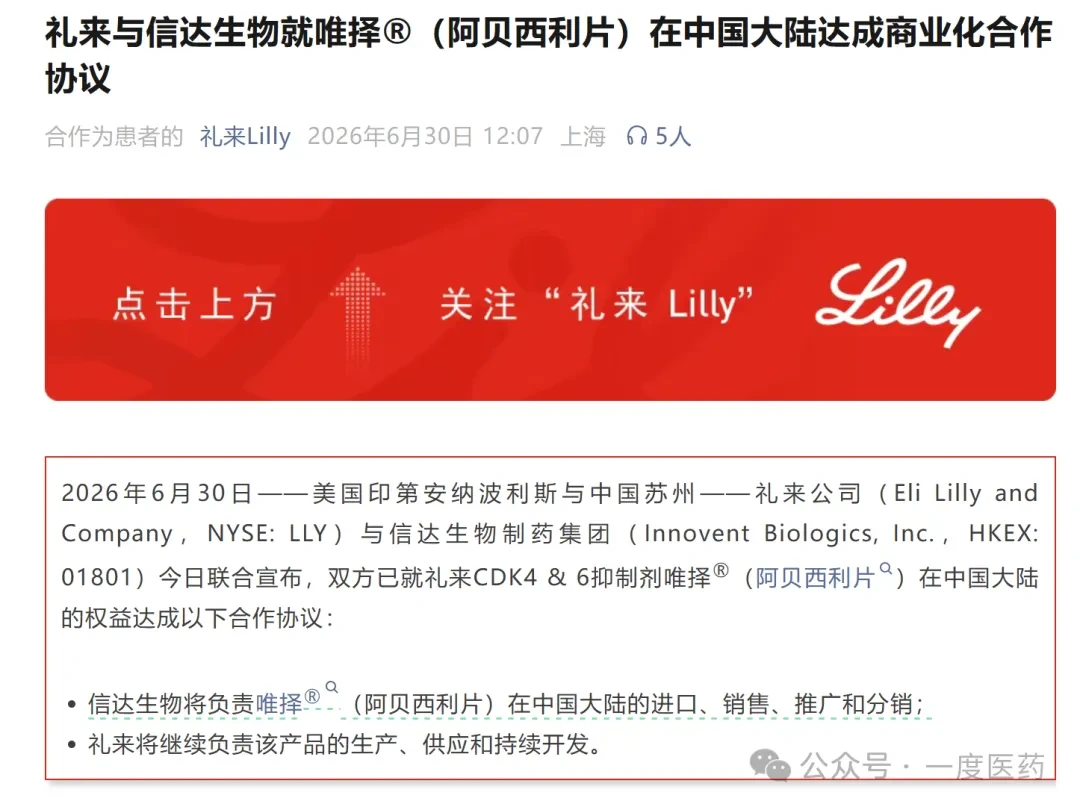
Source: Eli Lilly’s Official WeChat Account
Innovent will assume full responsibility for the drug’s import access, academic promotion, market sales, and channel distribution in China; Eli Lilly will continue to maintain strict control over active pharmaceutical ingredient (API) production and supply chain assurance, while also leading ongoing research and development for new indications.
This transaction represents a continuation of the two companies’ multi-year strategic partnership and marks a further step by multinational pharmaceutical companies in entrusting the local commercialization of mature oncology portfolios to leading domestic biotech firms.
Data indicate that Verzenio® (generic name: abemaciclib), an oral CDK4/6 targeted inhibitor, was independently developed through the entire R&D process by Eli Lilly. This drug blocks the tumor cell proliferation cycle and plays a significant role in the comprehensive treatment of HR-positive, HER2-negative breast cancer. It is also one of the few products in its class that can be administered via continuous, uninterrupted oral dosing, offering lower hematologic toxicity and simpler clinical management.
Globally, the drug first received U.S. FDA approval in 2017, subsequently securing indications for first- and second-line treatment of advanced breast cancer; in 2018, its indications were further expanded to include first-line combination therapy with endocrine therapy.
In December 2020, the Chinese National Medical Products Administration (NMPA) approved abemaciclib for launch in the Chinese market for two treatment indications in advanced metastatic breast cancer, making it the second CDK4/6 inhibitor approved in China. By the end of 2021, the drug secured an indication for adjuvant therapy in early-stage high-risk breast cancer, becoming the only CDK4/6 inhibitor in China at that time covering postoperative adjuvant treatment for early-stage disease. Subsequently, regulatory authorities continued to relax enrollment restrictions by removing the Ki-67 index threshold, further expanding the eligible population to cover more patients at high risk of recurrence.
The product was included in the National Reimbursement Drug List in its second year on the market, achieving full coverage for both early-stage and late-stage breast cancer indications, significantly reducing medication costs for patients, with prescription volumes continuing to grow steadily.
Amid the increasingly fierce competition in the domestic CDK4/6 inhibitor landscape, this drug has consistently maintained its position in the second tier of its niche category, leveraging its advantage in indications covering the entire disease course. With a solid foundation in the hospital market, it represents a mature product in targeted breast cancer therapy that generates stable cash flow.
According to the prevailing standards in the pharmaceutical industry, annual revenue exceeding $1 billion qualifies a drug as a "blockbuster." Abemaciclib has long surpassed this threshold:Global sales revenue reached $5.31 billion in 2024 and further climbed to $5.723 billion in 2025, ranking second only to tirzepatide within Eli Lilly’s entire product portfolio and serving as the primary pillar of the company’s oncology business. In terms of specific therapeutic segments, this drug officially surpassed Pfizer’s palbociclib in 2024, topping the global sales chart for CDK4/6 inhibitors.
In Eli Lilly’s annual financial reports disclosed to the public, this drug has consistently been categorized as a core growth product, listed alongside tirzepatide and empagliflozin as a key driver of the group’s performance growth.
Amid healthcare insurance cost-containment measures and competitive pressures, the self-promotion profits of this blockbuster oncology drug, now in the mid-patent lifecycle, have continued to shrink. Given the smooth collaboration between the two parties, Eli Lilly has chosen to entrust Innovent with full responsibility for commercialization in China. This strategic move aims to streamline local sales expenses and concentrate resources on advancing its global innovative pipeline, while leveraging Innovent’s deep-market marketing capabilities to stabilize the product’s sales volume.
Notably, this marks the eighth pharmaceutical collaboration between Eli Lilly and Innovent. Over the past decade, their partnership has evolved from joint research and development to commercial licensing, with the cooperation model continuously iterating and upgrading—
2015: The starting point of collaboration, with joint development of novel large-molecule drugs. The two parties consecutively signed two rounds of strategic cooperation agreements to co-develop multiple anti-tumor monoclonal antibodies. Among these, the core product, Tyvyt® (sintilimab), had its clinical development jointly advanced by both parties. Subsequently, Innovent licensed the overseas rights of this product to Eli Lilly, becoming a landmark case for the international licensing of innovative drugs from China.
2022: In a bulk divestiture of commercialization rights for oncology drugs, Innovent secured the exclusive sales rights in mainland China for two blockbuster targeted therapies, Cyramza® (ramucirumab) and Retevmo® (selpercatinib), while also obtaining the right of first refusal for collaboration on the BTK inhibitor pirtobrutinib.
2024: Commercialization partnership for a BTK inhibitor was implemented. The two parties officially signed an agreement, with Innovent taking over all domestic promotion and distribution activities for Jaypirca® (pirtobrutinib tablets), continuing the model where foreign companies handle R&D and manufacturing while local enterprises manage commercialization.
Early 2026: Upgrading Source Innovation Collaboration. The two companies launched a joint early-stage new drug development project, with Innovent responsible for drug discovery and domestic early-phase clinical trials in China, while Eli Lilly secured global rights excluding the Greater China region. The collaboration has extended from the sales of mature pharmaceuticals to the source development of cutting-edge molecules, with the total potential transaction value exceeding US$8.5 billion.
With the commercialization handover of abemaciclib, Innovent now holds domestic commercialization rights for seven oncology products from Eli Lilly, further strengthening its portfolio in breast cancer, lung cancer, gastric cancer, and hematologic malignancies.
In addition, the two parties have expanded into the field of metabolic diseases, jointly advancing the domestic development of OXM3, an innovative dual-target GLP-1 drug, with their collaboration extending beyond the oncology sector.
It is evident that in recent years, an increasing number of multinational pharmaceutical companies have been entrusting the domestic sales and operational activities of their mature anti-tumor drugs—those in the mid-to-late stages of patent protection and already included in the National Reimbursement Drug List—to local innovative pharmaceutical enterprises. This has become a new trend in the industry.