▲9June 4-5 CBI Biopharmaceutical Innovation ExpoScan the QR code to register
Note:This article does not constitute any investment advice or recommendations; please refer to official/company announcements for authoritative information.This article is intended solely for the introduction of drugs related to medical health and does not constitute a recommendation for treatment plans (if involved), nor does it represent the platform's stance.Any article reprint requires authorization.
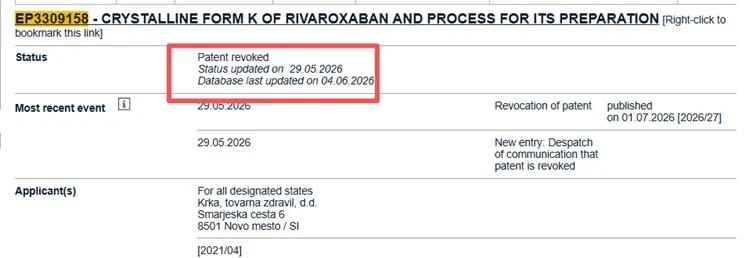
In a recent decision, the Boards of Appeal of the European Patent Office completely invalidated Bayer’s patent on the K crystal form of rivaroxaban (EP3309158), held by the generic manufacturer KRKA.For Krka, securing this patent would enable it to become the sole company legally authorized to market generic rivaroxaban in the K crystal form following the 2023 patent licensing, thereby capturing market share before the expiration of Bayer’s Form I patent in 2026.A patent may be a valuable ticket for early market entry.
Data Source: European Patent Office, EP3309158 patent; revokedI. Rivaroxaban: The Dispute Between Originator and Generic Versions of an Anticoagulant
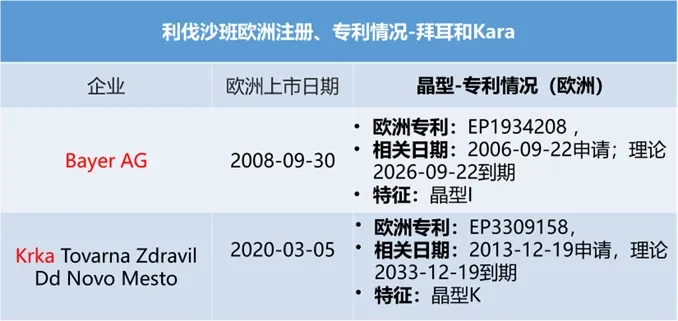
Rivaroxaban is a blockbuster anticoagulant developed by Bayer, used for the prevention and treatment of thromboembolic disorders; the original drug substance is in Crystal Form I.As a generic drug manufacturer, KRKA developed a new crystal form—Form K—and obtained authorization for European Patent EP3309158 (filed in 2013). With this patent, KRKA’s generic product can be legally launched and exclusively marketed using Form K after the expiration of the originator’s compound patent but before the expiration of the originator’s crystal form patent.Note: The compound patents for rivaroxaban in most European countries expired at the end of 2020. While minor variations may exist in certain countries due to patent extensions or Supplementary Protection Certificates (SPCs), the market has largely entered the generic competition phase. Furthermore, Bayer’s 2025 annual report indicates that sales of Xarelto™ (rivaroxaban) declined to €1,712 million (2024: €2,818 million) due to the expiration of product patents in Europe.due to product patents expiringinEuropeand Asia/PacificData source: European Medicines Agency (EMA); Patent information: European Patent Office; Chart: self-preparedIn other words, Krka sought to circumvent Bayer’s original crystal form patent by introducing a “new crystal form” to penetrate the market. Furthermore, Krka claimed in its patent that Crystal Form K exhibits superior milling processability and a more favorable dissolution rate compared to Crystal Form I.But Bayer did not sit idly by. Opposition, appeal, and final invalidation—Following a series of coordinated actions, KRKA's patent was completely invalidated.II. Key Issue in the Case: How Was the Polymorph Patent for the Generic Drug Invalidated?
(1) Does “relative strength” recited in the claims actually count?
The core dispute in this case, summarized in one sentence:KRKA defines crystalline form K in claim 1 by the 2θ positions and relative intensities of seven XRPD peaks. So, do these relative intensities constitute limiting features?KRKA’s Position: The crystal form is primarily determined by peak positions; variations in relative intensity do not affect the identification of the crystal form. Furthermore, the K crystal form consists of plate-like particles, which are prone to orientation effects, leading to fluctuations in peak intensity—a fact well known to those skilled in the art.Bayer’s Perspective: Since you have included it, you must be capable of delivering it.Moreover, the experimental report D11 submitted by you demonstrates that the relative intensity of the samples prepared by you is fundamentally different from that stated in the claims.。The Appeals Committee’s decision hits the nail on the head:“There is no provision in the EPC that allows technical features explicitly included in the claims to be excluded when assessing sufficiency of disclosure merely because they are relatively less important or less typical than other features.”In other words: what is written constitutes a commitment; failure to fulfill it amounts to inadequate public disclosure.(2) The Fatal Blow: KRKA’s Own Laboratory Report Became “Court Evidence”
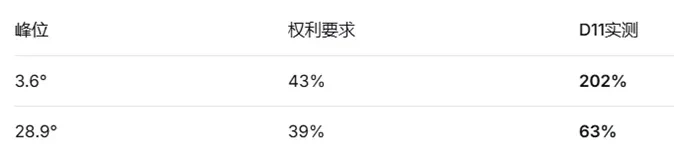
KRKA submitted an experimental report D11 in the opposition proceedings, intending to demonstrate that a person skilled in the art could reproduce the method of Example 4 of the patent to prepare Crystal Form K. D11 indeed shows that the XRPD pattern of the sample obtained from the repeated experiment meets the requirements for the seven peak positions listed in Claim 1. However—and this is the key point—in Figure 2 of D11, the relative intensity of the first peak (3.6°) is 202%, whereas Claim 1 specifies 43%; the relative intensity of the seventh peak (28.9°) is 63%, whereas Claim 1 specifies 39%.KRKA’s own experiments yielded relative potency results that differ from those stated in the patent.The Board accordingly holds that the relative intensities in the claims constitute limiting features, and the sample prepared in D11 does not correspond to the crystal form recited in claim 1. Therefore, a person skilled in the art cannot prepare Crystal Form K that simultaneously satisfies the requirements for peak positions and relative intensities based on the patent specification—Insufficient disclosure, patent invalidation。III. A Dual Perspective: Key Takeaways from This Patent Ruling
(1) On one hand, generic crystal form patents are being targeted by originator companies
This confrontation marks Bayer's targeting of the patent on the generic crystal form.KRKA’s crystal form patent was filed in 2020 and granted in 2023. As a patent professional, I suggest that originator pharmaceutical companies adopt a more strategic timing: closely monitor the application during the publication stage. Rather than waiting for the patent to be granted before launching an invalidation challenge, it is more effective to suppress it during the examination phase. Monitor upon publication; act upon grant.(2) On the other hand, the original research crystal form patent is also heavily challenged.
1. Fruquintinib Crystal Form Patent—All Invalidated
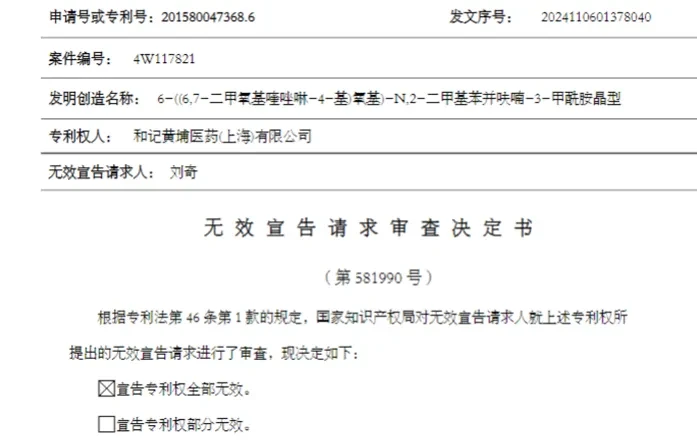
October 31, 2024The China National Intellectual Property Administration declared all claims of Hutchison MediPharma’s patent on the crystal form of fruquintinib (ZL201580047368.6) invalid; the patent was originally scheduled to expire in 2035.Why was it invalidated? This crystal form was obtained merely by changing the solvent system and adjusting the crystallization temperature, which constitutes routine experimental methods. The specification only provides qualitative descriptions such as “good stability” and “non-hygroscopic,” failing to demonstrate “unexpected technical effects.” The probative value of the supplementary experimental data submitted by the patentee is diminished.Implication: If your polymorph patent merely involves routine operations such as “changing the solvent or adjusting the temperature,” and lacks robust data to demonstrate an “unexpected” effect, the patent is vulnerable to invalidation at any time.2. Patent on Baricitinib Crystal Form—Invalidated More Than a Decade Ahead of Schedule
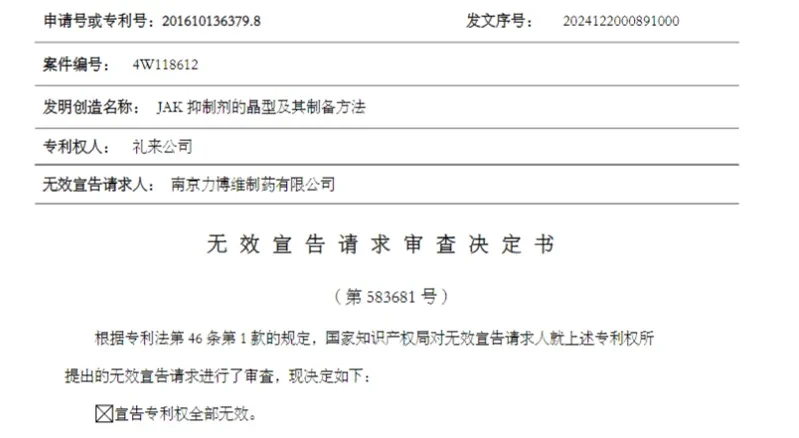
On December 25, 2024, Eli Lilly’s patent on the crystal form of baricitinib (ZL201610136379.8) was declared entirely invalid, advancing its expiration by more than a decade from the original expiry date in 2036.Why was it invalidated? Eli Lilly did not disclose further details on the development of crystal forms, and the technical effects were assessed as “ordinary,” failing to meet the standard of “unexpected.”Implication: The specification fails to disclose sufficient technical details, and the technical effects are merely “ordinary”—thus utterly unable to withstand any challenge.3. Patent for Linagliptin Crystal Form—Invalidated Due to Lack of Novelty and Inventiveness
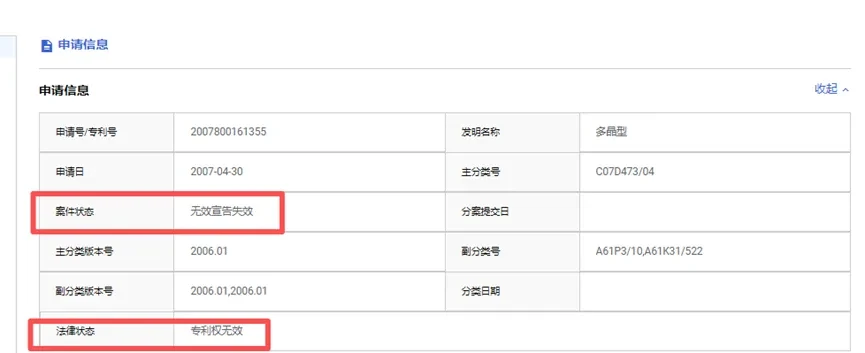
Boehringer Ingelheim’s patent on the crystal form of linagliptin (ZL200780016135.5) was declared wholly invalid.Why was it invalidated? Merely determining the microscopic crystalline form of a known compound through routine testing methods does not confer novelty; there is no evidence demonstrating an “unexpected technical effect,” nor does it possess inventiveness. The patentee’s appeal was dismissed.Implication: If the claimed crystal form is merely another crystalline form of a known compound, and “unexpected technical effects” are not demonstrated, it lacks both novelty and inventive step.Extension: According to statistics from PharmCube (using 2023 data as an example), among pharmaceutical patent invalidation cases, crystal form patents had the highest rate of complete invalidation, with a total invalidation rate reaching 75%.The original crystal form patents for drugs such as fruquintinib, baricitinib, and linagliptin have been successively invalidated by generic manufacturers, while the crystal forms developed by generic manufacturers have likewise been targeted for invalidation by originator companies. This precisely illustrates one fact: crystal form patents that can truly withstand challenges—whether held by originators or generic manufacturers—are invariably scarce.IV. Concluding Remarks
The original crystal form patents for fruquintinib, baricitinib, and linagliptin have successively fallen, with generic crystal forms also failing to escape this fate.Original Innovators Cannot Hold the Line, Generics Cannot Break Through—Crystal Form Patents Are Undergoing a “Major Test” Regardless of CampFor all originator and generic companies engaged in polymorph portfolio strategy, this serves as a sobering reminder: patents are not moats constructed through drafting, but technological barriers established through execution. Every numerical value included in the claims must be meticulously scrutinized to prevent competitors from exploiting vulnerabilities and delivering a fatal blow.The cruelest truth in the courtroom is that your opponent reads your patent far more carefully than you did when you wrote it.Author Profile: Yao Wan holds a master's degree from China Pharmaceutical University. With an educational background in both law and pharmacy, he possesses qualifications as a legal professional and a patent attorney. He is dedicated to research in pharmacy and patents, striving to be a valuable "pill."1. *EPO Boards of Appeal Decision T 0888/24*3. Bayer 2025 Annual Report4. TiPLab Related Analysis: Bayer Successfully Invalidates Generic Drug Company’s Polymorph Patent for Anticoagulant5. Patents for Crystal Forms of Fruquintinib and Dotinurad Declared Wholly Invalid - PharmCube
Copyright Statement: This article is reprinted fromFrom Pharmaceutical Affairs Across the Board, such asMedia outlets or individuals who do not wish their content to be reposted may contact us, and we will remove it immediately.