IMC002 CAR-T Therapy Demonstrates Over 3 Years of Sustained Complete Remission in Advanced Gastric Cancer Patient Following Single Infusion; Phase III Trial Now Enrolling Nationwide

Immunofoco
Developer of Novel Therapeutics for Solid Tumors

The anti-cancer journey for patients with advanced gastric cancer is always more arduous and hurried than that for other types of cancer.
More than half of gastric cancer patients present with locally advanced disease or distant metastasis at the time of diagnosis, rendering most ineligible for surgical resection. Current standard care is chemotherapy-based, combined with targeted therapy or immunotherapy as appropriate based on disease stage, molecular subtype, and patient performance status, aiming to control disease progression, prolong survival, and improve quality of life.
However, cold clinical data continue to relentlessly remind us that the 5-year survival rate for stage IV metastatic gastric cancer is only about 4%, and for stage III, it ranges from just 9.2% to 19.8%; the median overall survival for patients is typically less than one year. Countless patients and their families are left counting down the days, struggling through the arduous back-and-forth of first- and second-line treatments. And an exceedingly harsh reality is that once multi-line therapies fail, many patients face the dire predicament of having no further treatment options available.
But now, a turning point has arrived. Recently, IMC002, a CLDN18.2-targeted nanobody (VHH) CAR-T product independently developed by Immunofoco, is rewriting the survival story for patients with advanced gastric cancer. It breaks the vicious cycle of traditional therapy—"treatment, resistance, drug switch"—by requiring only a single administration to activate the patient’s own immune system against tumors, rather than repeated dosing. By precisely recognizing the CLDN18.2 target on the surface of tumor cells, IMC002 delivers genetically engineered "super soldiers"—nanobody CAR-T cells—back into the patient’s body. Once activated, these cells become "living drugs" stationed within the body, patrolling long-term, autonomously identifying, and continuously eliminating cancer cells, potentially enabling long-term recurrence-free survival.
Most encouragingly, real-world clinical cases have already shown patients rewriting their destinies as a result.
I. Light in the Darkness: A Clinical Testimony Spanning Three Years
The protagonist of this story was once pushed to the brink of the cliff.
In the autumn of 2022, she sought medical attention due to persistent abdominal discomfort accompanied by abnormal complexion, and was ultimately diagnosed with gastric antrum adenocarcinoma. By this time, the disease had progressed rapidly, with the tumor invading surrounding organs, thereby precluding the possibility of curative surgical resection. To address the urgent issue of gastrointestinal obstruction, the patient initially underwent palliative surgery, followed by trials of standardized chemotherapy regimens; however, the treatment response was poor, and the disease continued to progress.
Just as conventional treatment options were nearing exhaustion, the patient and their family did not lose hope. At Shanghai Changhai Hospital, following a rigorous multidisciplinary team (MDT) evaluation by Professor Luo Tianhang’s team, they learned of a potential therapeutic opportunity—the clinical trial of IMC002, a CLDN18.2-targeted nanobody CAR-T cell therapy.
What followed was both a scientific breakthrough in modern cellular immunotherapy and a testament to the patient’s tenacious will to survive:
● Preparation and Infusion of “Anti-Cancer Seeds”: In early 2023, the medical team collected peripheral blood mononuclear cells (PBMCs) from the patient. Immunofoco prepared a personalized CAR-T cell product for the patient at its GMP-compliant manufacturing facility. In early spring of the same year, the patient successfully underwent infusion of IMC002 cells. This bag of IMC002, carrying all hopes, was formally administered into the body to begin exerting its anti-tumor effects.

● Signs of a turning point in the patient’s condition: During the initial phase of treatment, the patient experienced manageable adverse reactions, such as fever, which gradually subsided following symptomatic management. Encouragingly, shortly after cell reinfusion, the patient’s clinical symptoms began to improve: normal eating resumed, complexion became progressively rosier, and physical strength recovered day by day.

● “Pathological Miracle”: Several months after cell infusion, the patient underwent radical gastrectomy. The pathological examination results were encouraging, revealing no tumor cells and detecting a small number of CAR-T cells, indicating achievement of pathological complete response (pCR)—a deeply effective endpoint widely recognized in the oncology community.

However, this is not the endpoint of treatment; long-term and rigorous postoperative follow-up is the ultimate test of therapeutic efficacy. At 2, 6, 9, and 14 months post-surgery, all imaging results consistently showed no signs of tumor recurrence.
Since the single cell infusion in early 2023, the patient has gained over three years of survival time, snatched from the jaws of death, and has not required any other anti-tumor treatments during this period. This patient’s personal experience proves that even advanced gastric cancer can see the dawn of hope.
II. Moving Forward with Hope: All 36 Centers Nationwide Have Completed Initiation of the Phase III Clinical Trial, and Patient Recruitment Is Ongoing
This groundbreaking clinical case offers important insights for the treatment of advanced gastric cancer; however, larger-scale Phase III clinical studies are still required to confirm the efficacy and safety of this innovative therapy so that more patients can benefit. Encouragingly, the pivotal Phase III registrational clinical study of IMC002, initiated by Immunofoco for CLDN18.2-positive advanced gastric cancer/gastroesophageal junction cancer, has made significant progress—all 36 research centers across China have successfully completed their initiation!
Serial Number | Center Name |
1 | Chinese People's Liberation Army General Hospital (301 Hospital) |
2 | Jinan Central Hospital |
3 | The First Affiliated Hospital of Anhui Medical University |
4 | Changhai Hospital |
5 | Shanxi Provincial Cancer Hospital |
6 | Nanjing Drum Tower Hospital, The Affiliated Hospital of Nanjing University Medical School |
7 | The Second Affiliated Hospital of Soochow University |
8 | Peking Union Medical College Hospital |
9 | Jiangsu Province People's Hospital |
10 | Shandong Cancer Hospital |
11 | Fujian Provincial Cancer Hospital |
12 | Henan Cancer Hospital |
13 | Liaoning Cancer Hospital |
14 | Tianjin Medical University Cancer Institute and Hospital |
15 | The First Affiliated Hospital of Xiamen University |
16 | Cancer Hospital, Chinese Academy of Medical Sciences |
17 | Beijing Cancer Hospital |
18 | The First Hospital of Jilin University |
19 | The First Affiliated Hospital of Zhengzhou University |
20 | West China Hospital, Sichuan University |
21 | The First Affiliated Hospital of Xi'an Jiaotong University |
22 | The First Affiliated Hospital, Zhejiang University |
23 | Nansha Hospital, Guangzhou First People's Hospital |
24 | Harbin Medical University Cancer Hospital |
25 | Sir Run Run Shaw Hospital, Zhejiang University School of Medicine |
26 | The Affiliated Hospital of Qingdao University |
27 | The First Affiliated Hospital of Sun Yat-sen University |
28 | Guangdong Provincial People's Hospital |
29 | Jilin Provincial Cancer Hospital |
30 | Zhejiang Cancer Hospital |
31 | Beijing Friendship Hospital |
31 | Fudan University Shanghai Cancer Center |
33 | Changzhi People's Hospital |
34 | The Second Affiliated Hospital of Xi'an Jiaotong University |
35 | Peking University Shenzhen Hospital |
36 | Shenzhen Hospital of the National Cancer Center, Chinese Academy of Medical Sciences |
As the study rolls out across all centers, patient recruitment is in full swing. By participating in this study, you will not incur any costs for the investigational drug or protocol-specified examinations. A team of experts will safeguard your health throughout the trial, conducting regular and meticulous monitoring of your condition. This represents an opportunity to secure a new lease on life in the “drug-free era” for yourself, while also contributing valuable strength to advancing gastric cancer treatment in China.
If you or your family members are facing treatment bottlenecks, please refer to the following key enrollment information ↓
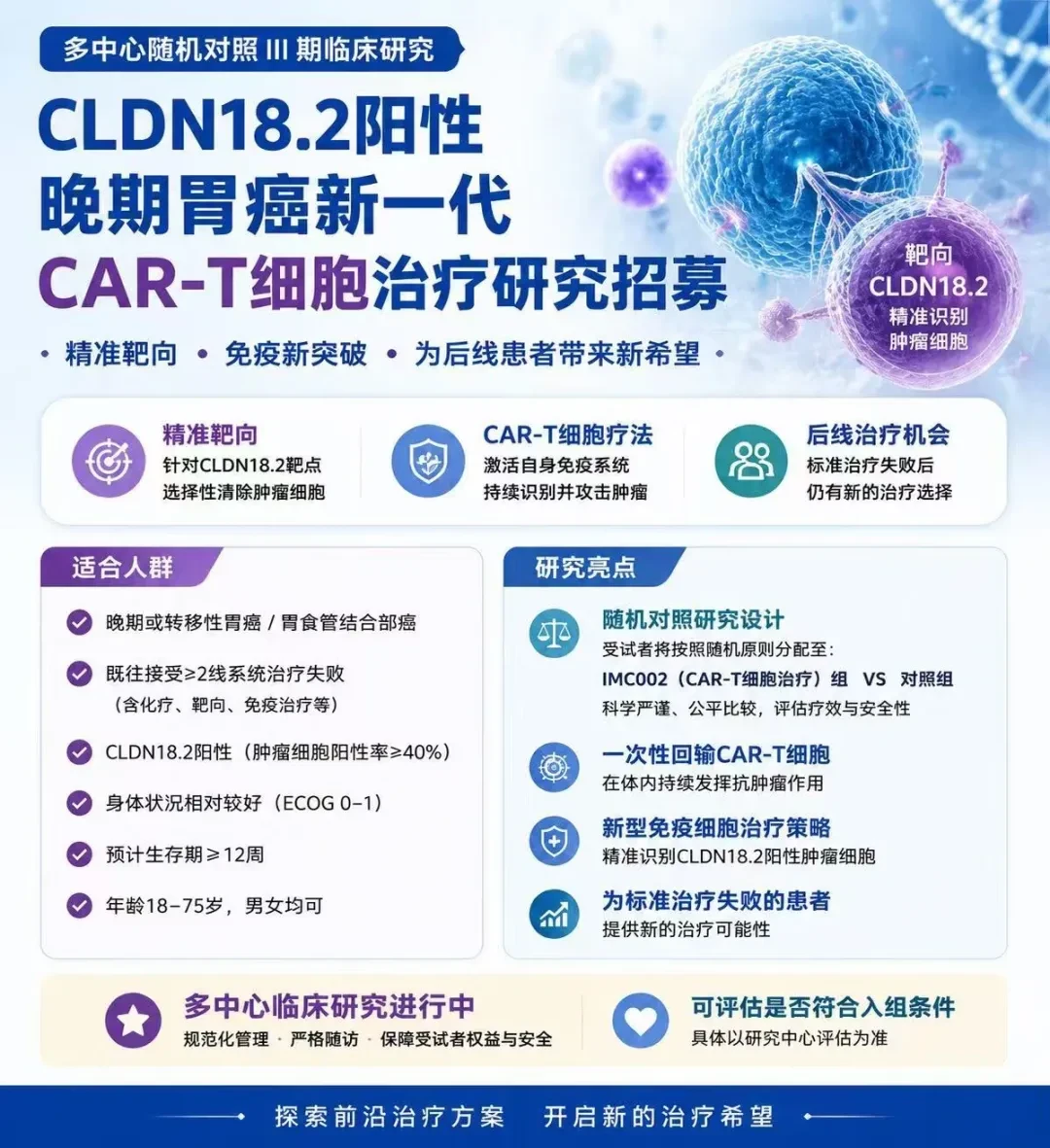
If you are unsure whether you meet the eligibility criteria or wish to obtain information about the research center nearest to you, please add the Clinical Recruitment Assistant for one-on-one professional consultation. The assistant will provide detailed enrollment guidance and help you assess your eligibility for participation in the study.

The journey of fighting cancer is never easy, but every act of perseverance may bring a turning point. It is hoped that this innovative cell therapy, independently developed in China, will illuminate the path to life for more patients with advanced gastric cancer.
References
Responsible Editor: Sun Jie
Layout Editor: Li Xin
[Copyright Statement]Copyright belongs to Oncology News. Individual forwarding and sharing are welcome. Other media outlets and websites must obtain authorization before reprinting or quoting content owned by this site, and must clearly indicate "Source: Liangyihui Patient Guide" in a prominent position.