2026 National Reimbursement Drug List Preliminary Review Released: Intense Competition in ADC and GLP-1 Therapies

Biokin
Pharmaceutical R&D Developer
LEPU BIOPHARMA
Innovative Oncology Treatment Product Developer
Hengrui Pharma
Innovative and High-Quality Pharmaceutical Developer
Innovent
High-end Biologics Developer
On June 29, the National Healthcare Security Administration announced the preliminary review list for negotiations on the 2026 National Reimbursement Drug List (NRDL) and the Innovative Drug List. A total of 557 products passed the preliminary review for the Basic Directory, including 334 outside the directory and 223 within the directory. For the Commercial Insurance Directory, 54 products passed the preliminary review, with 53 being outside the directory.
The pass rate for formal review has significantly increased this year. Excluding pre-declared varieties,The overall pass rate for formal review was 92%, an increase of 8 percentage points compared to last year.This means that an increasing number of enterprises are gaining a thorough understanding of policies and meeting standards.Commercial Insurance Formulary Cools Down Significantly,Last year, 121 products were approved, compared to only 53 this year, indicating a significant decline in corporate enthusiasm for inclusion in commercial insurance formularies.
In terms of popular drug categories, competition across various therapeutic areas is intensifying. Key focal points include the race among domestic manufacturers to become the leading player in the oncology ADC sector, the inclusion of GLP-1 agents such as mazdutide in price negotiations, competition in autoimmune diseases and hematologic malignancies, and the progress of price coordination between domestically developed CAR-T therapies and commercial health insurance.
The public notice period for the preliminary review results is from June 29 to July 5, during which feedback from all sectors of society is currently being accepted. In accordance with customary practice in previous years,NationalHomeThe National Healthcare Security Administration will conduct a re-review based on feedback, and the final list passing the formal review will be subject to further adjustments.。

Fierce Competition in the ADC and GLP-1 Fields
The Battle for the “Top ADC” Spot Is the Key Focus of This Year’s National Reimbursement Drug List (NRDL) Negotiations. The landscape of China’s ADC market is firmly dominated by AstraZeneca/Daiichi Sankyo’s trastuzumab deruxtecan. First approved for marketing in February 2023, trastuzumab deruxtecan has already had multiple indications included in the national reimbursement list. According to Daiichi Sankyo’s 2025 financial report, trastuzumab deruxtecan generated RMB 640 million (approximately JPY 14.1 billion) in revenue in the China region.
This Year's Preliminary Review ListinDomestically ProducedADCProductMajor Offensive。According to the announcement, Biokin’s Injection for Luncongyilongtuomab, LEPU BIOPHARMA’s Vebeketuotumab, and Hengrui Pharma’s Injection for Ruikangtrastuzumab have all passed the formal review.Biokin's LunkangyilongtuomabMost Highly Anticipated by the Industry,The core advantage of this globally unique bispecific antibody-drug conjugate (ADC) lies in its “dual-navigation” precise delivery.,Minimizes "collateral damage" to normal cells, resulting in higher killing efficiency.
Whether domestically produced bispecific antibodies will overturn imported drugs, or multinational pharmaceutical companies will leverage their comprehensive strength to maintain their existing market advantages, the 2026 National Reimbursement Drug List (NRDL) negotiations are clearly a significant watershed.Luncomab (Yilongtuomab) has been approved for recurrent/metastatic nasopharyngeal carcinoma, while Trastuzumab Deruxtecan’s strength lies in breast cancer; the two will not engage in direct head-to-head competition in the short term.Gang。LEPU BIOPHARMA and Hengrui Pharma’s products are by no means insignificant; industry estimates suggest that this year’s negotiations will result in a scenario where domestic ADCs collectively crowd out imported drugs.
In addition to anti-tumor ADC drugs, the GLP-1 sector is undoubtedly another hot area of industry focus. According to the preliminary review list:Innovent’s mazdutide injection and Pfizer’s enoboparm injection are both included.,To challenge Eli Lilly’s tirzepatide and Novo Nordisk’s semaglutide, and to expand the overall market share in China’s endocrinology sector.
The Chinese GLP-1 market has rapidly shifted from a “multinational duopoly” to a diversified competitive landscape featuring “originators, innovators, and generics.”Market leader Novo Nordisk is not sitting idly by,Its subsidiary’s insulin icodec and semaglutide injection has also been included in the initial review list.This is a weekly formulation of basal insulin/GLP-1 receptor agonist that was approved for market launch in March this year. As more products enter the national medical insurance negotiations, no company wants to lose its first-mover advantage. After the initial “race to launch,” GLP-1 products have entered a new phase characterized by a “race to scale up volume through medical insurance coverage.”

Significant Decline in the Number of Submissions for Commercial Insurance Formulary Inclusion
Based on the number of drugs in this year’s preliminary review list, the number of corporate submissions for the commercial health insurance innovative drug directory has decreased by 68 compared to last year, indicating a lack of strong enthusiasm for participation. The underlying reason is that the commercial health insurance directory is still in its early stages and has not yet established a sustainable operational model.The primary issue is the scarcity of reimbursement cases, which prevents companies from seeing the market prospects.
Nevertheless, this year’s commercial insurance drug formulary still features many highlights. Of particular interest to the industry is the application of Beprodalimab injection, known as “China’s most expensive drug,” for inclusion in the commercial insurance formulary, indicating that the formulary remains valuable for certain products.
Bopeda Keji Injection, developed by Belief BioMedicine, costs RMB 2.79 million per dose, is the highest-priced drug in China.Since its market approval in April 2025, patients have only accessed the medication through clinical trial enrollment; not a single out-of-pocket prescription has been issued in over a year. In early June this year, Belief Medicine slashed the price to RMB 1.39 million. After stacking reimbursements from inclusive commercial health insurance (Hui Min Bao) in some cities, patients’ out-of-pocket expenses amount to approximately RMB 1 million.
Based on last year’s negotiation experience, products with an annual treatment cost exceeding RMB 1 million are unlikely to be included in the National Reimbursement Drug List (NRDL) negotiations. Even inclusion in commercial health insurance formularies would face significant challenges, as these formularies are still in an exploratory stage.Even ifActually included"Sky-High-Priced Drugs",Can insurance companies reasonably cover the costs, and do hospital assessment systems support the prescription of exorbitantly priced drugs?These actual implementation processes are uncontrollable.
Relatively speaking, the path to commercial insurance coverage for CAR-T therapies may be somewhat smoother. This year, Renjiolencel Injection, developed by Hengrun Dasheng, passed the preliminary formal review for inclusion in both national reimbursement directories. It is the seventh CAR-T product approved for marketing in China, indicated for the treatment of large B-cell lymphoma, with a price ranging from approximately RMB 990,000 to RMB 1.2 million per dose. In December 2025, China Resources Double-Crane Pharmaceutical entered into a partnership with Hengrun Dasheng, securing exclusive nationwide distribution rights for the product. However, sales performance appears to have been less than satisfactory.CR Double-Crane did not disclose the operating performance of Renjiolencel in its financial reports.
Shu Rui Ji Ao Lun Sai Injection, the world’s first CAR-T therapy for solid tumors developed by CARsgen Therapeutics, which was just approved this month, has also appeared on the pre-application list. The formal approval documents must be submitted by 17:00 on July 3; only after passing the re-examination will it be considered to have passed the preliminary review. It is worth noting that even if Shu Rui Ji Ao Lun Sai Injection successfully passes the formal review, the market landscape for CAR-T in China is already dominated by five previously launched CAR-T products, all of which have been included in the 2025 commercial insurance directory.
That is to say, those who have just entered the “battlefield”If Renjiolunsa and Shuijilunsa are to make a comeback and break through, they will inevitably need to lower prices to gain more market space.
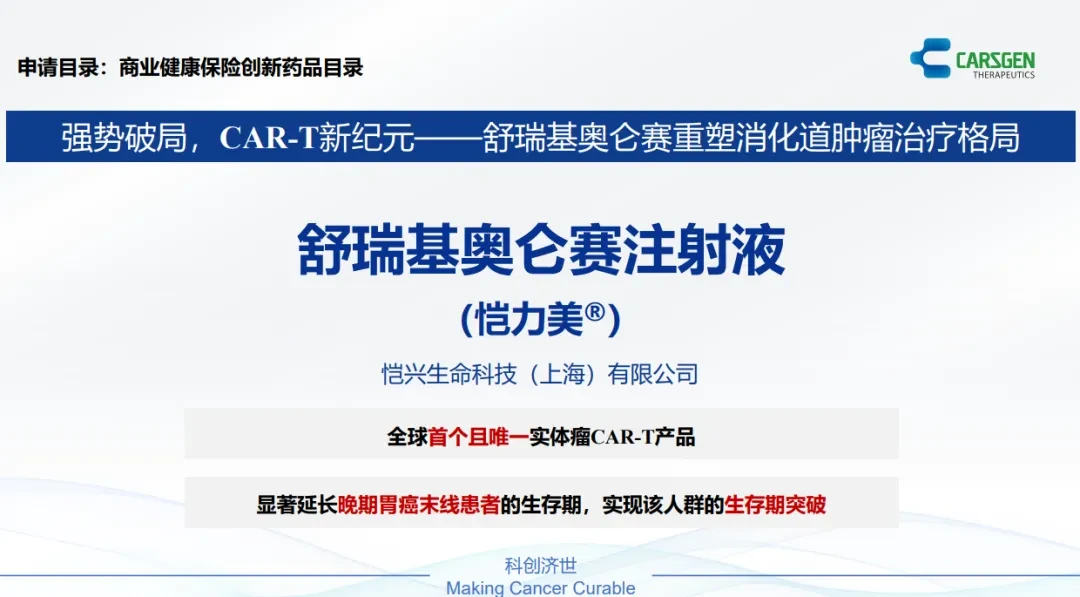
Application Materials for the Commercial Insurance Innovative Drug Formulary
Source: Official Website of the National Healthcare Security Administration
Meanwhile, Henlius’s PD-1 inhibitor serplulimab injection and Yttrium [90Y] Microspheres Injection, the first domestically launched selective internal radiation therapy product with dual indications, were also included in the list of commercial insurance products that passed the formal review.
Notice from the National Healthcare Security Administration: Passing the preliminary formal review is merely the first step in the entire catalog adjustment process following enterprise submission, and only indicates that the declared drugs are eligible to participate in the subsequent procedures of the catalog adjustment. Drugs that pass the preliminary review must still undergo multiple stages, including expert evaluation, negotiation and bidding, or price consultation, before a final determination is made on their inclusion in the new edition of the catalog.
By Lei Gong
Edited by Jiang Yun, Jia Ting
Operations | Nian Shisan
Disclaimer: Original content by Jian Shi Ju. Do not reproduce without permission.

Seven Years in the Making: Hengrui Pharma Precisely “Snipes” Xingqi Eye Medicine
Sinopharm Holdings’ Major Retreat: Over 10 Subsidiaries Sold Off in One Year