

Boruikang Files for IPO with Global First-Ever Approved Invasive Brain-Computer Interface

Neuracle
Developer and Manufacturer of Brain-Computer Interface Systems and Related Equipment
Author | Paramecium Editor | Xiang Yi
In 2026, brain-computer interfaces (BCI) once again captured widespread public attention. On the first trading day of the year, the BCI sector on China’s A-share market surged by 13.7%, with trading volume exceeding RMB 62.6 billion. Neuracle Technology (Shanghai) Co., Ltd.’s IPO application for listing on the STAR Market was accepted, with plans to raise RMB 2.5 billion. BrainCo completed a RMB 2 billion Series B+ financing round in January and confidentially filed its prospectus with the Hong Kong Stock Exchange. Stairway Medical secured cumulative financing of over RMB 1.1 billion in the past year.
Author | Paramecium Editor | Xiang Yi
In 2026, brain-computer interfaces (BCI) once again captured widespread public attention. On the first trading day of the year, the BCI sector on China’s A-share market surged by 13.7%, with trading volume exceeding RMB 62.6 billion. Neuracle Technology (Shanghai) Co., Ltd.’s IPO application for listing on the STAR Market was accepted, with plans to raise RMB 2.5 billion. BrainCo completed a RMB 2 billion Series B+ financing round in January and confidentially filed its prospectus with the Hong Kong Stock Exchange. Stairway Medical secured cumulative financing of over RMB 1.1 billion in the past year.
Editor | Xiang Yi
In 2026, brain-computer interfaces (BCI) once again captured widespread public attention. On the first trading day of the year, the BCI sector on China’s A-share market surged by 13.7%, with trading volume exceeding RMB 62.6 billion. Neuracle Technology (Shanghai) Co., Ltd.’s IPO application for listing on the STAR Market was accepted, with plans to raise RMB 2.5 billion. BrainCo completed a RMB 2 billion Series B+ financing round in January and confidentially filed its prospectus with the Hong Kong Stock Exchange. Stairway Medical secured cumulative financing of over RMB 1.1 billion in the past year.
2026In the first three months of the year, domestic brain-computer interface companies experienced17initiated financing, with a total amount exceeding2025Year-round.
Policy-wise, it also providesOuta clear signal. Brain-computer interfaces were included for the first time2026Annual Government Work Report, and included in“The 15th Five-Year Plan”Plan the key directions for future industries.Seven departments, including the Ministry of Industry and Information Technology, have proposed that by2030Annual Cultivation2To3A leading enterprise with global influence.The National Healthcare Security Administration has established three separate billing items for brain-computer interfaces: implantation fees for invasive devices, explantation fees, and fitting fees for non-invasive devices. Hubei and Zhejiang provinces were the first to approve pricing for medical services involving invasive and non-invasive brain-computer interfaces, while Shanghai has included them in its medical insurance coverage. The National Medical Products Administration approved the registration certificate for the world’s first implantable brain-computer interface medical device.
Brain-Computer InterfaceIndustryHas been removed from“Laboratory Exploration”Enter“Clinical Access”with“Fee Schedule”A New Phase of Parallelism.
01
Commercialization remains far from being realized
01
Commercialization remains far from being realized
01
Commercialization remains far from being realized
Neuracle was established in2011In [Year], the founding team originated from the Neural Engineering Laboratory at Tsinghua University. The company has since established two product lines: invasive and non-invasive. Among these, the non-invasive products cover scenarios such as motor function reconstruction, diagnosis and treatment of neurological disorders, and mental health care, and have entered the Chinese market.500Neuracle medical institutions and300more than 10 research institutions; invasive products are the focus of external attention.
As of2025Year-end, nationwide11home hospitals already have32patients completed the implantation surgery.2026Year3Month13Day, a subsidiary of NeuracleNEO-ONE SCIApproved for market launch, securing the world’s first medical device registration certificate for an invasive brain-computer interface.
NEO-ONE SCIThe indications are directed toward patients with quadriplegia resulting from cervical spinal cord injury.This product utilizes a minimally invasive epidural implantation approach, whereby the implanted device is embedded subcutaneously on the surface of the skull via minimally invasive surgery, with the electrode array placed over the outer surface of the dura mater.The implant captures intracranial electroencephalogram (iEEG) signals associated with motor intent, which are then transmitted wirelessly to an external host unit for decoding. Upon recognizing the user’s intent, the system generates control commands to drive a pneumatic glove, assisting patients in performing grasping movements. The core clinical challenges this product aims to address include eating, drinking, and independently holding objects.(Figure1)。
Figure1.NEO-ONE SCIProduct Principle Diagram
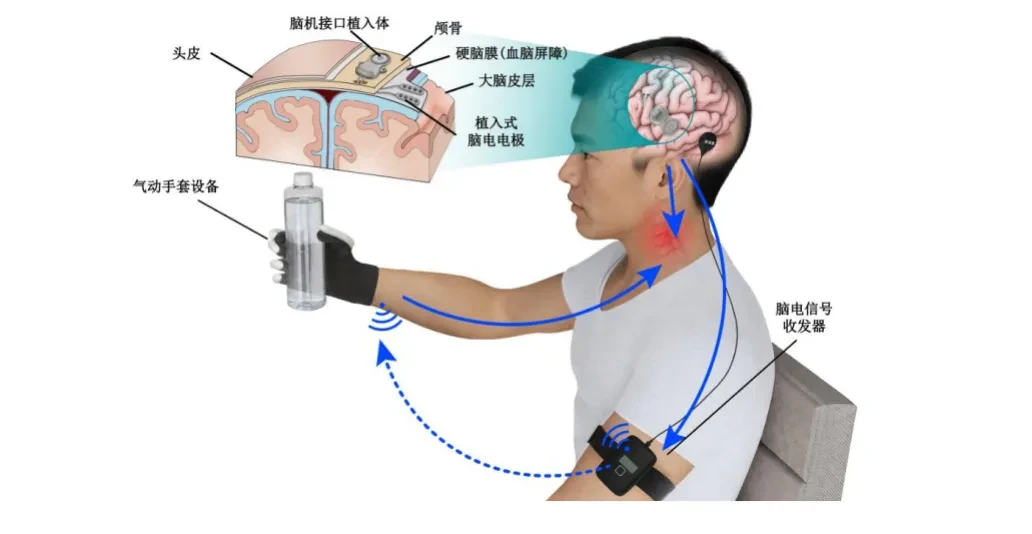
Image source: Neuracle's prospectus
Neuracle this timeIPOProposed issuance of no more than200010,000 shares, planned fundraising25100 million yuan, of which more than15Hundreds of millions of yuan will be invested in the research and development project for brain-computer interfaces. Since its establishment, the company has completed6round of financing.2025Year11Latest Monthly Round3Following the completion of a financing round worth hundreds of millions of yuan, its valuation reached40100 million yuan.
02
Synergistic Development of Three Major Technological Routes
02
Synergistic Development of Three Major Technological Routes
02
Synergistic Development of Three Major Technological Routes
Brain-computer interface (BCI) technology pathways are broadly categorized into invasive, semi-invasive, and non-invasive approaches.(Figure2)。
Invasive brain-computer interfaces refer to the implantation of electrodes into the cerebral cortex or within the gray matter via neurosurgical procedures, enabling direct contact with neurons for signal acquisition and recording from tissues beneath the skull.,It features the highest spatiotemporal resolution and signal-to-noise ratio, and is primarily used in deep brain therapeutic applications; however, it requires craniotomy, entailing significant trauma and higher risks.
Currently,Invasive brain-computer interfaces focus on breaking through the upper limit of signal quality via automated surgery and high-throughput flexible electrodes。
Musk at2026Year1Yue AnnouncedNeuralinkEntering the mass production phase, with the goal of implanting thousands of patients annually through automated surgical solutions.NeuralinkLatest GenerationR1/Rev10Surgical robots have achieved an average1.5Implant a microfilament in seconds and automatically avoid cortical vessels through high-precision vessel recognition algorithms, reducing the risk of cerebral hemorrhage. Meanwhile, its proposed“dura-sparing”The technology enables electrodes to penetrate the dura mater directly without dural resection, further simplifying neurosurgical procedures and advancing invasive brain-computer interfaces toward standardized and large-scale clinical application.
Furthermore,2026Year2In [Month], Zhiran Medical launched a thousand-channel invasive flexible brain-computer interface system. Its stretchable flexible electrodes utilize a special geometric structure to convert tensile stress generated by brain tissue movement into bending and torsional deformations, reducing the tensile force exerted on brain tissue to approximately that of traditional linear electrodes.1%, significantly reducing tissue damage caused by long-term implantation and providing an important foundation for stable operation over five years.
Figure2.Signal Acquisition Locations for Three Types of Technical ApproachesofDifference
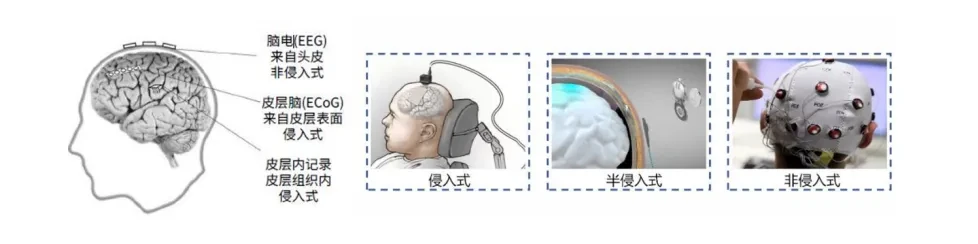
Image source: Southwest Securities research report
Semi-invasive brain-computer interfaces acquire high-quality neural signals by implanting electrodes on the dura mater, subdurally, or within cerebral blood vessels, without contacting the brain parenchyma, thereby balancing the performance advantages of invasive methods with the safety of non-invasive approaches.andPioneered the establishment of commercial approval channels.NEO-ONE SCIWorkThe First Commercialized Semi-Invasive Brain-Computer Interface Product in China, expected to2026achieved scaled-up patient enrollment and sales revenue in [year]。3Month15On [date], the National Healthcare Security Administration proactively engaged in coordination forNEO-ONE SCICompleted the assignment of medical insurance codes.
Non-invasive brain-computer interfaces do not require implanted electrodes; instead, they non-invasively acquire brain activity signals from the scalp surface or near the head. Due to the absence of surgical procedures and their high safety profile, their applications have expanded into fields such as medical rehabilitation, education, and entertainment.。
In recent years,Non-invasive Brain-Computer InterfacePositiveLeveraging generativeAIerror correction capability, achieving a leapfrog performance improvement on consumer-grade wearable devices.2026In [Year], the Chengdu Frontier Brain-Inspired Artificial Intelligence Innovation Center released China's first approved dry electrode.EEGThe platform overcomes hair interference through micro-nano contact structures, enabling rapid acquisition of high-quality EEG signals without conductive gel, significantly enhancing the device's ease of use and wearing experience.NAOXcompanies represented byEEGIntegrating electrodes into in-ear devices enables long-term health monitoring functions, including seizure prediction, sleep monitoring, and emotion management;NeurablewithMaster & DynamicLaunchedMW75 NeuroThe headset integrates EEG acquisition with high-end noise-canceling headphones, enabling real-time monitoring of user attention and facilitating the discreet, everyday use of brain-computer interface devices.
However, behind the bustling market activity, caution is warranted regarding the mismatch between technological maturity and commercialization progress. From the current state of the industry, brain-computer interfaces (BCIs) remain in the clinical validation stage. Whether it involves verifying the surgical safety of invasive approaches or enhancing signal accuracy for non-invasive methods, long-term technological iteration and support from large-scale clinical data are essential.
03
How Many Hurdles Remain for Brain-Computer Interfaces?
03
How Many Hurdles Remain for Brain-Computer Interfaces?
03
How Many Hurdles Remain for Brain-Computer Interfaces?
The global brain-computer interface market is currently transitioning from“Hundred-million-level”to“Ten billion”Key inflection point for the leap in US dollar magnitude. According to comprehensive data from institutions such as the Qianzhan Industry Research Institute, the globalBCIMarket size from2019annual12.0increased from $100 million to2023of the year19.8hundred million USD, estimated2029will further increase to in the year76.3hundred million USD. As one of the fastest-growing regions globally, the Chinese market is rapidly expanding in scale. ChinaBCIMarket size from2020Annual10.0increased from RMB 100 million to2023annual17.3100 million yuan, estimated2029is projected to further increase to105100 million yuan.MarketThe growth trend is clear, but the commercial foundation supporting this growth remains far from solid.
The issue on the payment side is the mostDirect。2025Year3Month11On [date], the National Healthcare Security Administration issued the "Guidelines for the Establishment of Pricing Items for Neurological Medical Services (Trial)," establishing three chargeable items: implantation fee for invasive brain-computer interfaces, explantation fee for invasive brain-computer interfaces, and fitting fee for non-invasive brain-computer interfaces. Hubei subsequently released China's first pricing standard for brain-computer interface medical services, with the implantation fee for invasive procedures set at6552Yuan/Next, remove the fee3139Yuan/, Non-invasive fitting fee966Yuan/times. Zhejiang Province2025Year6Month1Effective from the specified date, the relevant prices shall be implemented, including the fee for invasive implantation.6580Yuan/Extraction fee3150Yuan/Next, non-invasive fitting fee960Yuan/Time(Figure3)。
Figure3.Overview of Brain-Computer Interface Regulations and Health Insurance Coverage in Major Provinces
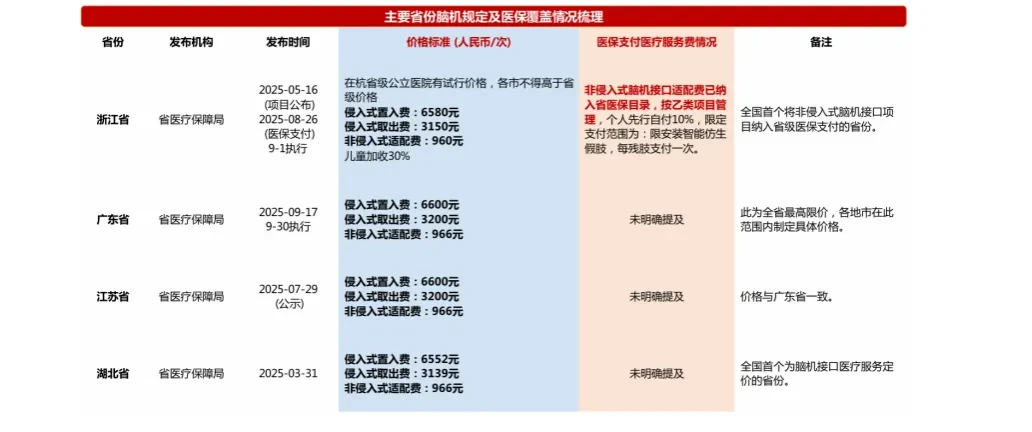
Image source: Southwest Securities research report
ThisSeveral itemsThe price covers only the medical service component; the cost of the equipment itself is currently borne by research funding or enterprises and has not been included in the scope of medical insurance reimbursement.2025Year11month, Wuhan Tongji Hospital treated a patient31A patient with high-level paraplegia underwent China’s first invasive brain-computer interface (BCI) implantation surgery performed at the government-approved price. This marked the first clinical procedure since the pricing policy was introduced; however, the surgical costs were still covered by research funding, with no involvement from medical insurance. This case validates the commercial payment model for brain-computer interfaces.offeasibility, but there is still a significant gap before a mature, replicable, and routine payment model can be established.
Cost SideThe pressure was also significant. The procurement price of a brain-computer interface training system at hospitals typically ranges from hundreds of thousands to over one million yuan. Companies pursuing the invasive approach generally incur cumulative investments exceeding1.5hundred million yuan, with some leading companies even reaching several hundred million yuan. Neuracle's cumulative R&D investment over the past three years1.87100 million yuan, itsIPOProposed Fundraising25100 million yuan, of which more than15Hundreds of millions of yuan will continue to be allocated to brain-computer interface (BCI) research and development projects. The industry’s cash burn rate rises in tandem with market enthusiasm, a prevailing reality across the sector.
Meanwhile,Long-term stability is another issue that requires continuous attention. After electrode implantation, challenges such as immune responses, fibrous encapsulation, material degradation, and signal attenuation arise.According to publicly available information,Implantation in Three Patients with Quadriplegia956To2130Following implantation of the Tianwei electrode array, the electrode materials exhibited varying degrees of physical degradation, with a correlation observed between surface damage and functional decline. Animal studies have shown that local field potential signals after implantation6within months was relatively stable, with the total spike firing rate at3To9peaks at months and then declines. For a medical device intended for long-term implantation in the human body, the validation period for stability is far longer than the observation window of clinical trials, whichalsoIt is an indispensable step in the process of technological maturation.
Therefore, the brain-computer interface (BCI) sector has not yet crossed the threshold for widespread application. Research and development efforts by companies both in China and abroad are largely focused on exploratory clinical trials for specific indications, while critical aspects such as insurance reimbursement, device costs, and long-term safety have not yet formed a closed loop. Substantial resource investment is still required on both the R&D and regulatory fronts, indicating that a mature industrial ecosystem remains a considerable distance away.
04
Conclusion
04
Conclusion
04
Conclusion
2026The year marks a critical juncture for brain-computer interfaces transitioning from the laboratory to mass production, with the industry narrative shifting frombyFrom Technical Validation to Commercial Realization: This Shift Is Not Merely a Breakthrough in a Single Technology,It is the result of the resonance of four factors: biomaterials, integrated circuits, decoding algorithms, and industrial policies.
In terms of implementation pace, non-invasive and semi-invasive approachesPromisingHaving taken the lead in entering the small-scale commercialization phase, invasive brain-computer interfaces still require a longer approval process.andSafety Validation Cycle. Overall, the industry is still in its introduction phase.End-stage, still some way from a true outbreak, but the turning point has already arrived.
References
[1]Neuracle Prospectus
[2]China Investment Consultant-2026In-Depth Analysis Report on China's Brain-Computer Interface Industry
[3]Southwest Securities research reports, etc.