

BeiGene to Pay RMB 446 Million in Tax Arrears and Penalties
BeOne
Developer of Molecular Targeted and Immune Anti-Tumor Drugs
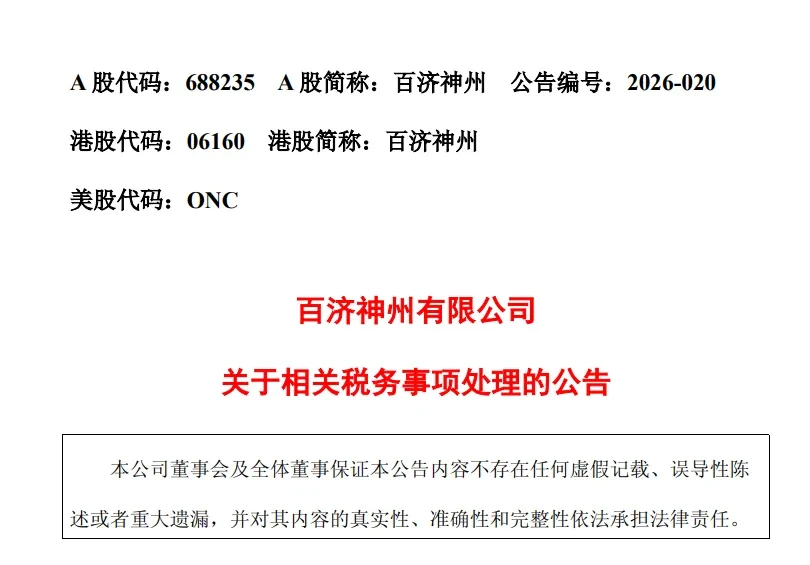
Back Taxes Paid: 446 Million
Public data shows that 2025 was a pivotal year for BeOne, marking its first annual profit since inception, with full-year revenue reaching RMB 38.225 billion and net profit attributable to shareholders amounting to RMB 1.461 billion.
Since the supplementary payment matter was determined not to constitute a prior-period accounting error, it does not involve retrospective adjustments to prior-period financial data. Consequently, the profitability figures disclosed in 2025 remain unaffected, which is crucial for the company to maintain market confidence. Had it been classified as a prior-period error, it would have triggered investors’ reassessment of the reliability of historical financial data.
Based on current information, a one-time expenditure of RMB 446 million is unlikely to have a fundamental impact on the overall financial position of BeOne, a company with annual revenues exceeding RMB 3.8 billion; nevertheless, it is undeniable thatThe supplementary payment of RMB 446 million will be fully recognized in the current period’s profit and loss for 2026.Even if BeOne continues to see growth in its 2026 performance, this one-time expense will still have a significant impact on the full-year net profit.
BeOne’s recent back-tax payment is not an isolated incident. Since 2025, numerous listed pharmaceutical companies have successively announced significant back-tax payments, primarily including:
June 2025: *Sheng Pharmaceutical made a supplementary payment of RMB 35.11 million, which was recognized in the current period’s profit and loss;
November 2025: *Qi Pharmaceutical’s subsidiary paid RMB 16.67 million in back taxes, with no administrative penalties involved;
November 2025:*Sinopharm Holdings’ 22 subsidiaries paid an additional RMB 44.3 million in taxes;
December 2025: The subsidiaries of Zhong* Pharmaceutical collectively paid an additional RMB 65.22 million in taxes;
January 2026: *Pharmaceutical Holdings (7 subsidiaries) paid back taxes amounting to RMB 32.21 million;
Why Has Widespread Back-Tax Payment Occurred?
Strengthened Tax Supervision:
In Recent YearsTax administration and collection efforts have been significantly intensified. The previously existing discretionary leeway in tax management, characterized by a “flexible or lenient” approach, has been largely replaced by standardized and stringent regulatory rules. At the National Tax Work Conference held in January 2026, it was explicitly stated that China should “strengthen tax supervision and inspection in a scientific and precise manner, effectively safeguard a sound tax ecosystem grounded in the rule of law and fairness, further enhance the quality and efficiency of tax risk management, and continuously strengthen tax supervision in key areas.”
The comprehensive application of digital regulatory tools, such as the Golden Tax Phase IV system, enables tax authorities to precisely identify corporate tax-related risks through big data. Many enterprises complete supplementary tax payments after conducting self-inspections in response to tax risk alerts pushed by tax authorities via big data analytics.
An official from the tax authorities stated, “In many cases, enterprises have deviated somewhat in their understanding and implementation of policies, rather than subjectively evading their tax obligations.”
Industry-Specific Issues:
The pharmaceutical industry has become the “hardest-hit area” in this wave of back-tax payments due to the combined pressures of anti-corruption campaigns, new tax policies, and enhanced oversight under the Golden Tax Phase IV system. The core reason is that the previous gray-area business models are no longer sustainable, marking the entry of the pharmaceutical sector into a period of normalized, stringent tax enforcement.
The pharmaceutical industry has long been plagued by gray-area practices such as "kickback-driven sales," issuance of false invoices, and transfer pricing through related-party transactions, making it a key focus of tax audits. Legal representatives of certain pharmaceutical companies have been legally barred from leaving the country due to outstanding tax liabilities. Multiple cases involving false invoicing and tax evasion have been successively exposed. Typical issues include: inflating costs and expenses to evade value-added tax (VAT) and corporate income tax; and improperly claiming or enjoying tax preferential policies in violation of regulations.
These changes serve as a warning to pharmaceutical companies regarding their financial management and cost control:
Tax compliance is no longer an optional choice that can be treated with leniency, but a mandatory requirement critical to corporate survival.
Any deviations in the understanding and implementation of policies can be precisely identified through big data. Companies should not harbor the侥幸心理 (luck-based mindset) of "not being caught," but rather regard compliance as the baseline for sustainable operations.
ForFor smaller pharmaceutical companies with thin profit margins, a single back-tax payment ranging from tens of millions to over 100 million yuan could completely wipe out their annual profits. Enterprises must proactively identify and assess tax risks and set aside reserves during daily operations, rather than passively responding after the fact.
It is also recommended that enterprises proactively maintain good communication with tax authorities, striving to characterize the supplementary tax payment as “voluntary rectification due to misinterpretation of policies” rather than a systemic financial quality issue;
As an increasing number of Chinese pharmaceutical companies expand globally, they must not only ensure tax compliance within China but also prioritize compliance in cross-border transactions and overseas taxation. Issues such as transfer pricing for related-party transactions, repatriation of overseas profits, and the application of tax treaties have now become key focuses of tax audits.
Traditional practices such as cashing out through “high-invoice” rebates, issuing false invoices, and improperly claiming tax incentives are no longer compliant with current regulatory policies.
For every pharmaceutical company, rather than passively making up tax payments after the fact, it is better to proactively ensure compliance beforehand. In today’s era of increasingly refined tax supervision, “compliance” is not only a legal obligation but also the cornerstone of sustainable development for pharmaceutical companies; otherwiseOnce the tax supplementation matter is characterized as a "prior period accounting error," it will trigger retrospective adjustments to historical financial statements, causing a secondary shock to stock prices and investor confidence, and severely impacting the company's sustainable development.
In accordance with the relevant provisions of the Advertising Law of the People's Republic of China and the Measures for the Administration of Internet Drug Information Services, the content on this platform does not fall within the scope of drug advertising. The drug-related information presented herein is for objective informational purposes only and does not possess any commercial promotional attributes.
The content published on this platform represents only the academic views of the authors based on their professional expertise and reflects their personal opinions. It does not represent the position of any organization or this official account. Should there be any inaccuracies, corrections are welcome. For reprints, please credit the author and source: Ouryao (Pugongying).